UCPMP Guidelines: Regulating India's Pharma-Doctor Nexus
Self-regulation under voluntary pharma marketing codes fails to curb commercial inducements, distorting prescriptions and burdening patients with high drug costs.
Oct, 2026
•9 min read

Context
India's regulatory regime for pharmaceutical marketing still struggles to halt commercial inducements in healthcare. The current framework relies on voluntary industry bodies rather than statutory mandates, leaving systemic prescription distortions intact.
While the Department of Pharmaceuticals introduced the Uniform Code for Pharmaceutical Marketing Practices (UCPMP) 2024 to curb lavish gifts and sponsored travel, association-run oversight panels lack penal authority. These commercial incentives inflate medicine prices, driving out-of-pocket expenditure and eroding patient trust. Fixing this requires shifting from industry self-policing to an enforceable statutory regime with mandatory transparency disclosures.
Why in the News: The Push to Revisit UCPMP Guidelines
The Department of Pharmaceuticals constituted a high-level three-member committee on 23 October 2026 to review India's existing pharmaceutical marketing framework and examine legal options to curb unethical promotions.
- Panel Leadership: Chaired by NITI Aayog Member Dr. M. Srinivas.
- Expert Members: Former Union Health Secretary Preeti Sudan and Medanta Chairman Dr. Naresh Trehan.
As of October 2026, the central government initiated this comprehensive review under explicit directions from the Supreme Court of India. A bench comprising Justices Vikram Nath and Sandeep Mehta ordered policy reconsideration during hearings on a writ petition filed by the Federation of Medical and Sales Representatives' Associations of India (FMRAI). The terms of reference direct the panel to assess the efficacy of the UCPMP and evaluate statutory measures to eliminate commercial conflicts of interest.
What is the Uniform Code for Pharmaceutical Marketing Practices (UCPMP)?
The Uniform Code for Pharmaceutical Marketing Practices (UCPMP) 2024 is an administrative code issued by the Department of Pharmaceuticals to govern the promotional conduct of drug manufacturers. Notified on 12 March 2024, the updated code superseded the earlier voluntary guidelines that operated across the sector since 1 January 2015.
The Department of Pharmaceuticals introduced tighter transparency obligations in September 2025 via Circular No. 3 of 2025. This executive instruction mandates that pharmaceutical companies submit annual disclosures of marketing expenditure on a designated public portal.
Clause 8.1 of the code imposes an explicit prohibition on direct personal incentives. Under this provision, drug companies and their marketing agents cannot offer or supply gifts or any pecuniary advantage for the personal benefit of healthcare professionals or their family members.
The regulatory framework establishes quantitative thresholds for promotional materials, medical samples, and medical education:
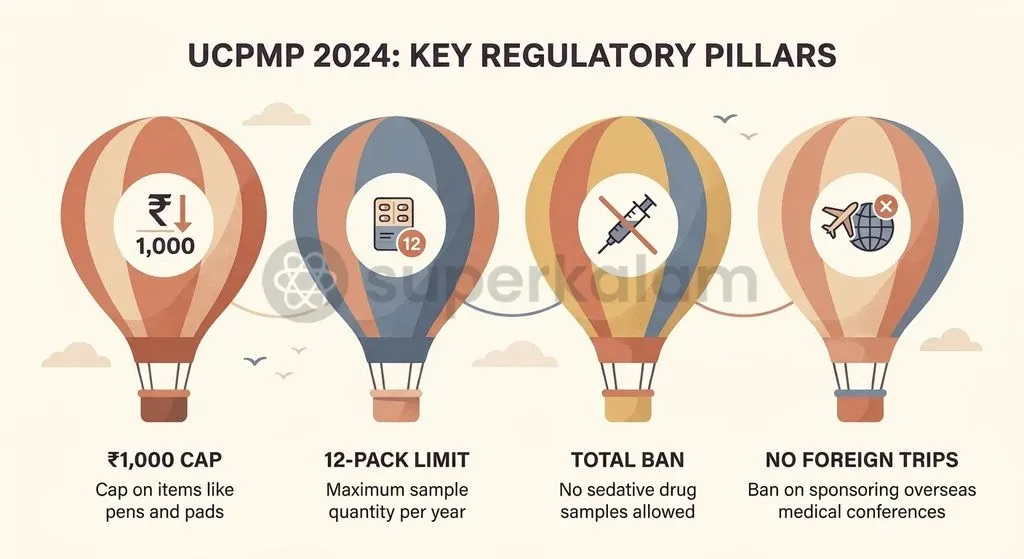
- Brand Reminders: Clause 5.1(i) restricts brand reminders strictly to educational items such as books, clinical guidelines, and dummy devices. These articles must carry an individual value cap of ₹1,000 and have no independent commercial value.
- Sample Distribution: Clause 5.1(ii) caps free drug samples at 12 packs per drug per physician annually, with each pack limited to a three-patient dosage course. Total sample value cannot exceed 2% of the company's annual domestic sales.
- Prohibited Formulations: Clause 5.1(ii)(d) explicitly outlaws the distribution of free samples of hypnotics, sedatives, and tranquillisers under any circumstances.
- Continuing Medical Education (CME): Clause 7 prohibits pharmaceutical firms from organising medical conferences in foreign destinations and restricts domestic sponsorships to institutional partnerships with published financial accounts.
Discuss with Superkalam
Recall the monetary ceiling placed on educational brand reminders and the annual sample pack limit per doctor under UCPMP 2024.
Ask NowThe Doctor-Pharma Nexus: How Promotional Freebies Distort Prescriptions
Commercial inducements from drug manufacturers systematically distort clinical decision-making. They spur irrational drug regimens, high-cost brand selection, and polypharmacy. When medical practitioners receive covert financial incentives, branded formulations take precedence over affordable generic alternatives.
Data from the Ministry of Health and Family Welfare reveals that pharmaceutical expenditure represents over 40% of out-of-pocket expenditure (OOPE) on healthcare in India. By skewing prescriptions toward expensive proprietary brands, marketing perks directly drive healthcare-induced household debt.
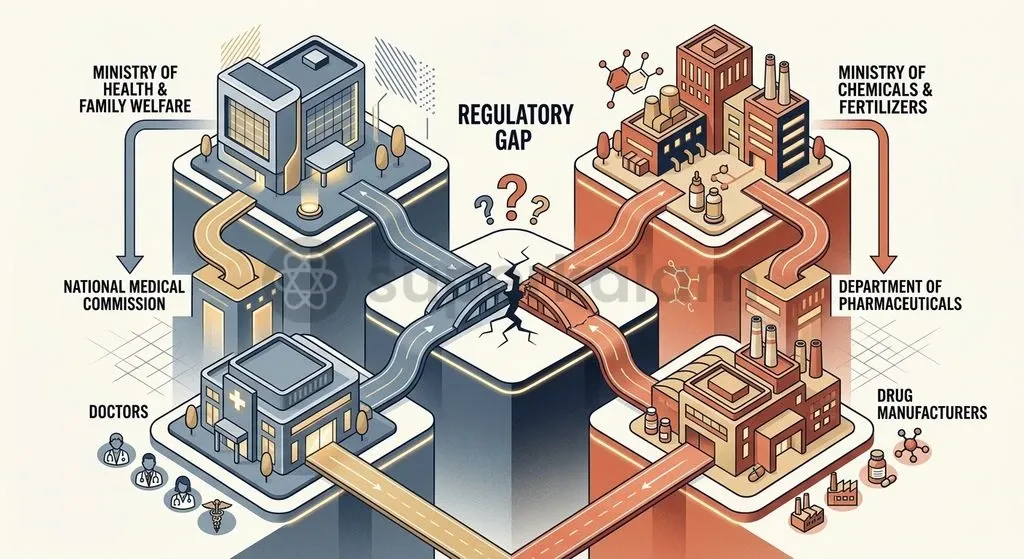
Structural misalignments in Indian healthcare governance worsen these promotional distortions. A persistent jurisdictional split divides regulatory oversight between two independent ministries:
- Physician Oversight: The Ministry of Health and Family Welfare regulates medical practitioners through the National Medical Commission (NMC).
- Manufacturer Oversight: The Ministry of Chemicals and Fertilizers regulates drug manufacturing companies via the Department of Pharmaceuticals (DoP).
This institutional division creates an enforcement gap. Doctors face potential disciplinary action from the NMC for receiving perks, yet pharmaceutical entities distributing those inducements operate under non-statutory executive guidelines.
Voluntary Guidelines vs Statutory Mandate: The Core Regulatory Dilemma
Self-regulation remains the fatal flaw of the UCPMP. Initial complaints are adjudicated by industry trade associations rather than an independent regulator.
Clause 9.2 mandates that inquiries begin before the Ethics Committee for Pharma Marketing Practices (ECPMP). This internal panel comprises three to five members formed within each pharmaceutical trade association and is chaired by the association's Chief Executive Officer.
Aggrieved parties may appeal ECPMP findings before the Apex Committee for Pharma Marketing Practices (ACPMP), chaired by the Secretary of the Department of Pharmaceuticals. Yet relying on peer review within industry bodies creates an obvious conflict of interest.
The punitive powers available under the code are strictly administrative. Clause 11.5 provides no criminal sanctions or statutory financial penalties, restricting enforcement to formal reprimands, demands for public apologies, recovery of perks, or expulsion from trade bodies.
| Regulatory Dimension | UCPMP 2024 Framework | Proposed Statutory Model |
|---|---|---|
| Legal Status | Administrative code issued by executive instruction | Enacted statute or rules under Drugs and Cosmetics Act, 1940 |
| First-instance Adjudication | Industry association Ethics Committee (ECPMP) | Independent statutory board or district medical tribunal |
| Enforcement Powers | Reprimand, association expulsion, perk recovery | Civil penalties, licence suspension, commercial prosecution |
| Disclosure Mandates | Portal disclosure via ministry circular | Legally binding, auditable public asset and transfer registry |
| Jurisdictional Coverage | Member pharmaceutical firms | Universal application across all manufacturers and distributors |
Discuss with Superkalam
Explain how the current adjudication hierarchy from ECPMP to ACPMP operates to address pharmaceutical marketing violations.
Ask NowLegal and Judicial Precedents: The Supreme Court Stance on Freebies and Tax Claims
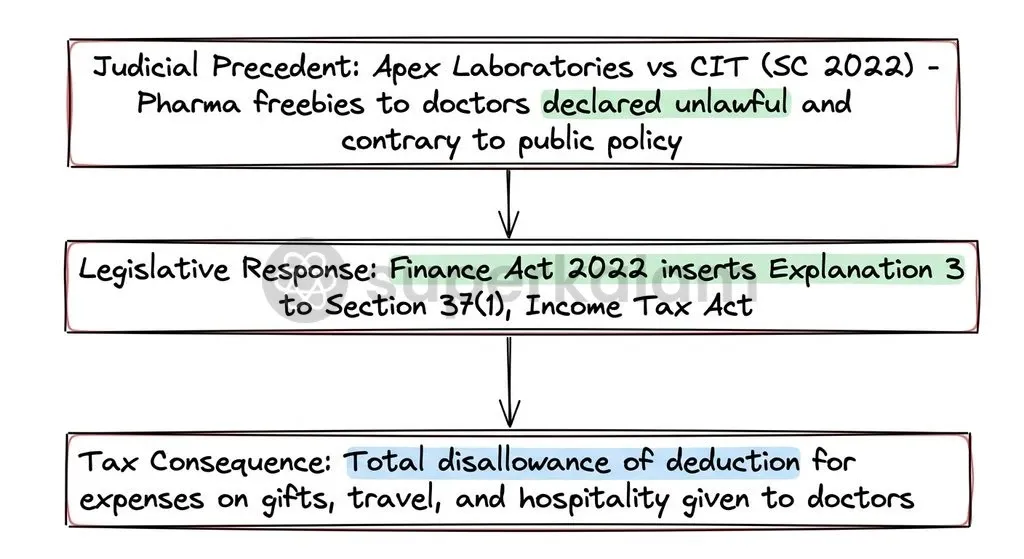
The Supreme Court of India established in Apex Laboratories Pvt. Ltd. v. Deputy Commissioner of Income Tax (2022) that pharmaceutical corporations cannot claim tax deductions for freebies distributed to doctors. The bench ruled that expenses incurred on gifts and travel perks are non-deductible under Section 37(1) of the Income Tax Act.
Free promotional incentives are never truly free. Writing for the bench, the court noted that companies factor marketing overheads into retail medicine prices, triggering pharmaceutical inflation and generating a perpetual publicly injurious cycle.
Key statutory and judicial developments governing commercial inducements include:
- Income Tax Disallowance: Following Apex Laboratories, Parliament amended Section 37(1) of the Income-tax Act via the Finance Act, 2022. It inserted Explanation 3, explicitly establishing that any expenditure incurred to provide a benefit or perquisite in violation of governing laws, regulations, or professional codes cannot be claimed as a deductible business expense.
- MCI Regulation 6.8: In December 2009, the Medical Council of India inserted Regulation 6.8 into the Indian Medical Council (Professional Conduct, Etiquette and Ethics) Regulations, 2002. This provision prohibits medical professionals from accepting travel facilities, hospitality, gifts, or financial grants from pharmaceutical companies.
- NMC Conduct Regulations 2023: The National Medical Commission attempted to expand these restrictions in August 2023 through the Registered Medical Practitioner (Professional Conduct) Regulations, 2023, which prohibited doctors from attending industry-sponsored educational seminars. The commission suspended the notification within weeks following representations from professional medical associations.
Discuss with Superkalam
If a pharmaceutical company sponsors an overseas symposium for doctors under the guise of an academic grant, how would Clause 7 of the UCPMP apply?
Ask NowEthical Dimensions: Medical Trust, Conflict of Interest, and Patient Harm
The physician-patient relationship rests on an implicit fiduciary contract. The patient assumes the clinician acts solely in the interest of human health. When commercial transactions enter this dynamic, institutional trust breaks down, replacing clinical objectivity with financial interest.
Inducement-driven prescribing carries severe clinical and constitutional implications:
- Bioethical Breach: The Indian Council of Medical Research (ICMR) notes that accepting commercial perks violates the bioethical principle of non-maleficence (primum non nocere). Such inducements spur excessive diagnostic testing, polypharmacy, and the use of poorly indicated medicines, raising direct drug safety risks for patients.
- Constitutional Guarantee: From a constitutional perspective, inflated medicine costs compromise the right to health. Courts recognise this guarantee as an integral facet of the right to life under Article 21. Preserving public confidence in clinical medicine requires structural safeguards that shield physicians from commercial inducement.
Global Best Practices: Lessons from the US Sunshine Act and European Models
The United States regulates pharmaceutical marketing through a mandatory statutory disclosure regime rather than voluntary industry self-policing. Section 6002 of the Affordable Care Act, known as the Physician Payments Sunshine Act, statutorily compels medical manufacturers to report financial transfers provided to physicians.
International frameworks demonstrate how transparency can be enforced by law:
- United States (Open Payments): Companies must submit records of any transfer of value exceeding $10 to the federal Centers for Medicare & Medicaid Services (CMS). These records are published annually on the publicly accessible Open Payments database, enabling patients, researchers, and enforcement agencies to scrutinise financial relationships.
- European Transparency Models: Several European nations combine mandatory disclosure registries with civil liability and severe financial sanctions for non-compliance. These models demonstrate that public transparency backed by statutory penalties provides a far stronger deterrent than internal trade association committees.
Discuss with Superkalam
Analyse the systemic factors explaining why tax disallowance under Section 37(1) of the Income Tax Act alone has not eliminated unethical marketing inducements.
Ask NowWay Forward: Building an Independent and Enforceable Regulatory Architecture
Reforming India's pharmaceutical marketing architecture requires transitioning from voluntary industry codes to a legally enforceable statutory regime. Public health groups and the FMRAI have urged the Union Government to enact binding rules with penal consequences, either by invoking Section 26B or Section 33 of the Drugs and Cosmetics Act, 1940, or by introducing dedicated standalone legislation, per submissions to the Supreme Court of India (as reported on 23 October 2026).
The recommendations of the Dr. M. Srinivas committee offer a concrete opportunity to modernise the regulatory architecture. Meaningful reform should incorporate three core pillars:
- Statutory Enforcement Authority: Move adjudication out of trade association committees (ECPMPs) and establish an independent statutory authority empowered to levy deterrent civil fines and suspend marketing approvals for repeated violations.
- Centralised Sunshine Portal: Transform the Department of Pharmaceuticals disclosure portal into a searchable, auditable public database. Mandate that every commercial transfer, research grant, and educational sponsorship above a designated value be published alongside doctor registration numbers.
- Inter-Ministerial Convergence: Reconcile the jurisdictional split between the Ministry of Chemicals and Fertilizers and the Ministry of Health and Family Welfare. Harmonise the UCPMP obligations of manufacturers with the professional conduct rules enforced by the National Medical Commission.
Key Takeaways
- The Department of Pharmaceuticals constituted a three-member review committee headed by Dr. M. Srinivas on 23 October 2026 following Supreme Court directions in the FMRAI litigation.
- The UCPMP 2024 establishes strict promotional caps, limiting brand reminders to educational items valued under ₹1,000 and free samples to 12 packs per drug annually, while prohibiting foreign-sponsored medical education.
- The regulatory architecture relies on internal association-led Ethics Committees (ECPMP) that lack statutory backing, independent investigative capacity, and penal sentencing powers.
- In Apex Laboratories (2022), the Supreme Court denied tax deductions under Section 37(1) of the Income Tax Act for doctor freebies, a principle later codified by Parliament via Explanation 3 in the Finance Act, 2022.
- Medicines constitute over 40% of out-of-pocket healthcare expenses in India, turning marketing-driven brand prescriptions into a significant driver of household financial distress.
Mains Question
"Self-regulation remains the fatal flaw of the pharmaceutical marketing framework in India." In light of the provisions of the Uniform Code for Pharmaceutical Marketing Practices (UCPMP) 2024, critically analyse this statement. (15 Marks)
Evaluate NowMains Question
Highlighting the ruling in Apex Laboratories Pvt. Ltd. v. DCIT (2022), evaluate how commercial inducements in healthcare impact patient welfare and public healthcare expenditure. (10 Marks)
Evaluate NowPractice MCQs
QUESTION 1
With reference to the Uniform Code for Pharmaceutical Marketing Practices (UCPMP) 2024, consider the following statements:
- It is a statutory framework enacted under the Drugs and Cosmetics Act, 1940.
- Brand reminders are restricted to educational items with a maximum individual value cap of ₹1,000.
- The distribution of free samples of hypnotics, sedatives, and tranquillisers is strictly prohibited. Which of the statements given above are correct?
QUESTION 2
Consider the following statements regarding the institutional dispute redressal mechanism under UCPMP 2024:
- First-instance inquiries are conducted by the Ethics Committee for Pharma Marketing Practices (ECPMP) established within each pharmaceutical trade association.
- The ECPMP is chaired by an independent judicial member appointed by the National Medical Commission.
- Appeals against ECPMP decisions lie before the Apex Committee for Pharma Marketing Practices (ACPMP), chaired by the Secretary of the Department of Pharmaceuticals. Which of the statements given above is/are correct?
QUESTION 3
With reference to legal and judicial developments concerning corporate freebies to medical practitioners in India, consider the following statements:
- In the Apex Laboratories case (2022), the Supreme Court ruled that promotional freebies given to doctors are non-deductible business expenses under Section 37(1) of the Income Tax Act.
- Explanation 3 was inserted into Section 37(1) of the Income-tax Act via the Finance Act, 2022 to disallow expenses incurred in violation of professional conduct regulations.
- Clause 11.5 of UCPMP 2024 empowers trade associations to initiate criminal prosecution and levy statutory financial penalties against violating drug firms. Which of the statements given above is/are correct?
QUESTION 4
In the context of Indian healthcare governance, which of the following best describes the 'jurisdictional split' that impedes effective curbing of unethical pharmaceutical marketing?
QUESTION 5
Consider the following statements regarding sample distribution and marketing regulations under UCPMP 2024:
- Free drug sample distribution is capped at 12 packs per drug per physician on an annual basis.
- The total value of free samples distributed by a pharmaceutical firm cannot exceed 2% of its annual domestic sales.
- Pharmaceutical firms are permitted to sponsor medical conferences in foreign destinations provided complete financial disclosures are made. Which of the statements given above is/are correct?