Two-Child Rule for Govt Jobs Scrapped in MP: Demographic and Legal Impact
With fertility rates dropping to 2.0, Madhya Pradesh scraps its civil services two-child disqualification, ending punitive limits on public employment.
Nov, 2026
•13 min read
Overview
On November 18, 2026, the Madhya Pradesh Cabinet dismantled its statutory two-child disqualification for state government jobs. This decision marks a shift away from punitive demographic control toward a rights-based framework aligned with India's below-replacement fertility rate.
The reform removes service barriers enforced since 2001 under the Madhya Pradesh Civil Services (General Conditions of Service) Rules. It also drops misconduct classifications for serving staff under conduct regulations.
State demographic data now shows a fertility rate of 2.0 children per woman. By halting active inquiries, this policy shift tackles long-standing constitutional concerns over gender justice, reproductive autonomy, and administrative fairness.
Why in the News: Madhya Pradesh Drops the Two-Child Norm for State Jobs
Madhya Pradesh has scrapped its two-decade-old employment barrier for parents of more than two children. On November 18, 2026, the Madhya Pradesh Cabinet meeting in Mandsaur formally approved the deletion of Sub-rule (6) of Rule 6 from the Madhya Pradesh Civil Services (General Conditions of Service) Rules, 1961, as recorded in the Madhya Pradesh Cabinet Decisions Summary.
The Cabinet enacted two decisive regulatory rollbacks:
- Recruitment Bar Abolished: The amendment eliminates the legal barrier that historically prohibited individuals with more than two living children from securing government employment.
- Disciplinary Shield for Serving Staff: Ministers deleted the clarification attached to Sub-rule (4) of Rule 22 of the Madhya Pradesh Civil Services (Conduct) Rules, 1965, which had treated the birth of a third child as official misconduct.
As of November 2026, all active departmental proceedings and inquiries launched against state employees under this clause stand terminated with immediate effect. The state clarified that past cases where competent authorities had already executed final penalty orders, dismissals, or removals will not be reopened.
Discuss with Superkalam
What is the demographic replacement threshold for Total Fertility Rate (TFR), and what is Madhya Pradesh's current TFR according to NFHS-5?
Ask NowWhat Was the Madhya Pradesh Two-Child Rule for Civil Services?
The Madhya Pradesh Civil Services (General Conditions of Service) Rules, 1961 barred any candidate having more than two living children from entering government employment. The Digvijaya Singh-led administration introduced this disqualification in 2001 through a service rule amendment.
The provision fixed a strict statutory cut-off date: any applicant who had a third child born on or after January 26, 2001, became ineligible for state civil service selection.
The regulatory framework enforced this restriction through two administrative mechanisms:
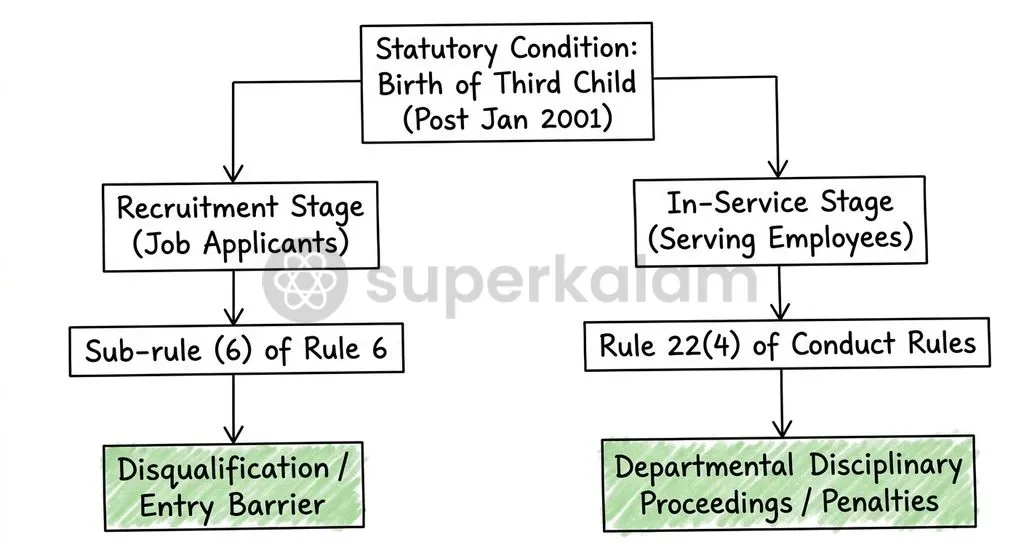
- Entry Disqualification: Sub-rule (6) of Rule 6 of the General Conditions of Service Rules was a gateway barrier. State recruitment bodies, including the Madhya Pradesh Public Service Commission, summarily rejected candidates who had more than two living children past the cut-off date.
- Service Misconduct: The clarification under Sub-rule (4) of Rule 22 of the Conduct Rules extended penalties to serving civil servants. An employee who had a third child while in service faced departmental inquiries, stalled promotions, withheld increments, or dismissal.
This framework was intended to turn civil servants into role models for small families. Over two decades of enforcement, administrative observers and legal scholars criticised the policy. The rule effectively penalised public job seekers for private reproductive choices, regardless of their merit.
Why Now? Falling Fertility Rates and Shifting Population Realities
Demographic data shows that family sizes have shrunk naturally across both the state and the country. According to the National Family Health Survey (NFHS-5, 2019-21) released by the Ministry of Health and Family Welfare, India's Total Fertility Rate (TFR) dropped to 2.0 children per woman.
This puts the country below the demographic replacement level of 2.1, the rate at which a population exactly replaces itself from one generation to the next without migration. State fact sheet data from NFHS-5 confirms that the TFR in Madhya Pradesh also dropped to 2.0 children per woman, matching the all-India average. The empirical justification that originally underpinned coercive anti-natalist policies has dissipated as the population stabilises naturally.
| Metric / Jurisdiction | Total Fertility Rate (TFR) |
|---|---|
| Demographic Replacement Threshold | 2.1 |
| All-India Average (NFHS-5) | 2.0 |
| Madhya Pradesh (NFHS-5) | 2.0 |
The demographic transition across India has been broad-based rather than regional. In Lok Sabha Unstarred Question No. 3438 answered on December 20, 2024, the Ministry of Health and Family Welfare reported that only five states remain above the replacement threshold of 2.1:
- Bihar: 2.98
- Meghalaya: 2.91
- Uttar Pradesh: 2.35
- Jharkhand: 2.26
- Manipur: 2.17
Because the vast majority of Indian states now record below-replacement fertility, retaining punitive small-family disincentives has become demographically redundant. Penalising citizens for having three children makes little public policy sense when state institutions are beginning to prepare for long-term demographic ageing.
Discuss with Superkalam
How did the Supreme Court's ruling in K.S. Puttaswamy (2017) create constitutional tension with the earlier precedent in Javed v. State of Haryana (2003)?
Ask NowState-by-State Comparison: How Different States Enforce or Relax Child Norms
State governments across India maintain diverging administrative standards regarding whether to retain or dismantle two-child eligibility criteria. While several states introduced two-child disqualifications following the 73rd and 74th Constitutional Amendment Acts for local body elections and public recruitment, multiple legislative bodies have recently chosen to roll back these restrictions.
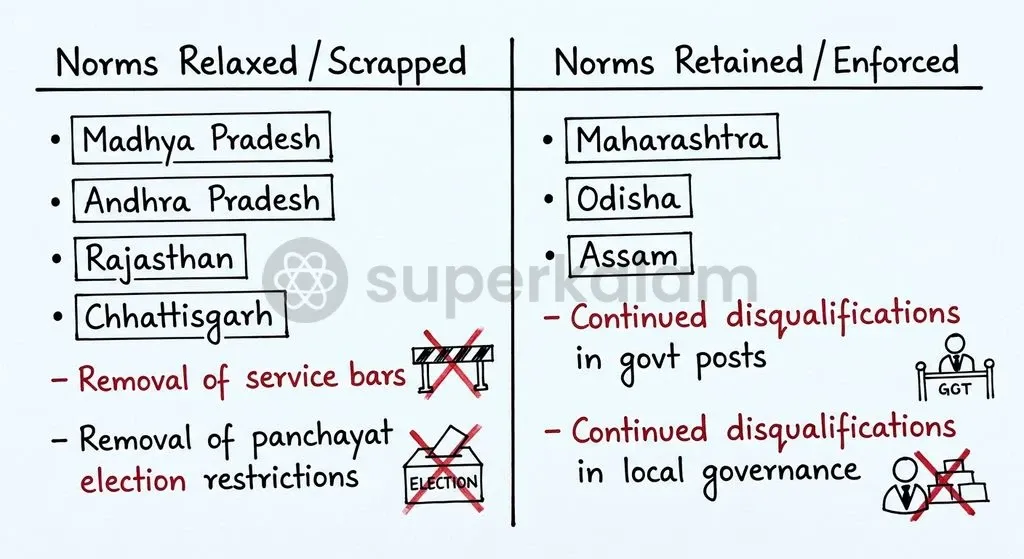
The administrative landscape divides into jurisdictions preserving restrictions and those actively dismantling them:
| State | Policy Area | Statutory Mechanism / Rule | Current Policy Stance |
|---|---|---|---|
| Madhya Pradesh | State Public Services | Rule 6(6), General Conditions of Service Rules, 1961 | Scrapped (November 2026); entry bar and misconduct clauses deleted. |
| Andhra Pradesh | Local Body Elections | AP Panchayat Raj & Municipal Laws Amendment Bills, 2024 | Scrapped (November 2024); repealed disqualifications to counter regional demographic ageing. |
| Rajasthan | Local Body Elections | Section 19, Panchayati Raj Act, 1994 & Municipalities Act, 2009 | Scrapped (February 2026); Cabinet approved repeal of local body candidacy bars. |
| Chhattisgarh | State Public Services | State Service Recruitment Rules | Scrapped (2017); eliminated two-child restrictions for government job applicants. |
| Maharashtra | Local Self-Government | Section 14(1)(j-1), Maharashtra Village Panchayats Act, 1959 | Enforced; bars candidates with more than two children from contesting panchayat seats. |
| Odisha | Local Self-Government | Section 25(1)(v), Odisha Grama Panchayats Act, 1964 | Enforced; maintains disqualification for Gram Panchayat election candidates. |
| Assam | State Public Services | Assam Public Services Rules, 2019 | Enforced (Since Jan 1, 2021); bars direct recruitment of candidates with over two children. |
This comparative landscape highlights a growing federal divide. Several states are unwinding punitive measures due to dropping fertility rates, while others maintain active statutory disincentives.
Discuss with Superkalam
Compare the demographic and policy justifications of states actively scrapping two-child norms (such as MP and Andhra Pradesh) with those retaining them (such as Assam).
Ask NowLegal and Constitutional Dimensions: From Javed v. State of Haryana to Reproductive Rights
Judicial thinking on population control disincentives has shifted dramatically from statutory deference toward fundamental rights protections.
| Case / Benchmark | Legal Standard Established | Impact on Two-Child Rules |
|---|---|---|
| Javed v. State of Haryana (2003) | Upheld panchayat disqualification under Article 14 | Declared election contest a statutory privilege, permitting population control restrictions. |
| K.S. Puttaswamy v. Union of India (2017) | Established privacy and bodily autonomy under Article 21 | Protected intimate reproductive decisions against disproportionate state coercion. |
| Mangala Bhimrao Ingle Case (2026) | Two-judge bench referred Javed to a larger bench | Re-evaluating proportionality in light of below-replacement national fertility rates. |
In Javed v. State of Haryana (2003) 8 SCC 369, a three-judge bench tested Section 175(1)(q) of the Haryana Panchayati Raj Act, 1994, which disqualified individuals with more than two children from contesting panchayat polls. The bench upheld the provision, concluding that the classification was non-arbitrary under Article 14 and carried an intelligible differentia with a rational nexus to population control. The court also observed that the right to contest an election is a statutory privilege, permitting state legislatures to prescribe disqualifying conditions.
Subsequent jurisprudence on constitutional protections expanded substantially. In Justice K.S. Puttaswamy (Retd.) v. Union of India (2017) 10 SCC 1, a nine-judge Constitution bench explicitly affirmed that personal autonomy, bodily integrity, and reproductive choice constitute core facets of privacy guaranteed under Article 21. By establishing that intimate family choices fall within fundamental liberties, the Puttaswamy ruling created legal tension with older precedents that had sanctioned coercive state disincentives.
This constitutional friction reached a turning point on November 4, 2026. In Mangala Bhimrao Ingle v. The Additional Commissioner, Amravati Division (2026 INSC 1193), a two-judge bench of the Supreme Court referred the Javed v. State of Haryana precedent to a larger bench for formal reconsideration. The division bench noted that India's national TFR had dropped below replacement level, requiring the judiciary to examine whether early-2000s population control restrictions remain proportionate and constitutionally tenable today.
Public employment involves different constitutional benchmarks than local elections. Under Article 16 of the Constitution, citizens enjoy a fundamental right to equality of opportunity in public employment. Disqualifications that disproportionately exclude specific social strata without advancing a compelling state interest run into heightened scrutiny under Articles 14 and 16.
Discuss with Superkalam
To what extent are punitive employment and electoral disincentives ethically and administratively justifiable when national fertility is already below replacement level?
Ask NowDebating the Two-Child Policy: Coercive Disincentives vs. Gender Justice
Administrative arguments supporting coercive child restrictions have consistently conflicted with empirical evidence documenting severe burdens imposed on marginalised women. Proponents historically argued that public servants and elected officials must serve as civic exemplars to accelerate demographic stabilisation. They maintained that without visible state disincentives, entrenched preferences for larger families would outstrip public resources and impede economic development.
Empirical field research reveals that these punitive disincentives produce profound adverse consequences:
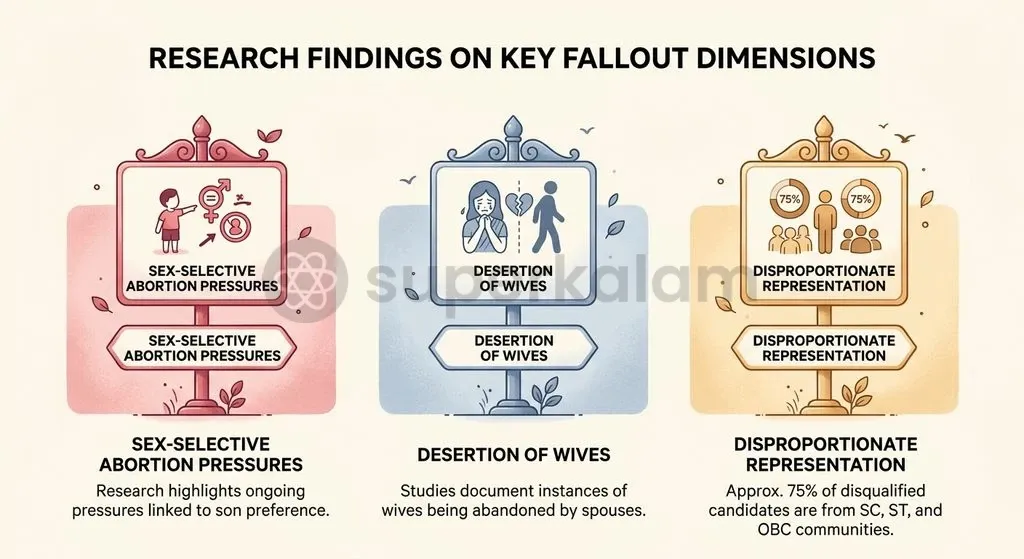
- Gender Bias and Desertion: A multi-state study led by former Madhya Pradesh Chief Secretary Nirmala Buch and Mahila Chetna Manch, supported by the Ministry of Health and Family Welfare and UNFPA, documented widespread harm resulting from local two-child norms. The investigation found that disqualified men frequently deserted, divorced, or disowned their wives to circumvent election barriers, while families resorted to sex-selective abortions to ensure male offspring without exceeding the child ceiling.
- Disproportionate Marginalisation: The Nirmala Buch research showed that over 50% of grassroots representatives disqualified under two-child rules were illiterate or possessed only primary schooling, and 75% belonged to Scheduled Castes, Scheduled Tribes, and Other Backward Classes.
- Structural Disempowerment of Women: A field study conducted by the SAMA Resource Group for Women and Health across 12 districts of Madhya Pradesh confirmed that roughly 50% of disqualified panchayat representatives belonged to SC, ST, and OBC communities. The study showed that rural women rarely exercise autonomy over reproductive decisions or contraceptive access, yet bore the brunt of disqualification when pregnancies occurred.
| Indicator | Empirical Finding |
|---|---|
| Literacy Profile | Over 50% of disqualified individuals had primary schooling or no literacy |
| Social Background | Roughly 50% to 75% belonged to SC, ST, and OBC communities |
| Documented Repercussions | Sex-selective abortions, marital desertion, and falsified birth records |
These structural realities turned what was intended as a neutral administrative filter into an engine of social exclusion. Rural candidates from underprivileged backgrounds faced exclusion from democratic participation and public employment because of socio-demographic realities beyond their immediate individual control.
Ethical and Policy Aspects: Rights-Based Family Planning
The National Population Policy 2000 established India's commitment to voluntary family welfare in alignment with international human rights benchmarks. Adopted by the Department of Family Welfare, the policy affirmed a voluntary, target-free approach, rejecting administrative coercion while prioritising healthcare infrastructure, female literacy, and expanded contraceptive choice. Coercive service disqualifications operate at direct cross-purposes with this official national strategy.
India's domestic commitments stem from international agreements. At the 1994 United Nations International Conference on Population and Development (ICPD) in Cairo, India joined the international consensus endorsing the ICPD Programme of Action. This agreement mandated a global paradigm shift:
- Discarding top-down demographic quotas, sterilisation targets, and civic penalties.
- Anchoring population programmes in reproductive rights, gender equality, and bodily autonomy.
- Recognising that female education and poverty eradication naturally drive down fertility without state coercion.
The central government has consistently maintained this stance before judicial forums. In a counter-affidavit filed before the Supreme Court in December 2020 in Ashwini Kumar Upadhyay v. Union of India, the Union Ministry of Health and Family Welfare formally opposed statutory two-child mandates. The Ministry affirmed that family planning in India operates on a voluntary basis, and that coercive legislative methods lead to demographic distortions and counterproductive public health outcomes.
Public administration ethics require state policies to balance utilitarian developmental objectives against individual fundamental freedoms. Depriving an otherwise qualified citizen of public livelihoods under Article 16 due to family size infringes personal dignity. When administrative measures disproportionately penalise women and marginalised communities for complex social dynamics, they violate the core tenets of ethical public administration.
Discuss with Superkalam
How should state governments formulate a forward-looking civil service recruitment policy that accommodates regional demographic ageing while maintaining administrative efficiency?
Ask NowWay Forward: Designing Evidence-Based Demographic Policy
Future demographic governance in India requires shifting administrative focus from punitive eligibility bars toward reproductive healthcare investments and institutional equity. Coercive child norms have proven demographically unnecessary and socially regressive. Policy design should concentrate on strengthening voluntary, positive interventions:
- Universalising Rights-Based Standards: State governments that still enforce two-child disqualifications for local bodies or civil services should review their administrative frameworks against NFHS-5 data and modern Article 21 jurisprudence, following the recent reforms enacted in Andhra Pradesh, Rajasthan, and Madhya Pradesh.
- Investments in Female Education and Healthcare: Longitudinal evidence proves that female secondary schooling, lower infant mortality, and reliable reproductive health services drive fertility stabilisation far more effectively than statutory disqualifications.
- Harmonising Service Jurisprudence: The Supreme Court's larger bench review of Javed v. State of Haryana offers an opportunity to establish nationwide legal standards reconciling state statutory disqualifications with the privacy and bodily autonomy doctrines articulated in Puttaswamy.
- Preparing for Demographic Transitions: Rather than policing birth numbers in a society where the TFR has already dropped to 2.0, administrative planners must prepare for upcoming challenges, including workforce ageing, shifting dependency ratios, and geriatric care systems.
Madhya Pradesh's decision to delete Sub-rule (6) of Rule 6 from its General Conditions of Service Rules aligns administrative practice with demographic reality. By dismantling an obsolete disincentive, the state restores merit-based access to public employment while upholding gender equity and constitutional rights.
Key Takeaways
- Cabinet Decision: On November 18, 2026, the Madhya Pradesh Cabinet approved the deletion of Sub-rule (6) of Rule 6 of the MP Civil Services Rules, 1961, removing the two-child disqualification for state government jobs.
- Conduct Rule Amendments: The government scrapped the misconduct clarification under Rule 22(4) of the MP Civil Services Conduct Rules, 1965, terminating ongoing departmental inquiries while leaving settled penalty orders closed.
- Demographic Reality: Data from NFHS-5 indicates that both India and Madhya Pradesh have reached a Total Fertility Rate of 2.0 children per woman, dropping below the demographic replacement threshold of 2.1.
- Judicial Re-evaluation: While Javed v. State of Haryana (2003) upheld two-child limits for panchayat polls, the Supreme Court referred the precedent to a larger bench in November 2026 (Mangala Bhimrao Ingle case) following the Puttaswamy privacy doctrine.
- Social Justice Impact: Empirical studies by Nirmala Buch and SAMA showed that two-child disqualifications disproportionately excluded SC, ST, and OBC candidates (50% to 75% of disqualified individuals) and exacerbated female desertion and sex-selective abortions.
Mains Question
"The empirical justification that originally underpinned coercive anti-natalist policies has dissipated as the population stabilises naturally." In the light of National Family Health Survey (NFHS-5) data and recent regulatory rollbacks in Madhya Pradesh, examine the rationale behind dismantling the two-child disqualification norm in public service recruitment. (10 Marks)
Evaluate NowMains Question
From Javed v. State of Haryana (2003) to K.S. Puttaswamy v. Union of India (2017) and the reference in Mangala Bhimrao Ingle (2026), judicial interpretation of small-family norms has evolved significantly. Critically analyse how the expansion of reproductive autonomy under Article 21 challenges statutory two-child disqualifications. (15 Marks)
Evaluate NowPractice MCQs
QUESTION 1
Consider the following statements regarding the Madhya Pradesh Cabinet decision of November 18, 2026:
- It deleted Sub-rule (6) of Rule 6 from the Madhya Pradesh Civil Services (General Conditions of Service) Rules, 1961, removing the recruitment bar for candidates with more than two children.
- It reopened and reversed all past cases where competent authorities had already executed final dismissal or penalty orders.
- It deleted the clarification under Sub-rule (4) of Rule 22 of the Conduct Rules, 1965, thereby terminating active departmental inquiries against serving staff. Which of the statements given above are correct?
QUESTION 2
With reference to demographic indicators cited in the National Family Health Survey (NFHS-5) and parliamentary data, consider the following statements:
- The Total Fertility Rate (TFR) for Madhya Pradesh dropped to 2.0 children per woman, matching the all-India average.
- The demographic replacement threshold below which population stabilizes without migration is 2.1.
- According to Ministry of Health and Family Welfare data reported in the Lok Sabha in December 2024, every state in India has achieved below-replacement fertility. Which of the statements given above is/are correct?
QUESTION 3
Consider the following statements regarding the judicial evolution of population control disincentives in India:
- In Javed v. State of Haryana (2003), the Supreme Court upheld election disqualification for having more than two children, characterizing election contest as a statutory privilege.
- In Justice K.S. Puttaswamy v. Union of India (2017), the Supreme Court held that reproductive choice and personal autonomy are core facets of privacy under Article 21.
- In Mangala Bhimrao Ingle v. The Additional Commissioner (2026), a two-judge bench referred the Javed precedent to a larger bench for reconsideration. Which of the statements given above is/are correct?
QUESTION 4
Consider the following pairs of States and their current statutory stance on two-child eligibility restrictions:
- Andhra Pradesh: Repealed local body candidacy disqualifications via amendment bills in 2024
- Rajasthan: Approved repeal of local body candidacy bars in February 2026
- Assam: Enforces disqualification for direct recruitment in state public services under rules implemented since 2021 Which of the pairs given above are correctly matched?
QUESTION 5
Under the 2001 amendment to the Madhya Pradesh Civil Services (General Conditions of Service) Rules, 1961, what was the statutory cut-off date on or after which the birth of a third child disqualified an applicant from state service recruitment?