Consanguineous Marriages in India: Law, Genetics, and the Supreme Court
The Supreme Court notice on cousin unions balances Article 21 reproductive autonomy against the urgent public health duty to prevent rare genetic disorders.
Nov, 2026
•12 min read

Context
A Supreme Court notice on consanguineous marriages highlights a pressing policy reality: curbing deep-seated customary unions requires institutional capacity-building, public education, and informed reproductive choice rather than blunt statutory bans. Hearing a public interest petition challenging intra-familial marriages, the bench declined to usurp parliamentary authority over personal law reform. The intervention shifts the national focus toward healthcare interventions, primary prevention, and carrier screening under the National Policy for Rare Diseases 2021. This approach reconciles bodily autonomy under Article 21 with the collective public health need to reduce debilitating autosomal recessive disorders.
Why in the News?
On November 20, 2026, a Supreme Court bench of Chief Justice Surya Kant, Justice Joymalya Bagchi, and Justice V. Mohana issued a limited notice to the Union Government on a public interest litigation (PIL) flagging the genetic and medical risks of marriages between close blood relatives and seeking stronger public awareness measures.
The PIL called for targeted state action across three fronts:
- Statutory safeguards against preventable congenital defects.
- Legislative reforms addressing customary intra-familial marriages.
- Nationwide public awareness programmes to sensitise families about hereditary risks.
Clarifying the boundaries of judicial review, the Supreme Court noted that enacting social reform legislation falls exclusively within the domain of Parliament. The bench stated that the judiciary would not compel lawmakers to pass a blanket ban on customary cousin marriages.
Instead, the Court aimed to sensitise Union Ministries to evaluate public health interventions. It invoked the non-justiciable Fundamental Duty under Article 51A(h) of the Constitution to develop scientific temper and inquiry.

What Are Consanguineous Marriages and How Prevalent Are They in India?
A consanguineous marriage is biologically defined as a union between two individuals related as second cousins or closer. According to the World Health Organization (WHO), consanguinity significantly increases the parental coefficient of relationship. This genetic metric measures the proportion of identical genes inherited from a common ancestor.
Data released by the Ministry of Health and Family Welfare under the National Family Health Survey-5 (NFHS-5, 2019–21) shows that consanguinity remains an entrenched practice. Nationwide, 10.8% of ever-married women aged 15–49 reported being married to a biological blood relative.
Regional distributions document sharp geographical divergence across the country:
- Southern India: Practices of uncle-niece and first-cousin alliances remain culturally endorsed. State-level data records the highest prevalence in Tamil Nadu (28%), Karnataka (27%), and Andhra Pradesh (26%).
- Northern India: Consanguineous unions are statistically negligible because kinship models strictly enforce regional, territorial, and gotra exogamy.
Discuss with Superkalam
Recall the generational thresholds defined under Section 3(f) of the Hindu Marriage Act, 1955 for sapinda relationships along the maternal and paternal lines.
Ask NowThe Health Argument: Genetic Risks and Congenital Disorders
The primary health argument against intra-familial marriage centres on autosomal recessive inheritance patterns. When two individuals share common forebears, their genetic proximity elevates offspring homozygosity. This dynamic drastically raises the probability that both biological parents transmit the exact same mutated, recessive allele to their children.
Children born to consanguineous couples face elevated medical vulnerabilities across their lifespans:
- Congenital Structural Malformations: Heightened incidence of cardiac anomalies, cleft palates, and neural tube defects.
- Sensory Impairments: Severe manifestation of inherited hereditary conditions, such as early-onset cone dystrophy, congenital blindness, and neurosensory deafness.
- Inborn Errors of Metabolism: Elevated occurrences of lysosomal storage disorders and organic acidemias. As reported by the Lysosomal Storage Disorders Support Society (LSDSS), an estimated 40% of patients with genetic disorders visiting designated Centres of Excellence have parents who are related by blood.
- Paediatric Mortality: Increased rates of spontaneous miscarriages, stillbirths, and premature infant mortality.
To counter these intergenerational burdens, the Ministry of Health and Family Welfare formulated the National Policy for Rare Diseases (NPRD) 2021. The framework identifies premarital genetic counselling and early carrier screening as essential primary preventive strategies.
Discuss with Superkalam
Explain how parental consanguinity elevates offspring homozygosity and increases the likelihood of autosomal recessive congenital disorders.
Ask NowWhat Indian Law Currently Says on Marrying Within the Family
Indian family law regulates intra-familial marriages through distinct personal laws and civil registration statutes. While civil codes aim to standardise social behaviour, personal statutes offer wide latitude to local customs. This creates significant variation in how consanguinity is treated legally across different communities.
| Statutory Framework | Core Statutory Provision | Scope of Consanguinity Prohibitions | Statutory Exceptions |
|---|---|---|---|
| **Hindu Marriage Act, 1955** | Section 3(f), Section 3(g), Section 5(iv), Section 5(v) | Prohibits sapinda relationships and specified degrees of prohibited relationship. | Validated if an established, uninterrupted **custom or usage** permits the union. |
| **Special Marriage Act, 1954** | Section 4(d) and First Schedule | Prohibits civil solemnisation within defined degrees of prohibited affinity and consanguinity. | Permissible under the **1963 amendment proviso** if a customary exception is officially notified by the State Government. |
| **Muslim Personal Law** | Uncodified Shariat application; Quran (Surah An-Nisa 4:23) | Prohibits direct ascendants, descendants, siblings, and direct aunts or uncles. | **Expressly permits** both parallel-cousin and cross-cousin marriages without statutory impediment. |
| **Indian Christian Marriage Act, 1872** | Substantive personal canon of respective church denominations | Governed by internal canonical requirements; Roman Catholic canon bars first-cousin unions. | Relaxed through discretionary **episcopal dispensations** granted by church authorities. |
| **Parsi Marriage and Divorce Act, 1936** | Section 3(1)(a) and Schedule I | Prohibits any marriage falling within the degrees of consanguinity set out in Schedule I. | Strictly applied; non-conforming unions are statutorily invalid. |
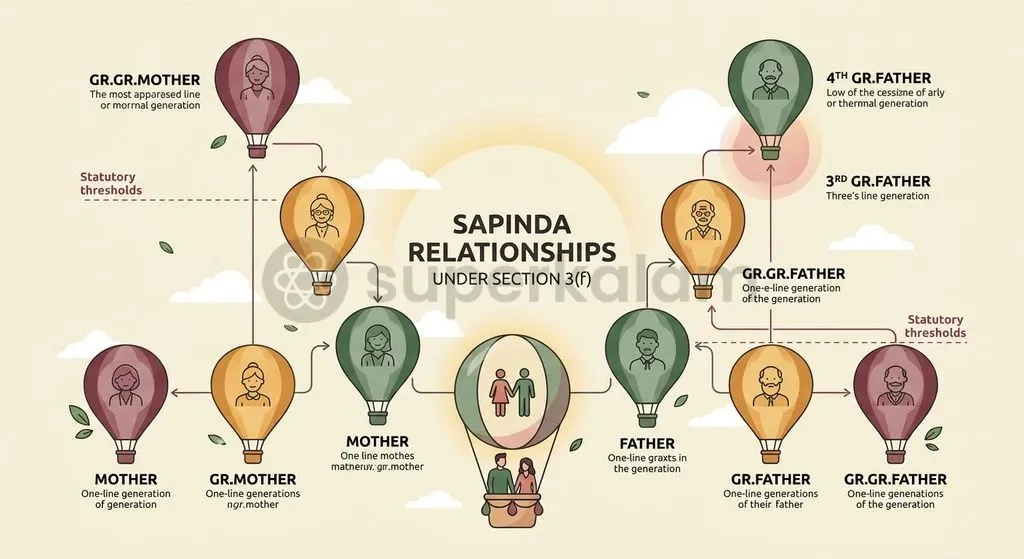
Hindu Marriage Act: Sapinda Relationships and Degrees of Prohibited Relationship
The Hindu Marriage Act, 1955 provides clear statutory rules regarding consanguinity, primarily through the concepts of sapinda relationships and prohibited degrees of affinity.
Sapinda Relationship: Section 3(f)
Under Section 3(f) of the Hindu Marriage Act, 1955, a 'sapinda relationship' extends up to the third generation (inclusive) through the mother's line of ascent, and up to the fifth generation (inclusive) through the father's line of ascent. Two individuals are considered sapindas if they share a common lineal ancestor within these statutory boundaries.
Degrees of Prohibited Relationship: Section 3(g)
Section 3(g) of the Act sets out the 'degrees of prohibited relationship'. It bars marriages between:
- Lineal ascendants and descendants.
- Collateral relatives, including brothers and sisters, uncles and nieces, or aunts and nephews.
- Two individuals who are first cousins, being children of brothers, sisters, or a brother and sister.
The Statutory Customary Exception: Section 5
Despite these statutory bars, Sections 5(iv) and 5(v) provide a significant exception. A marriage that breaches prohibited degrees or sapinda rules is fully lawful if an established custom or usage governing each party allows it.
Without a valid custom, Section 11 renders the union null and void ab initio. Furthermore, Section 18(b) imposes criminal liability of simple imprisonment up to one month, a fine up to one thousand rupees, or both, on anyone contracting such a marriage without customary protection.
How Other Personal Laws and the Special Marriage Act Treat Consanguinity
Different legal frameworks across India govern intra-familial unions under distinct civil and religious rules:
- Special Marriage Act, 1954: This civil, secular statute maintains strict kinship boundaries under Section 4(d), declaring any marriage within prohibited degrees void. Under a 1963 amendment proviso, such unions are valid if an established custom permits it and the State Government formally notifies that custom in the Official Gazette.
- Muslim Personal Law: Uncodified Shariat follows Quranic standards outlined in Surah An-Nisa (4:22–24). The law bars direct maternal and paternal aunts, uncles, and siblings. Conversely, first-cousin marriages, whether maternal or paternal, remain explicitly valid without requiring administrative approval.
- Christian Marriages: The Indian Christian Marriage Act, 1872 incorporates the personal canon of individual church denominations. Roman Catholic canon law prohibits unions between first cousins. However, parties may lift this restriction by securing an episcopal dispensation from their bishop.
Discuss with Superkalam
Analyse the sociological and regional factors that explain the high prevalence of consanguineous marriages in Southern India compared to Northern India.
Ask NowCustomary Exceptions vs Public Health: The Legal and Constitutional Dilemma
The debate surrounding consanguineous marriages involves balancing personal liberty, religious tradition, and the State's duty to protect public health.
| Constitutional Provision | Core Guarantee | Application to Consanguinity |
|---|---|---|
| **Article 21** | Right to life and personal liberty | Protects bodily autonomy and marital choice (*Shafin Jahan*). |
| **Article 25** | Freedom of conscience and religion | Protects customary practices, but remains subject to public health and morality. |
| **Article 51A(h)** | Fundamental Duty | Calls on citizens and the state to develop scientific temper and inquiry. |
Reproductive Choice Under Article 21
The Supreme Court has repeatedly affirmed that adult individuals enjoy the fundamental right to marry a partner of their own choosing under Article 21. During Friday's proceedings, Justice Joymalya Bagchi pointed out that marriage is an exercise of personal autonomy. The bench noted that Indian jurisprudence permits individuals to marry HIV-positive partners, provided the decision is built on fully informed consent.
Religious Freedom and Public Health Under Article 25
Customary kinship unions frequently claim protection under Article 25(1), which safeguards religious and cultural traditions. However, the text of Article 25 explicitly subjects this freedom to public order, morality, and public health.
This dynamic creates an unresolved constitutional tension:
- Does the State's interest in preventing lifelong congenital disabilities permit legislative limits on deep-seated customary exceptions?
- Or should the prospective rights of an unborn child to inherit healthy biological conditions qualify the unchecked reproductive choices of the parents?
Discuss with Superkalam
Evaluate whether public health interventions, such as premarital carrier screening under NPRD 2021, are more effective and constitutionally viable than coercive statutory bans on cousin marriages.
Ask NowGlobal Precedents: How Other Jurisdictions Regulate Cousin Marriages
Different legal jurisdictions handle consanguineous marriages through distinct legislative, penal, and health-based strategies.
| Jurisdiction | Regulatory Approach | Core Mechanism |
|---|---|---|
| **Norway (2024) & Sweden (2025)** | Legislative Prohibitions | Statutory blanket bans on first-cousin unions to safeguard child health and curb forced marriages. |
| **United States** | Civil & Penal Restrictions | Roughly 30 states prohibit first-cousin marriages, while others require genetic counselling or older reproductive age. |
| **United Kingdom** | Awareness-Led Public Health | Voluntary screening and healthcare outreach guided by research such as the *Born in Bradford* study. |
- Norway and Sweden (Legislative Prohibitions): In 2024 and 2025, Norway and Sweden introduced legal bans on first-cousin marriages. These statutory reforms were designed to protect child health and prevent forced marital arrangements within immigrant enclaves.
- United States (State-Level Regulations): Approximately thirty US states prohibit first-cousin marriages outright under state penal or civil codes. Some states allow these unions under limited conditions, such as requiring both parties to present proof of genetic counselling or be beyond typical reproductive age.
- United Kingdom (Public Health Outreach): The UK does not legally ban first-cousin marriages. Instead, authorities rely on voluntary genetic screening, carrier testing, and healthcare counselling, supported by empirical research from initiatives like the Born in Bradford study.

Way Forward: Balancing Public Health, Legal Reform, and Cultural Sensitivities
Enacting immediate statutory bans or imposing criminal penalties against customary unions would likely prove counterproductive. Punitive bans risk pushing marginalised communities away from institutional healthcare and maternity facilities, exacerbating vulnerabilities for both mothers and newborns. Sustainable policy should balance constitutional rights with public health protections through practical, phased measures:
- Expanding District-Level Genetic Infrastructure: Strengthen testing facilities under the National Policy for Rare Diseases 2021 by setting up premarital carrier screening hubs at district hospitals and peripheral medical colleges.
- Community Outreach via Rural Health Workers: Involve Anganwadi workers, Accredited Social Health Activists (ASHAs), and local Panchayats to explain the genetic risks of consanguinity, using clear, non-stigmatising language.
- Equipping Youth with Scientific Information: Introduce reproductive genetics and inheritance patterns into higher secondary school curricula to encourage scientific temper under Article 51A(h) of the Constitution.
- Gradual Legal Harmonisation: Rather than criminalising unions under Section 18 of the Hindu Marriage Act, 1955, Parliament could amend the Special Marriage Act, 1954 and related personal statutes to require mandatory premarital genetic screening certificates before solemnising unions within prohibited degrees.
- Protecting Personal Choice Through Informed Consent: Policy interventions must respect personal liberty, treating informed consent as the primary standard for adult reproductive and marital decisions.
Key Takeaways
- The Supreme Court's notice in the consanguineous-marriage PIL focuses on legislative safeguards and health awareness regarding consanguineous marriages, leaving personal law reform to Parliament.
- Under Section 3(f) of the Hindu Marriage Act, 1955, sapinda relationships extend three generations through the mother and five generations through the father, prohibiting marriages within these degrees unless validated by custom under Section 5.
- According to NFHS-5, consanguineous marriages are reported by 10.8% of women nationwide, with high concentrations across southern states like Tamil Nadu (28%) and Karnataka (27%).
- Biologically, consanguineous unions elevate offspring homozygosity, which significantly increases the risk of autosomal recessive disorders, sensory defects, and inborn errors of metabolism.
- Clinical reports cited by the Lysosomal Storage Disorders Support Society indicate that an estimated 40% of patients with genetic disorders at specialised Centres of Excellence have parents related by blood, though this remains an observational estimate rather than an exhaustive national census figure.
- Effective public health policy should focus on premarital genetic counselling and rural healthcare outreach, resolving the tension between Article 21 personal autonomy and public health duties under Article 25.
Mains Question
"Enacting social reform legislation falls exclusively within the domain of Parliament." In light of this judicial stance, examine the constitutional tension between reproductive autonomy under Article 21 and the state's public health imperative to curb congenital genetic disorders arising from consanguineous marriages. (10 Marks)
Evaluate NowMains Question
The National Family Health Survey-5 (NFHS-5) highlights a significant regional divergence in the prevalence of consanguineous marriages across India. Discuss the legal, genetic, and policy implications of customary intra-familial unions, and evaluate the efficacy of public health interventions over statutory bans. (15 Marks)
Evaluate NowPractice MCQs
QUESTION 1
With reference to the regulation of marriages under the Hindu Marriage Act, 1955, consider the following statements:
- A sapinda relationship extends up to the third generation through the father's line of ascent and up to the fifth generation through the mother's line of ascent.
- First-cousin marriages fall under the statutory definition of degrees of prohibited relationship.
- A marriage solemnised within the degrees of prohibited relationship can be legally valid if governed by an established custom or usage. Which of the statements given above are correct?
QUESTION 2
Consider the following statements regarding the legal treatment of consanguineous marriages across different personal and civil laws in India:
- The Special Marriage Act, 1954 allows exceptions to prohibited degrees of relationship only if the customary exception is officially notified by the State Government.
- Muslim Personal Law strictly prohibits parallel-cousin and cross-cousin marriages.
- The Parsi Marriage and Divorce Act, 1936 strictly invalidates marriages falling within the consanguinity boundaries set out in its Schedule I. Which of the statements given above is/are correct?
QUESTION 3
According to the National Family Health Survey-5 (NFHS-5, 2019–21) and genetic health data, consider the following statements:
- Nationwide, more than one-fourth of ever-married women aged 15–49 reported being married to a biological blood relative.
- Southern Indian states show a significantly higher prevalence of consanguineous marriages compared to Northern Indian states.
- Consanguineous parentage elevates offspring homozygosity, increasing the risk of autosomal recessive disorders. Which of the statements given above is/are correct?
QUESTION 4
Under the National Policy for Rare Diseases (NPRD) 2021, which of the following are identified as primary preventive strategies to mitigate the intergenerational burden of congenital and rare genetic disorders?
QUESTION 5
In the context of the Supreme Court proceedings in 'Charvi S. v. Union of India', which constitutional provision did the bench invoke while emphasizing the need to sensitise the public regarding hereditary genetic risks?