Delhi Ehsaas 2026: Institutional Framework and Mental Health Challenges
Delhi's proactive mental health architecture operationalises Article 21 in classrooms, yet severe staffing deficits threaten its whole-campus reform blueprint.
Nov, 2026
•10 min read

Overview
On 19 November 2026, the Delhi Government launched 'Ehsaas 2026', a comprehensive Mental Health and Well-Being Policy targeting over 45 lakh students and youth across government, aided, CM SHRI, private schools, and higher education institutions in the National Capital Territory. The policy establishes a structural shift in educational governance, moving student well-being away from episodic triage into a proactive, whole-campus public health framework.
By formalising early behavioural detection, a six-tier escalation protocol, and dedicated District Well-Being Centres, the framework integrates preventive psychology directly into everyday classroom administration. However, this progressive model faces immediate operational friction against deep ground-level deficits in certified clinical personnel. The long-term viability of the reform will depend on resolving severe professional shortages while navigating rigid statutory obligations governing child autonomy, parental notification, and informed medical consent.
Why in the News? The Genesis of Delhi's Ehsaas 2026 Rollout
The Delhi Government formally notified the 'Ehsaas 2026' policy on 19 November 2026 to tackle rising psychological distress and institutional vulnerabilities among students across the capital. As of November 2026, the policy brings all state government schools, government-aided institutions, CM SHRI schools, recognised private schools, and higher education institutions under a unified institutional well-being architecture.
The policy addresses institutional gaps highlighted by the Supreme Court of India in Sukdeb Saha v. State of Andhra Pradesh (2025). In that ruling, the bench affirmed that mental health is an integral component of the fundamental right to life under Article 21 of the Constitution. Exercising its powers under Articles 32 and 141, the Court issued 15 binding nationwide directives, which mandated:
- Comprehensive Institutional Frameworks: Mandatory mental health support protocols across every educational tier.
- Compulsory Counsellor Deployments: Dedicated professional staffing on campuses exceeding 100 students.
- Prohibition of Academic Segregation: An explicit bar against segregating students into batches based on academic performance.
Delhi’s Ehsaas 2026 represents the first comprehensive state-level operationalisation of both those judicial mandates and the socio-emotional well-being directives embedded in the National Education Policy 2020.
Discuss with Superkalam
What counsellor-to-student ratios does the Ehsaas 2026 policy officially mandate for schools and higher education institutions?
Ask NowAnatomy of the Model: How Ehsaas Shifts Care from Clinic to Classroom
The Directorate of Education anchored Ehsaas 2026 on four institutional pillars: a whole-institution approach, preventive care, system-level accountability, and ethical, rights-based psychological support. The initiative targets over 45 lakh children and youth up to 29 years of age across the National Capital Territory.
Unlike traditional models that treat distress only after symptoms escalate into clinical crises, the policy mandates continuous, proactive observation across the entire school environment. The framework requires psychological sensitisation for non-academic personnel, including administrative staff, bus drivers, and ayahs, training them to identify early indicators of behavioural distress during routine interactions outside formal classrooms.
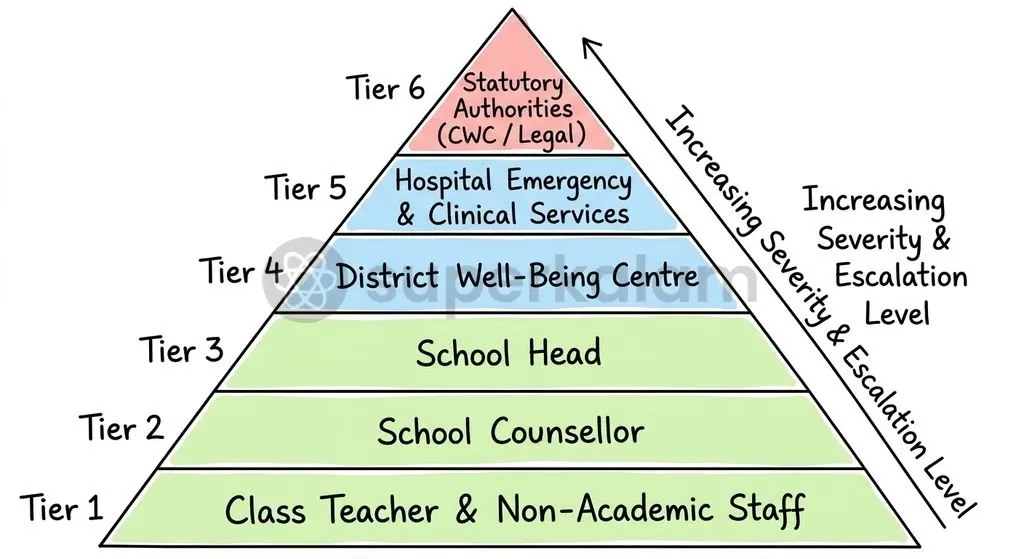
To institutionalise accountability, Ehsaas 2026 introduces digital governance through a centralised monitoring portal. Participating campuses must log quarterly self-evaluations to compute their School Wellness Services Index, creating transparent institutional metrics for campus safety and psychological preparedness. When psychological distress escalates, the framework activates a standardised Six-Tier Escalation Mechanism designed to prevent uncoordinated institutional responses:
- Tier 1 (Class Teacher): Conducts frontline behavioural observation and provides immediate, empathetic classroom-level support.
- Tier 2 (School Counsellor / First Responder): Carries out preliminary psychological screening and early non-clinical intervention.
- Tier 3 (School Head / Wellness Team): Coordinates institutional support, reviews academic adjustments, and liaises with guardians.
- Tier 4 (District Well-Being Centre): Newly established administrative hubs that deliver clinical psychological assessments, targeted therapeutic interventions, and specialised psychiatric consultations.
- Tier 5 (Hospital / Emergency Services): Manages acute crisis stabilisation, medical admissions, and clinical emergencies.
- Tier 6 (Statutory Authorities): Engages juvenile justice bodies, child protection committees, or legal authorities when institutional safety protocols demand statutory reporting.
What Ehsaas Gets Right: Early Detection, Peer Networks, and Institutionalising Care
The Ehsaas 2026 framework redefines student mental healthcare by dismantling the administrative silo that isolates pastoral care from general school administration. Rather than treating mental health as an individual pathology requiring private psychiatric clinics, the policy embeds emotional resilience into daily institutional routines, aligning directly with the National Education Policy 2020 recommendations for continuous socio-emotional learning.
The model operationalises reform across three structural fronts:
- Non-Clinical Early Detection: The framework mirrors principles from the 'Modular Handbook on Early Identification and Intervention for Mental Health Problems in School Going Children', jointly released by the Ministry of Education and NCERT on 6 September 2022.
- Whole-Campus Surveillance: Incorporating non-teaching operational staff captures behavioural changes across playgrounds, transport, and cafeterias, bypassing the social stigma that discourages voluntary visits to counselling rooms.
- Intermediate Public Health Tier: Dedicated District Well-Being Centres prevent secondary distress from overwhelming tertiary hospitals, creating an accessible bridge between school-level first aid and specialised psychiatric intervention.
Discuss with Superkalam
How does the inclusion of non-academic staff like bus drivers and ayahs support the whole-campus approach to mental health?
Ask NowThe Stress Test: Counsellor Shortages, Teacher Burnout, and Operational Hurdles
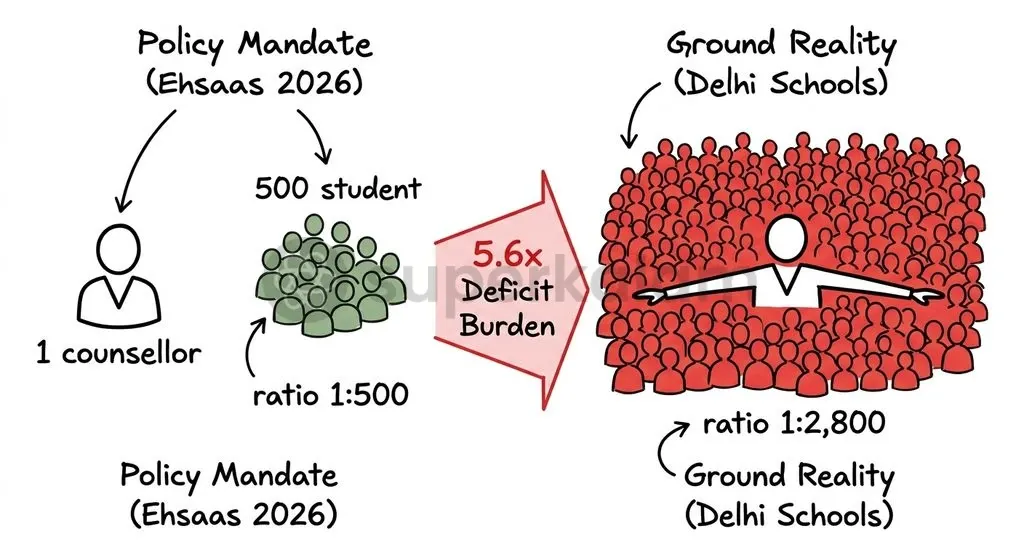
The Directorate of Education faces severe human resource deficits that threaten the structural goals of Ehsaas 2026. The policy formally mandates a ratio of at least one trained counsellor for every 500 students in schools, alongside one mental health professional for every 100 students in higher education institutions.
However, field reality reveals steep institutional bottlenecks across state schools:
- Widening Counsellor Ratios: According to Directorate of Education officials cited in November 2026 reporting, Delhi government schools operate with 489 Educational and Vocational Guidance Counsellors (EVGCs) for roughly 15 lakh enrolled students. This leaves an actual ratio of approximately 1 counsellor for every 3,000 students, six times thinner than the policy benchmark.
- Reliance on Paraprofessionals: The administration relies on over 500 teacher-counsellors across state campuses. While committed, these educators lack postgraduate clinical qualifications and statutory registration with the Rehabilitation Council of India.
- Teacher Burnout and Clinical Risk: Saddling instructional staff with psychiatric casework induces severe teacher burnout while leaving vulnerable children exposed to clinically unverified guidance during acute crises.
Comparing Approaches: Ehsaas vs MANODARPAN and Tele-MANAS
India’s national student mental health policy landscape has long relied on remote tele-triage and broad advisory guidelines rather than direct campus-level interventions. The Ministry of Health and Family Welfare launched the National Tele Mental Health Programme, known as Tele-MANAS, in October 2022 to provide continuous remote psychological counselling. Operating through the toll-free number 14416 across 36 States and Union Territories, Tele-MANAS provides an effective tertiary remote helpline. Similarly, the Ministry of Education’s MANODARPAN initiative provides psychosocial support materials and advisory hotlines.
The following table contrasts Delhi’s decentralised school-based model with these centralised national systems across core governance dimensions:
| Dimension | Delhi Ehsaas 2026 Model | National MANODARPAN Initiative | Tele-MANAS (MoHFW) |
|---|---|---|---|
| **Operational Locus** | Proactive whole-campus environment (classrooms, transport, corridors) | Centralised digital resources and national helpline support | Centralised round-the-clock tele-mental health call centres |
| **Target Population** | Over 45 lakh students and youth up to 29 years in Delhi | School and university students across India seeking self-guided aid | General population across 36 States and Union Territories |
| **Intervention Model** | Preventive early detection and continuous observation by staff | Self-directed access to counselling materials and advisory portals | On-demand crisis tele-consultation and psychiatric tele-triage |
| **Escalation Architecture** | Standardised Six-Tier Escalation Protocol ending in District Well-Being Centres | Advisory referral to external healthcare providers | Remote referral to state mental health establishments |
| **Accountability Metric** | Quarterly institutional tracking via School Wellness Services Index | Voluntary institutional adoption of NCERT training modules | Digital logging of call volume, resolution, and distress severity |
While tele-mental health platforms offer vital crisis support during acute emergencies, they remain fundamentally reactive, depending entirely on the distressed child's agency to dial a helpline. Ehsaas 2026 shifts the burden of identification from the suffering child to the surrounding institutional environment, creating a continuous safety net within the physical school ecosystem.
Discuss with Superkalam
How might a school wellness committee apply the Six-Tier Escalation Mechanism to a student exhibiting sudden academic decline and behavioural distress?
Ask NowEthical and Legal Dilemmas: Student Confidentiality and Child Autonomy under MHCA 2017
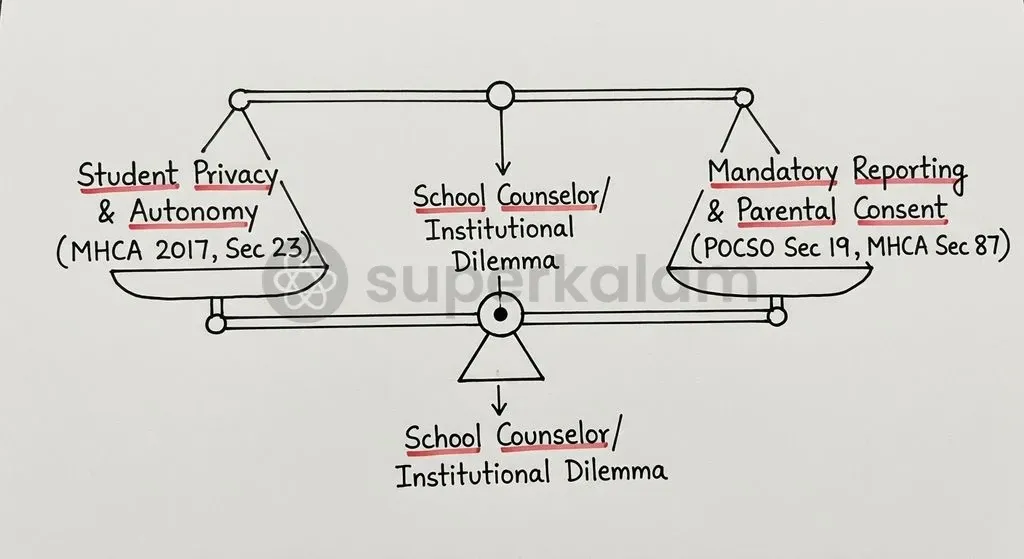
The operationalisation of Ehsaas 2026 intersects with complex legal protections governing student privacy, parental rights, and mandatory reporting. School authorities must balance competing statutory duties:
- Confidentiality Rights: Section 23 of the Mental Healthcare Act, 2017 guarantees a statutory right to confidentiality for any individual receiving mental healthcare, explicitly forbidding unauthorised disclosure of psychological records or therapeutic communications.
- Parental Custodial Authority: Under Section 87 of the Mental Healthcare Act, 2017, a minor can receive formal admission into a mental health establishment only upon an application made by their Nominated Representative—ordinarily a parent or legal guardian—supported by independent medical assessments. A school cannot transition an acutely distressed minor into clinical psychiatric care without parental notification, which may expose minors facing domestic abuse or identity crises to secondary trauma.
- Mandatory Abuse Reporting: Section 19 of the Protection of Children from Sexual Offences Act, 2012 imposes an absolute obligation on school psychologists and educators to immediately report child sexual abuse to the local police or the Special Juvenile Police Unit. Failure to report attracts criminal penalties, superseding therapeutic confidentiality.
Ehsaas 2026 reconciles these conflicting statutory obligations through a strict immediate-risk protocol. When a student exhibits acute self-harm intentions or imminent suicidal behaviour, institutional guidelines require that the child must not be left alone under any circumstance. Campus staff must maintain direct adult supervision until medical transfer is completed and statutory guardians are formally engaged, balancing ethical autonomy with the fundamental duty of care.
Policy Lessons: What Other States Can Adopt from Delhi's Blueprint
The structural architecture of Ehsaas 2026 provides a replicable roadmap for states seeking to operationalise the Supreme Court's directives in Sukdeb Saha v. State of Andhra Pradesh (2025). The central insight of the Delhi framework is that child mental health cannot be sustained solely through sporadic clinical appointments; it requires an integrated municipal ecosystem spanning sanitised escalation channels, teacher sensitisation, and district-level therapeutic hubs.
However, replicating this framework across larger states requires confronting severe fiscal and structural bottlenecks. Under the Centrally Sponsored Samagra Shiksha Scheme, student guidance and counselling components operate on a 60:40 Centre-State cost-sharing formula. Because past fiscal allocations have prioritised physical infrastructure, states have historically restricted counselling expenditures to precarious, low-paid contractual appointments.
To build sustainable school well-being systems, state education departments must implement three systemic reforms:
- Institutional Cadre Creation: State governments must transition from ad-hoc contractual hiring to creating permanent, pensionable cadres of educational psychologists within state education directorates, matching Delhi’s target ratio of 1 counsellor per 500 students.
- Fiscal Ring-Fencing under Samagra Shiksha: State project directorates should ring-fence a dedicated proportion of annual Samagra Shiksha allocations specifically for school mental health infrastructure and clinical supervision networks.
- District Diagnostic Hubs: Following Delhi's District Well-Being Centre model, states should link school clusters directly to district hospitals and tertiary medical colleges, providing certified referral channels that relieve classroom teachers of clinical diagnostic burdens.
Discuss with Superkalam
Contrast the structural efficacy of campus-based early detection in Ehsaas 2026 with centralised tele-counselling mechanisms like Tele-MANAS.
Ask NowKey Takeaways
- Policy Rollout: Launched on 19 November 2026, Delhi's 'Ehsaas 2026' introduces an institutional mental health policy targeting over 45 lakh students and youth across government and private institutions.
- Constitutional Anchor: The initiative directly enforces the Supreme Court's binding directives in Sukdeb Saha v. State of Andhra Pradesh (2025), which recognised mental healthcare as an integral component of the right to life under Article 21.
- Institutional Architecture: The policy shifts student care from reactive hotlines to continuous observation, supported by a Six-Tier Escalation Mechanism and newly established District Well-Being Centres.
- Human Resource Deficits: While the policy mandates a counsellor-to-student ratio of 1:500, Delhi state schools currently face an actual ratio of approximately 1:3,000, relying on over 500 non-specialist teacher-counsellors.
- Statutory Compliance: Institutional protocols balance confidentiality under Section 23 of the Mental Healthcare Act, 2017 with mandatory reporting obligations under Section 19 of the POCSO Act, 2012 and parental consent mandates under Section 87 of the MHCA, 2017.
Mains Question
In *Sukdeb Saha v. State of Andhra Pradesh* (2025), the Supreme Court affirmed that mental health is an integral component of Article 21. In light of this judicial directive, examine the structural innovations introduced under Delhi's 'Ehsaas 2026' policy to transition student mental healthcare from reactive clinical triage to classroom-level governance. (10 Marks)
Evaluate NowMains Question
'A progressive institutional architecture risks systemic failure when confronted with acute human resource deficits and informal task-shifting.' Critically analyse this statement in the context of the operationalisation of Delhi's Ehsaas 2026 policy. (15 Marks)
Evaluate NowPractice MCQs
QUESTION 1
In the context of student welfare and educational governance in India, consider the following statements regarding the Supreme Court's ruling in Sukdeb Saha v. State of Andhra Pradesh (2025):
- It held that mental health constitutes an integral facet of the fundamental right to life under Article 21.
- It mandated dedicated professional counsellor deployment on educational campuses exceeding 100 students.
- It permitted performance-based segregation of students into distinct academic batches to facilitate targeted counselling. Which of the statements given above is/are correct?
QUESTION 2
Consider the following statements regarding Delhi's 'Ehsaas 2026' policy framework:
- It covers students and youth up to 29 years of age across government, aided, CM SHRI, private schools, and higher education institutions.
- It establishes District Well-Being Centres under Tier 4 of its Six-Tier Escalation Mechanism to conduct clinical psychological assessments.
- It limits behavioural observation exclusively to certified postgraduate clinical psychologists to protect student confidentiality. Which of the statements given above is/are correct?
QUESTION 3
With reference to mental health initiatives in India, consider the following pairs:
- Tele-MANAS : Toll-free remote tele-mental health programme launched by the Ministry of Health and Family Welfare
- MANODARPAN : Psychosocial support initiative providing advisory resources under the Ministry of Education
- Ehsaas 2026 : Proactive whole-campus mental health framework incorporating the School Wellness Services Index Which of the pairs given above is/are correctly matched?
QUESTION 4
Under the Six-Tier Escalation Mechanism of Delhi's Ehsaas 2026 policy, which tier is specifically tasked with handling acute crisis stabilisation, medical admissions, and clinical emergencies?
QUESTION 5
Regarding the institutional norms and human resource targets under Delhi's Ehsaas 2026 framework, consider the following statements:
- The policy mandates a statutory benchmark of at least one trained counsellor for every 500 students in schools.
- In higher education institutions, the framework prescribes a ratio of one mental health professional for every 100 students. Which of the statements given above is/are correct?
Discuss with Superkalam
What institutional strategies should state education departments devise to reconcile severe counsellor deficits without inducing instructional burnout among teachers?
Ask Now