Tech Layoffs in India: Are White-Collar Workers Protected by Labour Law?
As corporate downsizing rattles the tech sector, outdated industrial laws test whether white-collar knowledge workers hold genuine statutory retrenchment rights.
Nov, 2026
•11 min read

Overview
Indian labour jurisprudence protects white-collar technology professionals primarily through Section 2(s) of the Industrial Disputes Act, 1947. This provision covers software developers and technical staff performing non-managerial work, despite widespread industry assumptions that high-earning knowledge workers lack statutory retrenchment safeguards.
While tech firms operate as commercial establishments under state laws requiring only basic severance notice, the Supreme Court looks beyond designations to the actual duties discharged. Consequently, engineers without administrative hire-and-fire authority retain statutory retrenchment protections. This reality exposes a widening regulatory gap between manufacturing-era laws and modern enterprise restructuring.
Why in the News: The Surge in White-Collar Redundancies
The Indian information technology sector witnessed widespread workforce rationalisation throughout 2023 and 2024. These widespread cuts prompted emerging labour groups to challenge mass corporate exits directly before statutory authorities.
Two immediate pressure points have brought these terminations into sharp focus:
- Union disputes: As of May 2024, employee unions such as the Nascent Information Technology Employees Senate and the Forum for IT Employees have increasingly filed formal complaints before state labour commissioners, alleging that multinational technology firms carried out illegal retrenchments and coerced resignations under the guise of voluntary separation programmes.
- Legal ambiguity: Disputes highlight a structural regulatory mismatch between twentieth-century industrial legislation and dynamic digital enterprises. This leaves thousands of salaried professionals uncertain of their legal standing during sudden corporate restructuring.
Discuss with Superkalam
What is the monthly wage ceiling specified under Section 2(s)(iv) of the Industrial Disputes Act, 1947 for supervisory personnel to retain workman status?
Ask NowThe Core Statutory Test: Who Qualifies as a 'Workman' Under the Industrial Disputes Act?
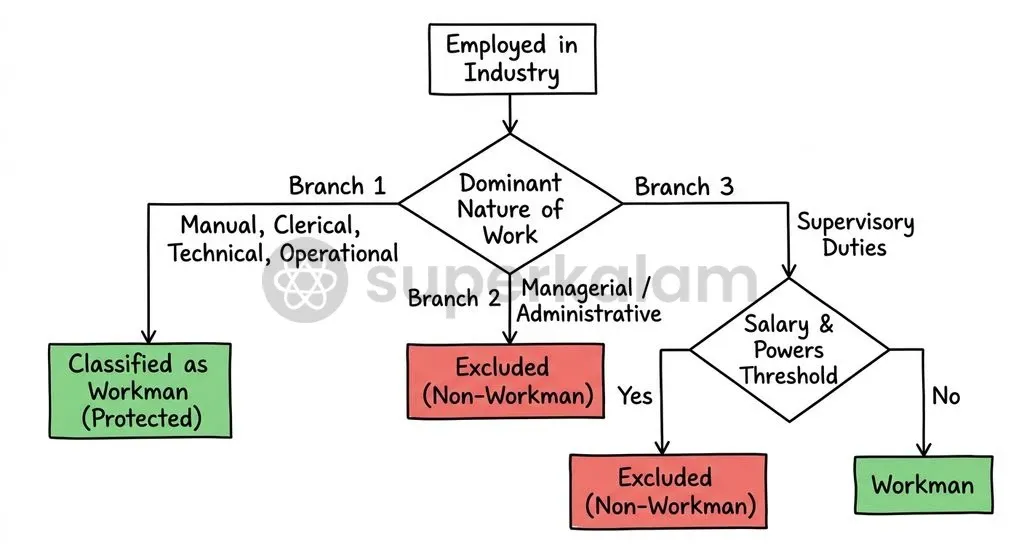
Section 2(s) of the Industrial Disputes Act, 1947 determines whether an Indian employee qualifies for statutory protection against retrenchment based on functional categories rather than salary brackets. Under Section 2(s) of the Industrial Disputes Act, 1947, a 'workman' includes any person employed in an industry to perform manual, unskilled, skilled, technical, operational, or clerical work for hire or reward. The statute excludes individuals employed mainly in a managerial or administrative capacity, regardless of internal corporate rank.
The statute establishes an additional operational ceiling under Section 2(s)(iv) of the Industrial Disputes Act, 1947. Any person employed in a supervisory capacity drawing monthly wages exceeding ₹10,000, or exercising managerial functions, is excluded from workman status.
For employees qualifying as workmen, Section 25F of the Industrial Disputes Act, 1947 prescribes strict conditions precedent to lawful retrenchment:
- The employee must receive one month's written notice indicating the reasons for retrenchment, or wages in lieu of such notice.
- The employer must pay retrenchment compensation equivalent to 15 days' average pay for every completed year of continuous service or any part thereof exceeding six months.
- The employer must serve mandatory notification upon the appropriate government authority in the prescribed format.
Failing to satisfy these requirements renders a retrenchment void from the beginning. In such cases, an aggrieved employee holds a legal claim to reinstatement with continuity of service and back wages.
How Courts Decide Workman Status: The 'Dominant Nature of Duties' Doctrine
Judicial determination of workman status prioritises substantive daily responsibilities over formal corporate nomenclature. Three landmark judicial principles govern this test:
- Designation is immaterial: The Supreme Court held in Burmah Shell Oil Storage and Distributing Co. of India Ltd. v. Burmah Shell Management Staff Association (1970) that titles such as "manager", "lead", or "consultant" are immaterial. Classification turns strictly on the primary and dominant duties an employee discharges. Incidental managerial tasks do not alter an operational employee's status.
- Affirmative functional test: In H.R. Adyanthaya v. Sandoz (India) Ltd. (1994), a five-judge Constitution Bench held that an employee does not become a workman merely by being excluded from managerial or supervisory roles. The claimant must affirmatively demonstrate that their primary work fits into manual, unskilled, skilled, technical, operational, or clerical categories.
- Application to software engineering: High courts have confirmed that coding and system maintenance fall squarely within skilled technical work. The Madras High Court affirmed in Thiru Venkataswamy v. Christian Medical College (2002) and subsequent labour rulings that software development constitutes technical work. Unless an engineer holds genuine power to hire, sanction leave, or evaluate performance, high compensation alone does not strip statutory safeguards.
Discuss with Superkalam
How does the 'dominant nature of duties' doctrine prevent employers from bypassing labour protections using executive job titles?
Ask NowState Shops and Commercial Establishments Acts: The Everyday Legal Regime for Tech Firms
State Shops and Commercial Establishments Acts govern information technology and IT-enabled services (IT/ITeS) companies across India as commercial entities rather than factories. Because software campuses operate under state-specific commercial legislation rather than the Factories Act, 1948, routine employment governance falls under state labour departments.
Under Section 39 of the Karnataka Shops and Commercial Establishments Act, 1961, an employer cannot dismiss an employee with at least six months of continuous service without one month's written notice or wages in lieu thereof, unless termination stems from established misconduct. Similar provisions operate across Maharashtra and Telangana. However, these state statutes provide only narrow individual remedies, lacking procedural mechanisms for mandatory mass-layoff approvals or collective bargaining.
| Regulatory Dimension | Application to Tech Establishments |
|---|---|
| Statutory Category | Commercial Establishment (State Acts) |
| Minimum Service for Notice | Six months of continuous employment |
| Standard Notice Period | One month or wages in lieu |
| Mandatory Government Approval | Absent under State Commercial Acts |
| Standing Orders Exemption Basis | Section 14, Industrial Employment Act |
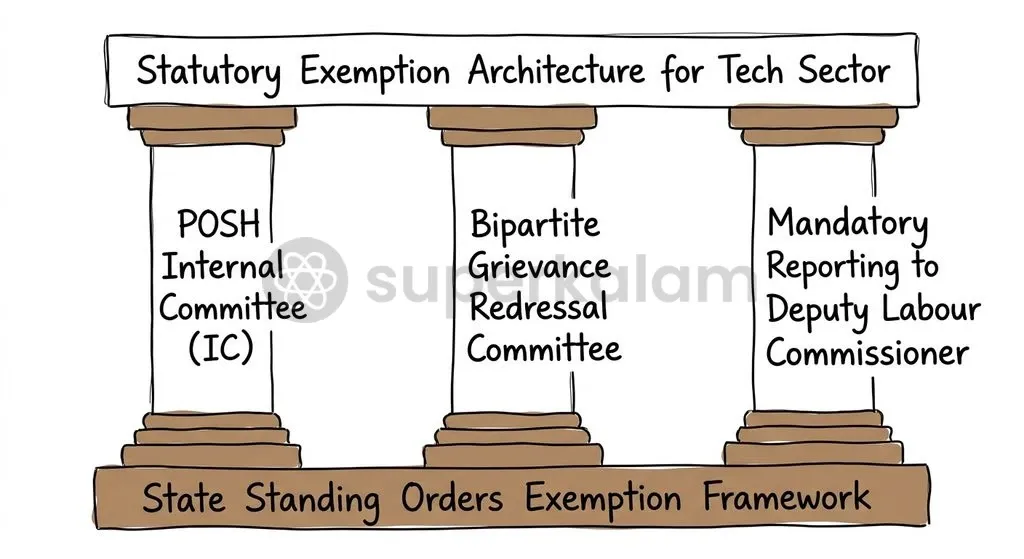
To preserve operational flexibility, key technology hubs routinely exempt IT firms from the Industrial Employment (Standing Orders) Act, 1946. On June 10, 2024, the Department of Labour of Karnataka issued Notification No. LD 328 LET 2023 under Section 14 of the 1946 Act, extending the standing orders exemption for IT, BPO, and knowledge industries for five years through June 2029. The Government of Tamil Nadu maintains similar exemptions through periodic executive notifications under G.O. (Ms) No. 82.
In exchange for this exemption, the Karnataka notification imposes strict statutory compliance conditions:
- Establishments must constitute an Internal Committee under the POSH Act to redress workplace sexual harassment.
- Employers must create a Grievance Redressal Committee featuring equal representation from management and employees.
- Companies must report all major disciplinary actions—including suspension, discharge, termination, demotion, and dismissal—to the jurisdictional Deputy Labour Commissioner.
Discuss with Superkalam
If a senior systems engineer earning a high salary is retrenched without government notification, how can the principles of Section 25F be applied to challenge the exit?
Ask NowGlobal Benchmark: How India Compares with US 'At-Will' and EU Redundancy Rules
International legal frameworks for corporate redundancies diverge sharply between the flexible hire-and-fire model of the United States and the strict consultation procedures enforced within the European Union. In the United States, private-sector employment operates under the common-law at-will employment doctrine, allowing employers to terminate an employment relationship at any time, for any reason or no reason, without statutory severance, unless barred by individual contract or anti-discrimination statutes.
To temper abrupt plant shutdowns, the United States Worker Adjustment and Retraining Notification (WARN) Act of 1988 mandates that enterprises employing 100 or more full-time workers must provide 60 calendar days' advance written notice before ordering a plant closing or mass layoff affecting 500 or more employees, or 50 to 499 employees if they represent at least 33 per cent of the active facility workforce.
| Dimension | United States Framework | European Union Framework | Indian Legal Framework |
|---|---|---|---|
| Primary Termination Doctrine | Common-law at-will employment | Just-cause and structured redundancy systems | Dual framework: Industrial Disputes Act and State Commercial Acts |
| Advance Notice Requirement | 60 days for qualifying layoffs under the WARN Act | Varies by member state; requires advance notification to public bodies | 30 days under Section 25F or applicable State Shops Acts |
| Worker Representation | No mandatory works councils for restructuring | Mandatory consultation with employee representatives | Bipartite Grievance Committees under standing order exemptions |
| Statutory Severance | Not mandated by federal statute | Prescribed by national statutes across member states | 15 days' average pay per completed year of service |
Across the European Union, Council Directive 98/59/EC imposes collective redundancy obligations requiring employers to enter into timely consultations with workers' representatives with a view to reaching an agreement. These consultations must explore ways to avoid redundancies, reduce the number of affected workers, and mitigate the social consequences through accompanying social measures.
Discuss with Superkalam
Contrast the procedural worker safeguards in the US WARN Act with the conditions precedent under Section 25F of India's Industrial Disputes Act, 1947.
Ask NowWhat the New Industrial Relations Code, 2020 Changes for Corporate Restructuring
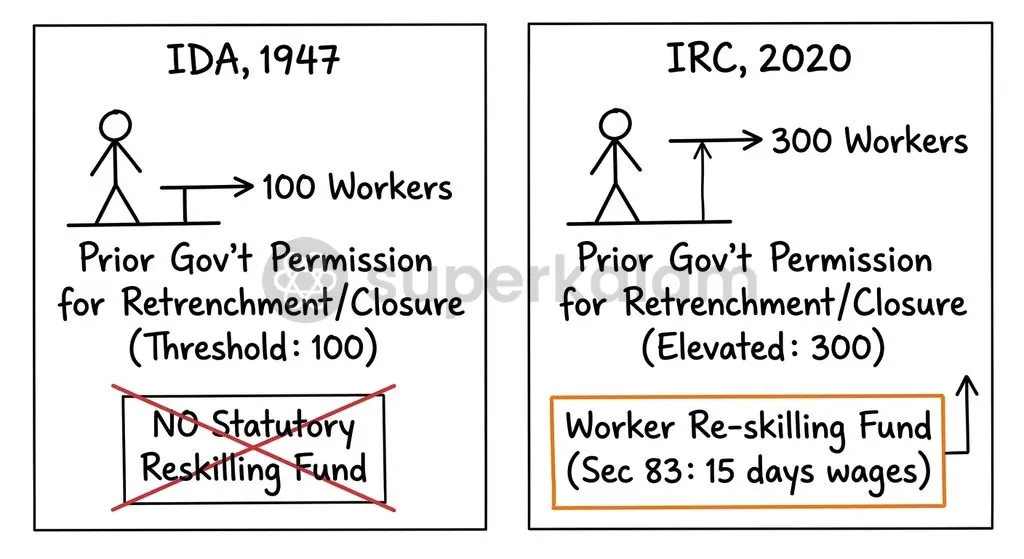
The Industrial Relations Code, 2020 consolidates earlier industrial dispute enactments while altering the statutory thresholds governing workforce rationalisation through three major reforms:
- Retrenchment approval thresholds: Under Section 77(1) of the Industrial Relations Code, 2020, the operational threshold requiring industrial establishments to obtain prior permission from the appropriate government before retrenchments, layoffs, or closures is increased from 100 to 300 workers.
- Supervisory wage ceilings: Section 2(zr) replaces 'workman' with 'worker', raising the supervisory wage exclusion threshold from ₹10,000 per month to ₹18,000 per month while continuing to exclude managerial and administrative staff.
- Statutory Re-skilling Fund: Section 83 establishes a Worker Re-skilling Fund. Retrenching employers contribute 15 days' last-drawn wages for each retrenched worker, and the fund credits that amount to the worker's account within 45 days of retrenchment.
Ethical and Economic Dimensions: Balancing Enterprise Agility with Employee Dignity
Corporate restructuring practices in the technology sector frequently bypass formal retrenchment procedures through informal mechanisms that raise serious ethical concerns. Employers often utilise "stealth layoffs" and compressed Performance Improvement Plans lasting 30 to 60 days with unachievable targets to reframe structural cost-cutting as personal employee underperformance. This practice enables organisations to avoid public disclosure and push employees into voluntary resignations, forfeiting their statutory retrenchment compensation.
Significant information asymmetry compounds these ethical dilemmas within digital workplaces:
- Algorithmic performance metrics and opaque evaluation systems deprive workers of the documentation required to contest bad-faith dismissals before labour tribunals.
- Broad non-disclosure agreements and non-disparagement clauses prevent affected personnel from publicising systemic workforce cuts.
- Structural power imbalances compel professionals to execute mutual separation agreements under threat of formal termination on record.
The broader economic consequences extend past individual job losses. A 2022 Deloitte report on workplace mental health estimated that job insecurity, burnout, and sudden downsizings cost Indian employers approximately $14 billion annually through absenteeism, presenteeism, and attrition. This loss highlights the economic imperative for sustainable human capital policies over short-term workforce cuts.
Discuss with Superkalam
Do executive exemptions from the Industrial Employment (Standing Orders) Act strike an appropriate balance between tech enterprise agility and white-collar job security?
Ask NowWay Forward: Updating Labour Jurisprudence for a Knowledge-Driven Economy
Modernising Indian labour law requires moving past mid-twentieth-century industrial classifications to construct a balanced regulatory framework suited to the knowledge economy. Legal scholars and policy analysts recommend that Parliament enact an explicit statutory definition of Knowledge Workers within labour codes, moving away from binary manual-versus-managerial categorisations. Such an amendment would guarantee structured exit timelines, transparent performance evaluations, and severance protections across tech ranks.
Public social security nets also require immediate structural adjustments to match corporate compensation realities:
- The central government must adjust wage ceilings under public insurance programmes, as the Atal Bimit Vyakti Kalyan Yojana administered by ESIC excludes tech workers due to its ₹21,000 monthly wage cap.
- State labour departments must rigorously monitor the conditionality attached to standing orders exemptions, ensuring that IT firms actively operate joint Grievance Redressal Committees.
- Transparent reporting mechanisms must be enforced to track involuntary exits, preventing firms from using coercive performance reviews as substitutes for statutory retrenchment.
Building institutional channels for corporate collective bargaining will enable enterprise agility while maintaining employee dignity. Providing structured transitional support ensures the Indian knowledge economy protects high-skilled human capital during technological shifts.
Key Takeaways
- Software developers and technical professionals qualify as workmen under Section 2(s) of the Industrial Disputes Act, 1947, provided their dominant duties are operational or technical rather than managerial.
- The Supreme Court established through Burmah Shell (1970) and H.R. Adyanthaya (1994) that functional job duties take precedence over formal corporate designations when evaluating workman status.
- Section 25F of the Industrial Disputes Act, 1947 mandates one month's written notice and 15 days' average pay per year of continuous service before retrenching eligible personnel.
- Technology firms operate primarily under State Shops and Commercial Establishments Acts and obtain periodic exemptions from certified standing orders, subject to maintaining internal grievance committees.
- Section 77(1) of the Industrial Relations Code, 2020 raises the threshold for mandatory prior government retrenchment permission from 100 to 300 workers in industrial establishments.
- Section 83 of the Industrial Relations Code, 2020 introduces a Worker Re-skilling Fund, obligating retrenching employers to contribute 15 days' wages per worker.
- Existing statutory unemployment safety nets, including ESIC benefits, remain out of reach for most software employees because of the ₹21,000 monthly wage ceiling.
Mains Question
"The determination of 'workman' status under Section 2(s) of the Industrial Disputes Act, 1947 relies upon the functional nature of daily duties rather than corporate designation or pay grade." In light of this principle, examine how Indian labour jurisprudence extends statutory retrenchment protections to white-collar technology employees. (15 Marks)
Evaluate NowMains Question
"Periodic executive exemptions granted to knowledge industries under Section 14 of the Industrial Employment (Standing Orders) Act, 1946 offer operational flexibility to firms, yet create procedural vulnerabilities for employees." Critically analyse. (10 Marks)
Evaluate NowPractice MCQs
QUESTION 1
With reference to the definition of a 'workman' under Section 2(s) of the Industrial Disputes Act, 1947, consider the following statements:
- Qualification as a workman is determined primarily by functional categories of work rather than salary brackets.
- Any person employed in a supervisory capacity drawing monthly wages exceeding ₹10,000 is excluded from workman status.
- An employee automatically qualifies as a workman merely by virtue of being excluded from managerial or supervisory functions. Which of the statements given above are correct?
QUESTION 2
Regarding the conditions precedent to lawful retrenchment under Section 25F of the Industrial Disputes Act, 1947, consider the following statements:
- The employer must provide at least three months' advance written notice indicating the reasons for retrenchment.
- Retrenchment compensation equivalent to 15 days' average pay for every completed year of continuous service must be paid.
- Mandatory notification must be served upon the appropriate government authority in the prescribed format. Which of the statements given above is/are correct?
QUESTION 3
Consider the following statements regarding the judicial determination of 'workman' status in India:
- In Burmah Shell (1970), the Supreme Court ruled that formal designations are immaterial and status turns on the primary and dominant duties discharged.
- High court rulings, including Thiru Venkataswamy v. Christian Medical College (2002), have held that software development constitutes skilled technical work.
- Receiving high financial compensation automatically deprives an engineer of statutory safeguards under the Industrial Disputes Act, 1947. Which of the statements given above are correct?
QUESTION 4
Under Notification No. LD 328 LET 2023 issued by the Government of Karnataka, IT and BPO establishments are granted an exemption from the Industrial Employment (Standing Orders) Act, 1946 subject to which of the following mandatory conditions?
- Constitution of an Internal Committee under the POSH Act.
- Formation of a Grievance Redressal Committee with equal representation of management and employees.
- Reporting all major disciplinary actions to the jurisdictional Deputy Labour Commissioner. Select the correct answer using the code given below:
QUESTION 5
Under the United States Worker Adjustment and Retraining Notification (WARN) Act of 1988, qualifying enterprises must provide advance written notice of at least how many calendar days before ordering a plant closing or mass layoff?