IAF Rafale Availability: Why 36 Delivered Jets Mean 32 Active
Tracking active flight lines reveals how maintenance cycles and contracted serviceability rates shape actual combat airpower beyond nominal squadron tallies.
Nov, 2026
•8 min read
Overview
India's operational fighter fleet reflects a sharp gap between total aircraft delivered and active flight-line availability. Military aircraft undergo routine depot overhauls, training rotations, and component inspections. Standard maintenance cycles systematically prevent an entire fleet from deploying at once.
The 2016 Inter-Governmental Agreement delivered 36 Dassault Rafale fighters to establish high-end multi-role capability across two frontline bases. In peacetime, standard military reserve frameworks keep serviceability rates between 75% and 85%.
This operational reality explains why open-source tracking counts 32 active Rafales rather than the full 36-aircraft inventory. For defence planners, sortie generation rates and flight-line availability determine combat power far more decisively than gross tail tallies alone.
Why in the News: The Gap Between Deliveries and Flight-Ready Jets
The Indian Air Force inventory faced external public scrutiny when commercial tracking publications adjusted their active operational tallies for Indian combat aircraft. As of November 2026, FlightGlobal's 2027 World Air Forces directory recorded 32 active Rafale fighter jets in the Indian inventory, down from 35 listed in late 2025.
| Fleet Metric | Aircraft Count | Operational Context |
|---|---|---|
| Total Delivered Airframes | 36 | Full contract delivery under the 2016 agreement |
| FlightGlobal Listed Active | 32 | Open-source commercial flight-line tally |
| Contracted Availability (75–85%) | 27–31 | Expected peacetime mission-ready baseline |
Social media commentary and Pakistani media outlets misconstrued this directory adjustment as evidence of four combat shootdowns during the May 2025 Operation Sindoor conflict. A former Vice Chief of Air Staff publicly dismissed these assertions, characterising claims that commercial directories proved combat losses as patently false.
Ministry of Defence officials confirmed that FlightGlobal received no official fleet data from Indian authorities and provided no individual tail-number tracking. Commercial directories rely on open-source sightings and transponder logs. They categorise an airframe as inactive whenever it goes unobserved over a rolling 12-month period during scheduled heavy maintenance.
Discuss with Superkalam
Can you identify the two IAF bases housing Rafale squadrons and the specific variant split between single-seat and twin-seat airframes?
Ask NowThe Math of Mission Readiness: Serviceability Rates and Reserves Explained
The Serviceability Rate defines the proportion of an air force's total aircraft inventory physically capable of executing assigned operational missions at any specific moment. In military aviation doctrine, this metric—also termed the Mission Capable Rate—never reaches 100% in any operational air service worldwide due to mandatory servicing schedules.
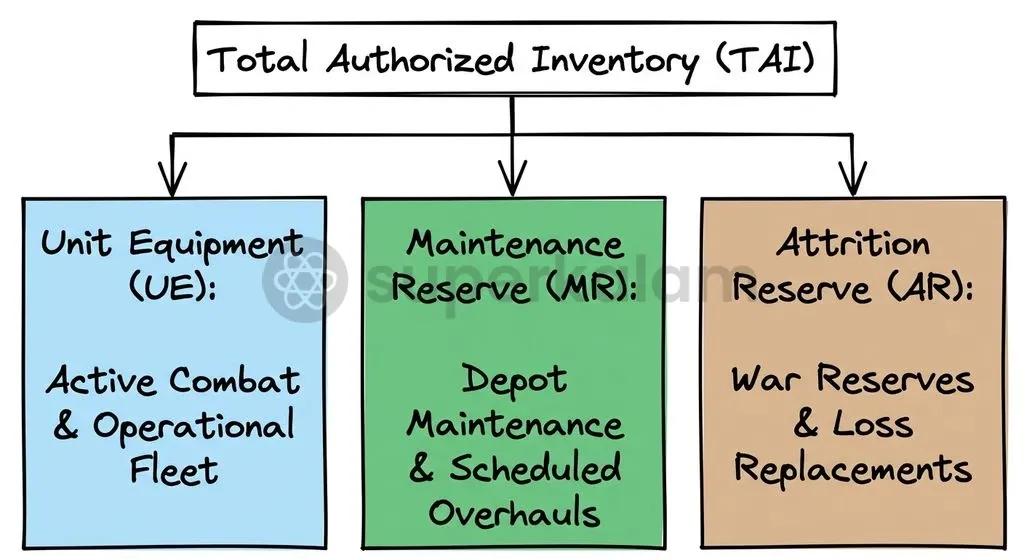
Total Authorised Inventory is divided into three distinct operational tiers to absorb maintenance and wear:
- Unit Equipment (UE): Combat-ready aircraft assigned directly to frontline squadrons for immediate operational tasking.
- Maintenance Reserves (MR): Airframes cycling through scheduled depot-level maintenance, deep technical overhauls, and software upgrades.
- Attrition Reserves (AR): Supplemental airframes held in reserve to replace peacetime operational accidents or anticipated wartime combat losses.
| Inventory Category | Core Function in Air Force Doctrine | Typical Share of Fleet |
|---|---|---|
| Unit Equipment (UE) | Immediate combat deployment and routine squadron training sorties | Primary squadron allocation (~80-85%) |
| Maintenance Reserves (MR) | Depot-level structural overhauls and technical modifications | Secondary maintenance pipeline (~10-15%) |
| Attrition Reserves (AR) | Replacements for structural wear, training crashes, and combat losses | Buffer inventory (~5-10%) |
Effective combat power equals total fleet size multiplied by the serviceability rate and daily sortie generation capacity, rather than gross book inventory. When airframes enter scheduled depot overhauls, visible flight-line counts naturally dip below procurement numbers.
Inside India's 36-Jet Fleet: Trainers, Rotations, and Dual-Base Realities
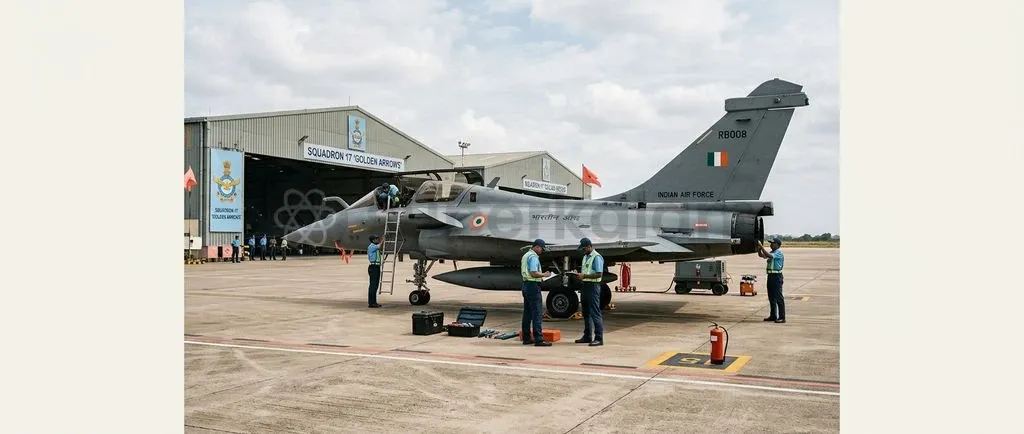
The Indian Air Force operates its 36 Dassault Rafales across two operational squadrons stationed at strategic air bases on northern and eastern borders. Acquired under an Inter-Governmental Agreement signed in September 2016 for €7.87 billion, the fleet consists of 28 single-seat EH variants and 8 twin-seat DH variants.
Frontline deployment divides the airframes equally between two historic formations:
- No. 17 Squadron ('Golden Arrows'): Based at Ambala Air Force Station in Haryana, covering the western sector.
- No. 101 Squadron ('Falcons'): Based at Hasimara Air Force Station in West Bengal, securing the eastern theatre.
A standard Indian fighter squadron is authorised for 16 to 18 Unit Equipment aircraft alongside 2 to 3 operational or maintenance reserves. Because the 36-aircraft contract provided exactly two squadrons without dedicated long-term Attrition Reserves, routine maintenance directly reduces visible flight-line numbers.
Procurement records confirmed continuous operational readiness across the fleet. In June 2026, the Indian Air Force released a formal Request for Proposal seeking bridge maintenance support calculated explicitly for all 36 Rafale airframes across 2,250 flying hours.
Discuss with Superkalam
How does the Performance-Based Logistics (PBL) model address the chronic serviceability issues that historically affected older fighter fleets like the Su-30MKI?
Ask Now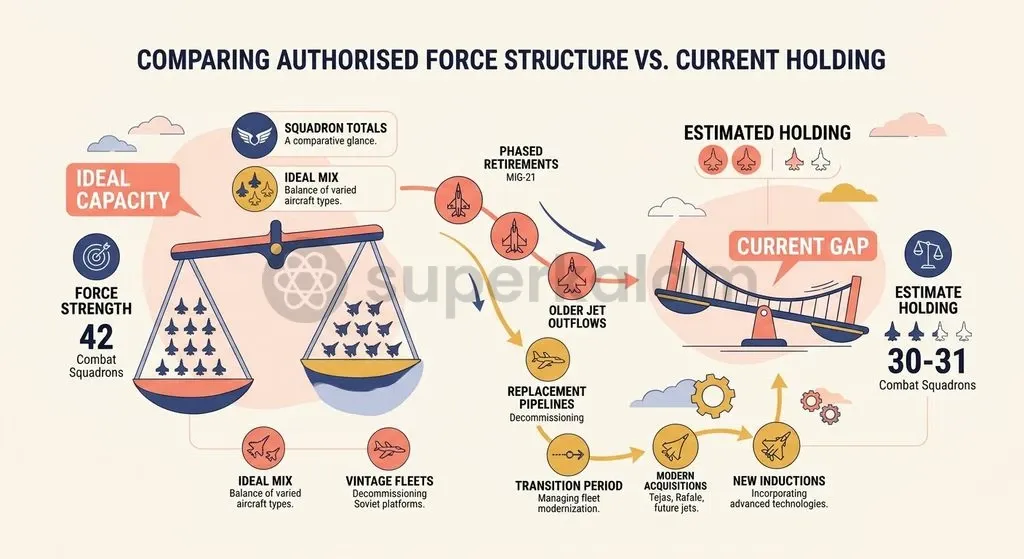
Discuss with Superkalam
If a modern air force operates 60 fighters under a 75% serviceability contract versus 80 fighters under a 50% traditional maintenance model, which configuration offers higher immediate combat power?
Ask NowThe Cost of High Readiness: Performance-Based Logistics and Spares Chains
Performance-Based Logistics structures defence maintenance contracts around guaranteed equipment availability rather than transactional purchases of individual spare parts. The 2016 Rafale agreement incorporated a €353 million contract requiring Dassault Aviation to legally guarantee a minimum 75% availability rate across five years.
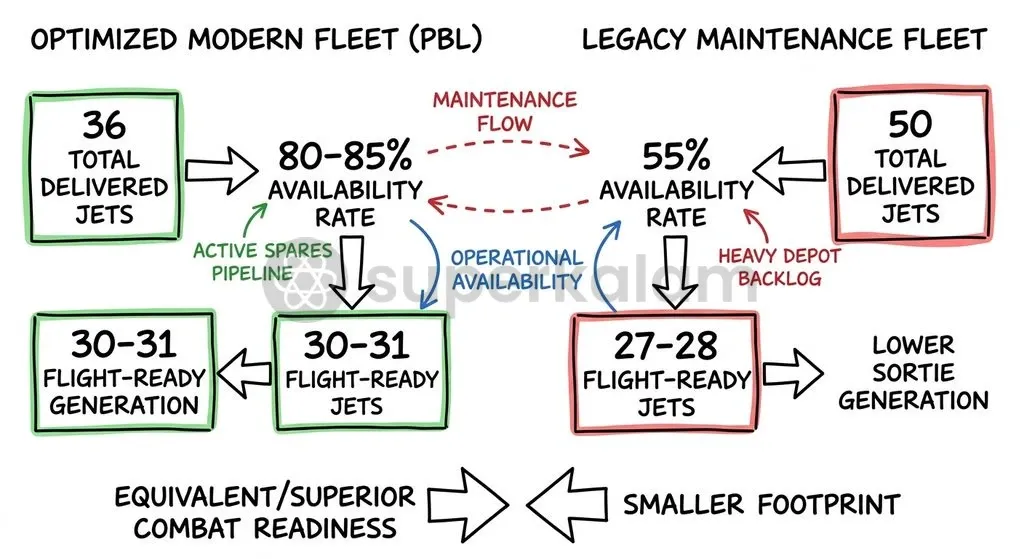
Complying with a 75% to 85% availability benchmark across 36 aircraft mathematically means 27 to 31 airframes remain mission-ready at any given moment. The remaining aircraft undergo scheduled maintenance rotations, structural inspections, and avionics upgrades.
Historical performance audits by the Comptroller and Auditor General highlighted how traditional procurement models compromised fleet availability. Older fleets such as the Su-30MKI and naval MiG-29K suffered from serviceability rates between 50% and 60% due to chronic component bottlenecks.
Mathematical comparisons demonstrate the operational efficiency of contracted availability:
- A 36-jet fleet operating at 75% to 85% availability delivers 27 to 31 active fighters on the flight line.
- A 50-jet fleet operating at 55% availability generates approximately 27 to 28 active combat aircraft.
High availability dramatically optimises sortie production per airframe. However, elevated serviceability rates cannot fully compensate for a lack of physical airframe mass when establishing simultaneous combat air patrols across geographically separate theatres.
Discuss with Superkalam
Why do open-source intelligence methods relying on rolling 12-month transponder sighting thresholds risk misrepresenting peacetime military fleet readiness as combat losses?
Ask NowWay Forward: Closing the Fighter Gap Through Sustained Fleet Availability
Closing the Indian Air Force fighter deficit requires balancing aggressive domestic manufacturing with modern contracted fleet support frameworks. The Standing Committee on Defence has consistently highlighted the urgent necessity of arresting squadron drawdowns through timely procurements and domestic production.
Key policy priorities include:
- Institutionalising Performance-Based Logistics: Applying commercial availability benchmarks to indigenous platforms like the Light Combat Aircraft Tejas maximises day-to-day mission readiness and prevents modern acquisitions from idling in depot maintenance pipelines.
- Procuring Dedicated Attrition Reserves: Defence planners must procure adequate reserve airframes alongside base squadron allocations. Acquiring future fighter batches under the Multi-Role Fighter Aircraft framework with formal Attrition Reserves prevents scheduled depot overhauls from suppressing operational frontline strength.
- Improving Strategic Intelligence Literacy: Strategic analysis requires distinguishing open-source tracking snapshots from verified operational readiness. Commercial military aviation directories reflect rolling observational windows rather than operational attrition records. Sustaining high readiness benchmarks ensures that actual combat capability remains intact even as broader force structure transitions continue.
Key Takeaways
- The Indian Air Force acquired 36 Dassault Rafales in 2016, structured into 28 single-seat EH and 8 twin-seat DH fighters stationed at Ambala and Hasimara.
- Serviceability rates in military aviation never reach 100%, as aircraft continuously rotate through Unit Equipment, Maintenance Reserves, and Attrition Reserves pipelines.
- FlightGlobal's 2027 directory listing of 32 active Rafales reflected commercial tracking methodology rather than combat losses, which former air leadership dismissed as false.
- Dassault Aviation is legally obligated under a €353 million Performance-Based Logistics contract to sustain a minimum 75% fleet availability benchmark.
- A 75% to 85% availability rate across 36 jets produces 27 to 31 flight-ready aircraft, generating sortie volume equivalent to a 50-jet fleet operating at 55% serviceability.
- High serviceability rates maximize individual airframe sorties but cannot fully replace physical force mass during simultaneous two-front deployments.
Mains Question
"High fleet serviceability rates optimize sortie generation capacity, yet they cannot fully substitute for gross airframe mass when facing dispersed operational commitments." In the context of the Indian Air Force's authorized establishment of 42 combat squadrons versus its current drawdown, critically examine this statement. (15 Marks)
Evaluate NowMains Question
Highlighting the three-tier inventory structure comprising Unit Equipment, Maintenance Reserves, and Attrition Reserves, elucidate how standard maintenance cycles explain the variance between delivered military aircraft and flight-line availability. (10 Marks)
Evaluate NowPractice MCQs
QUESTION 1
With reference to military aviation inventory management in the Indian Air Force, consider the following statements:
- Unit Equipment (UE) refers to aircraft cycling through scheduled depot-level overhauls and technical modifications.
- Maintenance Reserves (MR) are supplemental airframes kept specifically to replace wartime combat losses and training crashes.
- In military aviation doctrine, the Mission Capable Rate never reaches 100% due to mandatory servicing schedules. Which of the statements given above is/are correct?
QUESTION 2
Consider the following statements regarding the operational deployment of the Dassault Rafale fleet in the Indian Air Force:
- The 36-jet fleet procured under the 2016 Inter-Governmental Agreement comprises 28 single-seat EH variants and 8 twin-seat DH variants.
- The entire fleet is operated under a single central squadron based at Ambala Air Force Station to optimize shared logistics.
- The bridge maintenance support requested by the Indian Air Force in June 2026 was calculated explicitly for all 36 airframes. Which of the statements given above is/are correct?
QUESTION 3
In the context of defence acquisitions, how does a 'Performance-Based Logistics' (PBL) framework differ from traditional maintenance models as highlighted in the context of the IAF Rafale fleet?
QUESTION 4
Consider the following statements regarding the force structure and squadron strength of the Indian Air Force:
- The authorized establishment of the Indian Air Force is 42 combat squadrons to address a potential collusive two-front threat.
- The active fighter strength has dropped to approximately 30 to 31 operational squadrons due to the phased retirement of Soviet-era fleets outstripping new inductions.
- External commercial directories like FlightGlobal rely on direct classified audits supplied by the Indian Ministry of Defence. Which of the statements given above is/are correct?
QUESTION 5
According to reports cited by the Comptroller and Auditor General (CAG) and parliamentary committees, older Indian combat fleets like the Su-30MKI and naval MiG-29K historically experienced lower serviceability rates primarily due to which factor?
Discuss with Superkalam
Given the current drawdown to 30-31 squadrons against an authorized 42, should India prioritize higher-cost availability contracts for existing platforms or accelerate capital procurement of new airframes?
Ask Now