Gram Sabha Mining Veto: From Niyamgiri to Bibol Toppo Ruling
As court rulings collide with executive dilutions, the battle over tribal consent reveals whether grassroots democracy can withstand industrial extraction.
Nov, 2026
•12 min read

Overview
The statutory authority of the Gram Sabha to veto destructive commercial mining projects in Scheduled Areas represents the constitutional frontline between local tribal self-governance and centralised natural resource extraction. Established definitively by the Supreme Court in the landmark 2013 Niyamgiri judgment, this community consent mechanism anchored statutory protections under the Forest Rights Act, 2006 and the Panchayats (Extension to the Scheduled Areas) Act, 1996 directly to fundamental religious and cultural liberties under Article 25. Over the subsequent decade, however, executive rule revisions and sectoral statutory exemptions progressively pushed Gram Sabha verification to the final administrative margins of land handover. This systematic dilution transforms mandatory consent into a post-facto bureaucratic formality, eroding grassroots democracy and precipitating recurring legal confrontations across India's mineral-rich forest belts.
Why in the News? Fresh Flashpoints Over Tribal Mining Clearances
Judicial scrutiny over tribal land diversion revived significantly after the Supreme Court delivered its ruling in Bibol Toppo & Ors. v. State of Odisha & Ors. (2026 INSC 1244). As of November 2026, the Supreme Court ruled that obtaining prior consent of the Gram Sabha under Section 41(3) of the Right to Fair Compensation and Transparency in Land Acquisition, Rehabilitation and Resettlement (RFCTLARR) Act, 2013 is a mandatory statutory condition for land acquisition in Scheduled Areas, non-compliance with which vitiates the acquisition proceedings. The bench quashed the acquisition of 273.57 hectares of land across Kukuda, Bihabandha, and Lanjiberna villages in Sundargarh district for limestone mining surface rights granted to Dalmia Cement Bharat Limited.
The Supreme Court established that commercial mining operations undertaken for a private entity fall squarely under Section 2(2)(b) of the RFCTLARR Act, 2013, requiring prior consent from at least 80% of affected families. The court clarified that the Mines and Minerals (Development and Regulation) Act, 1957 and the RFCTLARR Act, 2013 operate in distinct legal spheres. A pre-existing mining lease does not grant an exemption from statutory land acquisition consent requirements. This judgment halts the executive tendency to treat statutory consent as optional paperwork, directly confronting years of administrative dilution that undermined the historic Niyamgiri precedent.
Discuss with Superkalam
Which Particularly Vulnerable Tribal Group (PVTG) successfully exercised its community veto against bauxite mining in the Niyamgiri hills?
Ask NowThe Landmark Precedent: How Niyamgiri's 12 Palli Sabhas Halted Vedanta
The Supreme Court established an unprecedented environmental jurisprudence in Orissa Mining Corporation Ltd. v. Ministry of Environment & Forests & Others ((2013) 6 SCC 476). The court ruled that Gram Sabhas hold the statutory authority under the Forest Rights Act, 2006 (FRA) and the Panchayats (Extension to the Scheduled Areas) Act, 1996 (PESA) to determine whether bauxite mining impinges on the religious and cultural rights of tribal communities protected under Articles 25 and 26 of the Constitution. The legal challenge centred on bauxite extraction in the Niyamgiri hill range across Rayagada and Kalahandi districts in Odisha, home to the Dongria Kondh, a Particularly Vulnerable Tribal Group (PVTG).
The Dongria Kondh revere the upper reaches of the Niyamgiri hills as the sacred abode of their presiding deity, Niyam Raja. Writing for the bench, the court recognized that customary community forest rights and habitat rights are intertwined with religious worship and cultural preservation. Following the judicial directive, administrative authorities convened assemblies across 12 village Gram Sabhas in the affected ranges. All 12 village assemblies voted unanimously against the bauxite mining project of Vedanta Resources and the Orissa Mining Corporation.
This unanimous democratic rejection compelled the Ministry of Environment, Forest and Climate Change (MoEFCC) to issue a formal rejection order on January 8, 2014, withholding final forest clearance. The Niyamgiri ruling turned the Gram Sabha into an autonomous environmental decision-maker, establishing that local consent operates as an indispensable substantive pre-condition rather than an advisory exercise.
| Regulatory Dimension | Niyamgiri Precedent (2013 OMC Ruling) | Diluted Executive Framework (Post-2022) |
|---|---|---|
| Stage of Consent Verification | Prior to Stage-II final forest clearance (Circular dated July 30, 2009) | Shifted to post-Stage II clearance at the land handover stage |
| Constitutional Anchor | Articles 25 and 26 read with Section 5 of the Forest Rights Act, 2006 | Delegated state land tenancy and administrative transfer procedures |
| Legal Nature of Gram Sabha Decision | Determinative veto over ecological, customary, and religious displacement | Procedural consultation, frequently subordinated to commercial timelines |
| Statutory Harmonisation | Synthesised FRA 2006 and PESA 1996 with forest conservation approvals | Segmented clearance regimes (FCA 1980 delinked from FRA 2006 checks) |
Case in Point: Hasdeo Arand and the Mechanism of Bypassed Consent
Hasdeo Arand, spanning northern Chhattisgarh, exposes how project proponents circumvent statutory Gram Sabha consent when institutional checks are systematically weakened. Covering dense contiguous sal forests, the landscape shelters diverse wildlife and critical water catchments. The allocation of the Parsa and the Parsa East and Kente Basan (PEKB) coal blocks provoked long-running resistance from indigenous Gond and other forest communities. Instead of honouring autonomous local assemblies, project proponents and local district administrations repeatedly faced documented allegations of procedural subversion.
A formal enquiry report by the Chhattisgarh State Scheduled Tribes Commission in November 2024 revealed that clearances for the 1,252-hectare Parsa coal block were secured through fabricated Gram Sabha resolutions. The commission documented unauthorized post-adjournment insertions and inflated attendance records that created a false veneer of community approval. Forest diversion moved forward despite sustained public objections and ongoing complaints submitted to state oversight bodies.
Procedural subversion resurfaced during the expansion of the adjacent Parsa East and Kente Basan Phase-II coal block proceedings. Ghatbarra village representatives formally demonstrated that the 2019 Gram Sabha attendance records submitted to secure Stage-II clearance included forged signatures of individuals who had died before the meeting date. When statutory assemblies are falsified, community forest rights recognized under the Forest Rights Act, 2006 are extinguished by administrative fiat, leaving forest-dwelling communities without legal recourse prior to tree felling.
Discuss with Superkalam
How does deferring FRA compliance checks until after Stage-II clearance create what the Ministry of Tribal Affairs termed a 'fait accompli'?
Ask NowThe Regulatory Shift: How Forest Conservation Rules 2022 Diluted Pre-Approval Checks
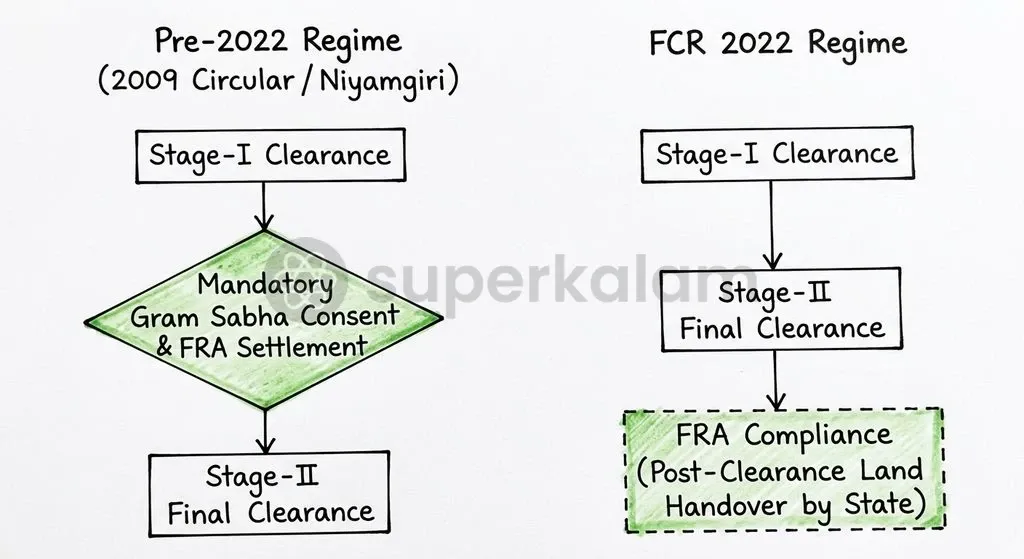
The Ministry of Environment, Forest and Climate Change initiated a significant administrative shift by notifying the Forest Conservation Rules, 2022. These rules eliminated the requirement of obtaining Gram Sabha consent prior to the Central Government granting Stage-II final forest clearance. Under the preceding circular issued on July 30, 2009, no Stage-II forest clearance proposal could proceed without an explicit resolution from the Gram Sabha certifying the completion of FRA recognition and recording free, prior, and informed consent.
Under the revised 2022 framework, the Central Government limits its inquiry to project feasibility, compensatory afforestation, and net present value levies. The statutory responsibility of verifying FRA compliance and obtaining local consent shifted entirely to state administrations after Stage-II approval, at the point of physical land handover. The Van (Sanrakshan Evam Samvardhan) Rules, 2023 preserved this bifurcated procedural framework under the amended 1980 Act, delegating tribal rights settlement to regional collectorates after national approvals are finalised.
This administrative bifurcation creates severe imbalances on the ground. When the central government accords Stage-II clearance, project proponents commit significant capital, mobilize heavy machinery, and finalize supply chains. The Ministry of Tribal Affairs (MoTA) had warned during inter-ministerial deliberations that deferring FRA compliance checks until after Stage-II approval creates a 'fait accompli'. Once substantial capital is deployed, local forest-dwelling communities face intense administrative and economic coercion to relinquish their lands.
Discuss with Superkalam
If a private mining company holds a valid mining lease under the MMDR Act, 1957, can it acquire land in a Scheduled Area without obtaining prior Gram Sabha consent?
Ask NowLegal Collision: Supreme Court Jurisprudence Versus Executive Deregulation
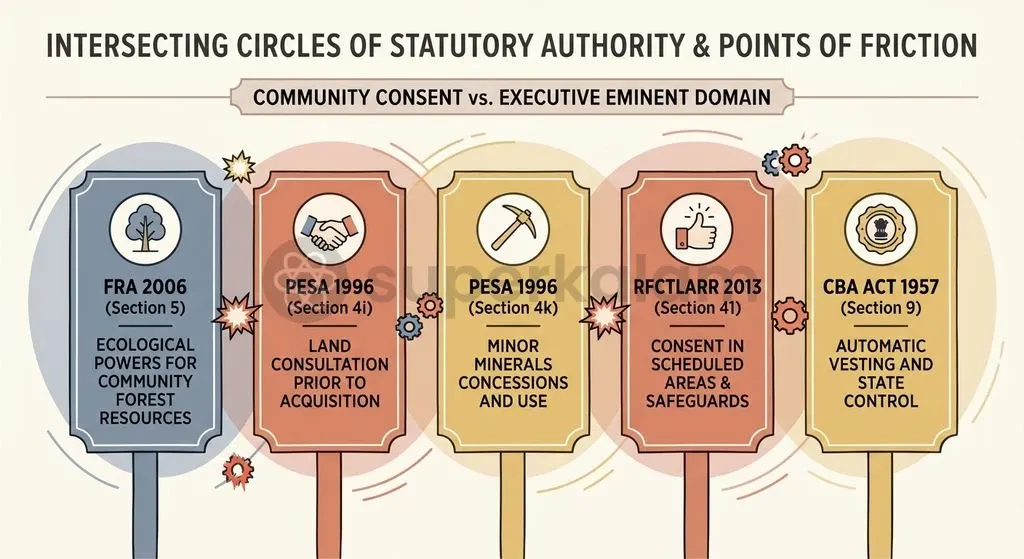
Statutory fragmentation intensifies the conflict between executive fast-tracking initiatives and progressive judicial jurisprudence. In Dharam Singh Korram v. Union of India (2022), the High Court of Chhattisgarh held that land acquisitions under the Coal Bearing Areas (Acquisition and Development) Act, 1957 are exempt from Gram Sabha consent requirements under Section 41(3) of the RFCTLARR Act, 2013. Section 105 read with the Fourth Schedule of the RFCTLARR Act, 2013 exempts 13 central enactments, including the 1957 Coal Bearing Areas Act and the Railways Act, 1989, from mandatory consent and Social Impact Assessment provisions.
Under Section 9 of the Coal Bearing Areas Act, 1957, issuing a notification automatically vests absolute title and surface rights over the land in the Central Government, free from all encumbrances, without local consultation. This statutory mechanism overrides participatory safeguards established in general land acquisition legislation.
The Provisions of the Panchayats (Extension to the Scheduled Areas) Act, 1996 contains distinct internal contradictions between major and minor minerals:
- Section 4(i) mandates prior consultation with the Gram Sabha or Panchayats at the appropriate level before acquiring land for development projects in Fifth Schedule areas.
- Section 4(k) mandates prior recommendation by the Gram Sabha only for granting prospecting licences or mining leases for minor minerals.
- Executive bodies exploit this statutory distinction to argue that Gram Sabhas possess merely advisory powers over major strategic minerals like coal, bauxite, and iron ore.
Conversely, the Supreme Court has repeatedly affirmed protective constitutional doctrines for Fifth Schedule areas. In Samatha v. State of Andhra Pradesh ((1997) 8 SCC 191), the Supreme Court ruled that tribal lands in Scheduled Areas cannot be leased to non-tribal private persons or private corporations for mining, designating the State as a fiduciary trustee bound to preserve tribal territorial integrity. Furthermore, Section 5 of the Forest Rights Act, 2006 explicitly empowers Gram Sabhas to protect wildlife, biodiversity, and adjoining catchment areas against destructive commercial activities.
The National Green Tribunal Southern Bench reinforced this principle in 2021. The tribunal ruled that Stage-I and Stage-II approvals under forest conservation laws are composite stages where the failure to respect community forest rights recognized under the FRA invalidates subsequent felling and excavation permissions. A substantial institutional divergence persists: while the Ministry of Tribal Affairs communicated in August 2026 that the bare statutory text of the Forest Rights Act, 2006 lacks an express textual provision mandating Gram Sabha consent for forest clearance (per Ministry of Tribal Affairs Official Communication on Forest Clearances and FRA, reported August 2026), the Supreme Court's ruling in Bibol Toppo (2026) reaffirmed that prior consent remains mandatory for private commercial mining in Scheduled Areas.
Discuss with Superkalam
How do the legal mechanisms of the Coal Bearing Areas Act, 1957 conflict with the participatory governance principles established under PESA and the FRA?
Ask NowEthical and Democratic Costs: Self-Determination Against Industrial Extraction
Administrative dilution of participatory rights reduces democratic self-governance to an instrumental bureaucratic exercise. As documented in the 2014 Xaxa Committee Report, replacing genuine consent with bureaucratic consultation reduces statutory safeguards for Particularly Vulnerable Tribal Groups into box-ticking exercises that compromise intergenerational ecological justice. True self-determination demands that communities retain the autonomous right to say "no" to projects that permanently dismantle their cultural habitats and subsistence ecosystems.
Article 32 of the United Nations Declaration on the Rights of Indigenous Peoples (UNDRIP), to which India is a signatory, establishes that states must obtain Free, Prior, and Informed Consent (FPIC) before approving projects affecting indigenous lands and resources. When Gram Sabha consent is bypassed or obtained through coerced assemblies, this normative standard is dismantled.
| Democratic Dimension | Instrumental Consultation | Free, Prior, and Informed Consent (FPIC) |
|---|---|---|
| Information Distribution | Selective project summaries provided during public hearings | Independent social, environmental, and cultural impact assessments |
| Institutional Timing | Post-clearance compliance verification at land handover | Prior to project finalisation and capital expenditure commitments |
| Community Agency | Passive recipients of predetermined state compensation schemes | Autonomous statutory decision-makers holding genuine veto authority |
| Ethical Premise | Utilitarian displacement for centralised macroeconomic growth | Intergenerational stewardship, indigenous dignity, and cultural integrity |
Subordinating community rights to resource extraction generates acute moral dilemmas for environmental governance. Sections 41(1) and 41(2) of the RFCTLARR Act, 2013 stipulate that land acquisition in Scheduled Areas must occur only as a demonstrable last resort. Disregarding these provisions commodifies fragile tribal ecosystems, violating the state's fiduciary obligation to preserve historic forest-dwelling cultures.
Restoring Institutional Teeth: Ground Rules for Genuine Tribal Consent
Re-establishing the constitutional authority of the Gram Sabha requires systemic legislative harmonisation and independent oversight mechanisms. The procedural loophole introduced by the Forest Conservation Rules, 2022 must be addressed by restoring the mandatory linkage between Stage-I approvals and complete FRA recognition. The Central Government should not grant Stage-II clearance until the Ministry of Tribal Affairs formally verifies that all community forest rights and habitat rights claims have been settled through documented Gram Sabha resolutions.
Legislative reforms must eliminate the statutory exemptions that shield sector-specific acquisitions from democratic accountability. Parliament should amend Section 105 and the Fourth Schedule of the RFCTLARR Act, 2013 to ensure that the Coal Bearing Areas Act, 1957 and the Railways Act, 1989 adhere strictly to mandatory Social Impact Assessments and Gram Sabha consent. Furthermore, Parliament must amend Section 4(k) of PESA 1996 to extend the mandatory prior recommendation of the Gram Sabha to major minerals, eliminating the artificial distinction that denies local vetoes over large-scale open-cast mining.
Administrative credibility requires strict procedural integrity for village assemblies. State governments must mandate digital, geo-tagged video recordings of all Gram Sabha meetings convened for environmental and land acquisition clearances. Any evidence of forged signatures or post-adjournment insertions, such as the malpractices documented in Hasdeo Arand, should automatically suspend clearance proceedings and trigger independent judicial investigations. As reaffirmed in Bibol Toppo (2026), sustainable economic development cannot be achieved by dismantling the statutory rights of India's most vulnerable forest communities.
Discuss with Superkalam
Weigh the executive interest in fast-tracking industrial mineral extraction against the constitutional imperative of local self-determination in Scheduled Areas.
Ask NowKey Takeaways
- In Bibol Toppo (2026 INSC 1244), the Supreme Court ruled that prior consent of the Gram Sabha under Section 41(3) of the RFCTLARR Act, 2013 is mandatory for land acquisition in Scheduled Areas, quashing a 273.57-hectare mining acquisition in Odisha.
- The 2013 Niyamgiri judgment established that Gram Sabhas have constitutional authority under FRA 2006 and PESA 1996 to protect religious and cultural rights under Articles 25 and 26, prompting all 12 village assemblies to vote unanimously against Vedanta's bauxite project.
- The Forest Conservation Rules, 2022 removed the requirement of obtaining Gram Sabha consent prior to Stage-II forest clearance, shifting verification to state administrations at the post-approval land handover stage.
- Field investigations by the Chhattisgarh State Scheduled Tribes Commission in Hasdeo Arand uncovered fabricated Gram Sabha resolutions and forged signatures of deceased persons utilized to obtain mining clearances.
- Under Section 105 read with the Fourth Schedule of the RFCTLARR Act, 2013, 13 central laws, including the Coal Bearing Areas Act, 1957, remain exempt from general statutory consent provisions.
- Harmonising PESA 1996, the Forest Rights Act, 2006, and mining laws requires reinstating pre-Stage II consent checks and mandating geo-tagged video recording of tribal assemblies to uphold Free, Prior, and Informed Consent.
Mains Question
"The deferral of Forest Rights Act (FRA) compliance verification to the post-Stage-II land handover stage under the Forest Conservation Rules, 2022 creates an administrative 'fait accompli' against forest-dwelling communities." Critically examine. (15 Marks)
Evaluate NowMains Question
In Bibol Toppo & Ors. v. State of Odisha (2026), the Supreme Court affirmed that a pre-existing mining lease does not grant exemption from statutory Gram Sabha consent under the RFCTLARR Act, 2013. Elucidate how this ruling restores institutional teeth to tribal self-governance in Scheduled Areas. (10 Marks)
Evaluate NowPractice MCQs
QUESTION 1
Regarding the Supreme Court's ruling in Bibol Toppo & Ors. v. State of Odisha & Ors. (2026), consider the following statements:
- It held that obtaining prior consent of the Gram Sabha under Section 41(3) of the RFCTLARR Act, 2013 is a mandatory condition for land acquisition in Scheduled Areas.
- It established that holding a mining lease under the MMDR Act, 1957 grants an automatic exemption from land acquisition consent requirements.
- It ruled that commercial mining operations undertaken for a private entity require prior consent from at least 80% of affected families under Section 2(2)(b) of the RFCTLARR Act, 2013. Which of the statements given above are correct?
QUESTION 2
With reference to the landmark 2013 Niyamgiri judgment (Orissa Mining Corporation Ltd. v. MoEF), consider the following statements:
- The Supreme Court tied the statutory protections under the Forest Rights Act, 2006 directly to religious and cultural liberties protected under Articles 25 and 26 of the Constitution.
- All 12 village Gram Sabhas convened pursuant to the court's direction voted unanimously against the bauxite mining project.
- The community whose habitat and religious rights were recognized belonged to the Dongria Kondh, a Particularly Vulnerable Tribal Group (PVTG). Which of the statements given above is/are correct?
QUESTION 3
Consider the following statements regarding the regulatory framework under the Forest Conservation Rules, 2022:
- They eliminated the requirement of obtaining Gram Sabha consent prior to the Central Government granting Stage-II final forest clearance.
- The responsibility of verifying FRA compliance was shifted to state administrations at the stage of physical land handover.
- Under the earlier July 30, 2009 circular, Stage-II clearance could be accorded before obtaining an explicit Gram Sabha resolution. Which of the statements given above is/are correct?
QUESTION 4
Under the statutory framework governing land acquisition in India, which provision exempts enactments like the Coal Bearing Areas (Acquisition and Development) Act, 1957 from mandatory consent and Social Impact Assessment requirements?
QUESTION 5
Consider the following statements regarding statutory provisions and judicial pronouncements concerning Scheduled Areas:
- Section 41(3) of the RFCTLARR Act, 2013 mandates obtaining the prior consent of the Gram Sabha for land acquisition in Scheduled Areas.
- Section 9 of the Coal Bearing Areas (Acquisition and Development) Act, 1957 automatically vests absolute title in the Central Government free from all encumbrances upon notification.
- In Dharam Singh Korram v. Union of India (2022), the High Court of Chhattisgarh ruled that Coal Bearing Areas Act acquisitions must strictly obtain Gram Sabha consent under Section 41(3) of the RFCTLARR Act, 2013. Which of the statements given above are correct?