Green India Mission: Decoding Key CAG and PAC Audit Findings
A decade of chronic underfunding and unverified sapling survival leaves the Green India Mission with a 5.3% delivery rate, imperiling climate commitments.
Nov, 2026
•10 min read

Context
The National Mission for a Green India faces severe scrutiny after parliamentary audits revealed that physical interventions achieved only 0.14793 million hectares against a government-approved target of 2.8 million hectares. That gap translates to an overall achievement rate of approximately 5.3% across a decade of operations. Approved in February 2014 under the National Action Plan on Climate Change, the mission sought to protect, restore, and enhance India's forest cover on 10 million hectares while sequestering 50 to 60 million tonnes of carbon dioxide equivalent annually.
Instead, systemic underfunding, bureaucratic delays, and reliance on unverified afforestation data have crippled execution. This structural stagnation raises urgent concerns regarding India's ability to fulfil its international climate pledge of generating an additional carbon sink of 2.5 to 3.0 billion tonnes by 2030.
Why the Green India Mission Is Under Scrutiny Today
Parliamentary audit findings have placed the Ministry of Environment, Forest and Climate Change under intense examination. The Comptroller and Auditor General of India tabled Performance Audit Report No. 4 of 2026 on the Green India Mission in Parliament on 12 August 2026, evaluating operations across 16 States and Union Territories between 2015-16 and 2024-25. The findings exposed profound deficits in physical afforestation and financial governance.
The Public Accounts Committee reviewed CAG Report No. 4 of 2026 on 19 November 2026. Committee members expressed grave dissatisfaction with the Environment Ministry regarding the mission's 5.3% achievement rate. Key points raised during the review include:
- Sluggish Execution: The committee rebuked the Ministry over the 5.3% achievement rate across ten years of operational outlays.
- Aravalli Green Wall Inaction: The committee reprimanded the Ministry for failing to advance the prioritised Aravalli Green Wall project, linking chronic inaction to acute air pollution across Delhi-National Capital Region.
During the review proceedings, the Secretary of the Ministry assured the committee that revised implementation guidelines would be finalised within one to two months, per Public Accounts Committee proceedings (as reported on 19 November 2026).
The core finding is stark. The Green India Mission suffers not merely from fiscal starvation, but from a broken governance architecture that prioritises bureaucratic spending over genuine landscape-level ecological restoration.
Discuss with Superkalam
What percentage of the physical afforestation target was achieved by the Green India Mission according to the CAG audit report?
Ask NowWhat Was the Green India Mission Designed to Achieve?
The Cabinet Committee on Economic Affairs approved the National Mission for a Green India in February 2014 as one of the key missions under the National Action Plan on Climate Change. The mission framework established a comprehensive mandate to protect, restore, and enhance forest cover across 10 million hectares of forest and non-forest lands.
Landscape-level interventions formed the core operational philosophy of the mission. The initial blueprint projected that holistic interventions would yield an annual incremental carbon sequestration potential of 50 to 60 million tonnes of carbon dioxide equivalent. Unlike traditional plantation drives, the scheme intended to treat degraded ecosystems through multi-layered vegetative cover, soil moisture conservation, and hydrological catchment improvement.
| Dimension | Mission Design Objective | Core Mechanism |
|---|---|---|
| Physical Scope | 10 million hectares total treatment | Landscape-level ecological restoration |
| Cover Expansion | New forest creation | Afforestation on fallow and non-forest lands |
| Quality Enhancement | Density improvement | Upgrading moderately dense and open forests |
| Climate Mitigation | 50 to 60 MtCO2e annual sequestration | Biomass accumulation and soil carbon sinks |
| Community Role | Democratic decentralisation | Direct execution by Gram Sabhas and local bodies |
The mission was structured around double-pronged ecological targets: expanding green cover onto new lands while simultaneously improving canopy density across degraded forests. Democratic decentralisation formed an explicit pillar of this design. Forest protection committees and local village assemblies were slated to lead micro-planning, ensuring that forest enhancement supported tribal and rural livelihoods.
Discuss with Superkalam
Explain why inter-scheme convergence with programmes like MGNREGS and CAMPA failed to provide the envisaged financing for the Green India Mission.
Ask NowWhat Did the CAG and PAC Audits Uncover?
The Comptroller and Auditor General documented near-total delivery failure across both physical objectives. Field performance fell drastically behind targets:
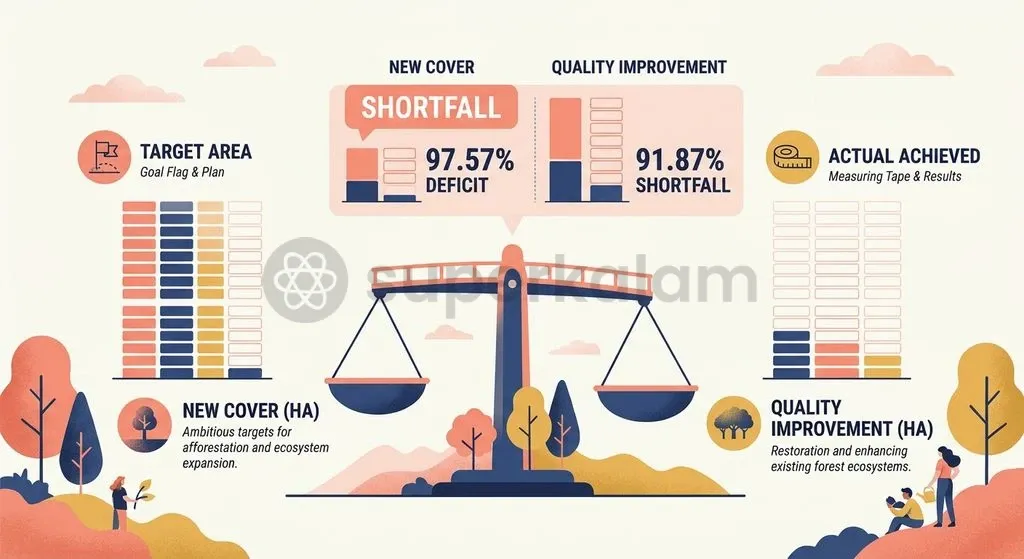
- Forest Cover Expansion: Against a target of expanding forest cover across 1.4 million hectares, the mission achieved an increase across only 0.03409 million hectares, registering a 97.57% shortfall.
- Forest Quality Improvement: Targets aimed at improving existing forest quality fared similarly, covering just 0.11384 million hectares against the 1.4 million-hectare goal—a 91.87% deficit.
- Overall Combined Coverage: Combined interventions reached merely 0.14793 million hectares against the government-approved 2.8 million-hectare target, yielding an overall physical achievement rate of approximately 5.3%.
Across the 16 audited States and Union Territories, ecological treatment remained confined to scattered patches rather than contiguous landscapes.
The Public Accounts Committee observed that these abysmal outcomes stemmed from an institutional refusal to treat the mission as an integrated national priority. Administrative inertia and fragmented field delivery converted an ambitious national climate mission into an inconsequential departmental scheme.
Chronic Underfunding and Diverted Money: The Financial Bottlenecks
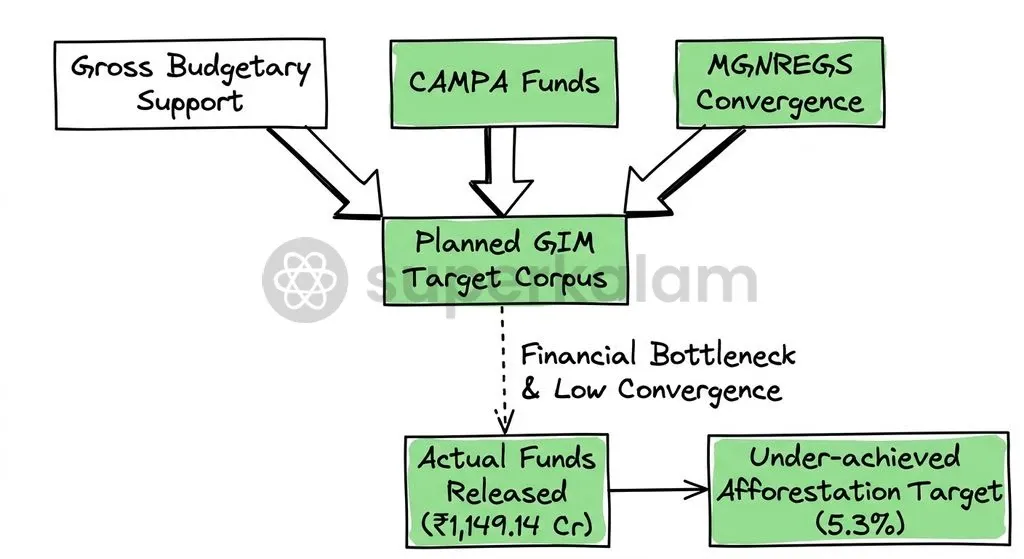
The Green India Mission suffered from structural financing flaws from its inception. The original 12th Five-Year Plan implementation framework envisaged a total outlay of ₹13,000 crore, combining ₹2,400 crore in regular budgetary and Finance Commission support with ₹10,600 crore in inter-scheme convergence funds. This non-budgetary funding was intended to flow from three streams:
- The Mahatma Gandhi National Rural Employment Guarantee Scheme,
- The Compensatory Afforestation Fund Management and Planning Authority (CAMPA), and
- The National Afforestation Programme.
Auditors found that the planned ₹10,600 crore inter-scheme convergence failed to materialise. Over a ten-year operational span, the mission received merely ₹1,149.14 crore in budgetary releases, fulfilling just 47.88% of the initial ₹2,400 crore direct allocation. Starved of resources, State forest departments lacked the capital to maintain multi-year silvicultural treatments.
The Public Accounts Committee delivered a scathing institutional critique of the Environment Ministry's fiscal practices. The committee censured the Ministry for relying on CAMPA funds as an ad-hoc substitute for regular budgetary support. This practice masked severe shortfalls in core governmental funding. Allied afforestation initiatives, including the Nagar Van Yojana and state CAMPA authorities, operated in isolated silos without unified monitoring or coordinated financial oversight.
Financial indiscipline extended deep into state-level execution. The CAG audit revealed that eight audited States and Union Territories failed to maintain annual accounts for mission funds, creating unverified ledgers and significant accountability vacuums. Without verified expenditure records, tracking actual fund flow to local executing committees proved virtually impossible.
Discuss with Superkalam
How might bypassing Gram Sabhas during afforestation planning undermine the long-term survival rate of planted saplings?
Ask NowFlawed Implementation: Delays, Land Conflicts, and Weak State Coordination
Administrative bottlenecks crippled the operational rhythm of the Green India Mission across participating states. CAG Report No. 4 of 2026 exposed systematic procedural and planning failures:
- Chronic Planning Delays: Only six out of 68 sampled Annual Plans of Operation were submitted by States to the Environment Ministry before the financial year commenced. Not a single annual plan received ministerial approval on schedule, delaying fund releases past critical pre-monsoon planting windows.
- Distorted Site Selection: The audit revealed that districts with low to moderate climate vulnerability were selected for interventions, while high-vulnerability ecotones facing severe land degradation were overlooked. Administrative convenience superseded scientific site-selection criteria.
- Exclusion of Gram Sabhas: Section 5 of the Scheduled Tribes and Other Traditional Forest Dwellers (Recognition of Forest Rights) Act, 2006 empowers Gram Sabhas to protect wildlife, biodiversity, and community forest resources. Implementing agencies routinely bypassed Gram Sabhas and Joint Forest Management Committees, abandoning mandatory bottom-up micro-planning.
This administrative exclusion provoked severe local land conflicts and detached rural communities from plantation maintenance.
Counting Trees Instead of Forests: The Problem with Survival Rates and Monocultures
State forest departments consistently prioritised rapid seedling planting numbers over durable ecological restoration. Audit scrutiny uncovered critical ecological deficiencies:
- Proliferation of Monocultures: Implementing agencies favoured monoculture timber plantations and commercial exotic species instead of native, multi-layered forest regeneration. These artificial plantations fail to replicate the biodiversity or ecological stability of native forest canopies.
- Massive Sapling Mortality: Independent satellite verifications undertaken during the CAG audit found no discernible new tree cover at 70% of surveyed sites, demonstrating extensive mortality. Field agencies accounted for expenditure upon initial planting, disregarding subsequent maintenance.
- Omission of Moisture Conservation: Sub-audits of the Maharashtra Forest Department showed that mandatory soil and moisture conservation operations were skipped at surveyed sites despite funds being booked as fully spent. Without moisture conservation trenches, saplings withered during dry seasons.
- Deficient Tracking Tools: The Forest Survey of India and the Environment Ministry operate specialised geoportals. Yet auditors found that national afforestation tracking tools lacked verified spatial polygon boundaries and field survival audits.
Discuss with Superkalam
Assess whether substituting regular budgetary allocations with ad-hoc CAMPA funds compromises parliamentary financial accountability.
Ask NowWhat This Shortfall Means for India’s NDC Carbon Sink Commitments
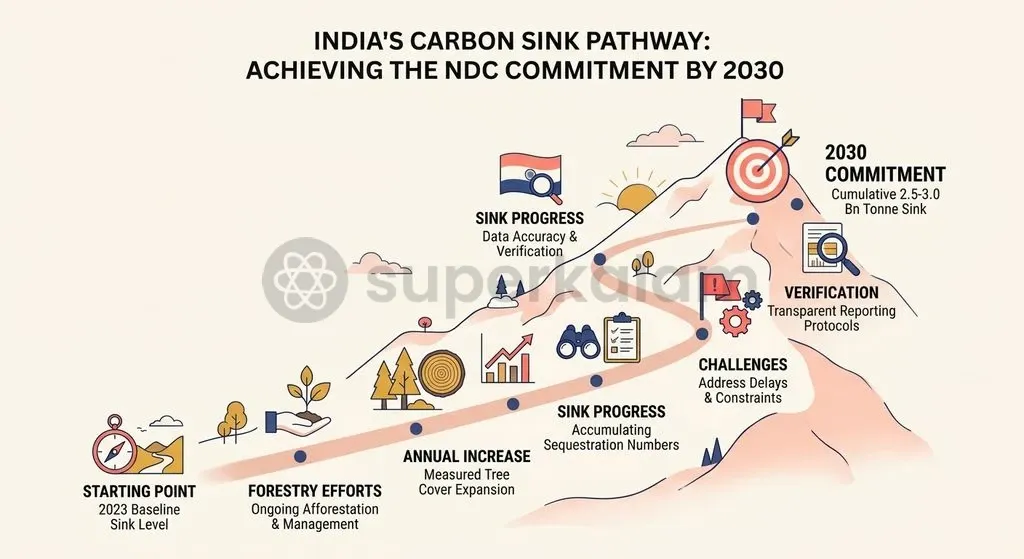
India's international climate mitigation architecture relies heavily on expanding forest biomass. Under its updated Nationally Determined Contribution submitted to the UNFCCC under the Paris Agreement in 2022, India pledged to create an additional cumulative carbon sink of 2.5 to 3.0 billion tonnes of carbon dioxide equivalent by 2030 through additional forest and tree cover.
Current forestry baselines underline the scale of this mitigation challenge. India's Third National Communication to the UNFCCC established that existing forests and tree cover act as a net carbon sink, sequestering approximately 331 million tonnes of carbon dioxide equivalent annually. Achieving the cumulative 2030 NDC target requires significant annual net expansion above this baseline.
| Parameter | NDC Climate Policy Commitment | Field Reality Under GIM Audit |
|---|---|---|
| Carbon Sequestration Goal | Additional 2.5 to 3.0 billion tonnes CO2e by 2030 | Only 2 states assessed carbon sequestration |
| Annual GIM Mitigation Target | 50 to 60 million tonnes CO2e per year | Physical shortfall of 94.7% on approved targets |
| Forest Ecosystem Quality | Improved crown canopy and biomass density | Monocultures and 70% zero-cover sites |
| Geospatial Accountability | Transparent, verified carbon tracking | National geoportals lack verified polygon data |
CAG Report No. 4 of 2026 warned that persistent physical shortfalls and stagnant canopy density under the Green India Mission pose a direct threat to India's 2030 NDC forest commitments. Despite explicit statutory rules, no state except Madhya Pradesh and Chhattisgarh conducted any scientific carbon sequestration assessments between 2015 and 2025. Without accurate baseline field measurements, national claims regarding forestry sinks remain highly vulnerable to international technical scrutiny.
Discuss with Superkalam
Propose three structural governance reforms to ensure that state forest departments meet pre-monsoon planting schedules without procedural delays.
Ask NowReforming Forest Governance: What Must Change in Mission Delivery?
Structural overhaul of the Green India Mission requires moving away from input-based administrative grants. Institutional corrections must focus on three core fronts:
- Outcome-Linked Disbursements: Transition the mission to an outcome-oriented fiscal release framework directly linked to verified satellite canopy gains and mandatory third-party survival audits. Budgetary disbursements should occur only after multi-spectral satellite imagery confirms established canopy cover.
- Unified Inter-Agency Governance: The Environment Ministry must establish an integrated afforestation dashboard synchronising the Green India Mission, CAMPA allocations, and the Nagar Van Yojana under unified ecological metrics. Ending the use of compensatory afforestation money to paper over core budget deficits is necessary to restore fiscal integrity.
- Enforceable Community Rights: Planning must be grounded in Section 5 of the Scheduled Tribes and Other Traditional Forest Dwellers (Recognition of Forest Rights) Act, 2006, ensuring that Gram Sabhas lead local site selection and species design.
Combining indigenous ecological knowledge with open-access geospatial polygon mapping will ensure that public afforestation expenditure builds genuine, resilient carbon sinks.
Key Takeaways
- The Green India Mission achieved only 0.14793 million hectares against a 2.8 million-hectare target between 2015-16 and 2024-25, registering an overall physical achievement rate of approximately 5.3%.
- The planned ₹10,600 crore inter-scheme convergence failed to materialise, and the mission received only ₹1,149.14 crore over a decade—less than half of its initial ₹2,400 crore core budgetary outlay.
- The Public Accounts Committee censured the Environment Ministry for using CAMPA funds to mask core budgetary shortfalls and condemned the lack of coordinated monitoring across afforestation schemes.
- Independent satellite analysis showed no discernible new tree cover at 70% of surveyed plantation sites due to high sapling mortality, monocultures, and the omission of soil conservation measures.
- Sidelining Gram Sabhas empowered under Section 5 of the Forest Rights Act, 2006 degraded community participation and sparked local land conflicts.
- This prolonged delivery failure threatens India's Paris Agreement NDC commitment to create an additional carbon sink of 2.5 to 3.0 billion tonnes of CO2 equivalent by 2030.
Mains Question
"The Green India Mission suffers not merely from fiscal starvation, but from a broken governance architecture that prioritises bureaucratic spending over genuine landscape-level ecological restoration." Comment in light of recent parliamentary audit findings. (15 Marks)
Evaluate NowMains Question
Evaluating the performance audit of the Green India Mission, examine how procedural delays and flawed micro-planning hinder the achievement of India's Nationally Determined Contribution (NDC) carbon sink target. (10 Marks)
Evaluate NowPractice MCQs
QUESTION 1
Regarding the National Mission for a Green India (GIM), consider the following statements:
- It was approved in 2014 as one of the missions under the National Action Plan on Climate Change.
- It aimed to treat forest and non-forest lands across 10 million hectares.
- The mission's operational framework mandated centralized implementation exclusively through State Forest Departments, excluding local Gram Sabhas.
Which of the statements given above is/are correct?
QUESTION 2
With reference to the findings of CAG Performance Audit Report No. 4 of 2026 on the Green India Mission, consider the following statements:
- The mission achieved an overall physical target rate of approximately 5.3% across a decade of operations.
- The shortfall in expanding forest cover on new lands exceeded 95%.
- All audited States and Union Territories successfully maintained verified annual accounts for mission expenditures.
Which of the statements given above is/are correct?
QUESTION 3
Consider the following statements regarding the financial architecture of the Green India Mission:
- The 12th Five-Year Plan framework envisaged major funding through convergence with MGNREGS, CAMPA, and the National Afforestation Programme.
- Direct budgetary releases over a ten-year operational span met less than 50% of the initially planned direct allocation.
- The Public Accounts Committee commended the Ministry of Environment, Forest and Climate Change for effectively substituting core budgetary support with CAMPA funds.
Which of the statements given above is/are correct?
QUESTION 4
Which of the following statutory provisions was highlighted by the CAG audit for being bypassed during the implementation of the Green India Mission?
QUESTION 5
Consider the following statements regarding the implementation bottlenecks identified in the Green India Mission:
- Out of 68 sampled Annual Plans of Operation, only six were submitted before the start of the financial year.
- In several cases, high-vulnerability ecotones were bypassed in favour of low to moderate climate vulnerability districts.
- State forest departments frequently prioritised monoculture timber plantations over native multi-layered regeneration.
Which of the statements given above are correct?