India-Japan 2+2 Dialogue: The Shift to Operational Deterrence
As Tokyo and Delhi operationalize reciprocal deterrence and naval co-production, their strategic convergence reshapes the Indo-Pacific balance of power.
Nov, 2026
•10 min read
Overview
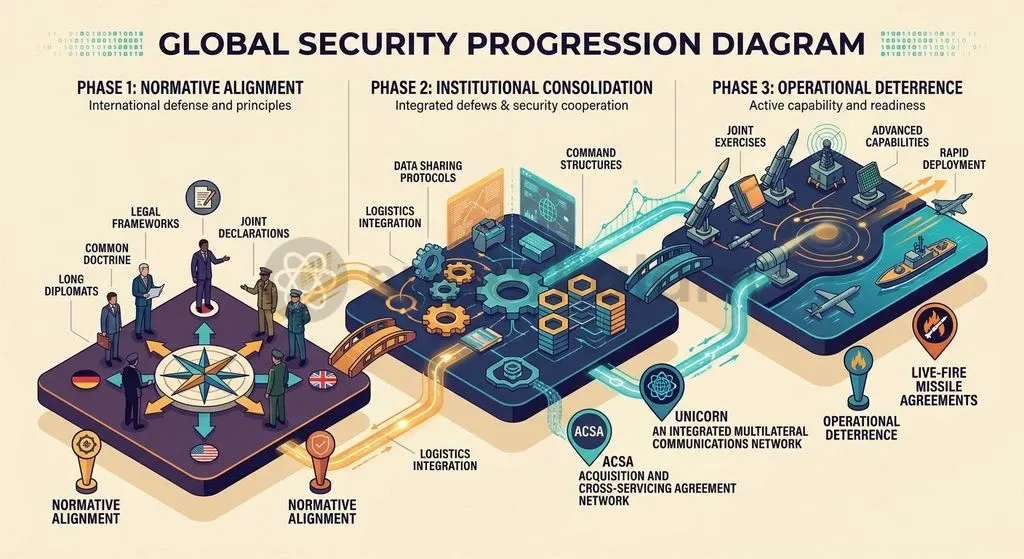
The India-Japan partnership has fundamentally transitioned from normative diplomatic declarations into operational deterrence, anchored by reciprocal military logistics, joint defence co-production, and coordinated economic statecraft across the Indo-Pacific theatre. As of November 2026, the bilateral relationship addresses acute regional coercion through tangible defence integration rather than generic diplomatic communiques. Both nations now combine reciprocal basing rights with targeted supply-chain de-risking, creating a resilient balance of power. This strategic convergence links New Delhi's continental security needs with Tokyo's maritime imperatives.
Why in the News: The 2026 India-Japan 2+2 Ministerial Dialogue
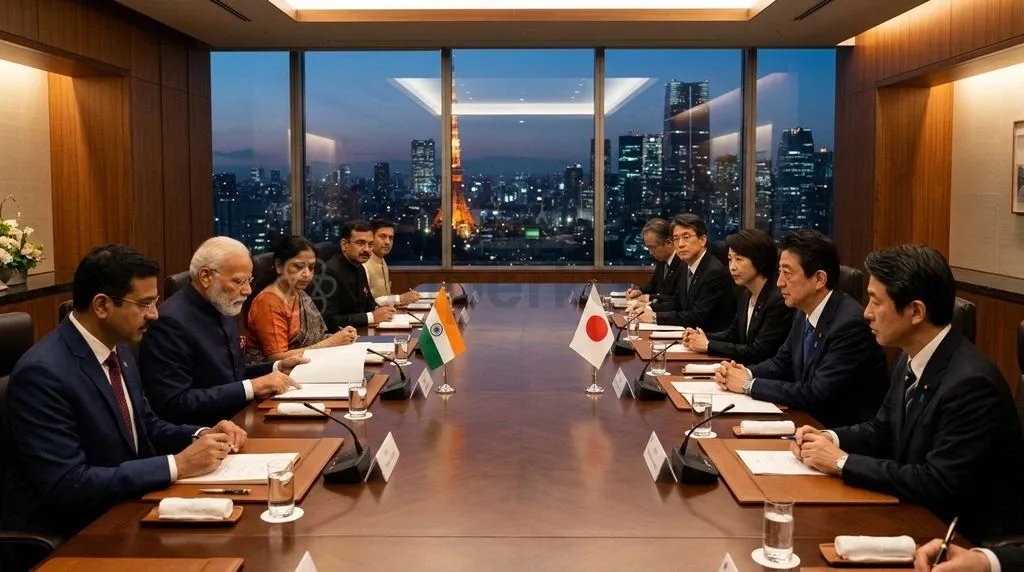
The Fourth India-Japan 2+2 Foreign and Defence Ministerial Meeting convened in Tokyo on 19 November 2026, co-chaired by Indian and Japanese ministers under their Special Strategic and Global Partnership. Defence Minister Rajnath Singh and External Affairs Minister Dr. S. Jaishankar met their counterparts Toshimitsu Motegi and Shinjiro Koizumi to advance institutional defence ties, as detailed in the PIB release on the joint statement. The ministers committed to countering unilateral attempts to alter the status quo across regional land perimeters and the maritime commons.
A historic operational breakthrough emerged when the two sides signed a Letter of Intent for live-fire training at Indian facilities. This agreement permits the Japan Self-Defense Forces to conduct live-fire drills, including tests involving surface-to-ship missiles, at Indian firing ranges for the very first time.
The Tokyo summit also established forward diplomatic milestones to celebrate bilateral historical ties. Both governments agreed to designate 2027 as the 'India-Japan Year of Shared Horizons', commemorating the 75th anniversary of their diplomatic relations. Alongside unveiling an official commemorative logo, the partners planned joint consular tabletop exercises to rehearse coordinated civilian evacuations during overseas crises.
Discuss with Superkalam
Which bilateral agreement, signed in September 2020, provides the legal basis for mutual logistics support and port servicing between the Indian military and the Japan Self-Defense Forces?
Ask NowDefence Hardware and Co-Development: Moving Beyond Drills to UNICORN and Co-Production
The Indian Navy and Japan Maritime Self-Defense Force are transitioning from combined tactical drills to joint industrial co-production. While exercises like JIMEX, Dharma Guardian, and Malabar established tactical interoperability, defence technology transfers historically remained limited. Export constraints and distinct military doctrines long stalled ambitious hardware acquisitions, including previous discussions surrounding the US-2 amphibious aircraft.
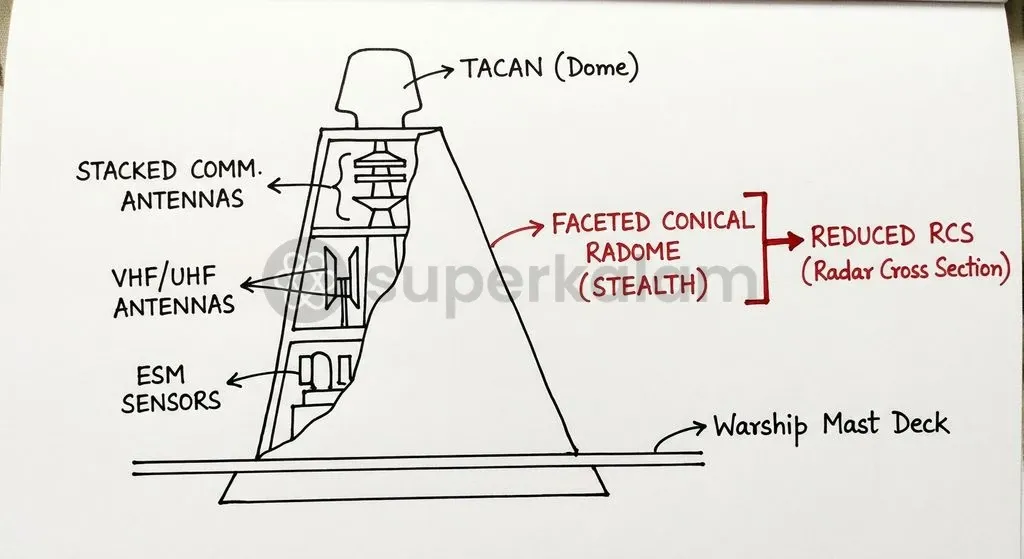
Both nations have bypassed these historic hurdles by targeting specialised subsystem co-development. India and Japan affirmed plans to conclude co-production arrangements for the UNICORN stealth warship mast under a 'Design with Japan, Make in India' framework. The Unified Complex Radio Antenna integrates diverse communication antennas inside a single stealth housing, significantly reducing the radar cross-section of front-line naval combatants. According to the Japan Ministry of Defense, both sides are reportedly targeting India's Acceptance of Necessity approval by February 2027.
| Strategic Domain | Conventional Engagement Model | Operational Deterrence Model |
|---|---|---|
| Bilateral Drills | Basic passing exercises and separated tactical manoeuvres | Integrated cross-service drills (Dharma Guardian, JIMEX, Malabar) |
| Defence Hardware | Direct off-the-shelf procurement proposals (e.g. US-2 aircraft) | Co-development frameworks (UNICORN mast system) |
| Operational Access | Diplomatic port calls with basic commercial replenishment | Institutionalised ACSA logistics and military test-range sharing |
| Maritime Domain | Sporadic information sharing via liaison officers | Integrated MDA tracking spanning the IOR and Western Pacific |
Technological collaboration deepened further with the August 2026 Memorandum of Arrangement on Maritime Security Cooperation. This pact instituted a Joint Secretary/Director-General level Working Group focused on naval shipbuilding, mine countermeasures capabilities, and vessel design. Complementing this maritime focus, the India-Japan AI Cooperation Initiative accelerates public-private co-creation across national software ecosystems to support shared defence-security priorities.
Operationalising the Indo-Pacific: Reciprocal Logistics and Maritime Domain Awareness
The Acquisition and Cross-Servicing Agreement provides the statutory backbone for bilateral military logistics across the maritime commons. Signed in September 2020, the agreement enables reciprocal provision of food, water, fuel, spare parts, and operational repair services. Both governments committed at the Tokyo 2+2 meeting to institutionalise these protocols across Indian and Japanese military hubs.
Under this framework, Indian naval vessels gain routine logistics access to Japanese naval stations, expanding New Delhi's presence in the Western Pacific. Conversely, Japanese maritime units utilise Indian facilities across the Andaman and Nicobar Islands to support patrols near crucial Indo-Pacific trade corridors. This reciprocal access multiplies naval endurance without establishing permanent overseas bases.
The joint statement directly harmonised New Delhi's Indo-Pacific Oceans' Initiative and the MAHASAGAR framework with Tokyo's Free and Open Indo-Pacific vision. By uniting these doctrines, both capitals explicitly opposed any unilateral coercion intended to alter maritime boundaries. The resulting architecture feeds operational tracking data across monitoring bodies, ensuring continuous Maritime Domain Awareness from the Persian Gulf to the Sea of Japan.
Discuss with Superkalam
How does integrating multiple communication antennas into a single housing like the UNICORN mast enhance the operational stealth of modern naval vessels?
Ask NowNortheast India Connectivity: Linking the Bay of Bengal to Delhi's Act East Policy
The Japan International Cooperation Agency finances comprehensive strategic infrastructure corridors across India's landlocked Northeast. Through long-term concessionary financing, Tokyo supports the North East Road Network Connectivity Improvement Project to upgrade regional transit arteries. These projects enhance administrative mobility and facilitate market access across previously isolated frontier districts.
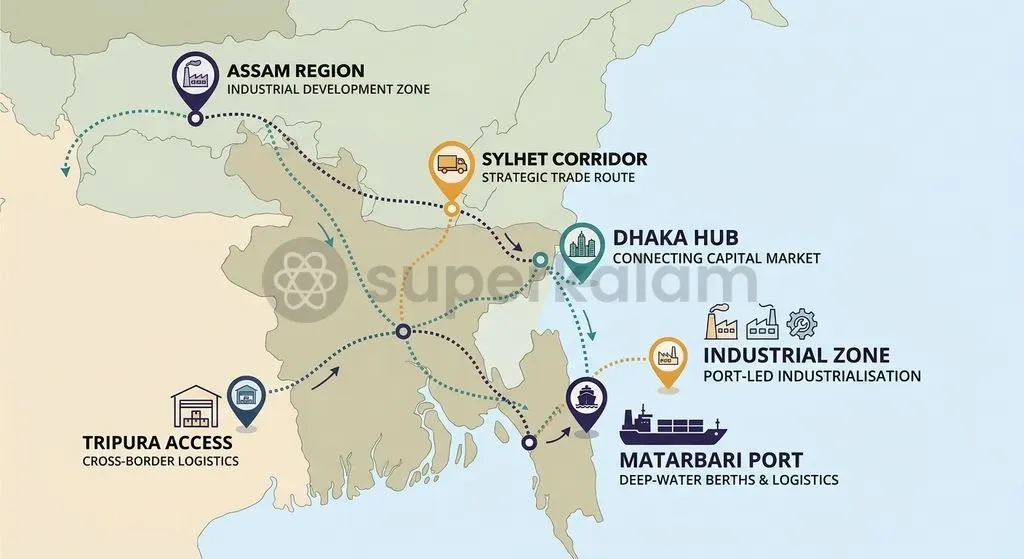
A critical component involves upgrading National Highway Phase 6 in Tripura to unlock landlocked state economies. This corridor provides direct access to Bangladesh's Matarbari deep-sea port, developed under Tokyo's Bay of Bengal Industrial Growth Belt initiative. Matarbari functions as a high-capacity logistics node, offering northeastern states access to international sea lines of communication.
This infrastructure corridor fuses India's Act East policy with Japan's Free and Open Indo-Pacific architecture. Connecting the Northeast to maritime Southeast Asia diversifies supply chains away from single-country trade dependencies. In doing so, it provides a stable economic counterweight across the Bay of Bengal littoral.
Discuss with Superkalam
If sea lines of communication face disruptions in the Western Pacific, how can the Indian Navy apply the provisions of ACSA using Japanese naval stations to maintain presence?
Ask NowEconomic Security: De-risking Supply Chains and Securing Critical Minerals via SCRI
The Supply Chain Resilience Initiative institutionalises trilateral economic security alongside Australia to insulate critical supply channels. Formalised in April 2021, the initiative designs resilient manufacturing networks to minimise systemic reliance on concentrated manufacturing hubs in China. The partners share customs data, coordinate export rules, and map dependencies across critical production inputs.
The November 2026 ministerial statement addressed these risks directly by condemning economic coercion and non-market policies. Both governments voiced serious concern over arbitrary export curbs and state-sponsored overcapacity that disrupt international technology commerce. These coordinated warnings highlight how economic levers now form an essential element of modern strategic deterrence.
Bilateral technology partnerships turn these defensive economic doctrines into domestic industrial capacity. Under the July 2023 Memorandum of Cooperation on Semiconductor Supply Chain Partnership, Japanese firms direct advanced semiconductor investments into India. These projects include Renesas Electronics' OSAT assembly facility and technical partnerships with Tokyo Electron in Gujarat, securing essential digital hardware supply chains.
Managing Strategic Friction: Divergent Sanctions Postures and the Russia Question
The bilateral relationship maintains durable operational convergence despite differing diplomatic stances on the Russian Federation. Following the 2022 invasion of Ukraine, Japan adhered strictly to G7 consensus by enacting rigorous asset freezes, price caps, and trade sanctions against Russian entities. Tokyo viewed the conflict as an unacceptable violation of sovereignty that carries dangerous systemic precedents for East Asian security.
Conversely, New Delhi preserved its foundational doctrine of strategic autonomy by sustaining diplomatic ties with Moscow. India expanded imports of discounted Russian crude oil to protect domestic energy security while maintaining legacy defence spare-parts pipelines. While this policy created occasional frictions within G7 capitals, Japanese diplomats have managed the divergence pragmatically, recognising India's indispensable position within the Indo-Pacific balance of power.
DIVERGENT STRATEGIC THREAT PERCEPTIONS
| India's strategic anchor | Japan's strategic anchor |
|---|---|
Primary kinetic focus:
| Primary kinetic focus:
|
Primary strategic goal:
| Primary strategic goal:
|
A structural asymmetry in immediate threat perceptions shapes bilateral defence priorities. India focuses on kinetic challenges along its Himalayan border, where the Indian Army remains locked in continental territorial standoffs. Conversely, Japan directs its military modernisation toward maritime flashpoints, including the Senkaku Islands and the Taiwan Strait. Bridging this continental-maritime divergence requires continuous diplomatic management to ensure neither front is neglected.
Discuss with Superkalam
Analyze the strategic and economic benefits of connecting India's landlocked northeastern states to the Japanese-built Matarbari deep-sea port in Bangladesh.
Ask NowWay Forward: How Delhi and Tokyo Can Bridge Operational and Strategic Gaps
India and Japan can bridge lingering strategic gaps by formalising institutional defence-production pipelines. While the UNICORN mast co-development sets a practical precedent, both ministries should establish dedicated fast-track mechanisms for joint naval technology co-production. Standardising export-control compliance will help bilateral defence industrial partnerships progress from initial blueprints to fleet-wide deployment.
Expanding minilateral operational drills with regional partners will enhance deterrence depth across maritime transit routes. Institutionalising trilateral drills with Indonesia and the Philippines integrates littoral coastguards and navies across the South China Sea and the Strait of Malacca. These multi-layered patrols build shared capacity without provoking the domestic political friction of a formal military pact.
On global governance, both nations should leverage their coordinated diplomatic initiatives to reform international institutions. India and Japan continue to endorse each other's bids for permanent seats on an expanded United Nations Security Council under the G4 framework. Tokyo and New Delhi also confirmed reciprocal backing for non-permanent seats covering the 2028-29 and 2033-34 terms. Aligning diplomatic strategy with economic resilience establishes a sustainable regional balance capable of preserving an open Indo-Pacific.
Discuss with Superkalam
Weigh the merits of flexible minilateral engagements, like the India-Japan-Philippines 1.5 dialogue, against traditional formal military alliances in ensuring Indo-Pacific security.
Ask NowKey Takeaways
- The Fourth India-Japan 2+2 Dialogue in November 2026 marked a transition from diplomatic rhetoric to operational deterrence, highlighted by live-fire military range access for Japanese forces in India.
- Hardware co-development advanced through the UNICORN stealth mast programme, with both nations reportedly targeting India's Acceptance of Necessity approval by February 2027 under an agile industrial framework.
- The 2020 Acquisition and Cross-Servicing Agreement provides reciprocal port access, maintenance, and logistics across Indian and Japanese bases, anchoring shared Maritime Domain Awareness.
- Japan's overseas development assistance links Northeast India to Bangladesh's Matarbari deep-sea port, connecting New Delhi's Act East policy directly to the Free and Open Indo-Pacific.
- Economic security is operationalised through the trilateral Supply Chain Resilience Initiative and bilateral semiconductor investments, insulating strategic industries from unilateral economic coercion.
- Divergences over Russian sanctions and different regional threat priorities are managed pragmatically, preserving broad strategic alignment despite differing continental and maritime pressures.
Mains Question
"The India-Japan partnership has fundamentally transitioned from normative diplomatic declarations into operational deterrence." In light of the recent 2+2 Ministerial Dialogue, elucidate how reciprocal logistics and defence co-development reflect this strategic shift. (10 Marks)
Evaluate NowMains Question
Connecting Northeast India to the maritime commons through the Matarbari deep-sea port reflects the convergence of Delhi's Act East Policy and Tokyo's Free and Open Indo-Pacific vision. Examine how regional infrastructure and economic statecraft initiatives like the Supply Chain Resilience Initiative (SCRI) reinforce strategic stability. (15 Marks)
Evaluate NowPractice MCQs
QUESTION 1
With reference to defence technology collaboration between India and Japan, consider the following statements:
- The UNICORN mast system integrates diverse communication antennas into a single stealth housing to reduce radar cross-section.
- The co-production of the UNICORN system is being advanced under a 'Design with Japan, Make in India' framework.
- The 2026 ministerial dialogue finalised the immediate off-the-shelf procurement of the US-2 amphibious aircraft for the Indian Navy.
Which of the statements given above is/are correct?
QUESTION 2
Consider the following statements regarding the Acquisition and Cross-Servicing Agreement (ACSA) between India and Japan:
- It was signed in September 2020 to provide reciprocal supplies, fuel, and operational repair services.
- Under its framework, Japanese maritime units are permitted logistics access to Indian facilities in the Andaman and Nicobar Islands.
- It mandates the establishment of permanent joint military bases in the Western Pacific.
Which of the statements given above is/are correct?
QUESTION 3
Regarding connectivity and economic security partnerships involving India and Japan, consider the following statements:
- JICA finances the North East Road Network Connectivity Improvement Project to connect Indian states to Bangladesh's Matarbari deep-sea port.
- Matarbari deep-sea port is being developed under Japan's Bay of Bengal Industrial Growth Belt initiative.
- The Supply Chain Resilience Initiative (SCRI) was formally launched in April 2021 by India, Japan, and the Philippines.
Which of the statements given above is/are correct?
QUESTION 4
Consider the following statements regarding outcomes of the Fourth India-Japan 2+2 Foreign and Defence Ministerial Meeting held in November 2026:
- Both nations concluded a Letter of Intent permitting the Japan Self-Defense Forces to conduct live-fire training, including surface-to-ship missile drills, at Indian ranges.
- The year 2027 was designated as the 'India-Japan Year of Shared Horizons' to commemorate the 75th anniversary of bilateral diplomatic relations.
Which of the statements given above is/are correct?
QUESTION 5
The foundational speech titled 'Confluence of the Two Seas', which established the intellectual basis for the contemporary Indo-Pacific strategic architecture, was delivered in 2007 by: