EPFO Systematic Withdrawal Plan: Phased Decumulation and Pension Security
As India confronts longevity risk, the EPFO shifts from lump-sum exits to phased drawdowns, balancing worker liquidity against sustainable old-age security.
Nov, 2026
•10 min read

Context
The Employees' Provident Fund Organisation has approved a Systematic Withdrawal Plan. Formal retirees can now draw accumulated provident fund savings in periodic instalments rather than as a single terminal lump sum. This reform marks a decisive shift toward phased retirement decumulation across the formal workforce.
According to a PIB release on the 240th Central Board of Trustees meeting, the framework lets subscribers receive monthly, quarterly, or half-yearly payouts. Unwithdrawn balances remain invested at statutory returns. The measure helps curb longevity risk and prevents premature corpus depletion as India's elderly demographic expands.
Why in the News: EPFO's Pivot Toward Systematic Withdrawals
According to a PIB release, the Central Board of Trustees of the Employees' Provident Fund approved the Systematic Withdrawal Plan during its 240th meeting chaired by Union Minister Mansukh Mandaviya. Under this framework, retiring subscribers under the Employees' Provident Funds Scheme, 1952, shift from mandatory lump-sum settlements to scheduled periodic drawdowns. As of November 2026, the reform seeks to modernise post-retirement income protection for India's organised workforce.
This policy directly tackles premature corpus exhaustion by replacing single disbursements with regular, predictable cash flows. According to a Ministry of Labour and Employment briefing, the initial rollout applies strict eligibility thresholds:
- Eligible Cohort: The initial phase is estimated to directly cover approximately 6.32 lakh EPF members aged above 55 years.
- Corpus Floor: Retiring members must hold provident fund balances exceeding ₹5 lakh.
The regulatory shift also recalibrates interim liquidity access. As detailed in the Central Board of Trustees proceedings, the mandatory minimum balance requirement for active subscribers has dropped from 25% to 10%. This revision lifts the ceiling for permissible partial withdrawals to 90% for approved contingencies.
Exit timelines have split along distinct tracks. The post-unemployment waiting period for a final provident fund settlement was reduced from 12 months back to 2 months. Conversely, the settlement waiting window for final pension withdrawal remains 36 months.
What Are the Proposed Systematic Withdrawal and Claim Rules?
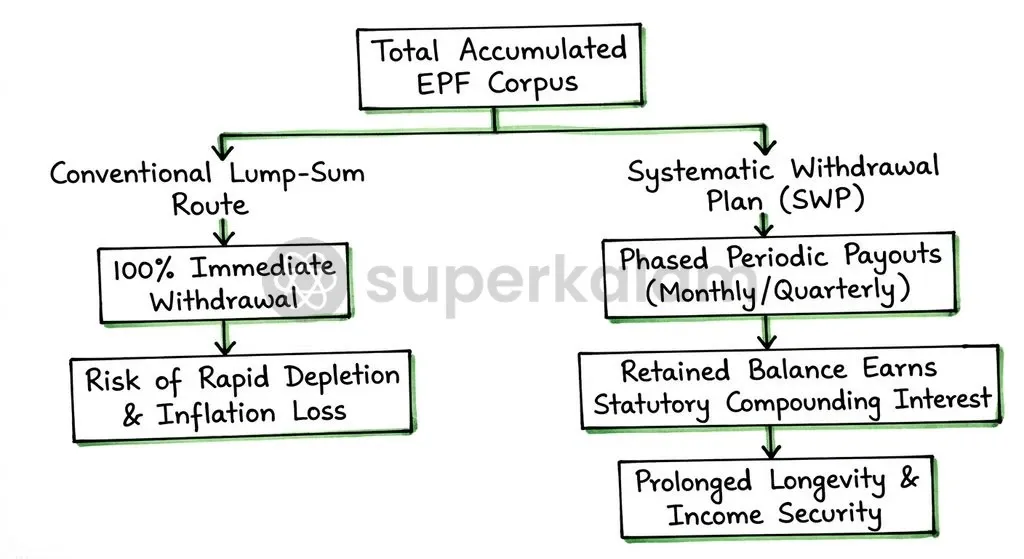
The Systematic Withdrawal Plan framework permits retiring subscribers to receive payments on a monthly, quarterly, or half-yearly schedule. Payout windows extend up to 20 years or as notified by the Central Government. Under proceedings reported by the Ministry of Labour and Employment, unwithdrawn balances retained within the provident fund continue to accrue statutory interest rather than turning dormant. Nominees receive the flexibility to either continue scheduled withdrawals or execute an immediate full settlement upon a subscriber's demise.
Administrative rules governing dormant accounts previously constrained post-retirement corpus retention. Under Paragraph 72(6) of the Employees' Provident Funds Scheme, 1952, a provident fund account stops generating compound interest and turns inoperative if no application for withdrawal is submitted within 36 months following retirement after attaining 55 years of age. The proposed facility overrides this stagnation trap by actively managing balances through a structured decumulation mechanism.
According to a Ministry of Labour and Employment administrative timeline, the operational rollout is anticipated within approximately two months post-approval, following legal vetting by the Department of Legal Affairs. The Ministry of Labour and Employment is also engaging the Ministry of Finance to formalise amendments to the Income Tax Act, 1961, establishing the taxability of periodic instalments and post-retirement accruals.
| Regulatory Dimension | Conventional EPF Exit Framework | Proposed Systematic Withdrawal Plan |
|---|---|---|
| Payout Structure | Single lump-sum final settlement | Monthly, quarterly, or half-yearly instalments |
| Duration of Payout | Immediate single disbursement | Up to 20 years or as government-notified |
| Account Operability | Becomes inoperative after 36 months under Para 72(6) | Continues earning statutory compound interest |
| Partial Withdrawal Limit | Capped at 75% under prior guidelines | Permissible up to 90% (minimum balance lowered to 10%) |
| Unemployment Exit Window | Required a 12-month waiting period | Reduced back to 2 months (pension exit remains 36 months) |
| Death Benefit Protocol | Single lump-sum transfer to designated nominee | Nominee may continue periodic SWP or take lump sum |
Discuss with Superkalam
What are the eligibility criteria regarding age and corpus size for the EPFO's initial Systematic Withdrawal Plan rollout?
Ask Now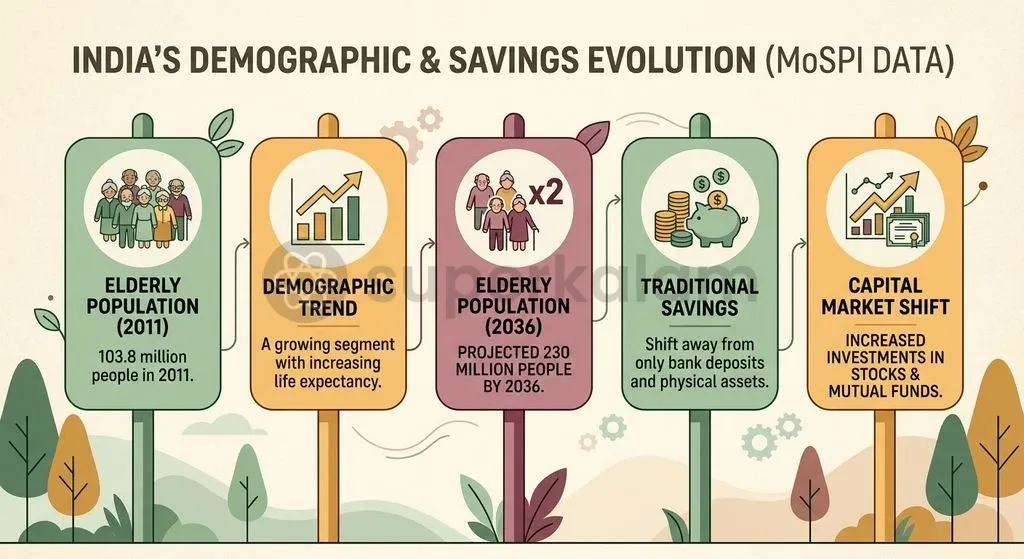
Discuss with Superkalam
How does the Systematic Withdrawal Plan prevent accounts from becoming inoperative under Paragraph 72(6) of the EPF Scheme, 1952?
Ask NowDiscuss with Superkalam
Suppose a 56-year-old worker with a ₹12 lakh corpus chooses an SWP over a lump-sum payout. How might this choice protect against longevity risk over a 15-year horizon?
Ask NowThe Shadow of EPS-95: Unresolved Pension Floor and Actuarial Disputes
The Employees' Pension Scheme, 1995 remains an unresolved flashpoint in formal social safety discussions. According to parliamentary clarifications by the Ministry of Labour and Employment, the statutory minimum pension under EPS-95 stands at ₹1,000 per month. This baseline has been maintained through annual central budgetary subsidies introduced in September 2014.
Trade unions and worker collectives continue to demand a minimum floor of ₹7,500 per month with inflation indexation. However, parliamentary statements confirm that the Central Government has declined across-the-board enhancements to ₹7,500. Statutory annual valuations under Paragraph 32 of EPS-95 reveal an extensive structural actuarial deficit within the pension pool.
The widening ratio between active workers and beneficiaries strains the scheme's viability:
- Pensioner Load: Official parliamentary records show the fund supports over 78 lakh pensioners.
- Contributor Base: The system relies on an active contributor pool of approximately 7 crore formal workers.
EPS-95 operates as a defined-benefit system financed by an 8.33% diversion from employer provident fund contributions. Raising monthly payouts without augmenting contribution rates would risk severe insolvency.
Discuss with Superkalam
Compare the trade-offs between relaxing pre-retirement liquidity limits (up to 90%) and preserving an adequate corpus for post-retirement systematic decumulation.
Ask NowBalancing Immediate Worker Liquidity with Macroeconomic Old-Age Security
The Central Board of Trustees balances individual liquidity against long-term capital preservation. Lowering the mandatory balance from 25% to 10% assists workers facing medical emergencies, higher education costs, or housing construction. Yet elevated mid-career withdrawals diminish the terminal corpus required for the Systematic Withdrawal Plan, undermining retirement adequacy.
Retaining funds through phased drawdowns generates distinct macroeconomic benefits. According to a policy memorandum from the Central Board of Trustees, systematic drawdown arrangements curb large episodic lump-sum redemptions, lengthening the duration of domestic institutional capital managed by the organisation.
EPFO manages an investment portfolio exceeding ₹24 lakh crore under its notified investment pattern, as detailed in an official PIB release. The current pattern allocates capital across distinct asset classes:
- Debt and Sovereign Securities: Captures over 90% of total portfolio holdings.
- Equity Exchange-Traded Funds: Absorbs 5% to 15% of fresh incremental flows.
Retaining balances within this framework underwrites domestic public debt without triggering inflation, while insulating private savings from stock market volatility. Portfolio diversification has now reached alternative assets. According to official meeting records, the 240th Central Board of Trustees meeting granted in-principle approval allowing EPFO to allocate up to 3% of its annual fresh accretions into eligible Category I and Category II Alternative Investment Funds, pursuing higher returns within strict risk guidelines.

Discuss with Superkalam
Given the actuarial imbalance in EPS-95 between 78 lakh pensioners and 7 crore active contributors, weigh the merits of raising contribution rates versus maintaining the ₹1,000 monthly floor.
Ask NowThe Way Forward: Building an Inclusive and Actuarially Sound Pension Regime
India's evolving retirement architecture requires institutional coordination to ensure that administrative innovations translate into genuine social protection. Transitioning the Systematic Withdrawal Plan from a board proposal into an operational pillar requires targeted regulatory, fiscal, and structural interventions.
- Clear Statutory and Tax Harmonisation: The Ministry of Finance must deliver clear statutory exemptions under Section 10 and Section 192A of the Income Tax Act, 1961. Clarifying that post-55 systematic withdrawals retain full tax immunity will prevent behavioural disincentives that steer retirees toward immediate full liquidation.
- Actuarial Recalibration of EPS-95: Sustaining the defined-benefit pension scheme necessitates raising the statutory wage ceiling alongside indexed shared contributions from the central exchequer. Addressing the actuarial shortfall identified under Paragraph 32 valuations is essential to deliver a dignity-preserving pension floor above the current ₹1,000 threshold.
- Full Enforcement of Code on Social Security: State governments and union ministries must expedite the final notification of rules under the Code on Social Security, 2020. Enforcing Section 114 aggregator levies will generate stable funding for the Section 141 Social Security Fund, bringing informal platform workers under institutional coverage.
- Demographic-Linked Investment Diversification: EPFO should leverage its long-duration liability profile to channel domestic savings into core infrastructure and sovereign green assets. Expanding the 3% allocation window for Alternative Investment Funds will enhance long-term real yields, counteracting inflation erosion for subscribers undergoing multi-decade systematic drawdowns.
Key Takeaways
- Core Structural Pivot: The Central Board of Trustees approved a Systematic Withdrawal Plan allowing retiring members to take monthly, quarterly, or half-yearly payouts over periods up to 20 years instead of mandatory single lump sums.
- Liquidity and Claim Reforms: The mandatory retention balance for partial EPF withdrawals was reduced from 25% to 10%, unlocking up to 90% liquidity for non-retirement contingencies, while the post-unemployment exit waiting period was lowered from 12 months to 2 months.
- Statutory EPS-95 Deadlock: The monthly minimum pension under EPS-95 remains ₹1,000 per month, with demands for a ₹7,500 floor declined by the government due to documented structural actuarial deficits evaluated under Paragraph 32.
- Inclusion via Unified Codes: The Code on Social Security, 2020 mandates a dedicated Social Security Fund under Section 141, backed by turnover levies of 1% to 2% on digital aggregators under Section 114 to protect gig and unorganised workers.
- Macroeconomic Scale: EPFO manages an investment portfolio exceeding ₹24 lakh crore, deploying over 90% in debt instruments and 5% to 15% of incremental flows in equities, supplemented by a newly approved 3% allocation ceiling for Alternative Investment Funds.
Mains Question
"Terminal lump-sum disbursements create a recurring behavioural hazard across emerging economies, accelerating premature corpus depletion." In light of this statement, elucidate how the EPFO's Systematic Withdrawal Plan mitigates longevity risk while balancing worker liquidity and macroeconomic capital stability. (15 Marks)
Evaluate NowMains Question
The Employees' Pension Scheme, 1995 (EPS-95) exhibits a structural actuarial deficit that complicates trade union demands for enhanced monthly floors. Critically analyse the institutional and actuarial challenges underpinning the EPS-95 pension floor. (10 Marks)
Evaluate NowPractice MCQs
QUESTION 1
With reference to the Systematic Withdrawal Plan (SWP) approved by the Employees' Provident Fund Organisation (EPFO), consider the following statements:
- The initial phase is designed to cover EPF members aged above 55 years who possess a provident fund balance exceeding ₹5 lakh.
- Under the proposed framework, unwithdrawn balances retained in the provident fund cease to earn compound interest once periodic drawdowns begin.
- The mandatory minimum balance requirement for active subscribers has been lowered from 25% to 10%, thereby permitting partial withdrawals up to 90%. Which of the statements given above are correct?
QUESTION 2
Regarding the provisions of the Code on Social Security, 2020 for unorganised and gig workers, consider the following statements:
- Section 141 mandates the establishment of a dedicated Social Security Fund to finance welfare schemes for gig, platform, and unorganised workers.
- Aggregators are required to contribute between 1% and 2% of their annual turnover, subject to a cap of 5% of aggregate payables to platform workers.
- The Central Board of Trustees approved Universal Account Number mechanisms allowing only employer-integrated contributions, prohibiting voluntary or third-party tips. Which of the statements given above is/are correct?
QUESTION 3
Consider the following statements regarding the regulatory rules governing the Employees' Provident Funds Scheme, 1952 and the Employees' Pension Scheme, 1995 (EPS-95):
- Under Paragraph 72(6) of the 1952 Scheme, an account turns inoperative and ceases to earn compound interest if no withdrawal application is made within 36 months of retirement after attaining 55 years of age.
- Following recent regulatory revisions, the post-unemployment waiting window for final provident fund settlement has been reduced from 12 months to 2 months.
- EPS-95 is structured as a defined-contribution system funded entirely through annual central budgetary grants rather than employer contributions. Which of the statements given above are correct?
QUESTION 4
With reference to taxation and portfolio allocations of the Employees' Provident Fund Organisation (EPFO), consider the following statements:
- Under Section 192A of the Income Tax Act, 1961, provident fund withdrawals completed after five continuous years of service remain entirely tax-exempt.
- In accordance with its notified investment pattern, EPFO allocates over 90% of its portfolio holdings to debt and sovereign securities.
- EPFO's fresh incremental flows are completely barred from investment in Equity Exchange-Traded Funds (ETFs). Which of the statements given above is/are correct?
QUESTION 5
Under the taxation rules outlined in the Fourth Schedule and Section 192A of the Income Tax Act, 1961, premature provident fund withdrawals prior to completing five continuous years of service are subject to Tax Deducted at Source (TDS) if the accumulated sum exceeds which threshold?