India's OPEC Crude Imports: Strategic Shift or Arbitrage?
As discounted Russian barrels push OPEC supply to a historic low, India faces a delicate choice between spot price arbitrage and durable Middle East diplomacy.
Nov, 2026
•12 min read
Context
India's crude oil purchases from the Organization of the Petroleum Exporting Countries fell to a historic low of 27.4% between April and October 2026. This drop marked an unprecedented shift toward discounted Eurasian barrels led by Russia.
The commercial reallocation delivered three immediate outcomes:
- Insulated retail fuel prices against global volatility.
- Expanded private refinery margins on international runs.
- Diversified import geography away from West Asian dominance.
Yet this pivot represents discount-driven arbitrage rather than a permanent structural realignment. As price differentials compress and maritime bottlenecks mount, long-term energy security remains anchored to Gulf partnerships, strategic reserves, and bilateral term contracts.
Why in the News: OPEC's Grip on India Drops to a Historic Low
OPEC member states supplied just 27.4% of India's crude oil imports between April and October 2026, plunging from 38.5% in the same period of 2025. Data from the Petroleum Planning & Analysis Cell (PPAC) Provisional Trade Report confirms that traditional West Asian exporters have yielded unprecedented market share to non-OPEC suppliers. Prior to 2022, OPEC members routinely delivered between 70% and 80% of India's crude import volume, according to historical trade records from the Ministry of Petroleum and Natural Gas.
| Period | OPEC Share in India's Crude Basket |
|---|---|
| Pre-2022 Baseline | 70% – 80% |
| FY 2024–25 | 48.5% |
| Apr–Oct 2025 | 38.5% |
| Apr–Oct 2026 | 27.4% (Historic Low) |
The compression of OPEC volumes occurred alongside an expansion in aggregate Indian energy demand. Total crude oil imports rose 2.7% year-on-year to 146.6 million metric tonnes during the April–October 2026 window, as documented by the PPAC Monthly Report on Indigenous Crude Oil Production, Import & Processing. India's import dependency on crude oil on a consumption basis reached 88.7% in fiscal year 2025–26, rising steadily from 85.5% in fiscal year 2021–22.
Price volatility also widened India's foreign exchange outlays during the same cycle. The net crude oil import bill during the first seven months of fiscal year 2026–27 expanded by 53.5% year-on-year to roughly $111 billion, according to the PPAC Flash Report on Petroleum Import/Export Values. Commercial refiners responded by maximising non-OPEC intake to protect refining margins against global price surges.
Discuss with Superkalam
What was OPEC's historical share in India's crude import basket prior to 2022 compared to its share in April–October 2026?
Ask NowThe Anatomy of the Shift: How Russia Overtook Traditional West Asian Suppliers
Eurasian suppliers captured 43.8% of India's crude imports during April–October 2026, relegating the Middle East to second position at 36%. The PPAC Regional Crude Import Basket Matrix details that South America accounted for 10.6%, Africa supplied 6.6%, and North America made up the remaining 3%. This regional distribution represents a complete reversal of historical sourcing norms that concentrated over three-quarters of India's intake within the Persian Gulf.
| Sourcing Region | Share in India's Import Basket (Apr–Oct 2026) |
|---|---|
| Eurasia (incl. Russia) | 43.8% |
| Middle East | 36.0% |
| South America | 10.6% |
| Africa | 6.6% |
| North America | 3.0% |
The transformation gathered momentum in fiscal year 2024–25 when Russia emerged as India's single largest crude supplier. Directorate General of Commercial Intelligence and Statistics records compiled alongside tanker tracking data show Russia secured a 36% market share, delivering 1.76 million barrels per day while compressing OPEC's aggregate share to 48.5%. Western sanctions redirected discounted Russian Urals crude eastward, allowing Indian refiners to substitute Middle Eastern medium-sour grades with cheaper alternatives.
Domestic refining architecture provided the physical flexibility required to absorb these unfamiliar Eurasian grades. India operates an aggregate domestic crude refining capacity of approximately 256.8 million metric tonnes per annum across 23 refineries, maintaining an average capacity utilisation above 100% according to the PPAC Snapshot of India's Oil & Gas Data. Complex coastal refineries processed heavier, discounted grades without compromising downstream yields:
- Secondary Conversion Depth: Advanced fluid catalytic cracking and coking units allow Indian refiners to process discount-heavy, sour crude while stripping out high sulphur content.
- Nelson Complexity Advantage: Reliance Industries' Jamnagar refinery complex, processing 1.4 million barrels per day, operates with a Nelson Complexity Index of 21.1. This technical sophistication enables the processing of heavily discounted, high-acid crude feedstocks at superior gross refining margins.
- Product Export Arbitrage: Refined petroleum exports are a structural hedge against India's import outlays. During April–October 2026, diesel comprised 43.4%, petrol represented 22.4%, and aviation turbine fuel accounted for 10% of total export volumes.

The Central Question: Durable Realignment or Fragile Price Arbitrage?
Commercial discounts on Russian Urals crude are the primary operational driver of India's reduced OPEC dependence. Delivered discounts on Russian Urals against benchmark Dated Brent fluctuated between $5 and $10 per barrel across 2025 and 2026, as reported by Kpler and S&P Global Commodity Insights in August 2026. These figures represent a noticeable contraction from the peak discounts of $15 to $30 per barrel observed during 2022 and 2023.
The central analytical issue is whether India's non-OPEC pivot reflects a structural realignment of national trade policy or opportunistic commercial arbitrage. The underlying data indicates that the shift remains fragile and price-sensitive. When discounts narrow, the logistical costs of hauling crude over extended maritime distances rapidly erode the initial price advantage.
| Dimension | OPEC / Middle Eastern Supply | Non-OPEC / Russian Supply |
|---|---|---|
| Contract Structure | Fixed annual term contracts | Spot purchases and short-term tenders |
| Transit Duration | 4 to 5 days from Persian Gulf | 30 to 40 days from Baltic ports |
| Pricing Benchmark | Official Selling Prices (OSP) pegged to Dubai/Oman | Floating spot differentials against Brent |
| Payment Mechanism | Established US Dollar channels | Multi-currency arrangements via third parties |
| Supply Reliability | High institutional durability and sovereign backing | High exposure to geopolitical sanctions |
Public sector undertakings, including Indian Oil Corporation Limited, Bharat Petroleum Corporation Limited, and Hindustan Petroleum Corporation Limited, deliberately avoid severing long-term Middle Eastern relationships. The Standing Committee on Petroleum and Natural Gas noted in its 23rd Report that state refiners maintain baseline annual term contracts with Middle Eastern national oil companies such as Saudi Aramco, Iraq's SOMO, and ADNOC. These baseline commitments prevent spot-market vulnerabilities during global supply crunches.
Discuss with Superkalam
Explain how a high Nelson Complexity Index allows coastal refineries to maintain gross refining margins when shifting feedstocks.
Ask NowDiplomatic Costs: Why Alienating Traditional Middle Eastern Partners Is a Risk
India's reduced procurement from traditional Gulf partners carries strategic and diplomatic implications that extend beyond refining economics. The Persian Gulf represents an indispensable geopolitical pillar for India's external stability, diaspora welfare, and direct inward investment. Sustained reductions in crude purchases risk straining bilateral goodwill with traditional suppliers who provided uninterrupted supplies during past geopolitical crises.
Economic interdependence between India and the Gulf Cooperation Council (GCC) spans energy, labour mobility, and capital flows:
- Diaspora and Remittance Security: Over 8.5 million Indian citizens reside and work across GCC member states, generating over $30 billion in annual remittances according to the Ministry of External Affairs and World Bank migration reviews.
- Sovereign Capital Commitments: Major Gulf sovereign wealth funds, including the Abu Dhabi Investment Authority, Mubadala, and Saudi Arabia's Public Investment Fund, have deployed tens of billions of dollars across India's National Investment and Infrastructure Fund, digital telecom platforms, and green energy infrastructure, as tracked by the Department for Promotion of Industry and Internal Trade.
- Geostrategic Positioning: The Middle East anchors India's connectivity corridors, maritime security architecture in the western Indian Ocean, and counter-terrorism coordination.
Saudi Arabia and Iraq adjusted official selling prices to defend market share as Indian volumes drifted toward non-OPEC suppliers. However, treating Gulf relationships as transactional swing capacity overlooks the value of supply reliability. Middle Eastern producers offer immediate geographic proximity, established credit mechanisms, and predictable sovereign backing that spot-market suppliers cannot replicate during extended regional disruptions.
Sanctions, Currencies, and Tankers: Bottlenecks in India's Non-OPEC Pivot
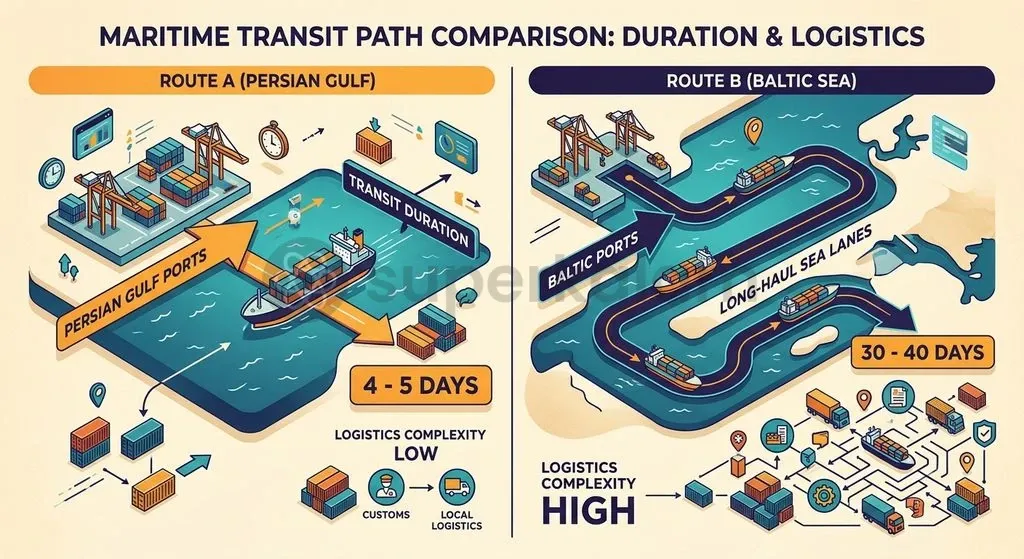
Transporting crude from Russian Baltic ports to the western coast of India requires a maritime voyage of 30 to 40 days. In contrast, crude lifted from the Persian Gulf arrives at Indian discharge terminals within 4 to 5 days, according to shipping logistics benchmarks from the Directorate General of Shipping and Kpler. This extended transit time locks up substantial working capital and ties up global tanker availability.
| Route | Maritime Transit Duration |
|---|---|
| Persian Gulf to West Coast India | 4 – 5 Days |
| Russian Baltic Ports to India | 30 – 40 Days |
Long-haul maritime logistics also introduce exposure to Western regulatory frameworks. Guidance from the US Department of the Treasury's Office of Foreign Assets Control enforces a strict price cap on Russian seaborne crude. The framework prohibits maritime service providers, shipbrokers, and protection and indemnity (P&I) maritime clubs subject to G7 jurisdiction from insuring or handling cargoes priced above the designated cap. Indian buyers must therefore rely on a complex ecosystem of non-Western shadow tankers and alternative insurers, raising maritime freight overheads.
Settling trade transactions outside the Western financial perimeter creates persistent operational friction:
- Vostro Account Inactivity: The Reserve Bank of India introduced a framework permitting international trade settlement in Indian Rupees via Special Rupee Vostro Accounts (SRVAs) under A.P. (DIR Series) Circular No. 10 in July 2022. The central bank rationalised and streamlined the cross-border INR settlement regime through A.P. (DIR Series) Circular No. 19 in July 2026.
- Repatriation Concerns: Major non-OPEC crude exporters showed reluctance to accept Indian Rupees for large-volume transactions. The Standing Committee on Petroleum and Natural Gas highlighted that foreign suppliers cited high currency conversion costs and limited avenues for repatriating accumulated Rupee surpluses as primary barriers.
- Third-Party Currency Risks: Refiners frequently diverted trade settlements into alternative currencies to circumvent banking bottlenecks. Commercial trade flow assessments from Reuters indicated that refiners settled several non-OPEC cargoes using UAE Dirhams and Chinese Yuan, exposing Indian trading firms to exchange-rate conversion losses and foreign jurisdiction oversight.
Discuss with Superkalam
Analyze the operational trade-offs between 4-to-5-day Persian Gulf transit under term contracts versus 30-to-40-day Baltic transit under spot purchases.
Ask NowInsulating the Energy Basket: Strategic Petroleum Reserves and Upstream Security
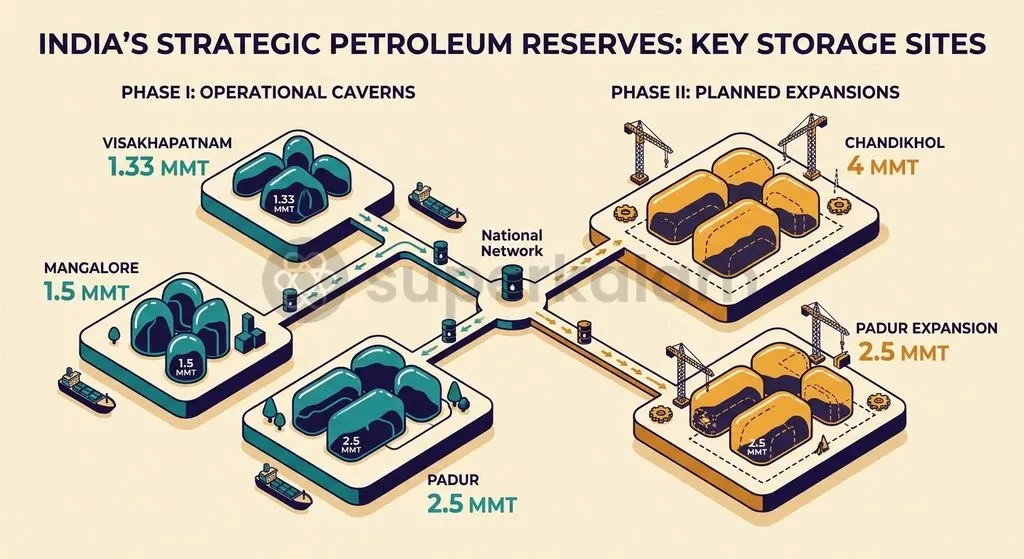
India safeguards domestic energy security against geopolitical shocks through underground storage infrastructure managed by Indian Strategic Petroleum Reserves Limited (ISPRL). Operational facilities built under Strategic Petroleum Reserve (SPR) Phase I provide a critical physical cushion against maritime blockades or sudden supply terminations.
| SPR Phase | Status / Storage Model | Cavern Location | Capacity |
|---|---|---|---|
| Phase I | Operational (~9.5 Days Crude Cover) | Visakhapatnam, Andhra Pradesh | 1.33 MMT |
| Phase I | Operational (~9.5 Days Crude Cover) | Mangalore, Karnataka | 1.5 MMT |
| Phase I | Operational (~9.5 Days Crude Cover) | Padur, Karnataka | 2.5 MMT |
| Phase II | Approved (Commercial-cum-Strategic PPP) | Chandikhol, Odisha | 4.00 MMT |
| Phase II | Approved (Commercial-cum-Strategic PPP) | Padur, Karnataka (Expansion) | 2.50 MMT |
| Total | National Strategic Storage | All Caverns | 11.83 MMT |
Phase I caverns hold an aggregate storage capacity of 5.33 million metric tonnes (approximately 39.14 million barrels) across three underground rock cavern locations:
- Visakhapatnam, Andhra Pradesh: 1.33 million metric tonnes
- Mangalore, Karnataka: 1.5 million metric tonnes
- Padur, Karnataka: 2.5 million metric tonnes
These Phase I reserves provide roughly 9.5 days of net crude import protection. To expand domestic buffers, the Union Government approved SPR Phase II, establishing an additional 6.5 million metric tonnes of underground storage under a public-private partnership model. The Phase II blueprint allocates 4.0 million metric tonnes to Chandikhol in Odisha and 2.5 million metric tonnes to a secondary facility at Padur in Karnataka, expanding total national SPR capacity to 11.83 million metric tonnes.
Operational storage held by oil marketing companies complements these subterranean rock caverns. Data from the Petroleum and Natural Gas Regulatory Board and ICRA Energy Sector Reviews indicates that combined inventories across SPR caverns, refinery storage, pipeline fills, and marketing terminals provide India with 74 to 87 days of cover for crude and petroleum products.
Discuss with Superkalam
Weigh the immediate commercial benefits of discounted crude arbitrage against the diplomatic risks to diaspora welfare and sovereign fund investments in the Gulf.
Ask NowThe Way Forward: Balancing Spot-Market Bargains with Long-Term Contracts
India's long-term energy strategy requires balancing commercial spot-market bargains against reliable, contractually protected supplies. Over-reliance on opportunistic arbitrage exposes the economy to secondary sanctions, rising shipping costs, and counterparty risks. Conversely, total dependence on traditional cartels leaves domestic fuel markets exposed to coordinated production cuts by OPEC+.
To build a resilient import basket, policymakers must execute a multi-pronged strategy:
- Retain Baseline Term Contracts with Gulf Suppliers: Public sector refiners should preserve core volumes with Saudi Aramco, ADNOC, and Iraq's SOMO under multi-year term agreements. These sovereign-backed contracts guarantee priority supply allocation during global shortfalls.
- Accelerate SPR Phase II Execution: Timely commercialisation and cavern construction at Chandikhol and Padur under the public-private partnership model will expand national strategic storage closer to the 90-day International Energy Agency benchmark.
- Institutionalise Non-Dollar Energy Clearing: Expanding the Special Rupee Vostro Account network under the RBI's updated circular requires creating attractive Rupee-denominated domestic investment instruments for foreign oil sellers. Offering access to sovereign green bonds or infrastructure securities can resolve balance-accumulation bottlenecks.
- Acquire Upstream Equity Assets Abroad: Upstream investments by ONGC Videsh Limited in non-OPEC geographies, including South America and Central Asia, help diversify equity crude flows and reduce exposure to regional choke points.
- Modernise Public Sector Refining Complexity: Upgrading public sector conversion units to match the Nelson Complexity ratings of private refineries will allow state refiners to alternate smoothly between light-sweet and heavy-sour grades as spot discounts fluctuate.
Discuss with Superkalam
Propose a policy framework for Indian public sector refiners to optimize the ratio between long-term bilateral term contracts and opportunistic spot purchases.
Ask NowKey Takeaways
- OPEC's contribution to India's crude import mix declined to a historic low of 27.4% during April–October 2026, down from 38.5% in the same period of 2025 and historical baseline levels of 70% to 80%.
- Eurasia emerged as India's primary crude sourcing region with a 43.8% share, while the Middle East dropped to 36%, reflecting a commercial reallocation toward discounted Russian Urals crude.
- India's crude import dependence on a consumption basis widened to 88.7% in fiscal year 2025–26, reinforcing domestic vulnerability to global oil price shocks and currency fluctuations.
- Maritime shipping distances of 30 to 40 days from Baltic ports, Western P&I insurance curbs under the G7 price cap, and currency settlement gridlocks with Vostro accounts impose significant operational frictions on non-OPEC purchases.
- National energy buffers rely on 5.33 MMT of operational Phase I SPR storage providing ~9.5 days of crude cover, with Phase II adding 6.5 MMT across Chandikhol and Padur to raise total strategic capacity to 11.83 MMT.
Mains Question
"The dramatic contraction of OPEC's share in India's crude basket to 27.4% represents opportunistic commercial arbitrage rather than a durable structural realignment." Critically examine this statement in light of import logistics, narrowing price differentials, and sovereign supply security. (15 Marks)
Evaluate NowMains Question
In light of India's multidimensional interdependence with the Gulf Cooperation Council (GCC) spanning remittances, capital investments, and energy logistics, evaluate the strategic risks of treating traditional Middle Eastern energy partnerships as transactional swing capacity. (10 Marks)
Evaluate NowPractice MCQs
QUESTION 1
With reference to India's crude oil import profile and sourcing trends documented between April and October 2026, consider the following statements:
- OPEC's share in India's crude oil import basket dropped to an unprecedented low of below 30%.
- Sourcing from Eurasia surpassed the Middle East to claim the largest regional share in India's crude basket.
- India's crude oil import dependency on a consumption basis declined relative to fiscal year 2021–22. Which of the statements given above are correct?
QUESTION 2
Consider the following statements regarding the operational differences between Middle Eastern and Russian crude supplies to India:
- Seaborne transit from Russian Baltic ports takes approximately 30 to 40 days, compared to 4 to 5 days from the Persian Gulf.
- While Middle Eastern crude relies primarily on fixed annual term contracts pegged to Official Selling Prices, Russian procurement has predominantly utilized spot purchases and floating differentials.
- In response to cheaper Eurasian crude, Indian public sector refiners fully terminated their baseline annual term contracts with Gulf national oil companies. Which of the statements given above is/are correct?
QUESTION 3
Regarding the technical and structural capabilities of India's petroleum refining sector mentioned in the article, consider the following statements:
- India's aggregate domestic refining capacity operates with an average capacity utilisation exceeding 100%.
- Advanced secondary conversion units and high Nelson Complexity Indices permit domestic coastal refiners to process discount-heavy, sour crude feedstocks.
- Diesel constituted the largest share of India's refined petroleum product exports during April–October 2026. Which of the statements given above is/are correct?
QUESTION 4
With reference to the regulatory and financial bottlenecks in India's non-OPEC crude procurement, consider the following statements:
- The US Office of Foreign Assets Control enforces a price cap that bars G7-jurisdiction maritime insurers and service providers from servicing Russian crude cargoes priced above the threshold.
- The Reserve Bank of India enabled international trade settlement in Indian Rupees via Special Rupee Vostro Accounts under A.P. (DIR Series) Circular No. 10 in July 2022. Which of the statements given above is/are correct?
QUESTION 5
According to the Petroleum Planning & Analysis Cell (PPAC) Regional Crude Import Basket Matrix for April–October 2026, which region ranked as India's third-largest supplier of crude oil?