AMR Drug Rule Amendments: Stopping Superbugs at the Industrial Source
India shifts from retail antibiotic warnings to factory containment, balancing generic drug affordability against an existential superbug threat.
Nov, 2026
•9 min read
Overview
The Union Health Ministry has drafted twin amendments to the Drugs Rules, 1945, and the New Drugs and Clinical Trials Rules, 2019. This framework shifts India's containment strategy from retail dispensary curbs to strict industrial supply-chain oversight.
As of November 2026, the overhaul reclassifies all antimicrobials as new drugs requiring central clearance, while instituting distinct wholesale licensing for active ingredients. Choking off factory effluents and blocking bulk chemical diversion into agriculture targets superbugs at their industrial root.
Why in the News: The Push to Overhaul Drug Manufacturing and Supply
The Union Ministry of Health and Family Welfare introduced draft regulatory amendments in November 2026 to bring all antimicrobials under central oversight. As reported by The Hindu and PIB in November 2026, draft G.S.R. 983(E) proposes adding antimicrobials to Rule 2(1)(w)(v) of the New Drugs and Clinical Trials (NDCT) Rules, 2019, bringing them within the new drug framework. Manufacturers must secure prior clearance from the Central Licensing Authority before applying to state bodies.
Simultaneously, the Ministry proposed targeted changes to the Drugs Rules, 1945, establishing a separated wholesale licensing regime for active pharmaceutical ingredients (APIs). These twin proposals secured endorsement across two statutory bodies:
- Drugs Consultative Committee: Approved the measures during its 67th meeting in November 2025.
- Drugs Technical Advisory Board (DTAB): Endorsed the draft rules during its 93rd meeting in February 2026.
Retail-focused containment has hit its practical limit. Unmonitored active ingredients and factory effluents accelerate drug resistance, requiring source-level containment alongside clinical stewardship.
Discuss with Superkalam
Which statutory advisory bodies endorsed the draft amendments to the Drugs Rules and NDCT Rules, and in which meetings?
Ask NowUnderstanding the AMR Crisis: Why India Faces a Superbug Threat
Antimicrobial resistance accelerates when bacterial pathogens survive antibiotic exposure. Microorganisms mutate under constant chemical contact, triggering prolonged clinical infections, climbing mortality, and escalating medical bills.
India faces heightened vulnerability from high disease burdens and dense population clusters. When untreated antibiotic residues enter rivers, environmental bacteria face sub-lethal chemical concentrations. This chronic exposure drives horizontal gene transfer, shifting resistant traits across species.
Resistant pathogens create severe systemic pressures across the healthcare system:
- Compromised emergency care: Routine surgeries, neonatal wards, and cancer chemotherapy become high-risk interventions.
- Generic drug obsolescence: Ineffective first-line generics force hospitals to deploy expensive reserve treatments.
- Multi-drug-resistant superbugs: Pathogens evade standard lines of defence, exhausting basic therapeutic options.
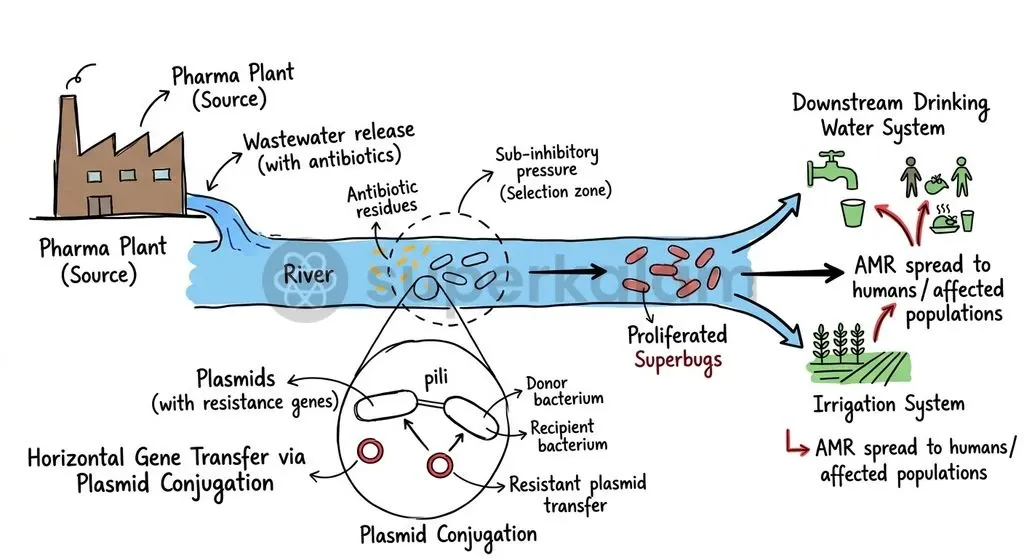
The transition to multi-drug-resistant superbugs renders low-cost generics ineffective, forcing healthcare providers toward toxic reserve drugs.
Pillar 1: Tighter Waste and Effluent Standards for Antimicrobial Factories
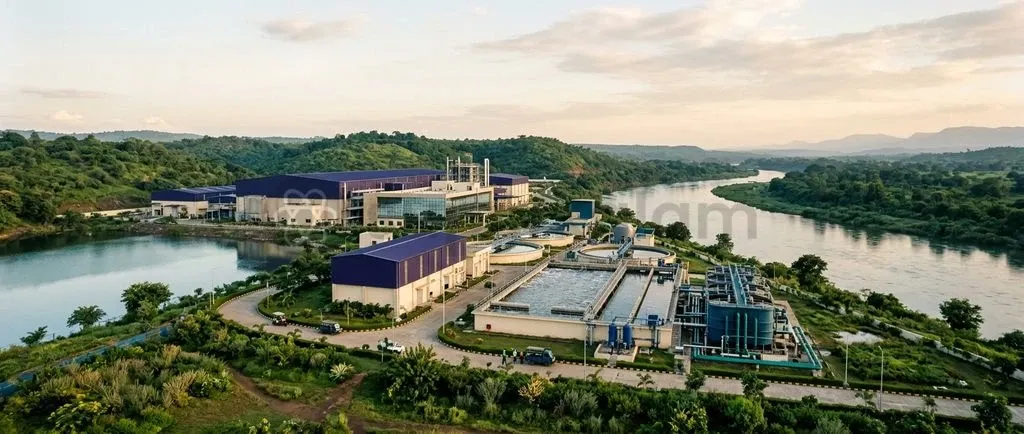
The Central Pollution Control Board classifies bulk drug and active pharmaceutical ingredient manufacturing facilities as Red Category industrial sectors. Under the Water (Prevention and Control of Pollution) Act, 1974, and the Environment (Protection) Act, 1986, these industrial operations face stringent environmental scrutiny due to the hazardous nature of their liquid discharges.
Standard municipal plants cannot neutralise antibiotic waste. To tackle this hazard, the Ministry of Environment, Forest and Climate Change formulated draft standards under the Environment (Protection) Amendment Rules. The 2020 draft under G.S.R. 44(E) proposed maximum permissible discharge concentration limits for 121 antibiotic residues across pharmaceutical plants and Common Effluent Treatment Plant discharges; the Supreme Court stayed the related NGT order in 2022, so it remains a contested regulatory proposal rather than an operational limit.
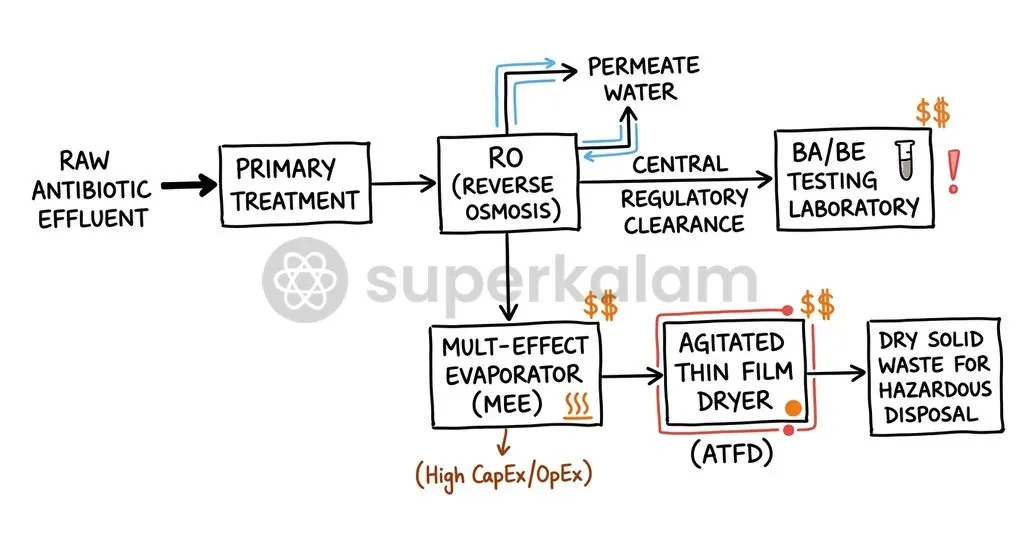
Central Pollution Control Board guidelines require units in water-stressed clusters to adopt Zero Liquid Discharge (ZLD) systems. These multi-stage setups combine reverse osmosis, multi-effect evaporators, and agitation thin film dryers. They recover clean water while concentrating chemical contaminants into solid residues.
| Regulatory Dimension | Conventional Wastewater Regimes | Antimicrobial Waste Regimes |
|---|---|---|
| Primary Statutory Focus | Biochemical Oxygen Demand (BOD) and chemical solids | Specific active ingredient residues and resistant genes |
| Governing Framework | General discharge standards under Environment Rules | Dedicated limits for 121 antibiotic residues |
| Treatment Technology | Primary sedimentation and biological treatment | Multi-effect evaporators and advanced oxidation processes |
| Environmental Objective | Preventing aquatic deoxygenation | Choking off selective evolutionary pressure |
Enforcement across this pillar involves coordinated statutory mandates. The Central Drugs Standard Control Organisation (CDSCO) sets pharmaceutical quality standards, State Licensing Authorities grant drug production permits, and State Pollution Control Boards administer industrial discharge permits through mandatory Consent to Operate certifications.
Discuss with Superkalam
Explain how the discharge of sub-lethal concentrations of antibiotics into water bodies drives horizontal gene transfer among bacteria.
Ask NowPillar 2: Tracking Bulk Drugs to Close the Supply-Chain Loophole
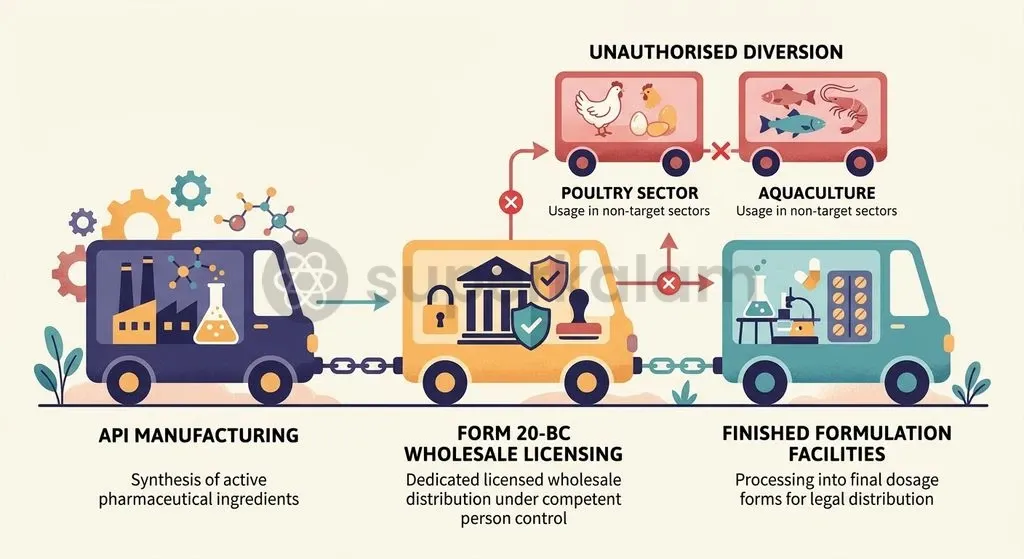
Bulk drug oversight is changing. The Drugs Rules, 1945, are slated for amendment to establish a distinct wholesale licensing framework dedicated exclusively to bulk pharmaceutical substances. Historically, wholesale trade licences pooled finished formulations and active raw ingredients under one regulatory umbrella, obscuring the physical distribution of bulk antibiotic compounds.
As notified in draft G.S.R. 987(E) and reported by PIB in November 2026, the proposed amendment introduces Form 19-BC as the dedicated application form and Form 20-BC as the statutory wholesale licence specifically governing bulk substances.
The draft framework introduces structured compliance obligations:
- Designated wholesale licence: Implements Form 20-BC to isolate raw chemical trade from retail finished doses.
- Supervision and ledger checks: Operations require a certified competent person, covering substances under the Narcotic Drugs and Psychotropic Substances Act, 1985.
- Transition compliance window: PIB states that existing wholesale operators must comply when their current retention period expires or 12 months after final publication, whichever is later.
- Central evaluation mandate: Reclassifying antimicrobials under Rule 2 requires central vetting of bioavailability and bioequivalence (BA/BE) data and stability assessments.
As reported by The Times of India in November 2026, shifting approvals to the Central Licensing Authority mandates central validation, preventing manufacturers from bypassing technical evaluations at the state level.
Beyond the Prescription: Why Curbing Industrial Leakage Matters
Clinical audits alone cannot stop superbugs. India's National Action Plan on Antimicrobial Resistance, NAP-AMR 2.0 (2025-2029), marks an operational shift from consumer monitoring to industrial containment. The policy roadmap recognises that prescription tracking fails if wholesale chemical leakage continues unchecked.
Early containment efforts operated almost exclusively on the retail dispensary side:
- Schedule H1 restrictions (2013): The Health Ministry notified Schedule H1 under the Drugs Rules, 1945, restricting 24 critical medicines to prescription-only dispensing backed by register logs.
- Red Line visual warnings (2016): Packaging rules placed a 5 mm red vertical line on antibiotic cartons to discourage self-medication.
- Blue stripe labelling (2026): Draft notification G.S.R. 51(E) proposed a conspicuous blue vertical strip on antimicrobial packaging to highlight resistance hazards.
Despite retail curbs, unmonitored wholesale channels leaked human-grade APIs into animal rearing. Unregulated distribution permitted bulk antimicrobials to enter poultry, livestock, and aquaculture as non-therapeutic growth promoters. This misuse accelerates animal resistance, creating zoonotic transmission pathways that transfer mutated pathogens back into human populations.
Discuss with Superkalam
How might a poultry farmer's unmonitored use of bulk human-grade APIs impact the efficacy of emergency surgeries in nearby tertiary hospitals?
Ask NowGround Realities: What This Means for Small and Medium Pharma Makers
Micro, Small, and Medium Enterprises face steep capital hurdles under these rules. India's generic drug manufacturing base includes thousands of small enterprises operating on slim margins. They supply affordable antibiotics across regional markets.
Upgrading environmental equipment requires heavy upfront investment:
- Effluent plant capital costs: Zero Liquid Discharge systems and advanced oxidation units require heavy upfront investment, with costs varying by plant capacity and treatment technology.
- High recurring utilities: Thermal evaporators consume substantial electrical energy, pushing up operating costs for small manufacturers.
- Bioequivalence trial outlays: Independent BA/BE testing adds a recurring compliance cost for manufacturers seeking new antimicrobial approvals.
Without shared common infrastructure, strict enforcement risks driving market consolidation. Smaller firms could shutter production, shrinking the domestic supply of low-cost generic antimicrobials.
Ethical and Public Health Stakes: Industry Costs vs Saving Lifesaving Drugs
Balancing Article 21 guarantees of low-cost treatment against collective superbug defence presents a major bioethical challenge. Under the constitutional right to life, the state must ensure accessible medicine for vulnerable populations.
| Bioethical Dimension | Commercial Viability & Patient Access | Collective Pathogen Containment |
|---|---|---|
| Constitutional Right | Accessible treatment under Article 21 guarantees | Collective survival against untreatable bacterial infections |
| Immediate Risk | Small firms shuttering lines, driving up generic prices | Unchecked discharges destroying antibiotic efficacy |
| Core Principle | Economic equity for low-income patients | Precautionary protection of modern medical care |
Allowing factory contamination to continue subsidises private production margins at the expense of communal public health. Utilitarian bioethics and the precautionary principle dictate that protecting the efficacy of existing antimicrobials remains paramount.
Discuss with Superkalam
Compare the regulatory efficacy of consumer-end retail curbs (such as Schedule H1 and Red Line labelling) with upstream industrial wholesale licensing (Form 20-BC).
Ask NowGlobal Standards: How Other Countries Regulate Antibiotic Waste
The World Health Organization released formal guidance in 2024 establishing risk-based ecological discharge limits for antibiotic manufacturing plants. This global benchmark directs national authorities to enforce binding industrial targets calculated using predicted no-effect concentrations (PNEC) to safeguard aquatic ecosystems.
International procurement frameworks have increasingly tied drug sourcing to environmental sustainability. Regulatory authorities in the European Union and the United States have integrated environmental risk assessments into their manufacturing guidelines, pressing global suppliers to certify that active ingredient production does not contaminate surrounding rivers.
| Jurisdiction | Regulatory Approach | Core Enforcement Mechanism |
|---|---|---|
| World Health Organization | Global technical guidance (2024) | Risk-based discharge targets using PNEC thresholds |
| European Union | Environmental risk reviews | Integration of ecological audits into supply tenders |
| India (Proposed Framework) | Statutory integration under Drugs and NDCT Rules | Mandatory central approvals, Form 20-BC licensing, and effluent standards |
Adopting clear effluent thresholds enables India's pharmaceutical exporters to align with evolving international procurement guidelines. Verifiable environmental standards help position domestic manufacturers as responsible producers in regulated global markets.
Way Forward: Balancing Tough Enforcement with Affordable Medicines
Public health defence must not choke industrial viability. Coordinated regulatory execution is essential across the CDSCO, pollution control boards, and state licensing authorities. Fragmented administrative silos must end. Regulators need shared inspection databases to verify that pharmaceutical facilities satisfy both drug quality and environmental standards.
To balance compliance burdens with public health imperatives, policy should focus on three interventions:
- Shared effluent infrastructure: The central government should expand Common Effluent Treatment Plants in pharma clusters, pooling capital costs for thermal evaporators and oxidation systems.
- Digital ledger integration: Linking Form 20-BC distribution logs to national traceability platforms will track active ingredients from synthesis to veterinary and medical use.
- Targeted MSME transition support: Phased compliance timelines and testing subsidies can prevent sudden supply contractions for essential generic antibiotics.
Key Takeaways
- The Union Health Ministry's proposed amendments mark an operational pivot from retail prescription warnings toward upstream supply-chain traceability and industrial containment.
- Under proposed revisions to the NDCT Rules, 2019, antimicrobials would enter the new-drug framework under Rule 2(1)(w)(v), requiring central technical validation of bioequivalence and stability data.
- The Drugs Rules, 1945, are slated to introduce Form 19-BC and Form 20-BC to establish a dedicated wholesale licensing framework for bulk active ingredients.
- Environmental controls rely on CPCB Red Category guidelines and proposed discharge limits for 121 antibiotic residues to prevent resistant gene selection in aquatic ecosystems.
- High capital requirements for Zero Liquid Discharge infrastructure and central bioequivalence testing present significant cost hurdles for domestic small and medium manufacturers.
Mains Question
"India's containment strategy against Antimicrobial Resistance (AMR) marks an operational transition from consumer-end prescription tracking to source-level industrial containment." In light of the National Action Plan on Antimicrobial Resistance (NAP-AMR 2.0), elucidate. (10 Marks)
Evaluate NowMains Question
While strict effluent standards and central licensing for antimicrobials are essential to curb superbugs, they present severe techno-economic challenges for small and medium pharmaceutical enterprises. Critically analyse. (15 Marks)
Evaluate NowPractice MCQs
QUESTION 1
With reference to the proposed amendments to the New Drugs and Clinical Trials (NDCT) Rules, 2019, consider the following statements:
- All antimicrobials are proposed to be reclassified as 'new drugs'.
- Manufacturers can bypass the Central Licensing Authority and obtain production clearance directly from State Licensing Authorities.
- The reclassification mandates central validation of bioavailability and bioequivalence (BA/BE) data. Which of the statements given above are correct?
QUESTION 2
Consider the following statements regarding the regulatory framework for bulk drugs under the Drugs Rules, 1945:
- Form 19-BC is introduced as the application form for wholesale licensing dedicated exclusively to bulk substances.
- Form 20-BC serves as the statutory wholesale licence to isolate raw active chemical trade from finished formulations.
- Wholesale operations under this framework require supervision by a certified competent person. Which of the statements given above is/are correct?
QUESTION 3
Regarding industrial effluent standards and antibiotic pollution control in India, consider the following statements:
- Bulk drug and active pharmaceutical ingredient manufacturing facilities are classified under the Green Category by the Central Pollution Control Board.
- Draft Environment (Protection) Amendment Rules propose discharge concentration limits for 121 antibiotic residues.
- Zero Liquid Discharge (ZLD) systems mandated in water-stressed clusters combine reverse osmosis, multi-effect evaporators, and agitation thin film dryers. Which of the statements given above is/are correct?
QUESTION 4
In the context of antimicrobial containment strategies in India, what was the primary objective of introducing Schedule H1 under the Drugs Rules, 1945 in 2013?
QUESTION 5
Consider the following statements regarding the institutional oversight of the draft AMR drug rules:
- The Drugs Consultative Committee approved the measures during its 67th meeting in November 2025.
- The Drugs Technical Advisory Board (DTAB) endorsed the draft rules during its 93rd meeting in February 2026. Which of the statements given above is/are correct?
Discuss with Superkalam
Evaluate the trade-off between imposing ₹5–15 crore ZLD mandates on MSME pharma units and maintaining the affordability and supply of generic antibiotics in India.
Ask Now