Multi-Agency Centre Expansion: Countering Radicalisation Hotspots
Decentralising India's premier intelligence fusion hub down to district police bridges frontline intelligence with predictive national security analytics.
Nov, 2026
•9 min read

Overview
India’s upgraded Multi-Agency Centre provides a unified counter-terrorism platform. It links central intelligence agencies directly with district police leadership. This network tracks decentralised radicalisation hotspots, detects lone-actor threats, and interdicts cross-border hybrid terror networks before violent execution.
Run under the Intelligence Bureau, the platform synthesises inputs across central armed police forces, defence wings, and state special branches. Pushing access down to district superintendents transforms counter-terrorism from a reactive central fusion desk into a proactive grassroots radar. Its long-term efficacy hinges on resolving federal trust deficits and codifying clear statutory safeguards.
Internal security threats increasingly pivot toward encrypted recruitments and narco-terror logistics. Linking grassroots policing to centralised predictive analytics marks a vital structural modernisation across India’s national security framework.
Why Radicalisation Hotspots and MAC Expansion Are in the News
The Union Ministry of Home Affairs expanded the operational mandate of the Multi-Agency Centre to tackle emerging radicalisation vectors, narcotics syndicates, and cyber-enabled terror networks. As of November 2026, the central platform actively pools real-time actionable intelligence across 28 member organisations, according to the Press Information Bureau. This framework connects frontline police officers directly to apex strategic analysts.
Frontline enforcement agencies confront an operational environment defined by shifting threats:
- Encrypted Digital Recruitment: Extremist recruitment occurs via encrypted applications rather than overt physical congregations.
- Dispersed Modules: Decentralised cells operate across state borders through dark web forums and transnationally directed propaganda.
- Early Threat Detection: Pushing intelligence down to district leaders enables forces to spot early behavioural indicators and disrupt recruitment pipelines before local cells strike.
What Is the Multi-Agency Centre and How Does It Function?
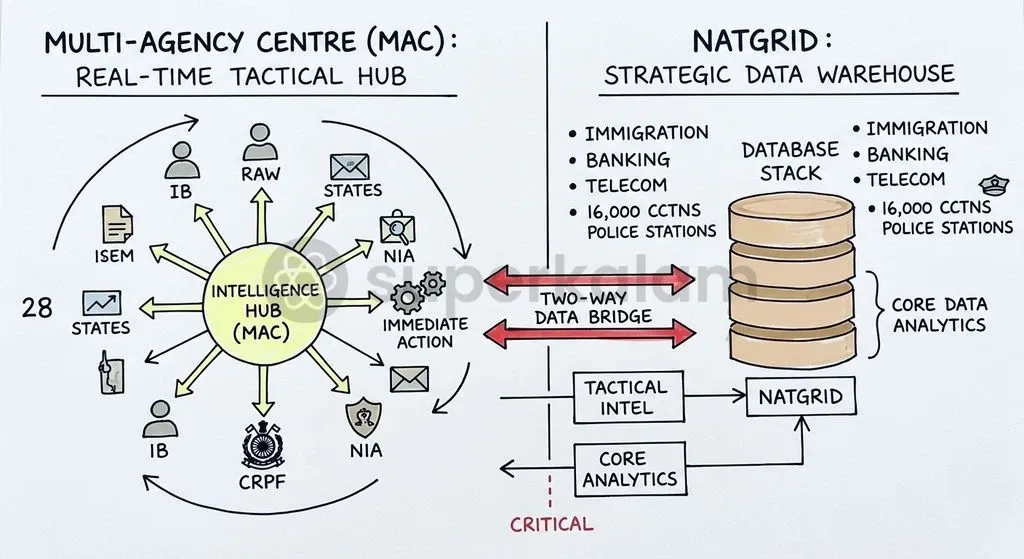
The Multi-Agency Centre serves as India’s nodal intelligence fusion hub. Operating 24x7 under the Intelligence Bureau, it works to eliminate inter-agency silos and facilitate real-time operational coordination.
Following strategic vulnerabilities identified by the Kargil Review Committee, the Group of Ministers Report on Reforming the National Security System formalised the platform in 2001. Its purpose was to integrate fragmented military and civil intelligence flows. The central government overhauled this mechanism following the 2008 Mumbai terror attacks, converting the fusion desk into a round-the-clock operational centre backed by Subsidiary Multi-Agency Centres across all state capitals, as documented in the Ministry of Home Affairs Annual Report 2008-09.
Daily operational briefings convene representatives from the Research and Analysis Wing, Defence Intelligence Agency, military intelligence Directorates, Central Armed Police Forces, and the National Investigation Agency. To prevent redundant inquiries and accelerate field responses, the platform collaborates closely with the National Intelligence Grid.
| Parameter | Multi-Agency Centre (MAC) | National Intelligence Grid (NATGRID) |
|---|---|---|
| Primary Mandate | Real-time tactical intelligence fusion and actionable counter-terrorism alerts | Centralised data consolidation and predictive analytics database |
| Operational Node | Intelligence Bureau (IB), Ministry of Home Affairs | Standalone entity under the Ministry of Home Affairs |
| Core Constituents | 28 operational agencies, including military intelligence and state police | 21 sensitive source agencies linked to over 16,000 police stations |
| Data Architecture | Daily tactical briefings, Threat Management System, National Memory Bank | Core records integration via CCTNS, immigration, banking, and travel logs |
| Response Horizon | Immediate operational interdiction and threat neutralisation | Investigative data queries, financial pattern tracking, and intelligence discovery |
Technical integration between both frameworks ensures tactical alerts shared via state-level networks are validated against historical archives. According to the Press Information Bureau, the National Intelligence Grid integrates core data from 21 sensitive source agencies with more than 16,000 police stations via the Crime and Criminal Tracking Network and Systems.
Discuss with Superkalam
Which committee and high-level reports initially led to the formalisation of the Multi-Agency Centre in 2001, and what event triggered its round-the-clock overhaul?
Ask NowMapping the Anatomy of Radicalisation Hotspots Across India
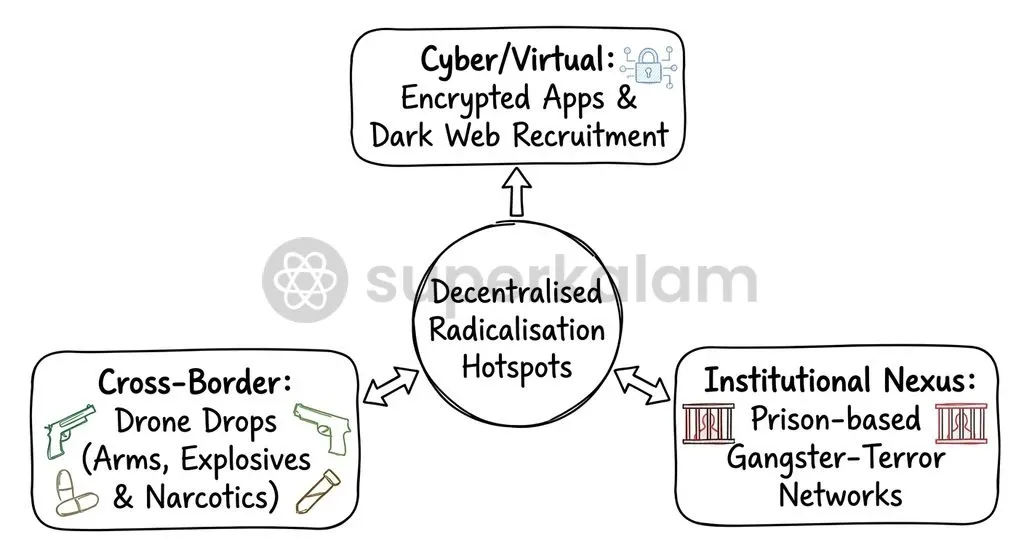
Modern radicalisation hotspots in India have shifted away from physical, geography-bound sanctuaries toward dispersed digital ecosystems and custodial recruitment hubs. Contemporary networks exploit distinct operational vectors:
- Decentralised Digital Cells: Cells exploit encrypted messaging applications and dark web platforms for lone-actor coordination, as outlined in the Ministry of Home Affairs Counter Terrorism and Counter Radicalization Division Work Allocation. Transnational terror groups, including Islamic State Khorasan Province, deploy encrypted digital channels to circulate propaganda and handle operational finance.
- Custodial Recruitment Hubs: Prisons increasingly facilitate narco-terror collaboration between violent extremists and organised gangster networks. This trend prompted the Union Government to introduce the Model Prisons Act, 2023 to modernise custodial management and isolate extremist recruiters, according to the Ministry of Home Affairs Year End Review 2023.
- Asymmetric Western Logistics: Extremist networks sustain local logistics through cross-border delivery. Unmanned aerial vehicles routinely transport synthetic narcotics consignments, small arms, and improvised explosive devices to finance and arm local sleeper cells, as highlighted in proceedings from the Union Home Minister's conference on counter-terrorism policy.
Specialised operations help security agencies detect digital recruitment patterns early. First reported in January 2015, the Intelligence Bureau mounted 'Operation Chakravyuh' to track online recruitment of Indian youth by the Islamic State and intercept self-radicalised recruits before they could leave the country.
How Expanding MAC to District Levels Transforms Counter-Terrorism
The upgraded Multi-Agency Centre architecture extends secure tactical communications down to district Superintendents of Police. This decentralises early threat detection far beyond traditional metropolitan nodes.
On May 16, 2025, the Union Government inaugurated this upgraded platform at North Block, New Delhi. The project invested over ₹500 crore to embed artificial intelligence, machine learning, and geographic information systems mapping for predictive hotspot analysis, per the Press Information Bureau. Secure connectivity reaches sensitive outposts, including island territories, border corridors, and insurgency-affected jurisdictions.
Frontline police leadership can now cross-reference local intelligence indicators directly against national databases. This enables officers to spot subtle demographic movements, illicit hawala transactions, and ideological recruitment on the ground.
The Operational Fusion Pipeline
- Frontline Police Stations: Capture grassroots indicators and submit CCTNS inputs.
- District Superintendents of Police (Secure MAC Terminals): Conduct tactical field verification and run local intercepts.
- Subsidiary Multi-Agency Centres (SMACs at State Capitals): Synthesise state-level agency intelligence and manage inter-district fusion.
- Central Multi-Agency Centre (North Block, New Delhi): Execute AI/ML analytics, query the Threat Management System, and check the National Memory Bank.
- Operational Directives: Dispatch actionable interdiction orders directly to field units.
The system relies on modern digital repositories to track threat persistence over time. Operational methodology incorporated a National Memory Bank and a centralised digital database linked to the Threat Management System in 2023, according to the Press Information Bureau.
At the international level, a Standing Focus Group instituted under the platform in January 2026 coordinated the extradition and return of 303 fugitives from 36 countries between 2019 and late 2026.
Discuss with Superkalam
How does the operational division between real-time tactical fusion (MAC) and consolidated investigative discovery (NATGRID) prevent institutional redundancy?
Ask NowKey Friction Points: Federal Hesitation and Agency Silos
Constitutional divisions create structural friction in inter-agency intelligence coordination between central institutions and regional police departments. Under the Seventh Schedule of the Constitution of India, 'Public order' falls under Entry 1 and 'Police' under Entry 2 of the State List (List II), whereas the 'Central Bureau of Intelligence and Investigation' is placed under Entry 8 of the Union List (List I).
This division often sparks administrative apprehension among state governments. Regional police administrations sometimes view central intelligence repositories as instruments of federal overreach, fearing that lateral intelligence sharing compromises local policing discretion.
Structural reluctance has consistently undermined information aggregation across the national grid. The Department-related Parliamentary Standing Committee on Home Affairs noted in Report No. 224 that state police departments historically accounted for a disproportionately low share of actionable inputs uploaded to the platform compared to central bodies.
Operational differences between agencies compound these institutional hesitations:
- Asymmetric Information Sharing: State police personnel routinely report that tactical leads flow from the centre downward, while field inputs sent upward rarely return as enriched, actionable feedback.
- Technological Disparities: Disparate data-entry formats, incompatible software stacks, and variable digital literacy across district special branches obstruct seamless data processing.
- Jurisdictional Turf Battles: Rivalries between specialised state Anti-Terrorism Squads and central enforcement bodies occasionally delay immediate operational interdictions.
Discuss with Superkalam
If a district police force uncovers cross-border drone drops carrying synthetic narcotics and weapons, how should the upgraded MAC pipeline process this threat?
Ask NowSurveillance, State Police Autonomy, and Civil Liberties
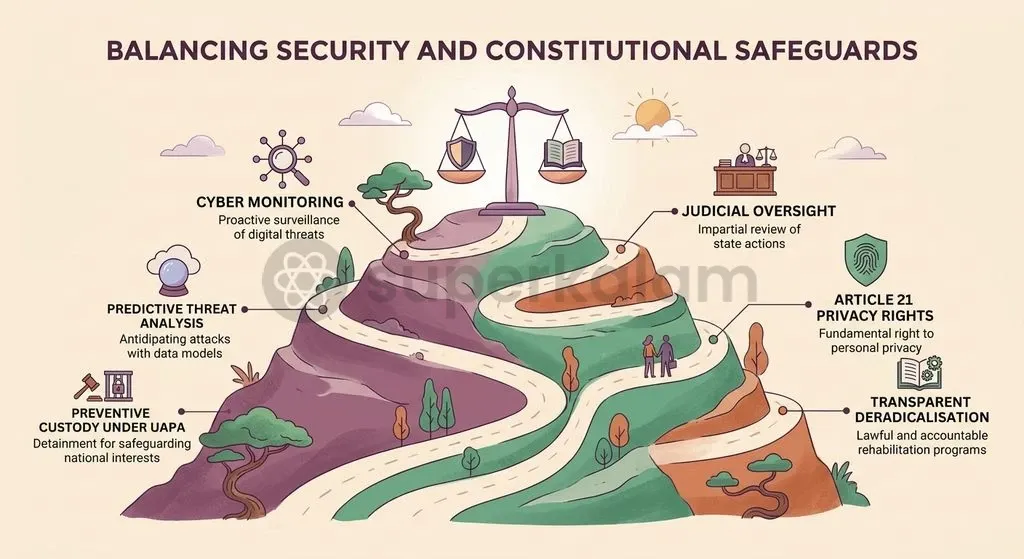
Expanding real-time surveillance down to the district tier raises sensitive constitutional questions regarding personal privacy, operational proportionality, and civil liberties. India lacks a comprehensive statutory framework regulating counter-radicalisation and intelligence collation. Operational protocols remain guided by executive guidelines and preventive provisions under the Unlawful Activities (Prevention) Act, 1967.
The central government has pursued specific administrative initiatives to systematise counter-radicalisation efforts:
- Specialised Central Divisions: The Ministry of Home Affairs established the Counter Terrorism and Counter Radicalisation Division alongside the Cyber and Information Security Division on November 13, 2017, as confirmed by the Press Information Bureau.
- State Cyber Units: Central guidelines instruct state Anti-Terrorism Squads to establish dedicated cyber-expert units to track illicit dark-web communications.
- Grassroots Community Interventions: As reported by The Hindu in January 2022, several states operate non-statutory deradicalisation programmes, such as the Maharashtra ATS initiative and community outreach programmes in Kerala. These combine family counselling, moderate religious scholars, and psychological evaluations to steer youth away from violent extremism.
Without precise legislative charters, digital tracking and predictive hotspot mapping risk capturing benign dissent alongside genuine threats. Modern counter-terrorism architectures demand statutory oversight mechanisms to preserve constitutional protections under Article 21 while ensuring operational efficacy.
Way Forward: Building an Integrated, Trust-Based Intelligence Architecture
The Multi-Agency Centre requires an updated statutory foundation and institutionalised accountability frameworks to operate as a sustainable national security asset. Creating a clear parliamentary charter for the platform would clarify data retention boundaries, define inter-agency responsibilities, and protect civil liberties through independent judicial oversight.
Federal intelligence sharing must transition from administrative compulsion into an institutionalised, mutually beneficial partnership:
- Institutionalising Two-Way Sharing: Central agencies must routinely supply enriched analytical products back to district police stations, ensuring field officers directly benefit from submitting raw reports.
- Standardising Technical Protocols: Standardising data ingestion formats across CCTNS, NATGRID, and the central threat grid will eliminate technical bottlenecks in field analysis.
- Enacting a National Deradicalisation Framework: Formulating a transparent statutory model for disengagement will replace informal police programmes with standardised rehabilitation protocols supported by mental health professionals and civil society stakeholders.
- Capacity Building for District Units: Allocating dedicated funding to modernise district-level special branches ensures local investigators can decode advanced cyber traces and encrypted transactions.
Discuss with Superkalam
Why do differences in Seventh Schedule competencies create a structural trust deficit in intelligence sharing between state special branches and central agencies?
Ask NowKey Takeaways
- Institutional Evolution: Conceptualised in 2001 following the Kargil Review Committee and reorganised post-26/11, the Multi-Agency Centre operates as India's 24x7 counter-terrorism intelligence fusion hub under the Intelligence Bureau.
- Technological Upgrade: Inaugurated on May 16, 2025, with an investment exceeding ₹500 crore, the modernised network incorporates artificial intelligence, machine learning, and geographic information systems mapping for predictive threat assessments.
- Grassroots Integration: Standalone secure access now extends down to district Superintendents of Police, linking frontline police observations with the National Memory Bank and the central Threat Management System.
- Constitutional Complexity: Intelligence cooperation faces federal friction due to the Seventh Schedule, which assigns Police and Public Order to the State List while central intelligence functions belong to the Union List.
- Statutory Governance Void: India currently lacks a dedicated national statute for deradicalisation, relying instead on executive procedures, specialised MHA divisions, and preventive measures under the Unlawful Activities (Prevention) Act, 1967.
Mains Question
"The Department-related Parliamentary Standing Committee on Home Affairs noted in Report No. 224 that state police departments historically accounted for a disproportionately low share of actionable inputs to the Multi-Agency Centre." In the context of the Seventh Schedule's distribution of security mandates, critically examine the federal and institutional impediments that hinder seamless intelligence fusion across India. (15 Marks)
Evaluate NowMains Question
With radicalisation hotspots increasingly shifting toward encrypted digital platforms and custodial hubs, evaluate the significance of extending the Multi-Agency Centre (MAC) architecture down to district police leadership. (10 Marks)
Evaluate NowPractice MCQs
QUESTION 1
Consider the following statements regarding India's counter-terrorism intelligence architecture:
- The Multi-Agency Centre operates 24x7 under the Intelligence Bureau to provide real-time tactical intelligence fusion.
- NATGRID functions as a standalone entity under the Ministry of Home Affairs to integrate core data from sensitive source agencies.
- The Multi-Agency Centre was originally formalised following the recommendations of the Kargil Review Committee and the Group of Ministers Report in 2001. Which of the statements given above are correct?
QUESTION 2
Consider the following statements with reference to constitutional entries and federal intelligence coordination:
- 'Public order' and 'Police' fall under the State List (List II) of the Seventh Schedule of the Constitution of India.
- The 'Central Bureau of Intelligence and Investigation' is enumerated under the Union List (List I) of the Seventh Schedule.
- Parliamentary Standing Committee on Home Affairs Report No. 224 highlighted that state police departments historically contributed a disproportionately low share of actionable inputs to the Multi-Agency Centre. Which of the statements given above is/are correct?
QUESTION 3
Consider the following statements regarding radicalisation trends and counter-measures highlighted in security policy:
- The Model Prisons Act, 2023 was introduced to address custodial recruitment hubs and narco-terror collaboration within prisons.
- 'Operation Chakravyuh' was initiated by the National Investigation Agency to conduct physical interdiction of cross-border weapon drops.
- Subsidiary Multi-Agency Centres (SMACs) are established across state capitals to facilitate state-level intelligence fusion. Which of the statements given above is/are correct?
QUESTION 4
Consider the following statements regarding the technological expansion of the Multi-Agency Centre (MAC):
- The upgraded MAC architecture incorporates a Threat Management System linked with a National Memory Bank.
- The upgraded platform decentralises secure connectivity directly down to district Superintendents of Police.
- The Standing Focus Group under the MAC framework is responsible for coordinating international fugitive extradition and return. Which of the statements given above is/are correct?
QUESTION 5
In the context of internal security mechanisms in India, 'Operation Chakravyuh' refers to an initiative undertaken by which of the following agencies?
Discuss with Superkalam
Does decentralising predictive surveillance tools to district police without an overarching counter-radicalisation law strike the right balance between security and civil liberties?
Ask Now