Private Capex in India: Why Corporate Tax Cuts Cannot Replace Wage Growth
Record corporate profits and tax windfalls cannot ignite fresh investment when stagnant wages throttle consumer demand and leave factory capacity idling.
Nov, 2026
•9 min read

Overview
India’s persistent private investment drought shows that supply-side tax concessions cannot replace household purchasing power. When aggregate demand stalls due to prolonged real wage stagnation across rural and informal labour markets, cutting corporate levies fails to spark factories.
Following the steep reductions under the Taxation Laws (Amendment) Act, 2019, corporate balance sheets saw record profitability and substantial balance-sheet deleveraging. Yet, private sector Gross Fixed Capital Formation failed to stage a durable recovery because industrial capacity utilisation hovered near 74.6%, safely below the threshold required to trigger broad-based greenfield capital outlays. Sustained capital formation requires an accelerator effect powered by mass consumption, demanding a policy rebalance toward wage growth, rural safety nets, and formal employment.
Why in the News: The Missing Relay Baton in India's Investment Cycle
The Union Government has repeatedly urged corporate India to accelerate private capital expenditure to relieve sovereign fiscal pressures. Addressing the centenary convention and 100th Annual General Meeting of FICCI on November 19, 2026, Prime Minister Narendra Modi publicly pulled up corporate leaders for keeping wages static and failing to expand employment despite receiving substantial corporate tax cuts.
This public critique followed earlier expressions of official frustration:
- In September 2022, Union Finance Minister Nirmala Sitharaman likened corporate India's hesitancy to invest to Lord Hanuman needing a reminder of his strength at the Mindmine Summit.
- By late 2026, the expected transition from public-led infrastructure expansion to self-sustaining private investment had failed to materialise.
The Central Government scaled public capital outlays to ₹11.11 lakh crore in FY 2024-25 and maintained annual capital budgets around ₹11-12 lakh crore in subsequent fiscal years to support gross domestic output. Yet, corporate capital formation has not picked up the relay baton, leaving the macroeconomic growth engine excessively reliant on sovereign borrowing.
The 2019 Corporate Tax Bet: What Was Promised vs What Corporates Delivered
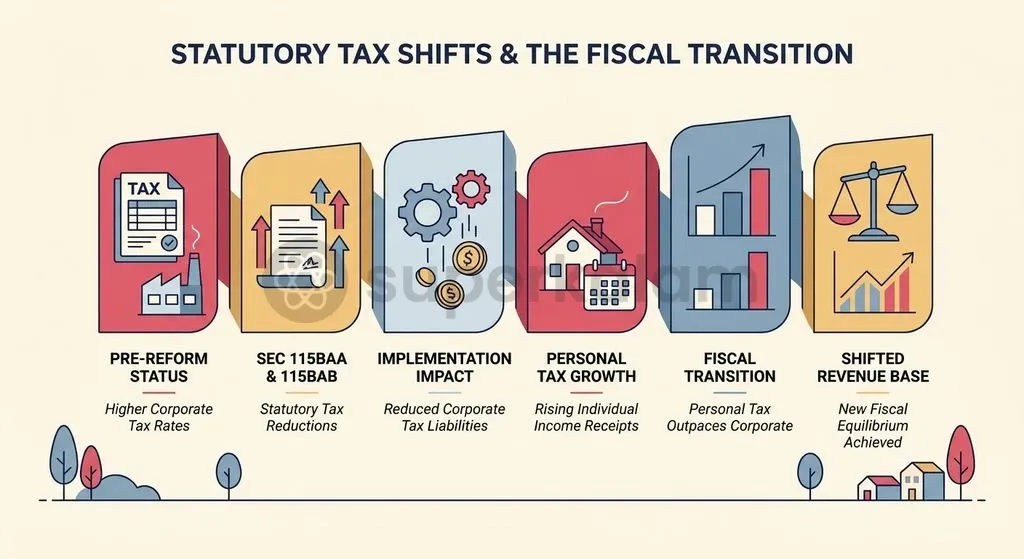
The Taxation Laws (Amendment) Act, 2019 overhauled India's corporate fiscal framework to kickstart an investment cycle. The statute introduced two concessional tax regimes under the Income-tax Act, 1961:
- Section 115BAA: Reduced the headline corporate tax rate for existing domestic firms to 22%, conditional on foregoing designated exemptions.
- Section 115BAB: Cut the corporate tax rate for newly established manufacturing units to 15%, subject to similar exemption trade-offs.
Supply-side theory presumed that lowering corporate taxation would unlock retained earnings and stimulate immediate greenfield outlays. According to a Press Information Bureau release by the Ministry of Finance, the annual revenue foregone from these tax cuts and associated relief measures stood at approximately ₹1.45 lakh crore.
Rather than accelerating industrial expansion, this concession triggered a structural shift in direct tax composition:
- Shift in revenue balance: Time-series data released by the Central Board of Direct Taxes indicates that Personal Income Tax collections surpassed Corporate Income Tax collections following the 2019 statutory amendments.
- Subdued capex recovery: Despite the state surrendering considerable direct tax revenues, Gross Fixed Capital Formation by the private corporate sector has hovered around 10-11% of GDP, remaining well below its historical peak of 14-16% recorded in 2007-08 and 2011-12.
Discuss with Superkalam
What were the concessional corporate tax rates introduced under Sections 115BAA and 115BAB in 2019?
Ask NowProfits Without Factories: How Tax Windfalls Went to Debt Paydown and Dividends
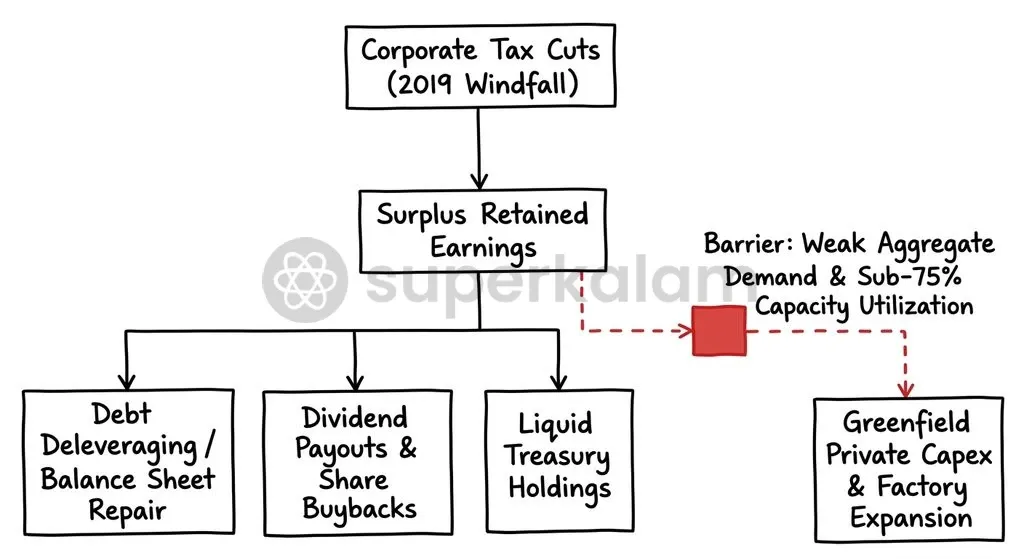
Corporate balance sheets absorbed the fiscal windfalls to bolster solvency rather than expanding physical plant capacity. According to a thematic study published in the Reserve Bank of India Bulletin examining listed non-government non-financial companies, post-pandemic corporate earnings and tax savings were deployed into three primary avenues rather than fresh greenfield physical assets:
- Rapid balance sheet deleveraging and debt servicing;
- Liquid cash accumulation and treasury investments; and
- Higher dividend payouts and equity buybacks.
Chief Economic Adviser V. Anantha Nageswaran highlighted this disconnect, noting that while corporate profits of listed entities compounded at over 30% post-pandemic, the rate of private sector capital formation failed to mirror that corporate profitability. Corporate boards responded rationally to existing incentives. Without steady consumer off-take, retiring debt and holding liquid assets was safer than erecting unneeded physical factories.
Private investment intentions documented by the Reserve Bank of India show that while bank-sanctioned project proposals rose to ₹4.4 lakh crore in 2025-26, ground-level completion and execution remained cautious due to external demand volatility. Corporate managers deferred major capital outlays, waiting for clear signals of sustained final demand before committing capital to irreversible physical projects.
The Capacity Trap: Why Stagnant Rural Wages Cap Factory Utilization
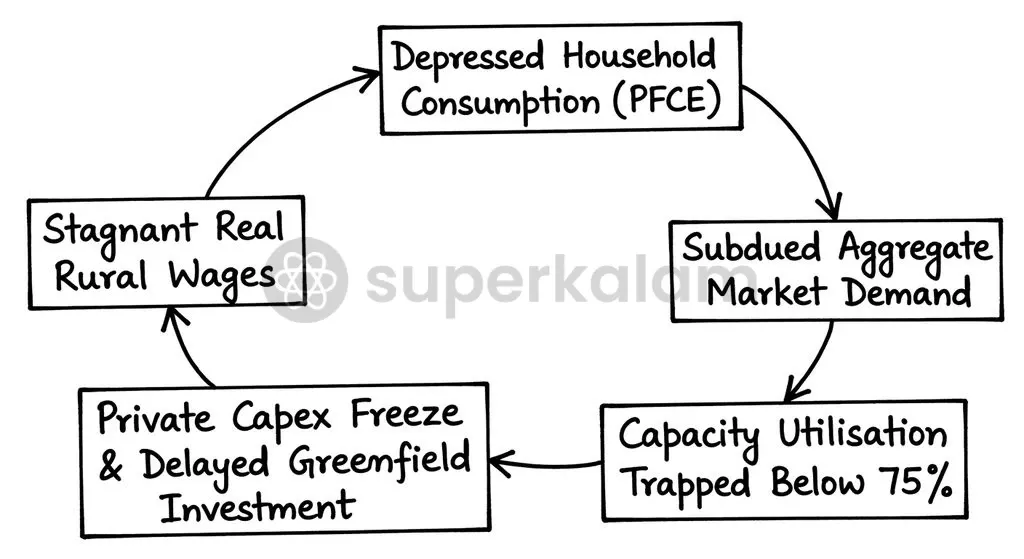
Factory investment stalls when existing machines sit idle. Round 74 of the RBI Order Books, Inventories and Capacity Utilisation Survey (OBICUS) for Q1:2026-27 reported aggregate manufacturing capacity utilisation at 74.6%. This level lingers near the 75% threshold that industrial economists treat as the operational trigger for fresh private capex cycles. Until aggregate manufacturing utilisation breaches and sustains levels above 75-76%, industrial enterprises can easily service incremental demand by adjusting work shifts rather than constructing new production lines.
Operating capacity remains capped because broad-based consumption expenditure lacks momentum:
- Consumption dominance: Private Final Consumption Expenditure accounts for roughly 56% to 60% of GDP, meaning national output is overwhelmingly consumption-driven.
- Rural wage stagnation: Labour Bureau data from the Wage Rates in Rural India series deflated by the Consumer Price Index for Agricultural Labourers reveals that real rural wage growth remained virtually stagnant or negative between 2019 and 2024.
- Food inflation drag: The Economic Survey confirmed that nominal rural wage growth failed to outpace elevated rural food inflation, leading to recurring spells of negative real wage gains for agricultural and casual non-farm labourers.
When the purchasing power of millions of rural households is eroded by inflation, demand for mass-market consumer durables and entry-level industrial goods inevitably contracts.
Discuss with Superkalam
How does real rural wage stagnation depress industrial capacity utilisation across manufacturing sectors?
Ask NowSide-by-Side: Supply-Side Tax Breaks vs Wage-Led Demand Revival
Macroeconomic policymakers face a strategic choice between subsidising corporate capital inputs and regenerating bottom-up purchasing power. Supply-side interventions reduce the cost of capital, whereas wage-led strategies expand product markets via the accelerator principle, which posits that capital investment is induced by prior increases in output and consumption.
| Evaluation Metric | Supply-Side Tax Concessions (2019 Route) | Wage-Led Demand Revival (Bottom-Up Route) |
|---|---|---|
| **Primary Statutory / Policy Mechanism** | Sections 115BAA and 115BAB of the Income-tax Act, 1961 | Rural safety nets (MGNREGS), real minimum wage enforcement, and MSME employment payroll support |
| **Direct Beneficiaries** | Formal corporate enterprises, capital owners, and equity investors | Agricultural labourers, informal wage earners, and rural households |
| **Corporate Balance Sheet Impact** | Accelerated **balance sheet deleveraging**, liquid cash reserves, and higher dividend distributions | Improved order book volumes, inventory liquidation, and elevated industrial capacity utilisation |
| **Output Multiplier Effect** | Low immediate output multiplier due to high savings propensity among capital owners | High fiscal multiplier of 2.45 to 3.25 from direct spending and consumption churn |
| **Fiscal Cost to Exchequer** | Estimated at approximately ₹1.45 lakh crore annually in revenue foregone | Reallocation of revenue expenditure towards targeted social transfers and rural capital works |
| **Capacity Utilisation Impact** | Marginal; leaves factory utilisation idling near the **74.6% capacity threshold** | Direct; absorbs idle manufacturing slack by expanding **Private Final Consumption Expenditure** |
Econometric findings explain why corporate tax deductions produce limited immediate growth impulses. Working papers from the National Institute of Public Finance and Policy demonstrate that public capital outlays generate an output multiplier of 2.45 to 3.25, whereas untargeted corporate tax cuts yield significantly lower immediate output multipliers because windfalls leak into corporate savings.
Discuss with Superkalam
If a government has ₹1.5 lakh crore in fiscal room, how would the output multiplier differ between cutting corporate tax rates and investing directly in rural infrastructure?
Ask NowFiscal Limits: Why Government Capex Cannot Carry the Burden Alone
The Central Government cannot indefinitely shoulder the entire burden of national capital formation without breaching statutory debt limits. Under the Fiscal Responsibility and Budget Management consolidation roadmap, the Centre committed to lowering its fiscal deficit below 4.5% of GDP by FY 2025-26 while targeting a medium-term debt-to-GDP anchor of 50±1% by 2030-31.
Rigid structural obligations restrict discretionary sovereign capital spending in two direct ways:
- Heavy interest commitments: Official expenditure profiles reveal that interest payments absorb over 25% of general government revenue and nearly 40% of the Centre's net revenue receipts, leaving narrow fiscal room to fund capital assets solely through market borrowing.
- Macroeconomic trade-offs: Expanding public capex in the absence of private participation threatens to crowd out private credit or precipitate ratings scrutiny.
Way Forward: Building Purchasing Power to Unlock Greenfield Investment
Industrial recovery requires an operational pivot from pure capital subsidisation toward reviving consumer purchasing power. NITI Aayog policy reviews and labour analyses suggest that industrial policy must complement capital support with targeted wage incentives, rural employment safety nets like MGNREGS, and credit backing for labour-intensive MSMEs.
A durable strategy for reviving private greenfield capex rests on three coordinated policy interventions:
- Restoring Rural Purchasing Power: Real wage growth must be insulated from inflation through calibrated adjustments to minimum wages and enhanced rural infrastructure allocations, ensuring that rural real incomes support entry-level consumer goods manufacturing.
- Targeting Production Incentives to Employment: Production-Linked Incentive schemes should be conditioned on verifiable domestic employment thresholds and domestic supply-chain integration rather than capital intensity alone.
- Formalising Informal Sector Productivity: Expanding credit access and regulatory simplification for MSMEs will raise productivity and earnings across the informal economy, rebuilding the domestic customer base required to lift factory capacity utilisation safely past the 75% benchmark.
Discuss with Superkalam
Why was balance sheet deleveraging and cash accumulation a rational choice for corporate boards during 2020-2026 despite official calls for greenfield investment?
Ask NowKey Takeaways
- The Taxation Laws (Amendment) Act, 2019 reduced corporate tax rates to 22% for existing companies and 15% for new manufacturing firms, resulting in an estimated annual revenue foregone of approximately ₹1.45 lakh crore.
- Corporate tax windfalls were predominantly deployed toward balance sheet deleveraging, debt reduction, and liquid cash accumulation rather than fresh greenfield assets, as documented by the Reserve Bank of India.
- Private corporate Gross Fixed Capital Formation has stagnated around 10-11% of GDP, far below its historical peak of 14-16% recorded in 2007-08 and 2011-12.
- Aggregate manufacturing capacity utilisation stood at 74.6% in Q1:2026-27 under the RBI OBICUS survey, remaining below the threshold required to trigger autonomous private capex cycles.
- Stagnant or negative real rural wage growth between 2019 and 2024 depressed Private Final Consumption Expenditure, which generates 56% to 60% of national GDP.
- Fiscal consolidation constraints under the FRBM framework, alongside interest payments consuming nearly 40% of net central revenue receipts, prevent the government from indefinitely funding public infrastructure outlays without private capex participation.
Mains Question
"Supply-side tax concessions cannot replace household purchasing power when aggregate demand stalls." In light of the Taxation Laws (Amendment) Act, 2019 and corporate investment trends, critically examine this statement. (15 Marks)
Evaluate NowMains Question
"While public capital expenditure has been scaled up to support output, sustainable growth requires private corporate capex to pick up the relay baton." Elucidate the factors restraining private investment despite robust corporate balance sheets. (10 Marks)
Evaluate NowPractice MCQs
QUESTION 1
With reference to the Taxation Laws (Amendment) Act, 2019, consider the following statements:
- Section 115BAA lowered the corporate tax rate to 22% for existing domestic firms, conditional on foregoing designated exemptions.
- Section 115BAB reduced the corporate tax rate for newly established manufacturing units to 15%.
- Following these amendments, Corporate Income Tax collections consistently exceeded Personal Income Tax collections. Which of the statements given above are correct?
QUESTION 2
Consider the following statements regarding industrial capacity utilisation and capital formation in India:
- Private sector Gross Fixed Capital Formation (GFCF) expanded to over 16% of GDP immediately following the 2019 corporate tax cuts.
- According to RBI's OBICUS Round 74, aggregate manufacturing capacity utilisation hovered around 74.6%.
- Industrial economists generally consider capacity utilisation crossing 75% to 76% as an operational threshold to spur fresh greenfield capex. Which of the statements given above are correct?
QUESTION 3
Consider the following statements regarding macroeconomic demand drivers and fiscal multipliers in India:
- Private Final Consumption Expenditure (PFCE) accounts for approximately 56% to 60% of India's GDP.
- National Institute of Public Finance and Policy (NIPFP) studies show that public capital outlays generate an output multiplier between 2.45 and 3.25.
- The accelerator principle posits that capital investment is induced primarily by supply-side tax concessions rather than changes in output and consumption. Which of the statements given above is/are correct?
QUESTION 4
Consider the following statements regarding the deployment of corporate earnings following the 2019 tax reductions:
- Listed non-government non-financial entities deployed post-pandemic tax windfalls and profits primarily into balance sheet deleveraging, liquid cash reserves, and dividend payouts.
- Bank-sanctioned private project proposals contracted sharply to under ₹1 lakh crore in 2025-26 due to corporate balance sheet stress. Which of the statements given above is/are correct?
QUESTION 5
Which of the following direct tax shifts occurred in India following the implementation of the Taxation Laws (Amendment) Act, 2019?
Discuss with Superkalam
Should India's medium-term fiscal strategy prioritize corporate supply-side incentives or wage-led purchasing power revival to ignite sustained private GFCF?
Ask Now