Revised IT Hardware Norms: Breaking India's Screwdriver Assembly Trap
By using public procurement to bypass WTO tariff locks, India targets superficial screwdriver assembly to build genuine domestic component manufacturing.
Nov, 2026
•10 min read
Overview
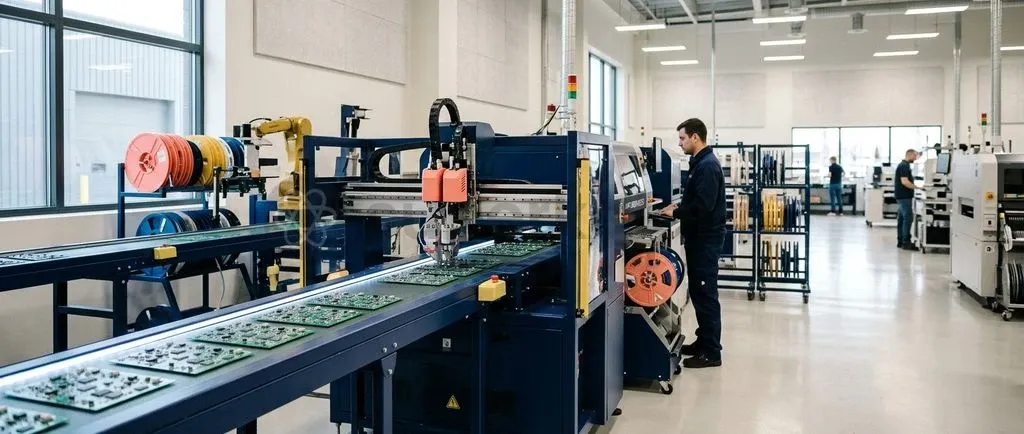
India revised its domestic value addition norms for six core information technology hardware products. The goal is straightforward: compel global hardware makers to build authentic domestic component lines rather than running low-depth assembly shops. Issued by the Ministry of Electronics and Information Technology under the Public Procurement Order, 2017, the framework scraps self-declared percentage claims in favour of an itemised Bill of Materials calculation.
This marks a decisive pivot in industrial policy. New Delhi is deploying state public procurement leverage to bypass multilateral tariff locks and anchor sub-tier production locally. Domestic value addition across Indian electronics manufacturing stood at approximately 18% to 20% as of April 2026, and this recalibrated mechanism tackles that gap directly.
Why in the News: MeitY Overhauls Domestic Value Addition Rules
The Ministry of Electronics and Information Technology revised the domestic value addition calculation methodology for six IT hardware product categories under the Public Procurement (Preference to Make in India) Order, 2017. As detailed by a MeitY Press Release on Revision of PPP-MII Order 2020 for Six IT Hardware Products (PIB Release ID: 2074819 / 2339142), the updated rules govern:
- Desktop PCs
- Laptop PCs
- Thin Clients
- Servers
- Computer Monitors
- Interactive Flat Panel Displays
The updated framework replaces generic, self-declared value claims with a verifiable, Bill of Materials-based calculation. Factory assessors will now track physical conversion steps carried out inside India.
Every supplier must submit a standardised self-certification backed by a mandatory audit trail to establish compliance during public procurement checks. The revised methodology takes effect six months after its gazette publication. This operational shift closes past loopholes that let low-depth screwdriver operations pocket state manufacturing preferences.
Discuss with Superkalam
Recall the six specific IT hardware product categories governed by MeitY's revised domestic value addition framework.
Ask NowThe Screwdriver Trap: Why Electronics Assembly Fails to Build True Value
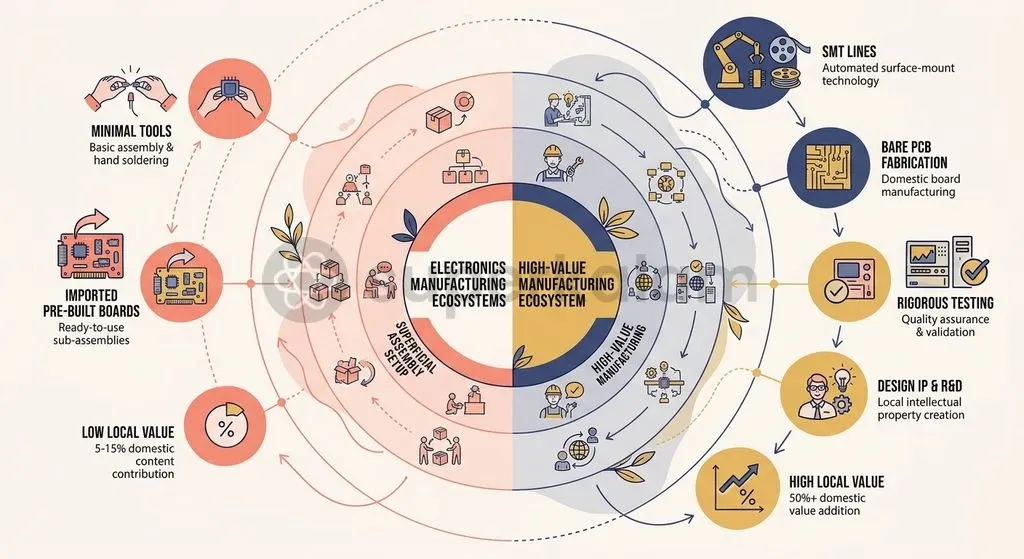
Traditional electronics assembly in India remains largely a low-margin screwdriver exercise. It creates shop-floor jobs, but it fails to generate enduring technical capabilities. According to a NITI Aayog Report on Electronics: Powering India's Participation in Global Value Chains, traditional Semi-Knocked Down and Completely Knocked Down electronics screwdriver assembly in India historically added only 5% to 15% domestic value.
Domestic value addition across Indian electronics manufacturing stood at approximately 18% to 20% as of April 2026, according to a Press Information Bureau release. While headline volumes surged under earlier incentive schemes, core intellectual property, high-grade silicon, and precision component fabrication stayed entirely offshore.
This pattern pulls developing markets straight into the screwdriver assembly trap. Foreign brands ship in pre-assembled printed circuit boards, displays, and structural casings. Local units merely screw parts together, snap plastic casings shut, and box the finished devices.
| Manufacturing Dimension | Low-Depth Assembly (Screwdriver Model) | Deep Component Localisation (Revised Framework) |
|---|---|---|
| Typical Value Addition | 5% to 15% of total product value | Exceeding 30% to 50% through component tiers |
| Primary Local Operations | Plastic snapping, screw fastening, packaging | Surface Mount Technology, component fabrication |
| Capital Investment | Low capex, portable assembly fixtures | High capex, automated cleanrooms and tooling |
| Supply Chain Linkages | Direct import of complete sub-assemblies | Domestic vendor integration for passive parts and PCBs |
| Vulnerability to Shocks | High vulnerability to external trade disruptions | Substantial supply chain autonomy and resilience |
These low-depth operations fail to cultivate domestic design engineers or support indigenous sub-tier suppliers. When geopolitical friction or export controls disrupt imported kits, local assembly lines grind to an immediate halt because alternative domestic parts do not exist.
The WTO ITA-1 Deadlock: Why India Is Forced to Use Procurement Instead of Tariffs
India cannot raise import customs tariffs to protect domestic computer hardware makers. Under the WTO Information Technology Agreement (ITA-1) Schedule of Concessions for India (1997), India is legally bound to maintain a zero-customs-duty regime on IT hardware products classified under Harmonised System Code 8471.
Tariff walls erected on related telecoms gear met swift legal opposition at the multilateral level:
- In April 2023, the World Trade Organisation Dispute Settlement Panel ruled against India in dispute complaints filed by the European Union, Japan, and Chinese Taipei regarding tariffs on certain information and communications technology products.
- Conversely, Article III:8(a) of the General Agreement on Tariffs and Trade 1994 provides the legal opening that enables India's revised strategy.
- The provision explicitly exempts government procurement from the national treatment obligations governing imported commercial goods.
Because border tariffs on imported laptops and servers trigger retaliatory trade disputes, New Delhi uses state spending as an alternative industrial lever. India conditions access to its massive public sector purchasing market on strict local manufacturing thresholds. This approach generates domestic demand without breaching bound tariff commitments.
Discuss with Superkalam
Explain why Article III:8(a) of GATT 1994 provides India with a viable legal pathway to encourage domestic hardware production where border tariffs cannot.
Ask NowHow the New Norms Work: Tiered Local Value Rules and Phased Component Timelines
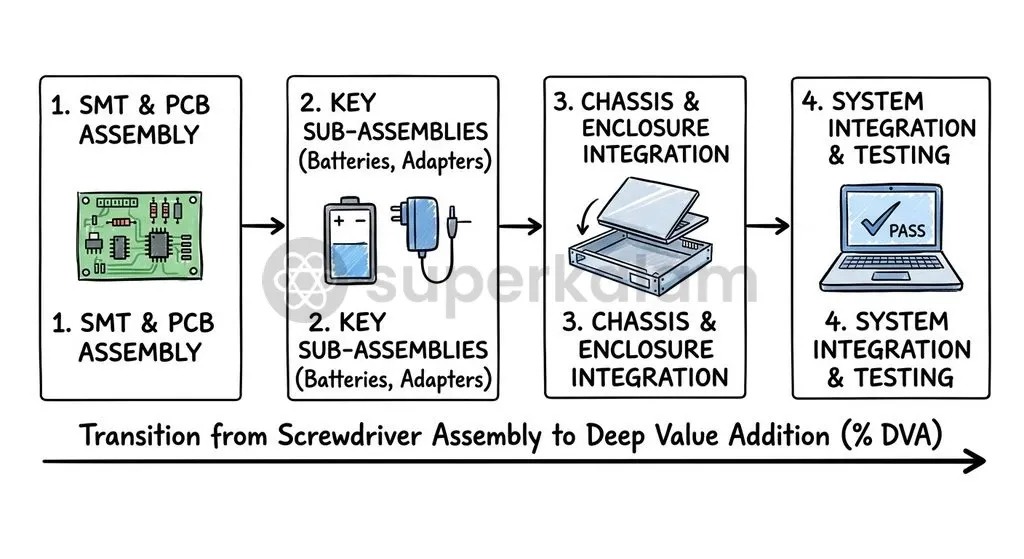
The revised MeitY framework enforces an itemised Bill of Materials breakdown that rewards only verifiable domestic engineering and fabrication steps. According to the MeitY Press Release on Revision of PPP-MII Order 2020 for Six IT Hardware Products (PIB Release ID: 2074819 / 2339142), recognised domestic manufacturing activities include mainboard Surface Mount Technology assembly, bare printed circuit board domestic sourcing, memory module packaging, display assembly, chassis and power supply sourcing, and final testing.
To calculate eligible Domestic Value Addition, manufacturers must account for physical processing stages completed on Indian territory:
- Sub-Assembly Fabrication: Bare PCB fabrication and Surface Mount Technology assembly of the motherboard.
- Component Integration: Local packaging, assembly, and testing of solid-state drives, memory modules, and display panels.
- Mechanical and Electrical Hardware: Domestic tooling and production of chassis enclosures, thermal heat sinks, and internal power adapters.
- Research and Development Credit: Assignment of explicit value weightage to eligible in-house research and product design conducted within India.
- Final Quality Assurance: Complete operational testing, firmware loading, and system integration.
The framework shuts down financial engineering tricks that previously inflated domestic content tallies. As specified by the Department for Promotion of Industry and Internal Trade and MeitY guidelines, the revised methodology explicitly excludes imported items sourced locally from distributors, overseas royalties, software licensing fees, and rebranded or repackaged kits from eligible domestic value addition.
Hardware must clear rigorous quality benchmarks before entering state procurement tenders. Mandatory testing and certification for localised IT hardware components must be completed through Bureau of Indian Standards Compulsory Registration Scheme and Standardisation Testing and Quality Certification labs.
Coupling Procurement with PLI 2.0: Forcing Supply Chains onto Indian Soil
The updated procurement rules join directly with capital subsidies to create a guaranteed market for participating manufacturers. The Union Cabinet approved the Production Linked Incentive Scheme 2.0 for IT Hardware on 17 May 2023 with a total budgetary outlay of ₹17,000 crore over a six-year implementation tenure.
Guidelines for the Operation of Production Linked Incentive Scheme - 2.0 for IT Hardware project that the initiative will generate ₹3.35 lakh crore in incremental production, attract ₹2,430 crore in additional investment, and create 75,000 direct manufacturing jobs. Supply-side capital incentives alone cannot ensure commercial viability if cheap imported hardware floods private retail channels.
Three coordinated mechanisms channel state demand directly to participating factories:
- Off-take Guarantees on GeM: The revised public procurement norms provide that demand guarantee on the Government e-Marketplace portal to secure domestic off-take for firms investing capital under the scheme.
- Purchase Preference Margins: Under DPIIT Revised Order No. P-45021/2/2017-PP (BE-II), a Class-I local supplier must meet a minimum local content threshold of 50% and receives a 20% purchase preference margin over non-local lowest bids.
- Global Tender Restrictions: Rule 161(iv) of the General Financial Rules prohibits issuing Global Tender Enquiries for government procurements with an estimated value below ₹200 crore unless specifically approved by the Department of Expenditure.
Discuss with Superkalam
If a hardware firm imports fully assembled motherboards and packages them in domestically molded plastic chassis, determine whether it qualifies for Class-I preference under the revised Bill of Materials rules.
Ask NowNational Security and Geopolitical De-risking: Cutting Exposure to Chinese Silicon
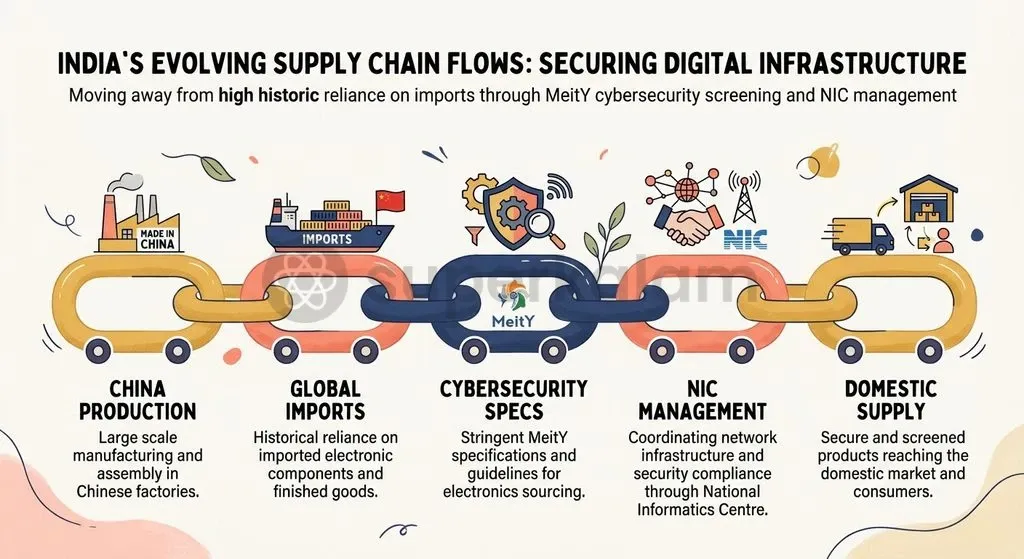
Concentrated import reliance creates acute strategic exposure that drives India's fast-tracked hardware localisation timeline. According to Ministry of Commerce and Industry Trade Statistics (HS 8471), more than 70% of imported laptops, personal computers, and server hardware entering India have historically originated from China.
Heavy reliance on single-country hardware leaves government intranets and critical civilian systems vulnerable to embedded firmware compromises. The central administration relies on a dual-track security response:
- Mandatory Cybersecurity Standards: MeitY Cyber Security Division Office Memorandum No. 8(1)/2023-Cybersecurity issued mandatory minimum technical and cybersecurity specifications for desktops, laptops, and tablets procured by central government bodies to facilitate centralised endpoint security management by the National Informatics Centre.
- Import Management System Oversight: The Directorate General of Foreign Trade placed IT hardware under the Restricted import category, requiring online authorisations via the Import Management System.
This monitoring apparatus remains actively enforced today. The Directorate General of Foreign Trade extended the Import Management System for restricted IT hardware for calendar year 2026, with import authorisations remaining valid until 31 December 2026.
Industry Pushback and Global Trade Friction: The Risks of Retaliation and Supply Bottlenecks
Global hardware manufacturers pushed back when India moved to regulate IT equipment inflows. Global original equipment manufacturers including Apple, HP, Dell, and Lenovo raised concerns regarding trade friction and compliance feasibility when India initially restricted IT hardware imports in 2023, as reported by Reuters on 4 August 2023.
Multinational hardware vendors and state procurement departments encounter three immediate operational bottlenecks:
- Supplier Qualification Bottlenecks: Qualifying local suppliers for bare printed circuit boards and passive components requires extensive validation cycles, assembly line recalibration, and statutory sign-offs.
- Laboratory Testing Capacity Strains: Mandatory certification through Bureau of Indian Standards Compulsory Registration Scheme and Standardisation Testing and Quality Certification labs could trigger testing backlogs, delaying public procurement cycles for schools, research institutions, and administrative departments.
- Multilateral Scrutiny: While GATT Article III:8(a) shields pure public procurement from WTO national treatment challenges, widespread restrictions that spill over into commercial enterprise channels risk friction with major trading counterparties.
Discuss with Superkalam
Analyse the key structural differences between low-depth screwdriver assembly and deep component localisation in terms of capex, value addition, and supply chain vulnerability.
Ask NowWay Forward: Building a Resilient Domestic Component Ecosystem
Moving past screwdriver assembly requires targeted industrial interventions across domestic component clusters. Public procurement preference gives local players breathing room, but durable competitiveness rests on component yields, cheap industrial power, and rapid customs clearance for raw materials.
To consolidate domestic electronics manufacturing capabilities, four operational priorities stand out:
- Component Sub-Assembly Clusters: Establish dedicated industrial parks for passive components, printed circuit boards, and connectors to reduce internal logistics costs.
- Testing and Certification Infrastructure: Expand the processing capacity and automated testing bays of Standardisation Testing and Quality Certification laboratories to eliminate certification backlogs.
- Domestic Intellectual Property Incentives: Enhance research and development tax credits and patent filing support under MeitY programmes to support homegrown hardware architectures.
- Skilled Technical Workforce: Align national technical training curricula with advanced Surface Mount Technology operations, precision tooling, and semiconductor packaging techniques.
By uniting public procurement power, capital subsidies, and enforceable component rules, India can systematically replace screwdriver assembly with genuine technological sovereignty in computer hardware.
Key Takeaways
- The Ministry of Electronics and Information Technology overhauled domestic value addition rules for six IT hardware product categories under the Public Procurement Order, 2017.
- Traditional electronics assembly in India historically added only 5% to 15% domestic value, trapping domestic industry in low-margin screwdriver operations.
- The 1996 WTO Information Technology Agreement prohibits border tariffs on IT hardware, forcing India to use GATT Article III:8(a) government procurement exceptions as its primary industrial policy lever.
- Public procurement rules require Class-I local suppliers to achieve at least 50% local content, providing a 20% margin of purchase preference on state contracts.
- Supply-side support under the ₹17,000-crore IT Hardware PLI 2.0 couples with demand-side off-take guarantees on the Government e-Marketplace portal.
- More than 70% of India's imported IT hardware has historically originated from China, prompting strict technical standards and centralised cybersecurity oversight by the National Informatics Centre.
Mains Question
"Bound by WTO ITA-1 tariff constraints, India is increasingly turning to public procurement leverage to overcome the low-depth 'screwdriver assembly trap' in domestic electronics." Discuss. (150 words) (10 Marks)
Evaluate NowMains Question
Critically examine how the revised Domestic Value Addition calculation methodology under the Public Procurement Order, 2017 seeks to foster deep component manufacturing while mitigating strategic supply chain risks. (250 words) (15 Marks)
Evaluate NowPractice MCQs
QUESTION 1
With reference to the revised domestic value addition rules for IT hardware under the Public Procurement Order, 2017, consider the following statements:
- The revised framework replaces generic self-declared value claims with an itemised Bill of Materials calculation.
- Eligible domestic value addition includes imported items sourced locally from domestic distributors.
- The calculation explicitly assigns value weightage to eligible in-house research and product design conducted within India. Which of the statements given above are correct?
QUESTION 2
Regarding international trade rules and public procurement in India's electronics sector, consider the following statements:
- Under the WTO Information Technology Agreement (ITA-1), India is committed to maintaining a zero-customs-duty regime on IT hardware classified under HS Code 8471.
- Article III:8(a) of the General Agreement on Tariffs and Trade (GATT) 1994 prohibits member states from exempting government procurement from national treatment obligations.
- In April 2023, a WTO Dispute Settlement Panel ruled against India regarding tariffs imposed on certain information and communications technology goods. Which of the statements given above is/are correct?
QUESTION 3
Consider the following statements regarding government procurement provisions under the Public Procurement (Preference to Make in India) Order and General Financial Rules:
- A Class-I local supplier is required to meet a minimum local content threshold of 50%.
- Class-I local suppliers are entitled to a 20% purchase preference margin over non-local lowest bids.
- Rule 161(iv) of the General Financial Rules prohibits issuing Global Tender Enquiries for procurements valued below ₹200 crore unless specifically approved by the Department of Expenditure. Which of the statements given above are correct?
QUESTION 4
The Production Linked Incentive (PLI) Scheme 2.0 for IT Hardware, approved in May 2023, was designed with which of the following projected targets over its six-year tenure?
QUESTION 5
Consider the following physical manufacturing operations in electronics hardware:
- Bare PCB fabrication
- Surface Mount Technology (SMT) assembly of motherboards
- Memory module packaging and testing
- Rebranding and packaging imported SKD kits Which of the operations listed above are recognised for calculating eligible Domestic Value Addition under the revised MeitY framework?
Discuss with Superkalam
Propose policy interventions beyond public procurement preference that could help build an indigenous component and semiconductor sub-tier ecosystem in India.
Ask Now