Tulu Language Recognition: Article 345 and Eighth Schedule
While states hold independent powers under Article 345 for official languages, inclusion in the Eighth Schedule demands rigorous constitutional consensus.
Sep, 2026
•9 min read

Overview
Demands for constitutional recognition of Tulu highlight a fundamental structural divide in Indian linguistic governance. While State Legislatures hold plenary constitutional authority under Article 345 to adopt regional languages for administrative purposes, inclusion in the Eighth Schedule requires a parliamentary constitutional amendment governed by unresolved national criteria.
This institutional tension illustrates why regional linguistic preservation cannot depend solely on central recognition. State-level administrative adoption, statutory protections for linguistic minorities, and educational access under Article 350A provide immediate constitutional avenues for cultural safeguarding while national policy debates continue.
Why in the News: The Renewed Push for Tulu's Official Status
The Karnataka State Cabinet moved to recognise Tulu as a second additional administrative language for Dakshina Kannada and Udupi districts, as reported in September 2026. This administrative measure included an initial budgetary allocation of Rs 82 lakh dedicated to administrative translation and departmental training, according to reportage on the Government of Karnataka Cabinet decision.
The long-standing campaign for Tulu operates across two parallel legal tracks:
- State-Level Adoption (Article 345): Linguistic groups urge the state government to exercise its legislative powers under Article 345 of the Constitution of India for local governance.
- National Recognition (Article 368): Regional representatives lobby the Union Government to include Tulu in the Eighth Schedule, requiring a formal constitutional amendment passed by Parliament under Article 368.
This dual approach reflects the core framework of language policy in India. State-level statutory adoption provides an immediate governance mechanism for regional tongues. In contrast, inclusion in the Eighth Schedule represents a separate national classification governed by parliamentary discretion.
Discuss with Superkalam
Which two committees were constituted by the Union Government to formulate criteria for the Eighth Schedule?
Ask NowUnderstanding Tulu: Linguistic Roots, Tulu Nadu Region, and Script Revival
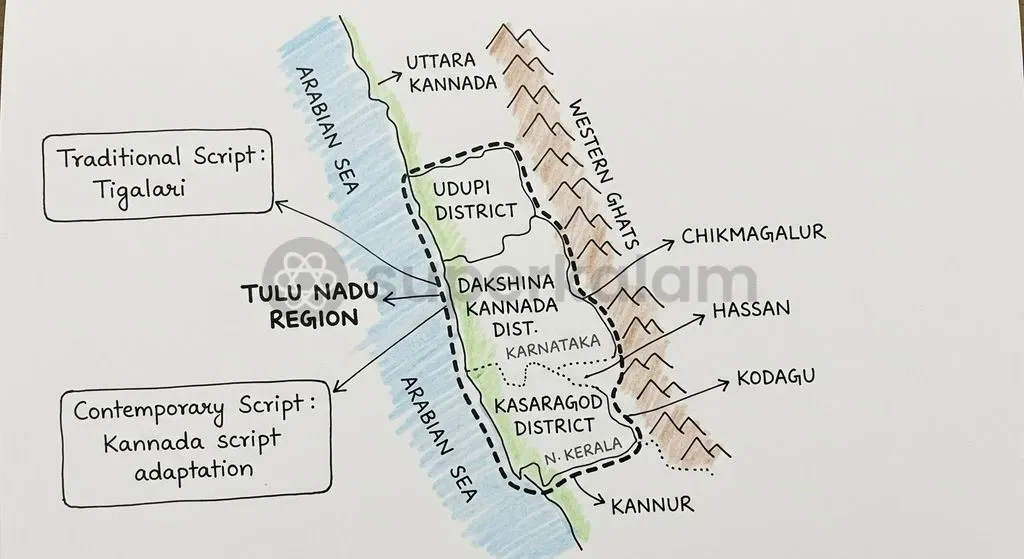
Tulu is an ancient South Dravidian language spoken primarily in the socio-cultural coastal belt historically designated as Tulu Nadu. According to the Central Institute of Indian Languages, this traditional cultural geography spans the Dakshina Kannada and Udupi districts of Karnataka along with the northern parts of the Kasaragod district in Kerala.
| State | Districts / Regions in Tulu Nadu |
|---|---|
| Karnataka | Dakshina Kannada, Udupi |
| Kerala | Northern Kasaragod |
The literary and epigraphic history of Tulu reflects unique orthographic transitions over centuries:
- Historical Script: Scholars recorded classical Tulu using the Tigalari script (also known as Tulu-Tigalari), an ancient writing system derived from the southern Grantha script, according to Unicode Technical Committee documentation.
- Contemporary Writing Systems: In contemporary usage, native speakers print and write Tulu predominantly using the Kannada script, while speakers in the Kasaragod region occasionally employ the Malayalam script.
- Digital Standardisation: Recent linguistic preservation efforts have concentrated on reviving the Tigalari script through standard digital encoding to preserve historic manuscripts and religious palm-leaf records.
How States Choose Their Official Languages: Constitutional Power Under Article 345
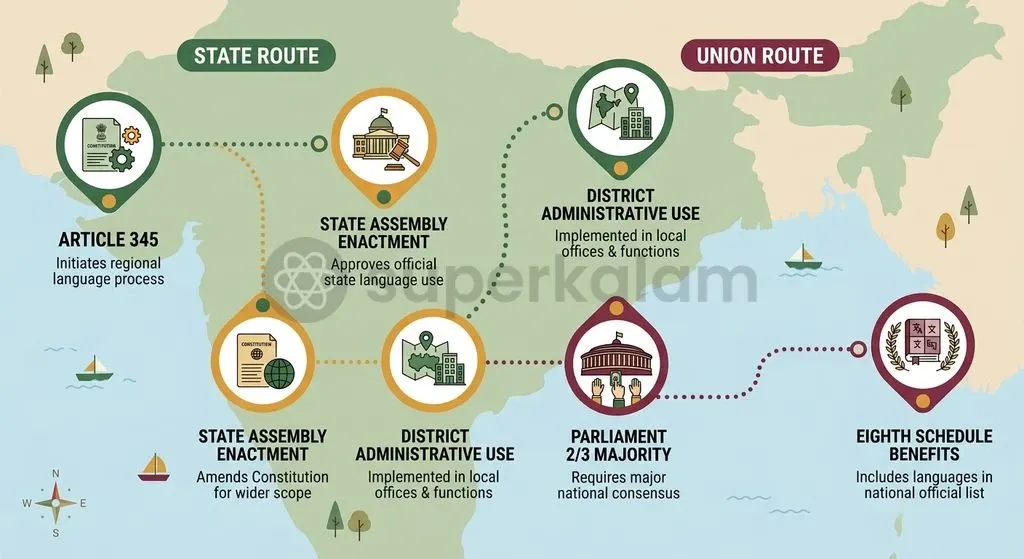
Article 345 of the Constitution of India establishes the constitutional authority of State Legislatures over regional language adoption. Under this provision, a state legislature may by law adopt any one or more of the languages in use in the state, or Hindi, for all or any official purposes of that state.
The constitutional framework establishes distinct pathways for sub-national language recognition:
- State Legislative Enactment (Article 345): State legislatures possess independent legislative competence under the State List and general constitutional provisions to declare official or additional official languages without requiring Union concurrence.
- Presidential Directive (Article 347): On a demand being made, the President of India may direct a state government to officially recognise a language spoken by a substantial proportion of its population across the entire state or any specific part thereof.
- Mother-Tongue Primary Education (Article 350A): Inserted through the Constitution (Seventh Amendment) Act, 1956, this directive mandates every state and local authority to provide adequate facilities for instruction in the mother-tongue at the primary stage to children belonging to linguistic minority groups.
- Special Officer for Linguistic Minorities (Article 350B): The President appoints a Special Officer to investigate all matters relating to constitutional safeguards provided for linguistic minorities and report directly to the President.
Discuss with Superkalam
Explain how the powers under Article 345 differ from those under Article 347 regarding the official recognition of languages.
Ask NowThe Eighth Schedule Route: Criteria, Past Committees, and Why It Is Difficult
The Eighth Schedule to the Constitution of India originally listed 14 languages in 1950 and has since expanded to 22 recognized languages through three successive constitutional amendments.
The Union Government has repeatedly encountered difficulties in establishing objective metrics for evaluating inclusion demands. As noted by the Ministry of Home Affairs in a parliamentary submission, two separate official committees examined this question without reaching a definitive standard:
- Ashok Pahwa Committee (1996): Set up to formulate criteria for the inclusion of languages in the Eighth Schedule, the committee examined administrative and demographic benchmarks but concluded without establishing a binding formula.
- Sitakant Mohapatra Committee (2003): Constituted to propose objective criteria, the committee submitted its report to the Union Government, yet the Ministry of Home Affairs found the formulation of universal criteria unfeasible due to India's vast linguistic diversity.
According to the Ministry of Home Affairs, the Union Government faces active demands for the inclusion of 38 languages, including Tulu, Bhojpuri, Rajasthani, Khasi, Kodava, and Bhoti. Because there are no codified, objective statutory criteria, every addition to the Eighth Schedule requires a political and legislative consensus to pass a Constitutional Amendment Bill under Article 368.
| Feature | State Official Language (Article 345) | Eighth Schedule Inclusion (Article 368) |
|---|---|---|
| Enacting Authority | State Legislature by state enactment | Parliament of India by Constitutional Amendment |
| Constitutional Basis | Article 345 | Eighth Schedule read with Articles 344(1) and 351 |
| Geographic Scope | Applicable within the declaring State or specific districts | Pan-Indian constitutional recognition |
| Administrative Purpose | State administration, court notifications, local governance | Union commissions, Sahitya Akademi awards, national exams |
| Current Number | Determined independently across various states | Fixed at 22 languages across the Union |
Discuss with Superkalam
How can a state government use Article 350A alongside Article 345 to safeguard a minority language within specific districts?
Ask NowCensus Rules on Language: The 10,000-Speaker Threshold and Mother Tongue Data
The Office of the Registrar General and Census Commissioner of India enforces specific demographic standards when processing language returns. In the Census of India methodology, only non-scheduled languages and mother tongues returned by 10,000 or more speakers at the all-India level are classified and presented separately in Part B of Table C-16.
All individual mother-tongue returns with fewer than 10,000 speakers are grouped under an umbrella category termed "Others" at the district and state levels.
| Step | Census Language Classification Stage |
|---|---|
| 1 | Enumeration of all spoken mother tongues across households |
| 2 | Application of the national 10,000-speaker threshold filter |
| 3 | Part A: 22 Scheduled Languages and affiliated mother tongues |
| 4 | Part B: Non-Scheduled Languages (≥10,000 speakers, such as Tulu) |
In the 2011 Census of India, Tulu was recorded as an independent non-scheduled language with 1,846,427 native speakers nationwide. This demographic strength places Tulu well above the statutory census reporting threshold, providing empirical grounding for its speakers' administrative and cultural representations.
Discuss with Superkalam
Analyze why linguistic demands often target Eighth Schedule inclusion rather than stopping at state-level administrative recognition.
Ask NowWhat Changes When a Language Joins the Eighth Schedule?
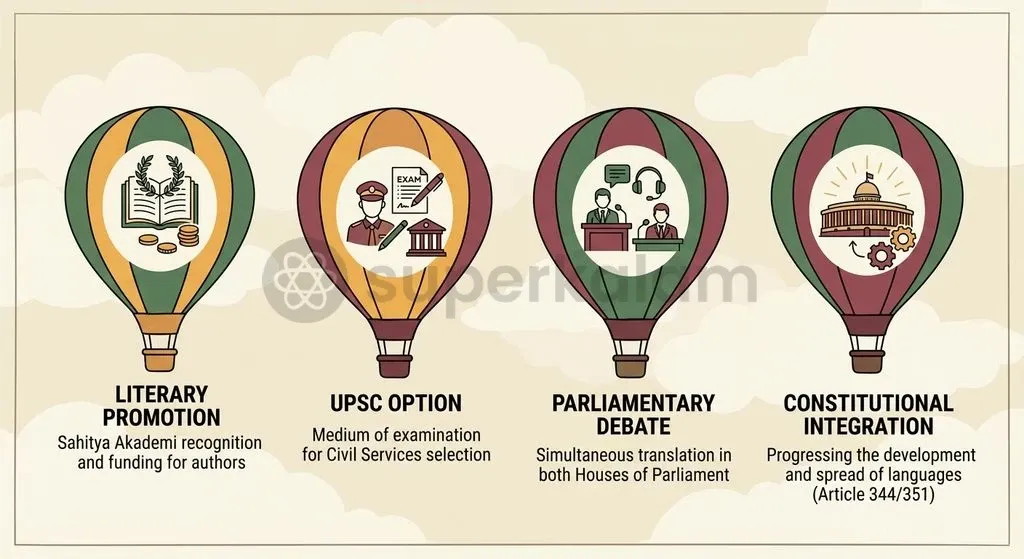
Inclusion in the Eighth Schedule confers several institutional privileges and protections across national administration, literature, and competitive examinations:
- Literary Patronage: The language receives formal recognition from the Sahitya Akademi, entitling writers to annual national literary awards and dedicated central grants for translating works into other recognized Indian languages.
- UPSC Civil Services Examination: Candidates are permitted to write all Mains general studies and essay papers in the language, opt for its literature as an optional subject, and use it to satisfy the mandatory Indian Language qualifying paper (Paper A).
- Parliamentary Proceedings: Members of the Lok Sabha and Rajya Sabha gain the statutory right to address their respective Houses in the language, backed by simultaneous interpretation facilities into Hindi and English under parliamentary rules of procedure.
- Official Language Commission Representation: Under Article 344(1), the President may include representatives of the language when constituting the Official Language Commission.
- Enrichment of Hindi: Under Article 351, the Union Government holds a constitutional directive to develop the Hindi language by assimilating expressions, forms, and styles from the languages specified in the Eighth Schedule.
Linguistic Federalism in India: Balancing Cultural Aspirations and Governance
India's constitutional design approaches linguistic diversity through a layered model of asymmetric federalism. The framers avoided establishing a single national language, instead creating distinct functional tiers for Union official business, interstate communication, and state-level governance.
This framework grants State Legislatures autonomous authority to promote regional idioms without awaiting central assent. When a state adopts a regional language under Article 345, it creates immediate opportunities for inclusive public administration:
- Public welfare notifications and land records can be processed in the regional idiom.
- Citizens can file administrative grievances in their native tongue before local bodies.
- Local educational curricula can integrate regional scripts under municipal oversight.
Relying exclusively on Eighth Schedule amendments can inadvertently centralise language policy. Because the Eighth Schedule requires a special parliamentary majority under Article 368, smaller linguistic communities often face political delays. Exercising state legislative competence under Article 345 offers a pragmatic, decentralised solution that fulfils regional linguistic aspirations while respecting constitutional boundaries.
Discuss with Superkalam
Weigh whether establishing fixed demographic criteria for the Eighth Schedule is desirable or if parliamentary discretion under Article 368 remains the better approach.
Ask NowThe Way Forward: Protecting Minor and Regional Languages
Protecting India's non-scheduled languages requires cooperative initiatives across Union and State jurisdictions:
- Decentralised State Enactments: State governments should actively use Article 345 to designate significant non-scheduled regional tongues, including Tulu and Kodava, as additional administrative languages in their predominant districts.
- Standardised Mother-Tongue Primary Education: District administrations must implement the mandate of Article 350A by developing primary bilingual textbooks and training teachers in local mother tongues.
- Objective National Evaluation Criteria: The Union Ministry of Home Affairs should revisit the findings of the Ashok Pahwa and Sitakant Mohapatra committees to frame transparent, rule-based benchmarks for future Eighth Schedule inclusions.
- Digital Archiving and Linguistic Documentation: State cultural academies and institutions like the Central Institute of Indian Languages must fund digital font standardisation, Unicode compliance for historical scripts like Tigalari, and comprehensive manuscript preservation.
Key Takeaways
- Article 345 grants State Legislatures independent constitutional authority to adopt any language in use in the state for official administrative purposes.
- Inclusion in the Eighth Schedule requires a Constitutional Amendment Bill passed by Parliament under Article 368, expanding a list that grew from 14 languages in 1950 to 22 today.
- The Ashok Pahwa Committee (1996) and Sitakant Mohapatra Committee (2003) were tasked with creating objective Eighth Schedule criteria, but both efforts concluded without a settled national formula.
- In the 2011 Census, Tulu recorded 1,846,427 native speakers, far exceeding the 10,000-speaker threshold required for independent enumeration under Part B of Table C-16.
- Eighth Schedule inclusion provides access to Sahitya Akademi awards, examination mediums for UPSC CSE Mains papers, and simultaneous interpretation in Parliament.
Mains Question
"While State Legislatures possess plenary authority under Article 345 to adopt regional languages, Eighth Schedule inclusion remains constrained by the absence of codified national criteria." Elucidate. (10 Marks)
Evaluate NowMains Question
Critically examine the institutional and federal challenges involved in accommodating demands for Eighth Schedule inclusion by non-scheduled linguistic groups. (15 Marks)
Evaluate NowPractice MCQs
QUESTION 1
With reference to the constitutional provisions regarding official languages in India, consider the following statements:
- Under Article 345, a State Legislature has the plenary authority to adopt any language in use in the State or Hindi for all or any official purposes without requiring prior Union concurrence.
- Article 347 empowers the President to direct a State Government to officially recognise a language spoken by a substantial proportion of its population.
- Article 350A mandates every State and local authority to provide adequate facilities for mother-tongue instruction at the secondary education stage to linguistic minority groups.
Which of the statements given above are correct?
QUESTION 2
Regarding the Eighth Schedule to the Constitution of India, consider the following statements:
- The Eighth Schedule originally contained 14 languages in 1950 and has been expanded to 22 languages through constitutional amendments.
- The Ashok Pahwa Committee (1996) and the Sitakant Mohapatra Committee (2003) successfully laid down universal, legally binding criteria for language inclusion in the Eighth Schedule.
- Inclusion of a language in the Eighth Schedule requires a Constitutional Amendment Bill passed under Article 368.
Which of the statements given above is/are correct?
QUESTION 3
Consider the following statements regarding the linguistic and geographical profile of Tulu:
- Tulu is classified linguistically as a South Dravidian language.
- The traditional cultural region of Tulu Nadu spans districts in both Karnataka and Kerala.
- Classical Tulu was historically recorded using the Tigalari script, derived from the southern Grantha script.
Which of the statements given above are correct?
QUESTION 4
In the Census of India methodology, what is the minimum speaker threshold required at the all-India level for a non-scheduled mother tongue to be classified and reported separately in Part B of Table C-16?
QUESTION 5
Which of the following institutional privileges are conferred upon a language when it is included in the Eighth Schedule to the Constitution of India?
- Formal recognition and annual national literary awards from the Sahitya Akademi.
- Eligibility for candidates to use the language as an optional subject in the UPSC Civil Services Examination.
- Automatic declaration as an official language in all Union Ministries.
- Provision of simultaneous interpretation facilities during parliamentary proceedings.
Select the correct answer using the code given below: