TRAFFIC Tiger Trafficking Report 2025: Findings and Conservation
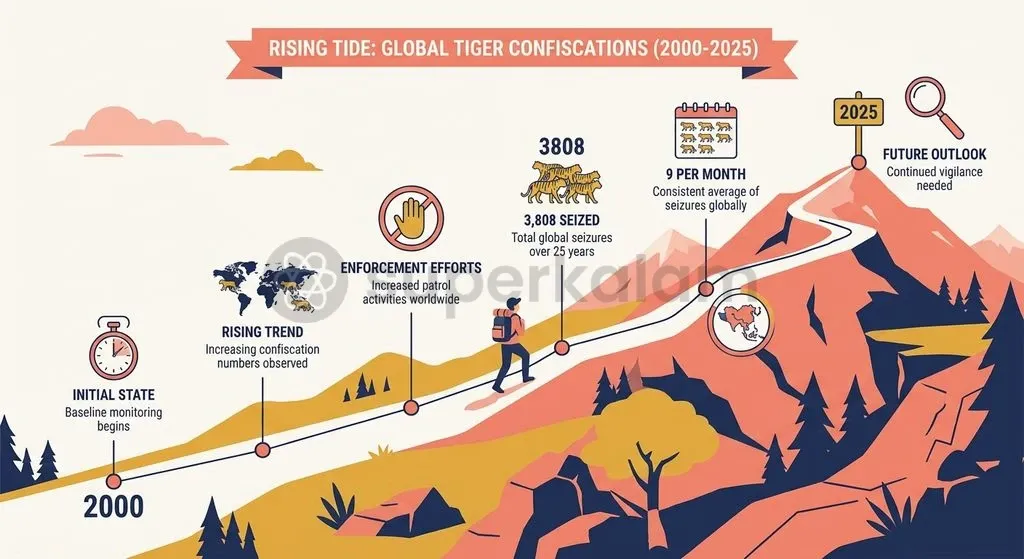
TRAFFIC recorded 2,551 seizures equivalent to at least 3,808 tigers from 2000 to June 2025. See the findings, wildlife trade risks and conservation measures.
Sep, 2026
•9 min read

Overview
The global wildlife trade monitoring network TRAFFIC published 'Beyond Skin and Bones: A 25-Year Analysis of Tiger Seizures', documenting 2,551 confiscation incidents accounting for at least 3,808 tigers worldwide between January 2000 and June 2025. Tiger Range Countries accounted for 83% of confiscated tigers, with illicit commercial networks increasingly trafficking whole live or dead specimens alongside body parts.
While in situ conservation has stabilised wild populations inside core protected areas, commercial captive breeding facilities and transnational smuggling syndicates continue to stimulate retail demand. Sustained species recovery requires moving beyond administrative reserve boundaries. Enforcement agencies must dismantle ex-reserve transit corridors, monitor digital wildlife trade, and enforce international legal frameworks against commercial tiger exploitation.
Why is the TRAFFIC Tiger Trafficking Report in the News?
As of November 2025, global wildlife monitoring network TRAFFIC published its comprehensive 25-year assessment documenting illegal tiger seizures across 13 Tiger Range Countries between 2000 and 2025. The analysis shows that illegal commerce remains an active conservation crisis.
Key enforcement metrics from the report include:
- Global Seizure Volumes: Law enforcement agencies confiscated 573 tigers across 765 incidents globally between January 2020 and June 2025.
- High Interdiction Frequency: Global confiscations averaged approximately nine tigers seized monthly during this five-year window, underscoring persistent syndicate operations.
- Rising Seizure Rate in India: Indian authorities confiscated 23 tigers in illegal seizures during the first six months of 2025 alone, almost matching the total of 25 tigers seized nationwide throughout 2024.
What is TRAFFIC and What is the 'Beyond Skin and Bones' Series?
TRAFFIC is an international non-governmental wildlife trade monitoring network established in 1976 as a joint initiative of the World Wide Fund for Nature and the IUCN. The organisation specialises in investigating illicit wildlife supply chains, assessing compliance with conservation treaties, and providing policy recommendations to national governments and multilateral bodies.
The 'Beyond Skin and Bones' series represents TRAFFIC's flagship longitudinal study tracking global tiger seizures. The report aggregates official law enforcement data, court records, and verified confiscation reports across Tiger Range Countries to map trafficking hotspots, shifting consumer preferences, and enforcement efficacy over multi-decade intervals.
Discuss with Superkalam
Which statutory authority was established under Section 38L of the Wildlife (Protection) Act, 1972 to supervise tiger conservation in India?
Ask NowKey Findings: Major Trends in Global Tiger Seizures and Trade
Seizure metrics compiled by TRAFFIC Southeast Asia reveal that 13 Tiger Range Countries accounted for 83% of all confiscated tigers and 77% of global seizure incidents. Between January 2000 and June 2025, authorities recorded 2,551 seizure incidents representing at least 3,808 individual tigers globally.
The physical composition of seized tiger contraband has undergone a notable structural transformation:
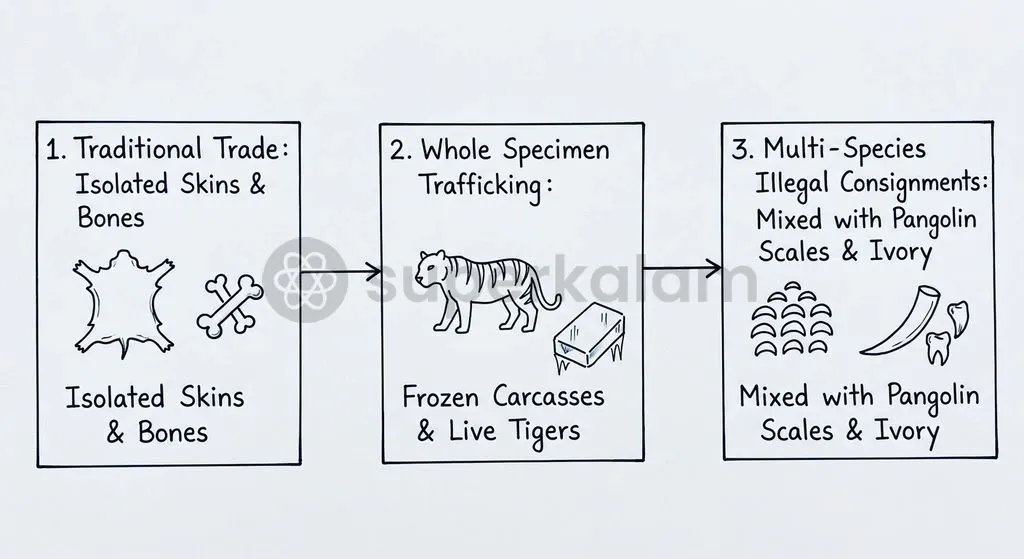
- Surge in Whole Tiger Seizures: Confiscations involving whole tigers (dead or alive) rose from roughly 10% of total seizures in the early 2000s to over 40% between 2020 and 2025.
- High Multi-Species Commingling: Nearly 20% of global tiger seizures involved multi-species consignments, where tiger contraband was concealed alongside pangolin scales, elephant ivory, bear parts, ungulate derivatives, and leopard skins.
- Concentrated Seizure Volumes: The majority of interdictions remain concentrated in key range states where wild populations overlap with organised smuggling infrastructure.
Beyond Skins and Bones: Which Tiger Parts are Most in Demand?
Illicit consumer markets drive demand for diverse tiger derivatives ranging from whole dead carcasses and traditional medicinal tonics to luxury status jewellery and talismans. Consumer preference has expanded beyond traditional raw skins and dried bones to encompass processed luxury products and live animals.
| Commodity Category | Specific Derivatives | Primary Consumer Driver |
|---|---|---|
| Medicinal Tonics & Health | Tiger bones, bone wine, boiled gelatine | Traditional Asian medicine formulations and vitality tonics |
| Status Symbols & Jewellery | Canine teeth, claws, carved bone items | Luxury talismans, personal ornamentation, and prestige gifting |
| Decorative & Taxidermy | Whole skins, taxidermy mounts, skulls | High-end interior décor and illicit luxury collections |
| Live Specimens & Exotic Pets | Live cubs, juveniles, mature adult tigers | Private menageries, entertainment venues, and commercial breeding |
Commercial demand for claws and teeth reflects a growing consumer appetite for wearable status jewellery, whereas whole carcasses serve commercial processors manufacturing bone wine and medicinal pastes.
Discuss with Superkalam
Why does commercial captive tiger breeding fail to relieve hunting pressure on wild tiger populations?
Ask NowCaptive Tiger Facilities vs Wild Populations: The 'Tiger Farm' Dilemma
Commercial captive tiger facilities across Southeast Asia and China hold over 8,000 tigers that actively leak specimens into domestic and transnational illegal trade networks. According to reports by the CITES Secretariat Standing Committee on Asian Big Cats, these private facilities sustain commercial tiger markets under the guise of captive breeding and tourism.
Captive breeding centres complicate wild tiger protection in several ways:
- Laundering Wild Specimens: Traffickers pass off wild-poached tiger parts as captive-bred derivatives, evading wildlife forensic verification.
- Perpetuating Market Demand: Continuous supply from commercial facilities legitimises consumer demand for tiger products, preventing demand-reduction campaigns from eroding market appetite.
- Economic Incentives: Poaching wild tigers remains substantially cheaper than feeding and maintaining captive tigers to maturity, which keeps wild populations under constant commercial hunting pressure.
Where is the Trade Moving? Key Smuggling Routes and Source Countries
Transnational trafficking syndicates exploit porous overland corridors connecting source habitats in Central India to illicit transit hubs across Northeast India and Myanmar. Major trafficking pipelines rely on complex multi-state networks to move contraband from core forest habitats toward international border crossings.
Recent investigations highlight specific routes and enforcement actions across these corridors:
- Targeting Transnational Kingpins: In December 2025, the Madhya Pradesh State Tiger Strike Force and the Wildlife Crime Control Bureau executed an INTERPOL Red Notice arrest of international trafficker Yangchen Lachungpa in Sikkim for orchestrating transboundary tiger part shipments into cross-border transit routes.
- The Central-to-Northeast Transit Pipeline: As reported by The Indian Express, joint operations between the Wildlife Crime Control Bureau, Assam Police, and Maharashtra Forest Department between 2023 and 2025 dismantled an organised pipeline moving tiger parts from Chandrapur in Maharashtra through Guwahati to Zokhawthar in Mizoram, and across the international border to wildlife dealers in Tahan, Myanmar.
Discuss with Superkalam
How do complex multi-state transit pipelines (such as Chandrapur to Mizoram and Myanmar) exploit gaps between reserve-level monitoring and border enforcement?
Ask NowIndia's Tiger Conservation Record and Existing Enforcement Safeguards
India shelters approximately 75% of the global wild tiger population, housing an estimated average of 3,682 individuals according to the 2022 national census. The statutory quadrennial estimation recorded a minimum baseline of 3,167 individual tigers, demonstrating substantial population recovery across key forest landscapes.
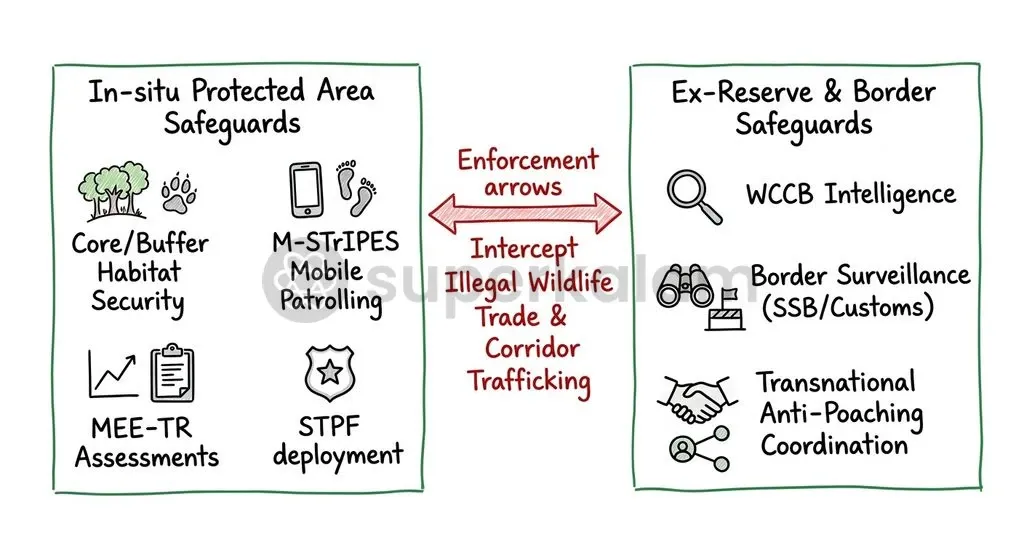
India's domestic enforcement framework integrates ground-level patrol monitoring with administrative landscape evaluations:
- M-STrIPES Digital Patrolling: The Monitoring System for Tigers - Intensive Protection and Ecological Status provides a patented GIS-based mobile application mandated across all Tiger Reserves to record ranger patrol tracks, detect poaching signs, and log ecological data.
- Management Effectiveness Evaluation (MEE-TR): Periodic evaluations assess administrative, financial, and ecological integrity inside reserve boundaries.
Management evaluations focus primarily on in situ administrative benchmarks within designated reserves. By contrast, TRAFFIC seizure data tracks ex-reserve commercial flows, uncovering poaching pressures along fragmented corridor habitats that lie outside formal reserve boundaries.
Key Legal and Institutional Frameworks Protecting Tigers
The Wildlife (Protection) Act, 1972 provides the primary statutory foundation for tiger conservation and anti-poaching operations across India. Key institutions and statutory provisions govern domestic protection and international trade restrictions:
- National Tiger Conservation Authority (NTCA): Constituted as a statutory authority under Section 38L of the Wildlife (Protection) Act, 1972 (following 2006 amendments) to supervise Project Tiger and approve Tiger Conservation Plans.
- Wildlife Crime Control Bureau (WCCB): Established under Section 38Y of the Act as a statutory multi-disciplinary body tasked with collecting criminal intelligence, maintaining centralised crime databases, and coordinating inter-agency enforcement operations.
- Stringent Penal Sanctions: The Wild Life (Protection) Amendment Act, 2022 classifies Panthera tigris under Schedule I, prescribing imprisonment up to seven years and fines up to 25 lakh rupees for hunting or trading offences involving protected species inside sanctuaries or national parks.
- CITES Appendix I Listing: Panthera tigris has been listed on Appendix I of the Convention on International Trade in Endangered Species of Wild Fauna and Flora since 1975, strictly banning all international commercial trade in wild specimens and body derivatives.
Discuss with Superkalam
Given that management evaluations (MEE-TR) focus on in situ reserve health while seizures occur along ex-reserve corridors, how should anti-poaching resource allocation be balanced?
Ask NowWhy Does Tiger Trafficking Persist? Major Enforcement Gaps
Wildlife law enforcement faces structural bottlenecks including low prosecution conviction rates, digital evasion tactics by syndicates, and jurisdictional fragmentation across international borders.
A multi-agency prosecution study conducted by GuArdean, WWF, and TRAFFIC ('From Seizure to Sentence', June 2026) revealed that only 42% of documented tiger trafficking cases across seven Southeast Asian range states between 2019 and 2024 ended in convictions carrying prison terms or fines.
Trafficking syndicates have also modified their operational tactics to evade detection:
- Migration to Closed Online Platforms: Illicit vendors increasingly use closed-loop encrypted messaging apps, invite-only forums, and digital payment wallets to negotiate transactions without maintaining physical storefronts.
- Porous Transboundary Borders: Wildlife contraband readily crosses remote frontier checkpoints that lack dedicated wildlife forensic equipment or specialised customs screening.
- Corridor Vulnerabilities Outside Reserves: While core tiger reserves receive intensive patrolling, territorial forest divisions and connecting wildlife corridors remain vulnerable to local poaching networks.
Way Forward: Strengthening Cross-Border Intelligence and Habitat Security
Effective deterrence requires integrating forensic wildlife tracking, real-time cross-border intelligence sharing, and stricter regulation of commercial captive breeding facilities across Asia. Tackling transnational wildlife networks requires coordinated policy responses at domestic, bilateral, and global tiers.
Key policy priorities include:
- Expanding Cyber-Wildlife Surveillance: Enhancing specialised digital investigation units within the Wildlife Crime Control Bureau to monitor closed social platforms, track crypto-payments, and intercept online wildlife trade networks.
- Phase-Out of Commercial Tiger Farms: Enforcing strict compliance under CITES Resolution Conf. 12.5 (Rev. CoP19) to audit, register DNA profiles, and progressively close commercial facilities holding over 8,000 captive tigers.
- Landscape-Level Corridor Protection: Extending systematic M-STrIPES patrolling protocols beyond reserve boundaries to encompass territorial forest divisions and ecological corridors.
- Bilateral Enforcement Coordination: Institutionalising joint intelligence protocols with neighbouring transit states to intercept cross-border smuggling syndicates operating along eastern land routes.
Key Takeaways
- 25-Year Seizure Scale: Between 2000 and June 2025, TRAFFIC recorded 2,551 seizure incidents representing at least 3,808 individual tigers globally, with 83% of confiscated tigers originating in the 13 Tiger Range Countries.
- Shift to Whole Specimens: Confiscations of whole tigers (live or dead) increased from approximately 10% in the early 2000s to over 40% between 2020 and 2025.
- Captive Facility Pressures: Over 8,000 captive tigers held across commercial facilities in Southeast Asia and China continue to leak derivatives into illicit markets, sustaining consumer demand.
- Statutory Protection in India: Tigers receive maximum protection under Schedule I of the Wild Life (Protection) Act, 1972, with operational oversight provided by the NTCA (Section 38L) and intelligence coordination by the WCCB (Section 38Y).
- Enforcement Bottlenecks: Prosecution analysis shows that only 42% of documented tiger trafficking cases across seven Southeast Asian range states between 2019 and 2024 resulted in legal convictions with penalties.
Mains Question
"While in situ monitoring tools like M-STrIPES and Management Effectiveness Evaluations (MEE-TR) have reinforced protection within designated reserves, wildlife trade data reveals that ex-reserve corridors remain highly vulnerable to organized transnational syndicates." Critically examine this statement in light of TRAFFIC's 25-year tiger seizure analysis. (15 Marks)
Evaluate NowMains Question
"Commercial captive tiger facilities, rather than alleviating commercial pressure on wild populations, actively stimulate illegal trade and complicate enforcement." Elucidate the mechanisms through which 'tiger farms' undermine global wild tiger conservation. (10 Marks)
Evaluate NowPractice MCQs
QUESTION 1
With reference to the wildlife trade monitoring network TRAFFIC and its findings in the 'Beyond Skin and Bones' report, consider the following statements: 1. TRAFFIC was established as a joint initiative of the World Wide Fund for Nature (WWF) and the IUCN. 2. Confiscations involving whole tigers (dead or alive) decreased significantly as a proportion of total seizures between 2020 and 2025 compared to the early 2000s. 3. Nearly 20% of global tiger seizures involved multi-species consignments concealed alongside contraband from other wildlife species. Which of the statements given above are correct?
QUESTION 2
Consider the following statements regarding commercial captive tiger breeding facilities and wild tiger conservation: 1. Captive facilities across Southeast Asia and China hold over 8,000 tigers. 2. Commercial captive breeding eliminates poaching pressure because captive-bred tiger derivatives are cheaper to produce than hunting wild specimens. Which of the statements given above is/are correct?
QUESTION 3
With reference to tiger conservation and enforcement safeguards in India, consider the following statements: 1. The National Tiger Conservation Authority (NTCA) is a statutory body constituted under Section 38L of the Wildlife (Protection) Act, 1972. 2. M-STrIPES is a patented GIS-based mobile application mandated across Tiger Reserves to log patrol tracks and ecological data. 3. According to the 2022 national census, India accounts for approximately 75% of the global wild tiger population. Which of the statements given above is/are correct?
QUESTION 4
In the context of transnational wildlife crime investigations reported by enforcement agencies in India, which of the following represents the dismantled pipeline used to traffic tiger parts from Central India to international borders?
QUESTION 5
Consider the following statements regarding seizure metrics from TRAFFIC's 25-year assessment: 1. The 13 Tiger Range Countries accounted for more than 80% of all tigers confiscated globally between 2000 and 2025. 2. Indian enforcement agencies seized 23 tigers in the first six months of 2025, nearly matching the total seized nationwide in all of 2024. Which of the statements given above is/are correct?