Toxic Fairness Creams: Health Risks, Drug Laws, and Regulation in India
Behind fair skin promises lies severe chemical toxicity, exposing critical gaps in India's drug regulatory enforcement and consumer safety oversight.
Nov, 2026
•12 min read

Context
Adulterated skin-lightening cosmetics circulate widely across India. This trade exposes a severe enforcement breakdown under the Drugs and Cosmetics Act, 1940, letting toxic formulations slip into everyday use.
Statutory rules ban intentional mercury addition and restrict potent bleaching agents. Yet retail pharmacies and e-commerce platforms routinely bypass these safeguards. Uninformed consumers face irreversible dermal damage, systemic nephrotoxicity, and neurological harm.
This crisis persists because clinical risks intersect directly with social colourism, weak post-market testing, and split oversight between central and state regulators. Halting it requires plugging enforcement loopholes, penalising digital marketplaces, and curbing predatory advertising.
Why Skin-Lightening Creams Are Under Scrutiny
The Central Drugs Standard Control Organisation faces intense scrutiny as dermatologists report rising organ damage linked to illegal fairness creams. What began as basic moisturising lotions has morphed into aggressive chemical treatments engineered to suppress melanin synthesis.
Melanin provides natural photoprotection for human skin, hair, and eyes. Unregulated products disrupt this defence across three distinct operational fronts:
- Unapproved active ingredients: Formulations carry pharmaceutical actives and heavy metals without statutory clearance.
- Disguised retail distribution: Substandard batches masquerade as daily skin care over the counter, bypassing prescription checks.
- Unseen systemic toxicity: Depigmentation occurs rapidly, leaving patients exposed to secondary systemic disorders without their knowledge.
State drug controllers struggle to intercept these batches before they reach households. When cosmetic depigmentation replaces safe dermatology, a retail choice quickly turns into a public health emergency.
What Toxic Ingredients Hide in Fairness Creams?
Bureau of Indian Standards investigations reveal that unapproved fairness creams frequently conceal hazardous heavy metals, depigmenting chemicals, and synthetic hormones. Manufacturers seeking rapid bleaching outcomes adulterate basic cosmetic emulsions with three primary compounds:
- Inorganic mercury salts: Interfere with the copper-containing enzyme tyrosinase to block eumelanin formation.
- Hydroquinone: Degrades active melanocytes to force immediate chemical bleaching.
- High-potency corticosteroids: Restrict cutaneous blood vessels to create an initial, temporary illusion of brightening.
Exterior packaging rarely reveals this chemical cocktail. Unethical manufacturers omit toxic adulterants from ingredient panels or hide them behind scientific pseudonyms to bypass lab screenings.
This deliberate deception violates basic consumer rights. It also obstructs timely clinical diagnosis when patients arrive at hospitals with undiagnosed systemic poisoning.
Understanding the Triad: Mercury, Hydroquinone, and Steroids
The Drugs Rules, 1945 categorise mercury, hydroquinone, and topical corticosteroids as high-risk therapeutic compounds requiring strict medical supervision. Each agent carries a distinct pharmacological profile:
- Inorganic mercury: It is an effective melanin suppressor that competes with copper in tyrosinase synthesis. Dermal absorption is rapid, causing biological accumulation. As noted by the World Health Organization, mercury in skin-lightening products impairs cellular function across vital organs, establishing toxic reserves in renal structures and neural pathways.
- Hydroquinone: Topical preparations containing hydroquinone are classified as Schedule H drugs under the Drugs Rules, 1945, making their sale illegal without a registered medical practitioner's prescription. While approved for localized conditions like melasma, unmonitored use causes cytotoxicity and impairs cutaneous respiration.
- Topical corticosteroids: In 2018, the Central Government amended the Drugs and Cosmetics Rules to classify 14 topical corticosteroids, including betamethasone, beclomethasone, and triamcinolone acetonide, under Schedule H to curb unrestricted over-the-counter dispensing. Non-medical use produces rapid pallor followed by biological dependence.
How Do These Chemical Agents Damage Human Health?
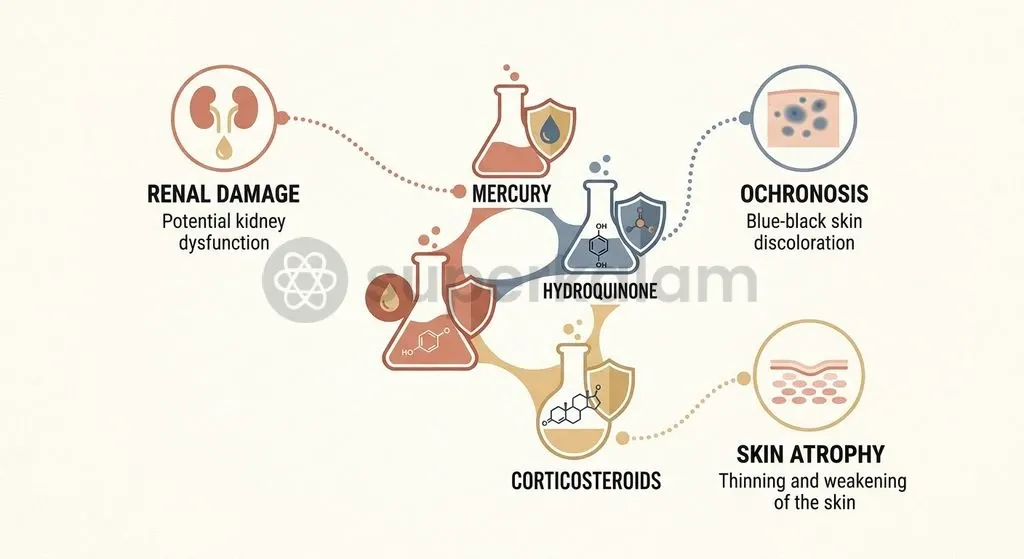
Clinical studies documented by the World Health Organization establish that cosmetic adulterants trigger irreversible dermal, renal, and neurological damage. Facial skin absorbs these chemicals rapidly, granting them direct access to systemic circulation.
Clinical evidence outlines severe, multi-organ pathology across three primary conditions:
- Nephrotic syndrome and renal failure: According to the World Health Organization, chronic exposure to mercury salts in cosmetic creams causes nephrotic syndrome, marked anxiety, peripheral neuropathy, and severe depression. Heavy metals settle inside renal glomeruli and damage biological filters. Research in the Indian Journal of Dermatology confirms that dermal absorption of mercury-adulterated creams directly induces secondary membranous nephropathy and life-threatening proteinuria.
- Exogenous ochronosis: Prolonged application of hydroquinone induces exogenous ochronosis, a refractory dermatological condition characterised by soot-like bluish-black cutaneous macules and tissue degradation. This hyperpigmentation occurs when polymerised homogentisic acid complexes lodge in dermal elastic fibres, resulting in permanent facial disfigurement.
- Topical Steroid-Damaged Face (TSDF): As documented by the Indian Association of Dermatologists, Venereologists and Leprologists (IADVL), chronic steroid misuse produces Topical Steroid-Damaged Face, marked by cutaneous atrophy, severe telangiectasia, secondary tinea incognito, and profound steroid addiction. Discontinuation unleashes severe rebound erythema and burning sensations, compelling patients to reapply the cream compulsively.
Discuss with Superkalam
What is the maximum permissible threshold for unintentional trace mercury in cosmetics under the Cosmetics Rules, 2020?
Ask NowSide-by-Side: Common Adulterants, Legal Limits, and Health Impacts
Indian Standard IS 4707 provides specific threshold prohibitions for cosmetic constituents, distinguishing permissible formulations from hazardous adulterations. Regulatory standards established by the Bureau of Indian Standards define explicit ceilings to preserve consumer safety across cosmetic product categories.
The following comparison details the chemical characteristics, legal boundaries, and medical complications associated with the primary adulterants found in fairness creams:
| Chemical Agent | Primary Purpose in Cosmetics | Legal Status in India | Permissible Limit | Clinical Health Impact |
|---|---|---|---|---|
| Inorganic Mercury | Inhibits tyrosinase enzyme to block melanin synthesis | Prohibited in cosmetic raw materials; trace impurity only | 1 mg/kg (1 ppm) for unintended traces | Membranous nephropathy, nephrotic syndrome, depression, peripheral neuropathy |
| Hydroquinone | Destroys active melanocytes to bleach hyperpigmented skin | Classified as Schedule H drug; banned in general cosmetics | Zero in retail cosmetics; prescription use only | Exogenous ochronosis, cutaneous atrophy, permanent bluish-black macules |
| Topical Corticosteroids | Induces vasoconstriction and suppresses local inflammation | 14 formulations classified under Schedule H | Zero in retail cosmetics; medical prescription required | Topical Steroid-Damaged Face (TSDF), skin atrophy, telangiectasia, steroid dependence |
The Bureau of Indian Standards standard IS 4707 (Part 2) explicitly includes mercury compounds, hydroquinone, and corticosteroids within its negative list of substances that must never form part of cosmetic compositions. Despite these clear statutory prohibitions, illegal supply chains exploit loopholes in domestic verification to distribute blended fairness formulations containing all three substances.
Discuss with Superkalam
How does inorganic mercury interfere with tyrosinase enzyme activity to block melanin synthesis, and how does this dermal route lead to systemic organ damage?
Ask NowIndia's Regulatory Framework for Cosmetics and Over-the-Counter Sales
The Drugs and Cosmetics Act, 1940 governs the manufacture, import, and distribution of cosmetic products across India. This statutory structure enforces safety standards and licensing protocols to shield consumers from misbranded formulations.
Key statutory safeguards operate across several levels of the supply chain:
- Cosmetics Rules, 2020: The Union Ministry of Health and Family Welfare notified these rules to modernise consumer safety. They ban deliberate mercury addition, limiting unintentional trace mercury to 1 ppm.
- Mandatory container labelling: Rule 34 of the Cosmetics Rules, 2020 mandates international nomenclature for ingredients, distinct batch identification numbers, manufacturer licence details, and necessary cautionary labels.
- Digital commerce compliance: Under the Consumer Protection (E-Commerce) Rules, 2020, digital marketplace entities must identify the country of origin, expiry dates, and complete ingredient panels for all cosmetics offered for sale on their platforms.
Professional medical groups actively counter regulatory non-compliance in the pharmaceutical sector. The Indian Association of Dermatologists, Venereologists and Leprologists established the IADVL Taskforce Against Topical Steroid Abuse to lobby drug regulators against irrational fixed-dose steroid combinations and raise public awareness regarding illegal over-the-counter dispensing. This clinical task force works alongside state drug controllers to halt the unlawful sale of Schedule H creams without valid medical prescriptions.
Why Do Hazardous Creams Continue to Flood the Market?
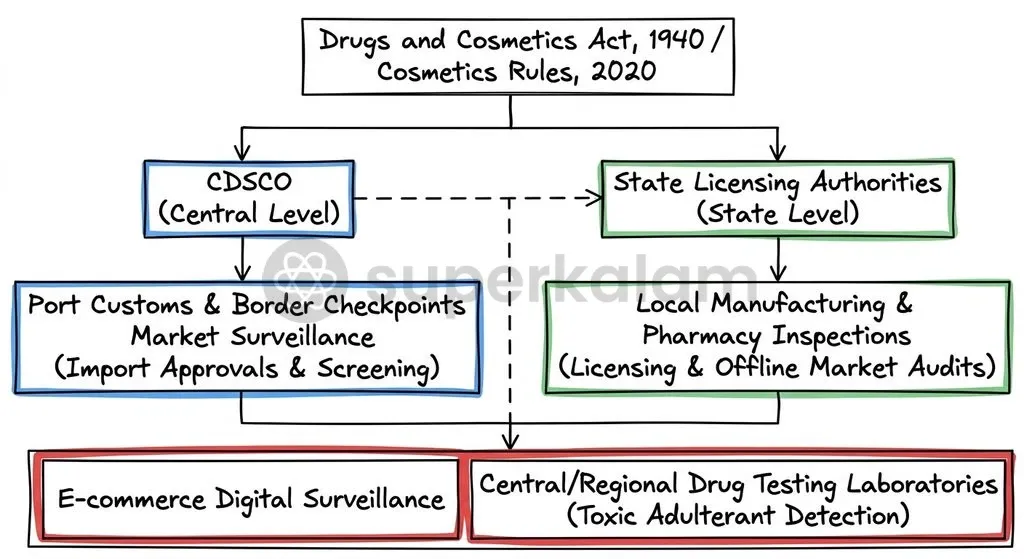
The Parliamentary Standing Committee on Health and Family Welfare highlighted critical surveillance fractures between central and state licensing authorities. These structural bottlenecks impede consistent nationwide product monitoring and permit illicit manufacturers to exploit jurisdictional grey zones.
Three distinct structural failures explain this persistent commercial leakage:
- Jurisdictional fractures: A report by the Parliamentary Standing Committee on Health and Family Welfare observed that the Central Drugs Standard Control Organisation and State Licensing Authorities share fragmented regulatory jurisdiction, creating market surveillance gaps where unapproved imported and domestic creams evade batch testing. While the central regulator manages imports and baseline standards, state drug administrations oversee factory audits and retail sampling. Wide disparities in state testing capacity paralyse enforcement.
- Over-the-counter retail leakage: Retail pharmacies routinely sell potent corticosteroids and hydroquinone over the counter without prescriptions. Pharmacists capitalise on scarce inspections, dispensing Schedule H tubes as cheap remedies for acne or pigmentation.
- Porous international trade channels: Small-scale importers move bulk shipments across borders without declaring chemical formulations. Meanwhile, online platforms fail to audit third-party inventory against national limits before goods reach buyers.
Discuss with Superkalam
Why do Schedule H depigmenting formulations continue to circulate as over-the-counter retail cosmetics despite explicit statutory prohibitions under the Drugs Rules, 1945?
Ask NowEnvironmental and Global Dimensions: Minamata Convention and Transboundary Trade
The Minamata Convention on Mercury establishes legally binding international controls to curtail the global manufacture and trade of toxic cosmetics. Adopted under the United Nations Environment Programme, the treaty acknowledges that chemical lightening agents undermine human health and damage vulnerable ecosystems.
Key international mechanisms and real-world hurdles shape global compliance:
- Mandatory trade phase-out: Annex A, Part I of the Minamata Convention on Mercury mandates that member parties phase out the manufacture, import, and export of cosmetics containing mercury levels exceeding 1 mg/kg (1 ppm). This ban targets creams and soaps that bypass national border checks.
- Ecological bioaccumulation: When consumers wash mercury-laden creams off their faces, the chemical effluents enter urban wastewater networks. These persistent residues accumulate in aquatic food chains and poison local fish stocks.
- Pervasive non-compliance: A 2018 global survey by the Zero Mercury Working Group reported that more than 10% of tested skin-lightening creams sourced from Asian and African markets contained mercury levels exceeding the 1 ppm legal threshold.

Cross-border enforcement remains vulnerable to regulatory arbitrage between nations with divergent legal regimes. Producers in poorly monitored states manufacture toxic fairness creams specifically for export to developing markets. Closing this trade demands chemical screenings at container terminals and coordinated intelligence exchanges between international customs authorities.
Societal Pressures and Advertising Ethics: The GS4 Angle
The Advertising Standards Council of India monitors cosmetic promotional campaigns to prevent discriminatory narratives that exploit social insecurities regarding skin complexion. Commercial beauty brands have long commodified entrenched colourist prejudices, framing fair complexions as an indispensable prerequisite for social status, professional employment, and marriageability.
This commercial practice raises grave ethical questions regarding human dignity and informed consent. Manipulative advertisements target young women, conditioning them to equate self-worth with lighter skin tones. This commercial pressure drives consumers toward dangerous chemical bleaching agents, subordinating physical safety to fabricated aesthetic ideals.
Regulatory and legal frameworks have mobilised several counter-measures against these marketing practices:
- Voluntary industry codes: Guidelines issued by the Advertising Standards Council of India explicitly prohibit fairness product advertisements from communicating that dark skin is disadvantageous, inferior, or an obstacle to marital and career success.
- Direct statutory penalties: Under Section 21 of the Consumer Protection Act, 2019, the Central Consumer Protection Authority can issue directives and penalise manufacturers and endorsers up to ₹10 lakh for false or misleading advertisements.
- Endorser accountability: The CCPA Guidelines for Prevention of Misleading Advertisements and Endorsements, 2022 mandate that celebrity endorsers exercise due diligence to substantiate claims and strictly prohibit unverified scientific representations.
- Proposed criminal deterrence: The Draft Drugs and Magic Remedies (Objectionable Advertisements) (Amendment) Bill, 2020 proposed adding 'fairness of skin' to the prohibited condition schedule, backed by penalties of up to 5 years imprisonment and ₹50 lakh fines.
Discuss with Superkalam
Between tightening post-market chemical testing by state drug controllers and holding e-commerce platforms vicariously liable, which intervention is more critical to halting adulterated cosmetic trade?
Ask NowThe Road Ahead: Stricter Enforcement, Labelling Reforms, and Consumer Awareness
The Central Consumer Protection Authority and drug regulators must coordinate institutional reforms to eliminate hazardous fairness formulations from retail and digital commerce. Fragmented surveillance cannot counter complex cosmetic adulteration without systematic structural interventions across supply chains.
Addressing this persistent public health threat requires three coordinated interventions:
- Unify central and state regulatory monitoring: Statutory enforcement must bridge the operational disconnect between the Central Drugs Standard Control Organisation and State Licensing Authorities. Establishing a shared digital testing repository lets regional inspectors identify substandard products instantly. As of May 2024, policy researchers have proposed mandatory QR-code traceability, certified laboratory batch testing at customs ports, and strict pharmacy audit registers to curb illicit corticosteroid and mercury distribution.
- Enforce strict marketplace liability: Digital commerce platforms must bear direct liability for hazardous third-party cosmetic sales. Under the Consumer Protection (E-Commerce) Rules, 2020, marketplace platforms must proactively remove unverified cosmetic listings that lack statutory ingredient declarations. Automated regulatory tools must scan vendor listings for prohibited bleaching terms, blocking non-compliant goods before shipment.
- Deconstruct colourism through public education: Public health administrations must partner with medical societies and civil society groups to conduct broad public education initiatives. Addressing the root causes of toxic cosmetic consumption requires dismantling cultural colourism through media campaigns, educational curricula, and community engagement. When society ceases to equate lighter skin tones with human dignity, the commercial demand sustaining toxic fairness formulations will diminish.
Key Takeaways
- Commercial fairness creams are frequently adulterated with inorganic mercury, hydroquinone, and potent topical corticosteroids, transforming ordinary cosmetic lotions into hazardous formulations that cause severe systemic toxicity.
- Dermal exposure to mercury salts suppresses tyrosinase enzymes but triggers secondary membranous nephropathy, severe proteinuria, nephrotic syndrome, and persistent neurological disturbances.
- Indian Standard IS 4707 (Part 2) explicitly places mercury, hydroquinone, and corticosteroids on its negative list, while the Cosmetics Rules, 2020 cap unintentional trace mercury at 1 ppm under the Drugs and Cosmetics Act, 1940.
- Fourteen topical corticosteroids, alongside hydroquinone formulations, are classified as Schedule H prescription drugs under the Drugs Rules, 1945, making over-the-counter dispensing an illegal commercial practice.
- Annex A, Part I of the Minamata Convention on Mercury establishes an international 1 ppm threshold to eliminate the global manufacture, import, and export of mercury-added cosmetics.
- The Central Consumer Protection Authority exercises statutory powers under Section 21 of the Consumer Protection Act, 2019 to penalise misleading advertisements and require celebrity endorsers to substantiate product claims.
Mains Question
"The statutory classification of potent depigmenting agents and corticosteroids under Schedule H of the Drugs Rules, 1945 was intended to prevent unmonitored dispensing, yet illicit skin-lightening formulations remain pervasive." In this context, examine the enforcement and regulatory challenges faced by drug control authorities in India. (10 Marks)
Evaluate NowMains Question
"Cosmetic depigmentation using unapproved chemical agents has transitioned from an individual cosmetic preference into a public health crisis." Critically analyse the clinical, institutional, and ethical dimensions of hazardous fairness creams in India. (15 Marks)
Evaluate NowPractice MCQs
QUESTION 1
With reference to the regulatory framework governing skin-lightening agents in India, consider the following statements:
- Hydroquinone is classified as a Schedule H drug under the Drugs Rules, 1945, restricting its sale to prescription-only use.
- Under the Cosmetics Rules, 2020, deliberate addition of mercury is prohibited, with unintended trace levels capped at 1 ppm.
- Indian Standard IS 4707 (Part 2) permits topical corticosteroids in over-the-counter cosmetics up to a defined ceiling limit. Which of the statements given above is/are correct?
QUESTION 2
Consider the following statements regarding the physiological effects of adulterants found in unapproved fairness formulations:
- Inorganic mercury salts compete with copper in the enzyme tyrosinase to inhibit eumelanin formation.
- Chronic dermal exposure to hydroquinone can lead to exogenous ochronosis through the deposition of polymerized homogentisic acid complexes.
- Prolonged non-medical misuse of topical corticosteroids induces cutaneous atrophy, telangiectasia, and steroid dependence. Which of the statements given above are correct?
QUESTION 3
Consider the following statements regarding statutory compliance and packaging standards for cosmetics in India:
- Rule 34 of the Cosmetics Rules, 2020 mandates international nomenclature for ingredients, manufacturer licence details, and batch identification numbers.
- Under the Consumer Protection (E-Commerce) Rules, 2020, digital marketplaces are required to display the country of origin, expiry dates, and complete ingredient panels for cosmetics.
- The Central Government's 2018 amendment to the Drugs and Cosmetics Rules placed 14 topical corticosteroids under Schedule H. Which of the statements given above are correct?
QUESTION 4
In the context of clinical pathology resulting from cosmetic adulteration, chronic dermal absorption of inorganic mercury salts is directly linked to which of the following renal disorders?
QUESTION 5
Consider the following statements regarding regulatory bodies and professional interventions in India's drug administration:
- The Drugs and Cosmetics Act, 1940 governs the manufacture, import, and distribution of cosmetic products across India.
- The Indian Association of Dermatologists, Venereologists and Leprologists established a dedicated taskforce to lobby regulators against irrational fixed-dose steroid combinations. Which of the statements given above is/are correct?