Tourism Carrying Capacity: Why Himachal's Mountains Need Hard Limits
As recurring monsoon disasters outstrip tourism revenue, Himachal Pradesh confronts the urgent trade-off between local economic growth and mountain survival.
Nov, 2026
•8 min read
Overview
Tourism carrying capacity defines the maximum threshold of visitors, vehicular traffic, and built infrastructure an alpine environment can sustain. Breaching this limit triggers irreversible ecological degradation, structural slope failures, or systemic municipal collapse.
In Himachal Pradesh, tourism contributes significantly to the mountain economy. Yet recurrent monsoon disasters reveal an unsustainable trade-off. Unchecked development destabilises young, seismically active Himalayan geology.
Annual disaster damages now systematically surpass state tourism revenues. Because of this, establishing legally binding limits has shifted from an idealistic preference to an existential physical necessity.
Why in the News: The Push to Measure Mountain Carrying Capacity
The Supreme Court of India mandated that the Union Government and Himalayan states formulate an overarching scientific framework to determine tourist and infrastructural carrying capacity.
Key judicial and administrative milestones include:
- Apex Court Directive: In Ashok Kumar Raghav v. Union of India, the Court addressed systemic hill degradation by instructing authorities to evaluate ecological thresholds across 13 Himalayan states and Union Territories, according to the Supreme Court order dated 21 August 2023.
- Union Advisory Framework: The Ministry of Environment, Forest and Climate Change (MoEFCC) submitted an affidavit proposing a 13-member technical committee led by the Director of the G.B. Pant National Institute of Himalayan Environment to devise state-specific implementation roadmaps. The MoEFCC had originally circulated official carrying-capacity guidelines to all 13 Himalayan states on 30 January 2020, reiterating them on 19 May 2023.
- State Implementation Deficit: As of October 2026, the Supreme Court-appointed Central Empowered Committee (CEC) reported that the Himachal Pradesh Tourism Department had conducted zero carrying-capacity studies for critical urban hubs, including Shimla, Manali, Dharamshala, Dalhousie, Kasol, and Spiti.
What Is Tourism Carrying Capacity and How Is It Measured?
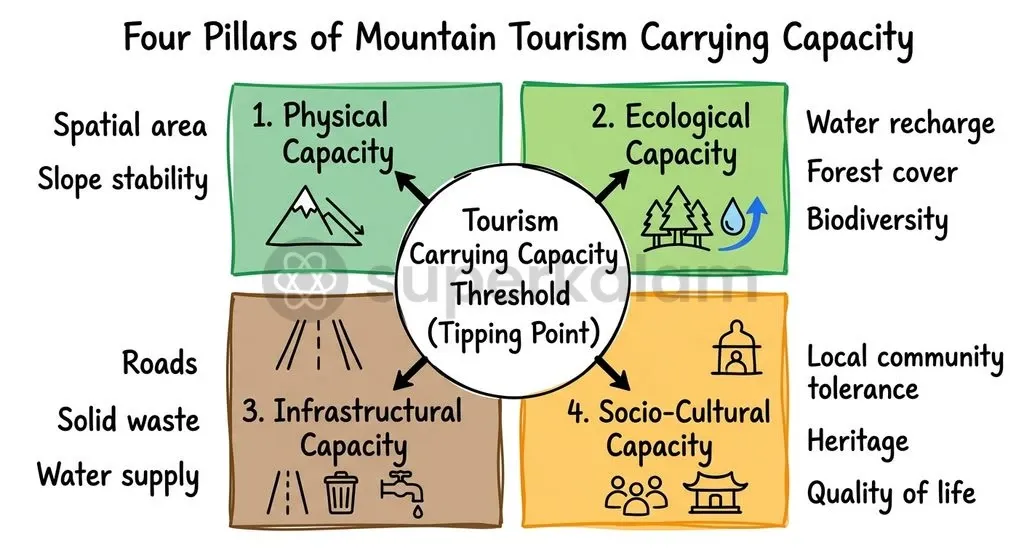
The United Nations Tourism organisation defines carrying capacity through four distinct dimensions: physical, ecological, social, and infrastructural thresholds. Rather than counting hotel beds alone, a sound assessment measures compound pressures on natural and human systems.
Physical carrying capacity denotes the sheer spatial limit of sensitive sites before footfall degrades geographic assets. Ecological carrying capacity represents the biophysical ceiling. It is defined by groundwater recharge rates, floral resilience, slope shear strength, and effluent absorption thresholds, as outlined by the G.B. Pant National Institute of Himalayan Environment.
Social capacity measures resident tolerance to crowding. In contrast, infrastructural capacity evaluates municipal stress across roads, sanitation, power, and water networks.
| Dimension | Primary Metric / Biophysical Parameter | Consequence of Breaching Limit |
|---|---|---|
| Physical Capacity | Spatial footprint, slope surface area, and trail room | Accelerated soil compaction, toe-erosion, and surface degradation |
| Ecological Capacity | Slope shear strength, water percolation, and assimilation capacity | Glacial black-carbon deposition, aquifer depletion, and slope failure |
| Infrastructural Capacity | Municipal water availability, sewage processing, and road lane capacity | Severe water deficits, untreated effluent runoff, and chronic vehicular gridlock |
| Social Capacity | Ratio of peak tourist footfall to local resident population | Cultural friction, loss of local amenity, and displacement of indigenous livelihoods |
Discuss with Superkalam
What is the daily vehicular cap set by the National Green Tribunal for Rohtang Pass, and how is it split between fuel types?
Ask NowWhy Himachal Pradesh Is Facing an Ecological Tipping Point
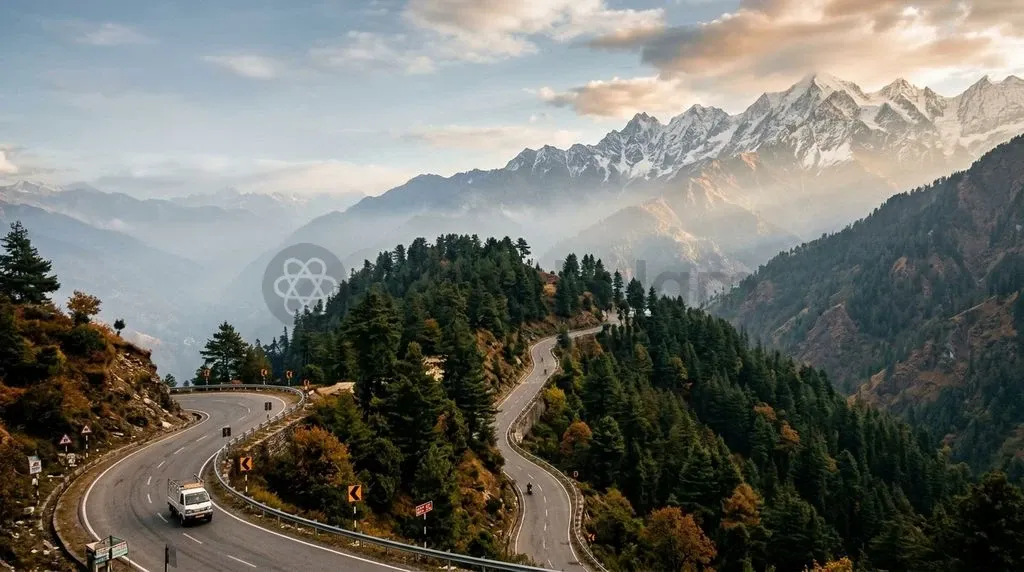
The Himachal Pradesh State Disaster Management Authority recorded that approximately 60% of the state's road network, comprising 993 kilometres of National Highways, falls within high landslide vulnerability zones. Unplanned road widening and destabilising civil works have substantially worsened these baseline geological weaknesses.
Four converging drivers have accelerated this vulnerability:
- Surge in Unregulated Hospitality: Between 2016 and 2026, registered hotels expanded by 90.8%, while registered homestays surged by 669.7% across Himachal Pradesh, leading homestays to outnumber commercial hotels, as verified by the Central Empowered Committee. This boom drove rapid ribbon development along fragile valleys without baseline sewage networks or structural engineering safeguards.
- Construction in Hazard Corridors: The National Disaster Management Authority documented that multi-storey concrete construction directly over river floodplains and un-engineered steep slopes magnified damage during the 2023 floods.
- Afforestation Deficit: Compounding this built footprint, infrastructure deficits have eroded forest cushions. Between 1981-82 and 2025-26, the state recorded a 10.85% afforestation shortfall—failing to plant 3,707 hectares against a statutory target of 34,169 hectares, as reported by the Central Empowered Committee.
- Hydroelectric Interventions: Hydroelectric tunnelling and un-rehabilitated muck disposal at projects like Larji, Parvati-II, and Parvati-III have undermined slope stability and deposited heavy silt into river channels.
Supreme Court and Green Tribunal Directives on Himalayan Safety
Judicial benches and statutory bodies have intervened repeatedly to enforce baseline geological safety norms across the state:
- Vehicular Caps at Sensitive Passes: The National Green Tribunal intervened early in Kullu district by establishing a strict cap of 1,200 vehicles per day for Rohtang Pass, split into 800 petrol and 400 diesel vehicles, to curb vehicular emissions and protect glaciers from black carbon. This regime requires tourists to secure an online permit and pay an environmental compensation cess.
- GIS-Based Master Planning: In State of Himachal Pradesh v. Yogendera Mohan Sengupta, the Supreme Court upheld the GIS-based Shimla Development Plan 2041, validating statutory controls over Floor Area Ratio, excavation limits, and building heights under the Himachal Pradesh Town and Country Planning Act, 1977.
- Mandatory Clearances for Linear Projects: The Central Empowered Committee recommended requiring mandatory environmental clearances for hill roads and rail lines expanding to two or more lanes.
- Slope Remediation and Dedicated Oversight: The National Highways Authority of India subsequently earmarked ₹825 crore to stabilise 44 high-risk landslide stretches along the Kiratpur-Manali highway. The CEC also recommended appointing an independent highway ombudsman across Himalayan states to resolve chronic slope stabilisation failures.
Discuss with Superkalam
Why is relying solely on hotel bed counts insufficient for measuring a mountain town's infrastructural carrying capacity?
Ask NowLivelihood vs Survival: The Economic Dilemma of Hill States
Tourism constitutes a primary pillar of Himachal Pradesh's economy, but the accompanying fiscal trade-off is increasingly unsustainable:
- Economic Contribution: Tourism contributes approximately 7.78% to the Gross State Domestic Product and employs over 14% of the state workforce. Following pandemic disruptions, annual arrivals surged from 1.60 crore in 2023 to more than 3.11 crore visitors across all circuits in 2025.
- Monsoon Devastation: Extreme weather strikes compromised mountain slopes with compounding force. The 2023 monsoon disaster alone caused an estimated ₹10,000 to ₹12,000 crore in economic damage, claiming more than 500 lives across 169 flash floods.
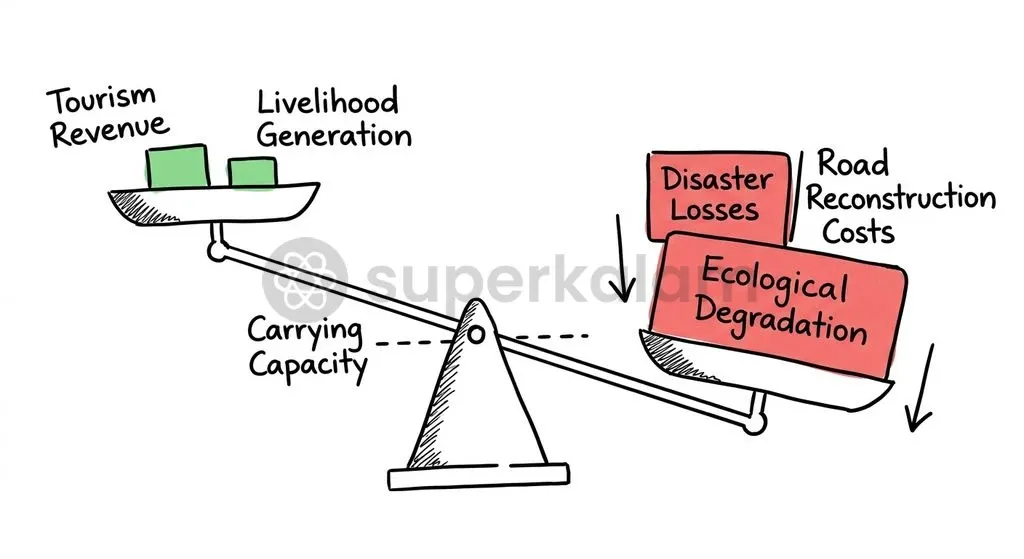
- Structural Fiscal Drain: Over a four-year period leading into 2025-26, cumulative disaster losses reached ₹46,000 crore, equivalent to roughly 4% of GSDP annually.
Short-term revenues yielded by unmanaged visitor influxes are systematically erased by post-disaster reconstruction expenses. Unregulated hill tourism shifts public expenditure away from social infrastructure toward repairing fractured roads, clearing debris, and restoring damaged municipal networks.
Lessons from Global and Regional Caps on High-Altitude Tourism
Enforcing hard caps on sensitive ecological circuits has proven operationally feasible and environmentally restorative when backed by transparent administrative systems.
The Rohtang Pass benchmark illustrates this balance through three core operational pillars:
- Permit Automation: An online booking portal and automated barrier enforce the daily ceiling of 1,200 vehicles per day.
- Dedicated Environmental Financing: An environmental compensation cess collected by local authorities finances targeted slope restoration and pollution mitigation along vulnerable stretches.
- Ecosystem Protection: Capping daily arrivals curbed micro-climatic pollution and reduced local traffic gridlock across high-altitude alpine corridors.
Adapting these mechanisms to urban hill stations requires transitioning from single-corridor vehicle limits to city-wide spatial caps. International high-altitude destinations deploy dynamic seasonal quotas alongside high-value, low-volume tariffs. They also enforce strict buffer zones to prevent urban sprawl from penetrating active hazard corridors.
Discuss with Superkalam
Compare how unregulated homestay expansion and linear highway widening jointly exacerbate slope instability in Himachal Pradesh.
Ask NowWay Forward: A Practical Blueprint for Climate-Smart Mountain Tourism
The Central Empowered Committee urged Special Area Development Authorities (SADAs) across Himachal Pradesh to integrate carrying-capacity thresholds into all building permissions and master plans. Moving away from reactive rebuilding requires grounding town development in statutory geophysical assessments under the Himachal Pradesh Town and Country Planning Act, 1977.
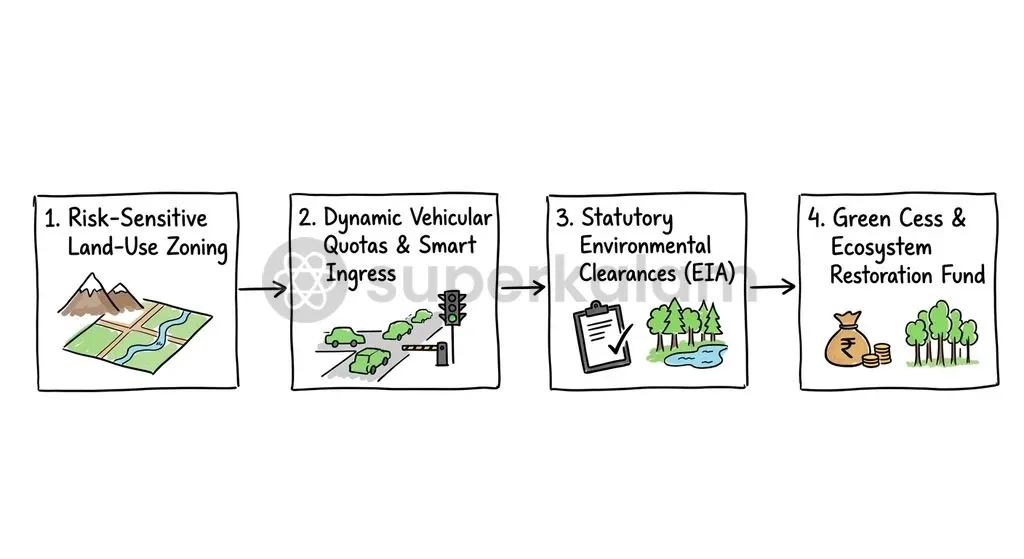
- Enact Risk-Sensitive Land Zoning: Town planning bodies must ban commercial construction on slopes exceeding 30 degrees, demarcate active floodplains as non-build zones, and enforce building height caps aligned with seismic vulnerability.
- Implement Real-Time Footfall Monitoring: Tourist gateways require automated check-posts that monitor vehicular volume, redirecting surplus traffic to satellite transit hubs when municipal thresholds are reached.
- Establish a Himalayan Highway Ombudsman: An ombudsman mechanism should hold road construction agencies liable for cutting hill slopes beyond geotechnical norms, dumping muck into waterways, or delaying toe-wall stabilisation.
- Mandate Comprehensive Impact Assessments: The Central Government should require formal environmental clearances for all linear infrastructure projects across fragile hill states, closing exemptions for incremental two-lane highway expansions.
- Levy Targeted Green Compensation Funds: Revenue gathered via environmental cesses must be ring-fenced to finance municipal solid waste treatment, afforestation targets, and community-led ecotourism initiatives.
Discuss with Superkalam
Propose an institutional framework for the recommended Himalayan Highway Ombudsman to penalise improper muck disposal and un-engineered slope cuts.
Ask NowKey Takeaways
- Four-Dimensional Framework: Tourism carrying capacity requires evaluating physical, ecological, infrastructural, and social limits rather than tracking raw accommodation counts alone.
- Judicial Mandate: In Ashok Kumar Raghav v. Union of India, the Supreme Court directed the Union and 13 Himalayan states to devise carrying-capacity plans through an expert committee chaired by the G.B. Pant Institute.
- Acute Planning Deficit: The Central Empowered Committee found that no carrying-capacity studies had been executed for primary hubs like Shimla, Manali, and Dharamshala, despite homestays surging by 669.7% between 2016 and 2026.
- Fiscal Imbalance: While tourism generates 7.78% of Himachal Pradesh's GSDP, cumulative four-year disaster losses touched ₹46,000 crore, highlighting that unmanaged growth erodes long-term state finances.
- Regulatory Reforms: Sustainable hill tourism hinges on making environmental clearances mandatory for major road widening, instituting highway ombudsmen, and enforcing dynamic zoning through municipal development authorities.
Mains Question
"Short-term revenues yielded by unmanaged visitor influxes in fragile mountain states are systematically erased by post-disaster reconstruction expenses." In the light of this statement, critically analyse the economic and ecological trade-offs of mass tourism in Himachal Pradesh. (15 Marks)
Evaluate NowMains Question
Citing judicial directives including Ashok Kumar Raghav v. Union of India and the Rohtang Pass regulatory framework, elucidate the core dimensions of 'carrying capacity' required for sustainable hill town planning. (10 Marks)
Evaluate NowPractice MCQs
QUESTION 1
With reference to tourism carrying capacity in mountainous regions, consider the following statements:
- Physical carrying capacity defines the sheer spatial limit before visitor footfall degrades geographic assets.
- Ecological carrying capacity is primarily determined by resident tolerance to crowding and indigenous livelihood retention.
- Infrastructural carrying capacity assesses municipal limits such as road lane capacity, water availability, and sewage processing. Which of the statements given above are correct?
QUESTION 2
Consider the following statements regarding the regulatory directives and administrative mechanisms for Himalayan ecology:
- In Ashok Kumar Raghav v. Union of India, the Supreme Court instructed authorities to evaluate carrying capacity across 13 Himalayan states and Union Territories.
- The Ministry of Environment, Forest and Climate Change (MoEFCC) constituted a technical committee headed by the Director of the G.B. Pant National Institute of Himalayan Environment.
- The National Green Tribunal imposed a daily cap of 1,200 vehicles for Rohtang Pass, evenly divided between petrol and diesel vehicles. Which of the statements given above is/are correct?
QUESTION 3
According to findings reported by statutory bodies such as the Central Empowered Committee (CEC) and the State Disaster Management Authority in Himachal Pradesh, consider the following statements:
- Approximately 60% of the state's road network falls within high landslide vulnerability zones.
- Between 2016 and 2026, registered homestays expanded by over 600%, outnumbering commercial hotels in the state.
- Between 1981-82 and 2025-26, the state exceeded its statutory afforestation targets by over 10%. Which of the statements given above is/are correct?
QUESTION 4
In the context of urban planning and ecological governance in Himachal Pradesh, the Supreme Court upheld the GIS-based Shimla Development Plan 2041 under which statutory enactment?
QUESTION 5
Which of the following measures have been recommended by the Central Empowered Committee (CEC) and judicial directives to mitigate ecological degradation in Himachal Pradesh?
- Mandating environmental clearances for linear hill projects expanding to two or more lanes.
- Banning commercial construction on slopes exceeding 30 degrees.
- Creating an independent Himalayan highway ombudsman to oversee slope stabilisation failures. Select the correct answer using the code given below: