Tiruppur Model: Industrial Clusters and Job Creation in India
Tiruppur's decentralized MSME network and zero-liquid discharge system offer critical blueprints for India's labor-intensive manufacturing and PM MITRA parks.
Sep, 2026
•9 min read
Overview
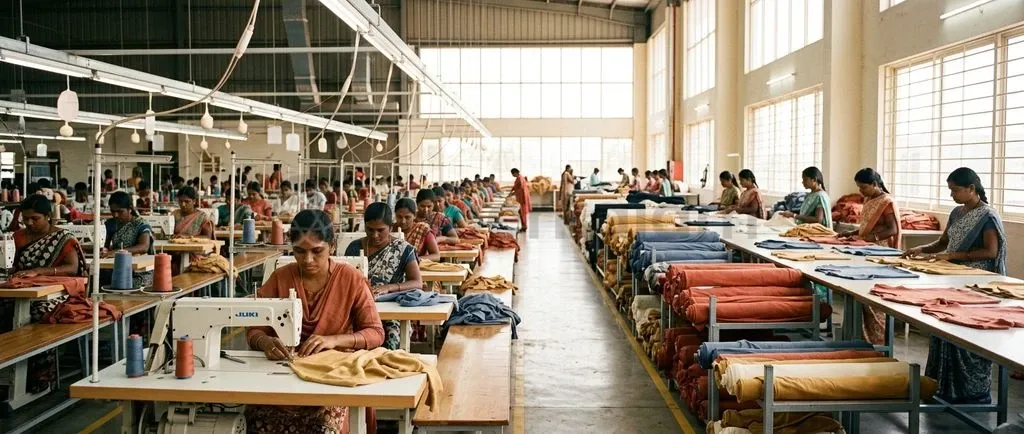
The Tiruppur textile cluster in Tamil Nadu represents India's most successful model of export-oriented industrial agglomeration. It generates over 33,000 crore to 40,000 crore rupees in annual garment exports while supporting decentralised micro, small, and medium enterprises. According to the Tirupur Exporters' Association and the Ministry of Textiles, this localised ecosystem produces more than half of India's cotton knitwear exports.
Tiruppur demonstrates how geographic concentration, specialised subcontracting, and high female workforce participation create durable industrial resilience. The cluster provides vital policy lessons for national manufacturing initiatives like PM MITRA parks.
Why Tiruppur Matters for India's Manufacturing and Jobs
The Tiruppur textile cluster serves as India's primary engine for cotton knitwear production and labour-intensive export growth. As of March 2026, the cluster accounts for over 50% to 55% of India's total cotton knitwear exports, generating over ₹33,000 crore to ₹40,000 crore annually in garment export revenue, according to the Tirupur Exporters' Association (TEA) Annual Export Review and the Ministry of Textiles.
Tiruppur proves that sustainable job creation requires dense MSME agglomeration, shared environmental infrastructure, and flexible labour arrangements rather than isolated mega-factories.
This industrial concentration proves that structural transformation in the Indian economy does not rely solely on large-scale corporate factories. Instead, Tiruppur demonstrates how localised micro, small, and medium enterprises (MSMEs) achieve massive scale through specialised job-work networks. The cluster absorbs millions of low-skilled and semi-skilled workers from rural hinterlands, translating industrial activity directly into poverty reduction and wage growth.
Discuss with Superkalam
Which river basin's pollution led to the 2011 Madras High Court order mandating Zero Liquid Discharge in Tiruppur?
Ask NowHow the Tiruppur Apparel Ecosystem Was Built: Key Pillars
The Tiruppur industrial ecosystem expanded from a modest domestic manufacturing centre into a global textile powerhouse through organic entrepreneurial networking. The cluster originated in the 1970s as a domestic cotton undergarment manufacturing hub. It expanded rapidly after receiving its first direct European export orders in the mid-1980s, institutionalising its collective bargaining through the founding of the Tirupur Exporters Association (TEA) in 1990.
Four structural pillars supported this historical expansion:
- Entrepreneurial Mobilisation: Local agrarian capital transitioned into textile manufacturing, creating an owner-operator culture with high risk tolerance.
- Institutional Coordination: The formation of the TEA established a unified bargaining body that negotiated trade terms, engaged government bodies, and coordinated worker welfare initiatives.
- Specialised Spatial Clustering: Units organised within compact geographic limits, minimising logistics overheads between distinct production stages.
- Export Orientation: Early entry into Western retail supply chains compelled units to modernise quality control and adhere to international delivery schedules.
Discuss with Superkalam
How does extreme functional disintegration reduce capital entry barriers for first-generation MSME entrepreneurs?
Ask NowCluster Dynamism: Why Geographic Concentration Drives Productivity
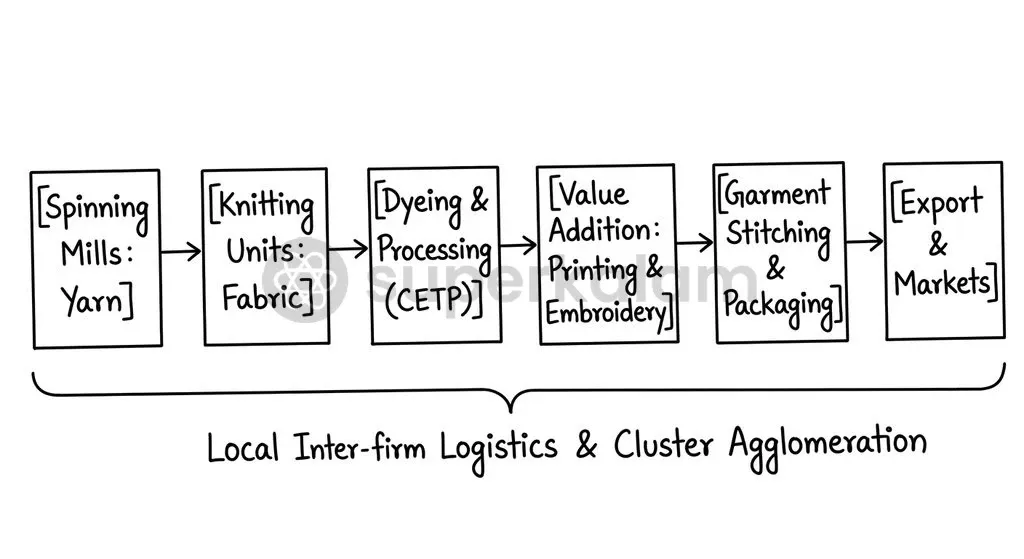
Agglomeration economies in Tiruppur create substantial cost efficiencies through functional disintegration and localised supply chains. According to a joint review by NITI Aayog and UNIDO, the agglomeration economy in Tiruppur relies on extreme functional disintegration, where specialised MSMEs handle distinct stages—spinning, knitting, processing, compacting, embroidery, and garmenting—connected via dense localised subcontracting.
Rather than housing every manufacturing phase under a single roof, the cluster separates operations across thousands of independent entities:
- Spinning and Yarn Sourcing: Procuring raw cotton and producing specialised carded or combed yarns.
- Knitting and Weaving: Transforming yarn into grey fabric using high-speed circular knitting machines.
- Wet Processing and Dyeing: Bleaching and colouration managed through specialised chemical units.
- Value-Addition Ancillaries: Printing, embroidery, buttonholing, and compacting carried out by micro-enterprises.
- Garment Fabrication and Packing: Cutting, stitching, inspection, and carton packing for international shipments.
This horizontal division of labour lowers entry capital barriers for first-generation entrepreneurs. Small enterprise owners do not need to finance integrated processing plants. Instead, they invest in a single process and purchase upstream services on credit.
Formal Employment and Women's Workforce Participation in Tiruppur
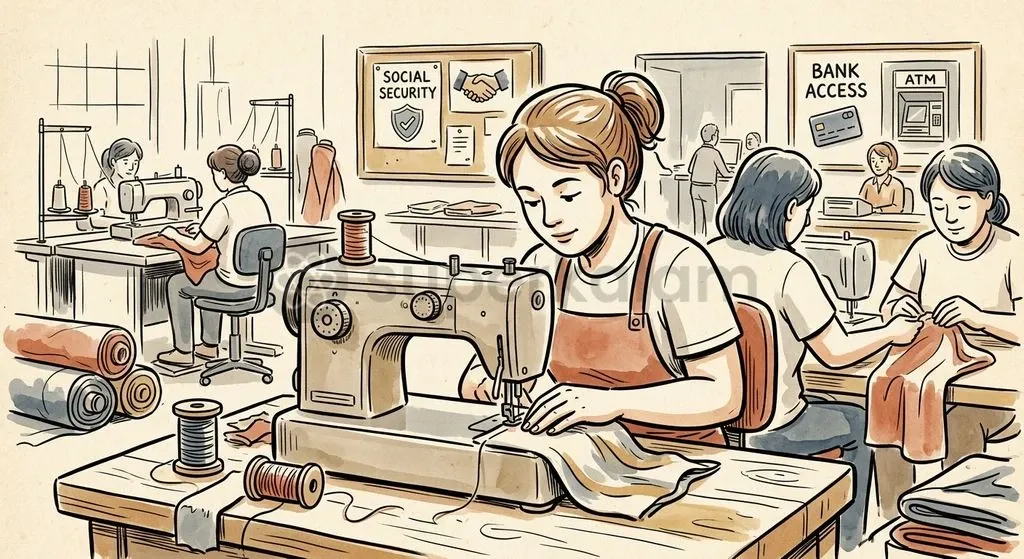
Tiruppur provides a vital pathway for rural women entering formal industrial employment across western Tamil Nadu. According to a working paper by the Tamil Nadu State Planning Commission, women constitute approximately 60% of the formal and semi-formal shop-floor workforce in the Tiruppur garment cluster.
The cluster has steadily transitioned away from unrecorded, informal piece-rate work toward institutionalised wage contracts. This transition is reinforced by expanded registration under the Employees' Provident Fund (EPF) and Employees' State Insurance (ESI) frameworks.
Labour market flexibility remains essential for seasonal export orders. The adoption of formal fixed-term employment models, alongside modernised contract labour regulations, allows manufacturers to scale employment during peak demand cycles while maintaining statutory social security contributions. This balance protects shop-floor workers against abrupt retrenchment while ensuring factory compliance with international buyer codes of conduct.
Discuss with Superkalam
How can the institutional coordination lessons of the Tirupur Exporters' Association (TEA) be applied to newly planned PM MITRA textile parks?
Ask NowGreen Transition and Sustainability: The Zero Liquid Discharge Turnaround
Judicial intervention in 2011 forced Tiruppur to pioneer global standards in ecological water management and industrial effluent treatment. In January 2011, the Madras High Court ordered the immediate closure of over 700 textile dyeing and bleaching units in Tiruppur for polluting the Noyyal River basin and failing to implement Zero Liquid Discharge (ZLD) systems.
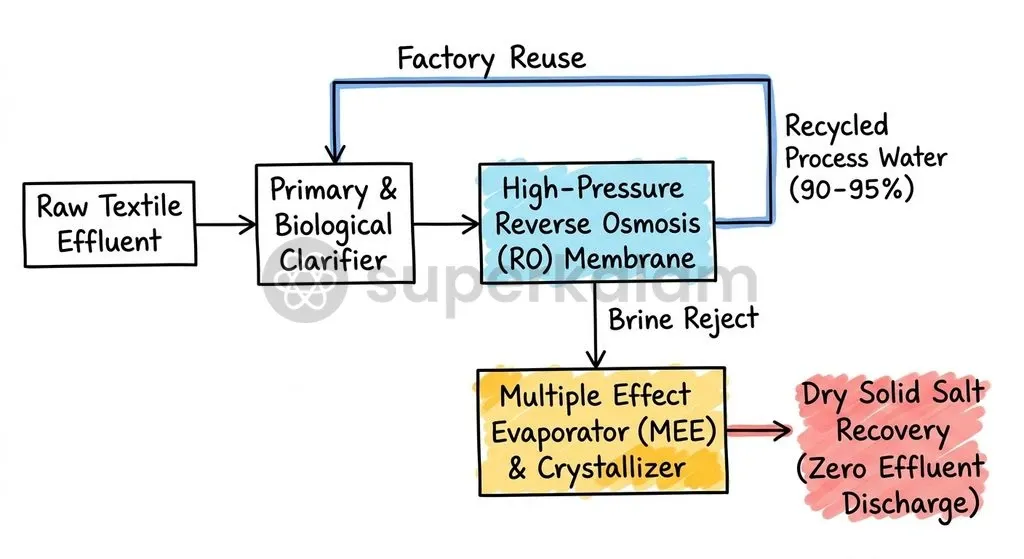
Faced with permanent closure, the cluster invested heavily in engineering solutions. Tiruppur became the world's first textile cluster to implement 100% Zero Liquid Discharge technology across its dyeing operations, recycling over 100 million litres of water daily.
The ZLD system relies on a multi-stage physical, biological, and chemical process:
- Primary and Secondary Clarification: Removing suspended solids and reducing biological oxygen demand through aerobic treatment.
- Reverse Osmosis (RO): Filtering treated effluent through high-pressure membranes to recover up to 85% reusable process water.
- Multiple Effect Evaporation (MEE): Evaporating the concentrated brine reject to recover solid industrial salt for reuse in dyeing cycles.
This turnaround transformed an environmental liability into a major competitive asset. It enabled Tiruppur to attract international fashion brands committed to rigorous ESG standards.
Discuss with Superkalam
Analyse the structural differences between Tiruppur's MSME-led cluster model and Bangladesh's vertically integrated mega-factory model in absorbing global demand shocks.
Ask NowStructural Challenges: Rising Input Costs, Competition, and Labor Gaps
Indian apparel manufacturers face significant tariff penalties and structural bottlenecks relative to international competitors. According to trade analyses by the WTO, UNCTAD, and the Global Trade Research Initiative (GTRI), Indian textile exporters face an average tariff disadvantage of 9.6% to 12% in major export markets like the European Union and the United Kingdom compared to competitors like Bangladesh, which enjoys duty-free access under the Least Developed Country (LDC) 'Everything But Arms' (EBA) framework.
The cluster also grapples with internal structural constraints:
- Cotton Dependency: Global apparel demand has shifted heavily toward Man-Made Fibres (MMF) such as polyester and viscose blends, whereas Tiruppur remains predominantly cotton-focused.
- Labour Turnover: Rising living costs in urban centres have generated domestic labour shortages, requiring units to recruit and house migrant workers from eastern and northern states.
- Power and Effluent Costs: Operating advanced ZLD evaporator systems adds substantial energy expenses, squeezing margins for small wet-processing units.
Comparison: Tiruppur vs Global Apparel Hubs like Bangladesh and Vietnam
Global textile manufacturing hubs operate under distinct structural models, tariff regimes, and supply chain integrations.
| Metric / Dimension | Tiruppur (India) | Bangladesh (Dhaka-Chittagong) | Vietnam (Binh Duong-Hanoi) |
|---|---|---|---|
| Primary Production Model | Decentralised MSME job-work and functional clustering | Large-scale, vertically integrated mega-factories | Foreign Direct Investment (FDI)-driven integrated hubs |
| Fiber Specialisation | Dominated by Cotton Knitwear | Cotton apparel and basic woven garments | High share of Man-Made Fibres (MMF) and sportswear |
| Tariff Access in EU/UK | Standard tariffs of 9.6% to 12% | Duty-free access via LDC 'Everything But Arms' (EBA) | Preferential zero-duty access via EU-Vietnam FTA |
| Environmental Compliance | Mandatory 100% Zero Liquid Discharge (ZLD) | Varied compliance across river basins | Strict industrial zone environmental zoning |
| Workforce Demographics | ~60% female workforce; local and inter-state migrants | Predominantly domestic female workforce (~60-70%) | Skilled domestic labour with high female participation |
Discuss with Superkalam
Weigh the trade-offs between the substantial operating costs of Multiple Effect Evaporators and the export advantages gained through international ESG compliance.
Ask NowPolicy Lessons and the Way Forward for India's Industrial Clusters
The Union Government has integrated the institutional lessons of Tiruppur into its modern national industrial policies. To replicate this cluster efficiency, the Union Government approved the PM Mega Integrated Textile Region and Apparel (PM MITRA) Parks scheme with a total financial outlay of ₹4,445 crore from FY 2021-22 to FY 2027-28 to develop 7 mega textile parks across India.
According to the Ministry of Textiles, each PM MITRA Park is projected to attract approximately ₹10,000 crore in investment and generate 3 lakh jobs, consisting of 1 lakh direct and 2 lakh indirect employment opportunities.
Under the PM MITRA guidelines, the Central Government provides Development Capital Support (DCS) up to ₹500 crore for greenfield parks and ₹200 crore for brownfield parks (covering up to 30% of project cost), alongside Competitive Incentive Support (CIS) up to ₹300 crore per park for early manufacturing units.
Complementary policies reinforce this industrial architecture:
- Production Linked Incentive (PLI) Scheme: Notified with an outlay of ₹10,683 crore specifically targeting Man-Made Fibre (MMF) apparel, MMF fabrics, and technical textiles over a five-year period.
- Rebate of State and Central Taxes and Levies (RoSCTL): Provides an export rebate on embedded central and state taxes to readymade garments and made-ups to maintain international price competitiveness.
- Free Trade Agreement Negotiations: Accelerating bilateral trade pacts with the UK and EU to neutralise the 9.6% to 12% tariff disadvantage faced by domestic exporters.
Replicating the Tiruppur model across India requires state governments to invest in common effluent infrastructure, facilitate collective industry associations, and encourage flexible labour arrangements that safeguard statutory social security.
Key Takeaways
- Export Dominance: Tiruppur generates over ₹33,000 crore to ₹40,000 crore annually in garment exports, accounting for 50% to 55% of India's total cotton knitwear exports.
- Agglomeration Dynamics: The cluster relies on extreme functional disintegration across MSME units, minimising capital barriers and enabling rapid production line reconfiguration during global demand shocks.
- Inclusive Labour: Women make up approximately 60% of the shop-floor workforce, demonstrating how decentralised textile manufacturing accelerates female labour force participation and formal social security integration.
- Environmental Turnaround: Following a 2011 Madras High Court closure order, Tiruppur became the world's first textile cluster to implement 100% Zero Liquid Discharge, recycling over 100 million litres of water daily.
- National Policy Blueprint: Central initiatives such as PM MITRA parks (₹4,445 crore outlay) and the PLI Scheme for Textiles (₹10,683 crore outlay) directly reflect Tiruppur's emphasis on integrated infrastructure and scale.
Mains Question
"The Tiruppur industrial cluster demonstrates that sustainable manufacturing growth and employment generation do not rely solely on large-scale corporate mega-factories." Elucidate the role of functional disintegration and agglomeration economies in driving cluster competitiveness. (10 Marks)
Evaluate NowMains Question
"Judicial intervention in 2011 forced the Tiruppur textile cluster to pioneer global benchmarks in Zero Liquid Discharge (ZLD), turning an environmental crisis into an export advantage." Critically analyse the economic and ecological trade-offs associated with green transitions in MSME-dominated clusters. (15 Marks)
Evaluate NowPractice MCQs
QUESTION 1
With reference to the Tiruppur textile cluster in India, consider the following statements:
- It accounts for more than half of India's total cotton knitwear exports.
- Women constitute approximately 60% of its formal and semi-formal shop-floor workforce.
- The cluster's production model is primarily based on large-scale vertically integrated corporate mega-factories. Which of the statements given above is/are correct?
QUESTION 2
Regarding the Zero Liquid Discharge (ZLD) transition in the Tiruppur textile ecosystem, consider the following statements:
- The shift to ZLD was triggered by a 2011 Madras High Court order closing non-compliant dyeing and bleaching units polluting the Noyyal River basin.
- The Reverse Osmosis (RO) stage in Tiruppur's ZLD process recovers up to 85% of reusable process water.
- Multiple Effect Evaporation (MEE) is deployed to recover solid industrial salt from concentrated brine reject. Which of the statements given above are correct?
QUESTION 3
Consider the following statements regarding the structural challenges and global trade dynamics of the Tiruppur apparel cluster:
- Indian textile exporters face a tariff disadvantage of 9.6% to 12% in the EU and UK markets relative to Bangladesh.
- Bangladesh benefits from duty-free export access under the Least Developed Country 'Everything But Arms' (EBA) framework.
- Tiruppur's manufacturing base is predominantly aligned with Man-Made Fibres (MMF) rather than cotton. Which of the statements given above is/are correct?
QUESTION 4
In the context of industrial organization, the concept of 'extreme functional disintegration' in the Tiruppur cluster implies that:
QUESTION 5
Consider the following factors contributing to the industrial resilience of the Tiruppur apparel cluster:
- Institutional collective bargaining through the Tirupur Exporters Association (TEA) founded in 1990.
- Capacity swapping and flexible shop floors across peer networks during demand downturns.
- Transition toward formal fixed-term employment with statutory social security (EPF and ESI) registrations. Which of the statements given above are correct?