Telangana Scraps Junior Colleges: The Shift to NEP 2020 Explained
Beyond administrative consolidation, Telangana's 55-year intermediate reset tests whether structural school integration can curb systemic secondary dropouts.
Nov, 2026
•9 min read
Overview
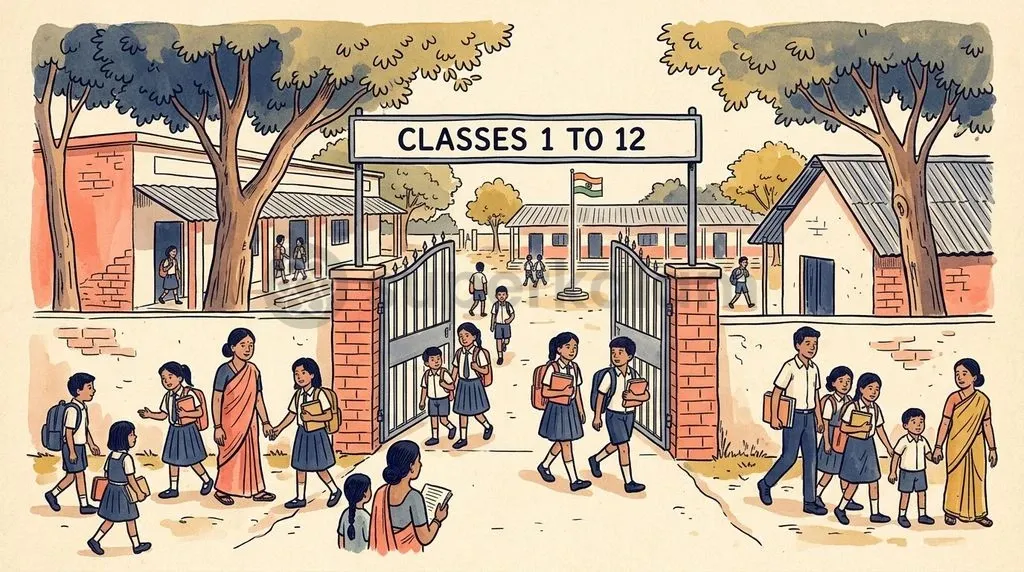
The Telangana government announced on 11 November 2026 that it will scrap standalone intermediate junior colleges. It will integrate Classes 11 and 12 directly into composite high schools under a unified 10+2 pattern, starting from the 2027–28 academic year.
This policy reform dismantles a 55-year-old administrative bifurcation dating back to the 1969–70 academic year. The move realigns the state's educational architecture with the National Education Policy 2020.
By absorbing intermediate education into composite secondary schools, the state targets an estimated 40% post-Class 10 dropout rate. This attrition remains heavily concentrated among rural girls and marginalised groups. Resolving cadre friction between School Assistants and Junior Lecturers, alongside upgrading science laboratories, will decide whether the reform succeeds.
Why Is Telangana Phasing Out Standalone Junior Colleges?
Telangana Chief Minister A. Revanth Reddy directed the Education Department on 11 November 2026 to dissolve standalone junior colleges and integrate higher secondary classes into composite high schools. According to reporting by The Hindu, this administrative transition will take formal effect from the 2027–28 academic year. It ends a bifurcated secondary education architecture that has operated since the late 1960s.
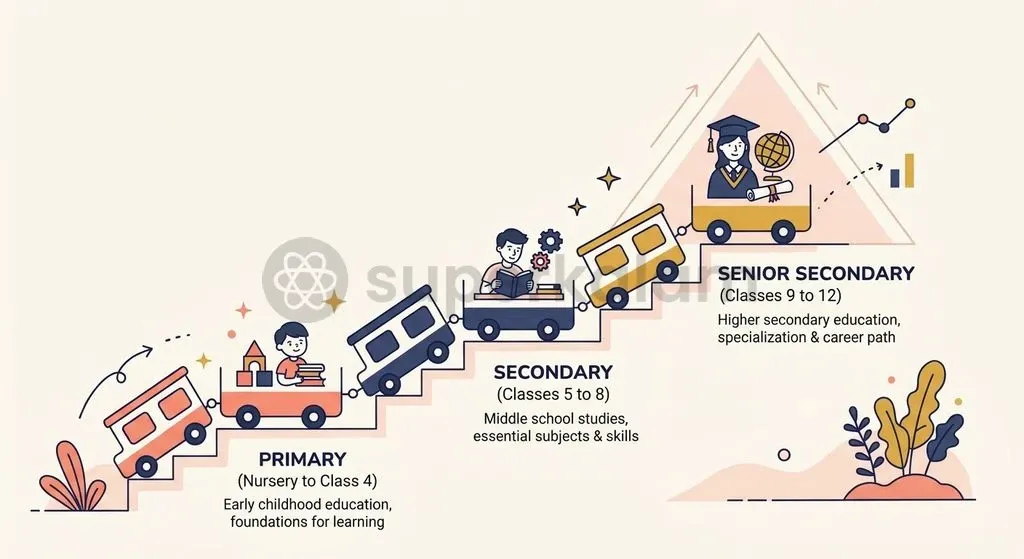
State authorities plan to merge the Telangana Board of Intermediate Education (TGBIE) with the Department of School Education, dissolving a 55-year-old administrative separation. Under the restructuring plan reported by The Times of India, school education in Telangana will be organised into three distinct tiers:
- Primary Stage: Nursery to Class 4
- Secondary Stage: Classes 5 to 8
- Senior Secondary Stage: Classes 9 to 12
This structural overhaul is not just a bureaucratic merger. It treats senior secondary education as an organic continuation of schooling rather than a disconnected commercial bottleneck.
Historically, standalone junior colleges operated as isolated pre-university entities. That setup severed pastoral care and created sharp hurdles for students completing Class 10. Bringing intermediate classes back onto school campuses eliminates admissions bottlenecks. It also removes the travel barriers that push vulnerable students out of formal education.
Discuss with Superkalam
Recall the academic year in which undivided Andhra Pradesh first adopted the Kothari Commission's 10+2 pattern.
Ask NowThe Intermediate System: Why Andhra Pradesh and Telangana Split 10+2
The Andhra Pradesh Intermediate Education Act, 1971 gave statutory backing to standalone junior colleges after the unified state adopted the Kothari Commission recommendations during the 1969–70 academic year. The Kothari Education Commission (1964–66) had proposed a uniform 10+2+3 educational pattern across India. It designed the two-year intermediate stage to bridge general schooling and specialised university degrees.
Undivided Andhra Pradesh took an exceptional institutional route compared to other regions:
- National Norm: Most northern and western states located higher secondary education inside existing secondary schools under State Secondary Boards or the Central Board of Secondary Education (CBSE).
- The AP Divergence: Undivided Andhra Pradesh set up dedicated intermediate colleges governed by a standalone statutory board, institutionalising junior colleges as distinct entities segregated from the Directorate of School Education.
This institutional split nurtured an aggressive private coaching market across undivided Andhra Pradesh and modern Telangana. Private operators expanded rapidly to fill regional seat deficits, eventually dominating enrolments:
- Enrolment Skew: According to The Hindu, private colleges currently accommodate approximately 8 lakh students out of the state's total intermediate enrolment of nearly 12 lakh.
- Coaching Distortion: Two-year junior colleges shifted away from foundational education, turning into high-pressure preparation hubs for engineering and medical entrance tests.
Discuss with Superkalam
Explain why the geographical gap between 11,000 secondary schools and 3,241 junior colleges disproportionately impacts rural female literacy.
Ask NowAligning with NEP 2020: Moving from 10+2 to the 5+3+3+4 School Framework
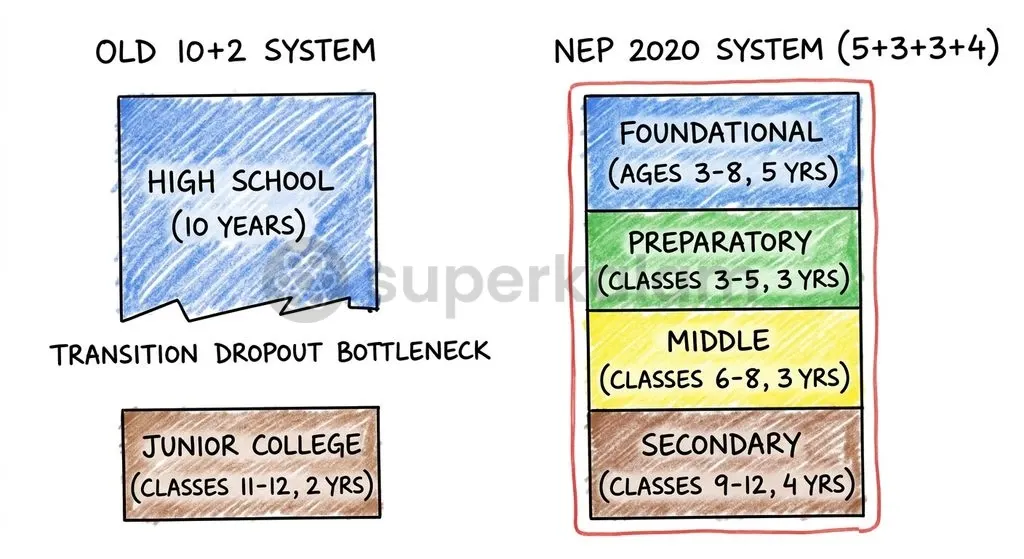
The National Education Policy 2020 replaces the historic 10+2 structure with a 5+3+3+4 curricular model. It groups Classes 9 through 12 into a single multidisciplinary secondary stage. This design eliminates arbitrary barriers between matriculation and intermediate studies, encouraging flexible subject choices across sciences, humanities, and vocational arts.
In its final report titled Education Policy for Telangana 2026: Vision for Inclusive Excellence, the Telangana Education Commission, chaired by retired IAS officer Akunuri Murali, formally recommended integrating intermediate education into composite schools. The commission advised unifying the Secondary School Certificate (SSC) and Intermediate examination boards into a single authority to streamline academic curricula and student assessments.
| Feature | Legacy 10+2 Intermediate Model | NEP 2020 Integrated Model |
|---|---|---|
| Institutional Location | Split across High Schools (Classes 1–10) and Junior Colleges (Classes 11–12) | Composite Higher Secondary Schools covering Classes 9 to 12 |
| Regulatory Board | Bifurcated under School Directorate and Intermediate Board (TGBIE) | Unified governance under a single State Directorate of School Education |
| Transition Barrier | High; requires campus transfer, fresh admissions, and new fee structures | Seamless; continuous four-year multidisciplinary secondary progression |
| Curricular Design | Rigid subject streams (MPC, BiPC, CEC, HEC) | Multidisciplinary subject options across sciences, arts, and vocational streams |
Secondary school integration removes the administrative friction of high-stakes transitions after Class 10. Students can pick subjects across traditional academic streams without shifting campuses. This structural consolidation bridges the conceptual gap between secondary and higher secondary education, establishing a base for continuous evaluation.
Fixing the Transition Gap: Can High School Integration Halt Grade 10 Dropouts?
Telangana reports an estimated post-Class 10 transition dropout rate of approximately 40%. This attrition crisis predominantly hits adolescent girls and students from marginalised communities. Government assessments cited by the Deccan Chronicle identify the physical break between Class 10 high schools and separate intermediate colleges as the primary institutional driver of this loss.
Geographical disparity between high schools and junior colleges shapes these dropout figures directly:
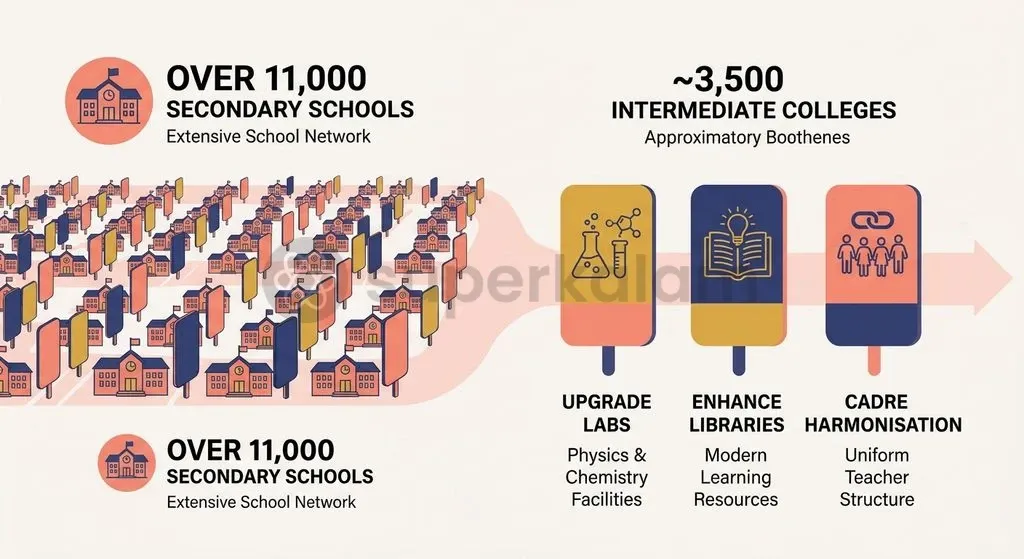
- Secondary Schools: Telangana operates over 11,000 schools providing education up to Class 10.
- Intermediate Colleges: The state hosts only 3,241 junior colleges, creating a severe physical access deficit.
Rural students completing Class 10 frequently find that the nearest government junior college sits tens of kilometres away in a mandal headquarters or urban centre. For adolescent girls, safety concerns surrounding long commutes and the burden of private transport expenses often lead families to discontinue schooling.
Data from residential setups confirms the advantage of composite schooling. Institutions such as Kasturba Gandhi Balika Vidyalayas (KGBVs), Jawahar Navodaya Vidyalayas, and Kendriya Vidyalayas register significantly lower post-Class 10 dropout rates because they offer uninterrupted on-campus schooling through Class 12. Retaining students in local composite schools eliminates travel barriers, protects female enrolment, and shields families from steep private tuition fees.
Discuss with Superkalam
If you were tasked with resolving the seniority conflict between Gazetted Headmasters and Junior College Principals, how would you structure supervisory roles on a unified campus?
Ask NowGovernance Challenges: Lecturer Cadres, Funding, and Infrastructure Readiness
The Telangana Education Department faces substantial friction between post-graduate Junior Lecturers and graduate School Assistants over pay parity, administrative hierarchy, and institutional seniority. Merging two independent departmental cadres creates administrative hurdles across multiple areas:
- Pay and Cadre Disparity: Under TSPSC Notification No. 22/2022, Government Junior Lecturers (JLs) are recruited with postgraduate degrees on a gazetted pay scale starting at Rs 54,220–1,33,630. High school School Assistants (SAs) are recruited with bachelor's and B.Ed qualifications on a different pay scale.
- Campus Supervisory Conflict: Reporting in The Hindu highlights administrative conflict between High School Gazetted Headmasters and Junior College Principals over supervisory authority in unified Class 9 to 12 schools.
- Physical Infrastructure Deficits: High schools require dedicated laboratories for Physics, Chemistry, and Biology, alongside expanded libraries and classrooms.
Chief Minister A. Revanth Reddy assured junior college staff that their employment status, pay scales, and pension benefits will be fully protected throughout the departmental integration. Even with employment safeguards in place, operational disputes over campus leadership demand clear service rules to prevent administrative stalemate.
Former Telangana Education Commission Chairman Akunuri Murali cautioned against upgrading all schools simultaneously, recommending a phased expansion backed by strict infrastructure inspections to prevent educational dilution. Educational analysts point to neighbouring Andhra Pradesh's 2022–23 initiative, which upgraded high schools to a 10+2 pattern; that rapid transition yielded an initial intermediate pass rate of **just ** due to acute teacher deficits and missing laboratory equipment.
Discuss with Superkalam
Analyse the factors that caused Andhra Pradesh's upgraded 'High School Plus' schools to record collapsing pass rates in 2022–23.
Ask NowReforming Secondary Education: The Path Ahead for State School Systems
Statutory reform requires the Telangana Legislature to repeal or amend the Telangana Intermediate Education Act, 1971 while updating the Telangana Education Act, 1982 to legitimise composite schooling. Enacting these legislative amendments is necessary to formally dissolve the intermediate board, unify state examination directorates, and grant legal standing to integrated Class 9 to 12 secondary schools.
From a constitutional perspective, structural integration advances universal education. While the Right of Children to Free and Compulsory Education (RTE Act, 2009) enacted under Article 21A guarantees fundamental educational rights only between ages 6 and 14 (up to Class 8), the National Education Policy 2020 advocates extending secondary coverage through age 18. Integrating senior secondary classes directly into the universal school system operationalises Directive Principles of State Policy under Article 41 (right to education) and Article 45 (early childhood and adolescent educational care).
State policymakers must implement targeted administrative interventions to make this restructuring durable:
- Phased Campus Upgrades: Upgrade high schools in clusters based on verified physical capacities, prioritising institutions with adequate land, existing classrooms, and laboratory readiness.
- Unified Cadre Framework: Formulate composite service rules that preserve the gazetted status and pay scales of Junior Lecturers while establishing clear administrative command structures for high school principals.
- Targeted Capital Allocation: Mobilise infrastructure financing through Samagra Shiksha Abhiyan and state budgetary grants to construct accredited science laboratories and digital libraries before launching Classes 11 and 12.
- Curricular Flexibility: Pilot multidisciplinary course options in upgraded schools, breaking rigid academic boundaries between physical sciences, commerce, and social studies.
Transforming junior college education from a segregated coaching market into a community-based secondary school system requires substantial financial commitment. If backed by institutional funding and administrative consensus, Telangana's structural transition will lower socio-economic barriers, curb female dropouts, and create an inclusive pathway through higher secondary education.
Key Takeaways
- Telangana plans to scrap standalone intermediate junior colleges starting from the 2027–28 academic year, merging Classes 11 and 12 into composite high schools.
- The reform ends a 55-year administrative bifurcation established under the Andhra Pradesh Intermediate Education Act, 1971 following the Kothari Commission (1964–66).
- Integrating higher secondary classes aligns the state system with the National Education Policy 2020's 5+3+3+4 architecture, forming a single four-year secondary stage from Classes 9 to 12.
- The primary socio-economic objective is halting a 40% post-Class 10 transition dropout rate caused by the scarcity of junior colleges relative to high schools.
- Administrative friction between Junior Lecturers (gazetted scale Rs 54,220–1,33,630) and high school administrators demands clear composite service rules.
- Policy success requires phased school upgrades and adequate science laboratory investments to avoid the low pass rates seen during Andhra Pradesh's 2022–23 school restructuring.
Mains Question
"The physical and administrative bifurcation of higher secondary education from secondary schooling has acted as an institutional driver of post-Class 10 student attrition." In light of Telangana's decision to scrap standalone junior colleges, examine how composite schooling addresses structural dropout rates, especially among vulnerable demographics. (10 Marks)
Evaluate NowMains Question
The Telangana Education Commission has recommended unifying school and intermediate education boards to realise the vision of NEP 2020. Critically analyse the governance, cadre, and infrastructural impediments that state administrations face during such systemic transitions. (15 Marks)
Evaluate NowPractice MCQs
QUESTION 1
With reference to the evolution of higher secondary education in undivided Andhra Pradesh, consider the following statements:
- Standalone junior colleges were given statutory backing through the Andhra Pradesh Intermediate Education Act, 1971.
- Undivided Andhra Pradesh adopted the Kothari Commission's recommended 10+2+3 pattern starting from the 1969–70 academic year.
- Unlike most northern and western states which embedded Classes 11 and 12 in secondary schools, Andhra Pradesh set up separate intermediate colleges under an independent statutory board.
Which of the statements given above are correct?
QUESTION 2
Regarding the structural realignment of school education proposed in Telangana under the National Education Policy (NEP) 2020, consider the following statements:
- The reform replaces the legacy 10+2 structure by grouping Classes 9 through 12 into a single composite secondary stage.
- The Telangana Education Commission, chaired by Akunuri Murali, recommended merging the Secondary School Certificate (SSC) and Intermediate examination boards into a unified authority.
- Under the restructuring plan, school education will be reorganised into three tiers, with the Primary Stage covering Nursery to Class 5.
Which of the statements given above is/are correct?
QUESTION 3
Consider the following statements regarding the transition gap and student dropout dynamics highlighted in Telangana:
- Telangana reports an estimated post-Class 10 transition dropout rate of approximately 40%, heavily concentrated among adolescent girls and marginalised groups.
- The state operates over 11,000 schools up to Class 10, contrasted with only 3,241 junior colleges, creating a severe physical access deficit.
- Institutions offering uninterrupted schooling through Class 12, such as Kasturba Gandhi Balika Vidyalayas, report significantly higher dropout rates compared to standalone junior colleges.
Which of the statements given above is/are correct?
QUESTION 4
Which of the following administrative and service-cadre challenges is identified in the proposed integration of junior colleges into composite high schools in Telangana?
QUESTION 5
With reference to the structural reforms in intermediate education in neighbouring Andhra Pradesh during 2022–23 cited in the article, consider the following statements:
- Andhra Pradesh upgraded government high schools into 'High School Plus' institutions offering intermediate classes in 2022–23.
- The upgraded schools recorded strong pass rates in their first intermediate examinations.
Which of the statements given above is/are correct?
Discuss with Superkalam
Weigh the benefits of an immediate state-wide school integration against the phased model recommended by the Telangana Education Commission.
Ask Now