Declining Parliament Sittings: Is Executive Scrutiny at Risk?
As legislative sessions shrink to historic lows, executive dominance threatens to dismantle the constitutional safeguards of continuous parliamentary oversight.
Nov, 2026
•11 min read
Overview
Executive accountability hinges on regular parliamentary sittings. Without them, legislative oversight fails. The 17th Lok Sabha met for only 274 sittings over its five-year tenure. That works out to roughly 55 sitting days per year, a historical low.
Article 85(1) sets a loose rule: no more than six months may elapse between successive sessions. In practice, the Cabinet Committee on Parliamentary Affairs uses this latitude to shrink sitting calendars. The fallout is immediate. Question Hour shrinks, committee referrals collapse, and the constitutional balance of powers under Article 75(3) weakens. Restoring oversight demands binding statutory minimums and mandatory pre-legislative scrutiny.
Why Parliament Sittings Are Back in the Spotlight
The 17th Lok Sabha concluded its term with only 274 sittings. It registered the lowest tally for any full-term Lok Sabha in independent India's history.
Data compiled by PRS Legislative Research highlights the extent of this contraction between 2019 and 2024:
- Low annual average: The House averaged approximately 55 sitting days per year.
- Premature adjournments: Presiding officers adjourned 11 of the 15 convened sessions adjourned sine die ahead of schedule, forfeiting 40 scheduled sittings or roughly 13% of planned legislative time.
- Hastened approvals: 58% of Bills passed during the 17th Lok Sabha were cleared within two weeks of their introduction.
- Minimal debate: Around 35% of passed Bills in the Lok Sabha and 34% in the Rajya Sabha were approved after less than one hour of plenary debate.
Deliberative scrutiny faced further disruption in the Winter Session of 2023. Presiding officers suspended 146 Opposition members across both Houses. Key structural overhauls—including the Bharatiya Nyaya Sanhita, the Bharatiya Nagarik Suraksha Sanhita, and the Bharatiya Sakshya Adhiniyam—passed under minimal floor resistance. This pattern sparked deep concern across civil society regarding the state of deliberative scrutiny.
Discuss with Superkalam
Can you recall the maximum time gap permitted between two consecutive sessions of Parliament under Article 85(1)?
Ask NowWhat Does the Constitution Say About Convening Parliament?
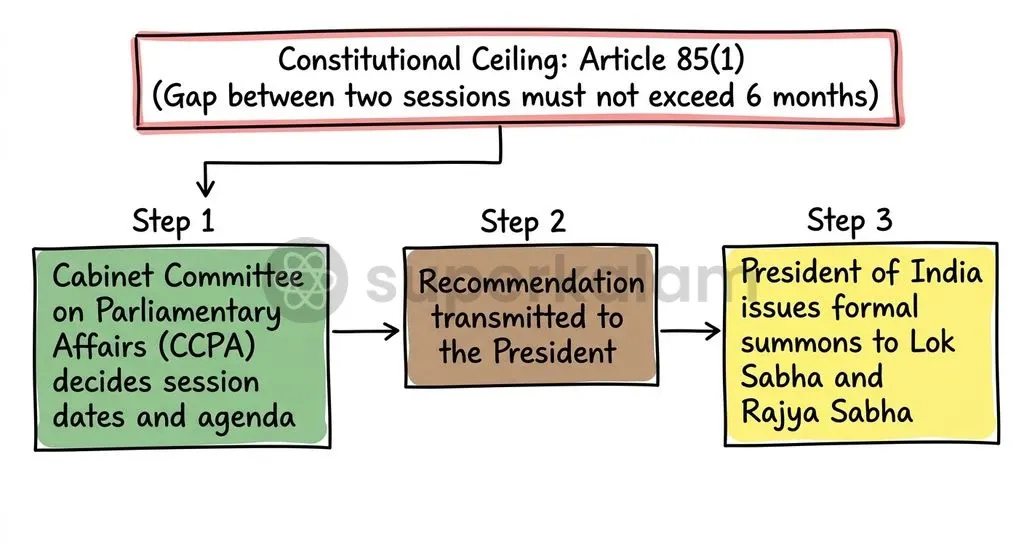
Article 85(1) of the Constitution mandates that the President shall summon each House of Parliament so that six months do not intervene between consecutive sessions. The Constituent Assembly intended this provision as an outer ceiling to prevent executive overreach. In practice, however, that outer limit has turned into an operational minimum.
The convening framework operates under an asymmetrical division of authority:
- Constitutional ceiling (Article 85(1)): The President formally summons Parliament, ensuring gaps between sessions never exceed six months.
- Executive scheduling: The Cabinet Committee on Parliamentary Affairs, assisted by the Ministry of Parliamentary Affairs, determines the dates and duration of sessions before recommending them to the President under Article 85(1).
- Collective responsibility (Article 75(3)): The Council of Ministers remains collectively responsible to the House of the People.
This structural arrangement creates an institutional paradox. When the executive controls the sittings of the body elected to hold it to account, the master sets the examiner's timetable.
The remedy lies in what Dr. B.R. Ambedkar termed constitutional morality during the Constituent Assembly debates on 4 November 1948. That doctrine demands that political leaders honour the spirit of continuous legislative scrutiny rather than treating Article 85(1) as a mere technical hurdle.
The Scrutiny Toolkit: How Parliament Holds the Government to Account
Parliamentary oversight relies on specific procedural instruments designed to extract ministerial information, compel policy justifications, and enforce public accountability. The Rules of Procedure and Conduct of Business in Lok Sabha arm members with varied devices for day-to-day oversight.
| Scrutiny Mechanism | Procedural Rule / Origin | Operational Function | Recent Performance / Trends |
|---|---|---|---|
| Question Hour | Rule 32 of Lok Sabha Rules; Rule 38 of Rajya Sabha Rules | Designated first hour for direct oral and written questions to ministers. | Functioned for only 60% of scheduled time in 17th Lok Sabha and 52% in Rajya Sabha due to disruptions. |
| Zero Hour | Uncodified Indian convention (established in 1962) | Allows MPs to raise urgent matters without the standard 10-day advance notice. | Commences at 12 noon immediately following Question Hour; frequently truncated during disruptions. |
| Calling Attention | Rule 197 of Lok Sabha Rules | Empowers an MP to draw ministerial attention to urgent public matters and elicit a statement. | Requires Speaker's permission; provides an intermediate scrutiny bridge. |
| No-Confidence Motion | Rule 198 of Lok Sabha Rules | Operationalises Article 75(3); requires 50 members to grant leave for debate within 10 days. | Tests the government’s collective survival; rarely shifts legislative outcomes under single-party majorities. |
| Standing Committees (DRPSCs) | Instituted in 1993; expanded to 24 committees in 2004 | Detailed technical examination of demands for grants, bills, and policies outside plenary glare. | Referral rate of introduced Bills collapsed to 16% in the 17th Lok Sabha. |
Question Hour is the frontline mechanism of ministerial accountability. Under Rule 32, ministers must provide precise factual replies to starred questions on the floor of the Lok Sabha. To shield this oversight from recurring morning disruptions, the Rajya Sabha under Chairman Hamid Ansari amended Rule 38 in 2014, shifting its Question Hour from 11:00 AM to 12:00 Noon.
Zero Hour gives backbenchers a direct channel to ventilate constituency grievances and flag emerging crises without notice. When floor sittings shrink or collapse into disorder, Question Hour and Zero Hour are invariably the first casualties. The executive is insulated from real-time interrogations as a result.
Discuss with Superkalam
How does the executive's power to schedule legislative sessions create an institutional conflict of interest under parliamentary democracy?
Ask NowWhy Are Sitting Days Declining? Arguments and Practical Constraints
Executive managers and political leaders put forward three primary operational arguments to justify shorter parliamentary sessions:
- Electoral calendar pressures: Union ministers and Members of Parliament face an unrelenting cycle of state assembly elections, which demands extensive regional campaigning. Proponents argue that continuous legislative sessions during major assembly campaigns force poor attendance and political friction.
- Administrative bandwidth constraints: Per administrative guidelines and reports from the Ministry of Parliamentary Affairs (as reported in 2022), prolonged parliamentary sessions place significant operational strain on line ministries. Executive departments argue that answering extensive daily parliamentary questions diverts senior civil servants from core welfare implementation and long-term policymaking.
- Shift towards specialised committees: Executive floor managers point to the 24 Department-related Parliamentary Standing Committees, which operate continuously throughout the calendar year. In theory, these closed-door panels offer calm, cross-party evaluation away from televised floor cameras.
This migration argument falls apart under scrutiny. While committees are structurally equipped for detailed line-by-line review, the executive has increasingly bypassed them altogether. Floor and committee oversight have eroded at the same time.
The Impact: What Happens When Sessions and Debates Are Curtailed?
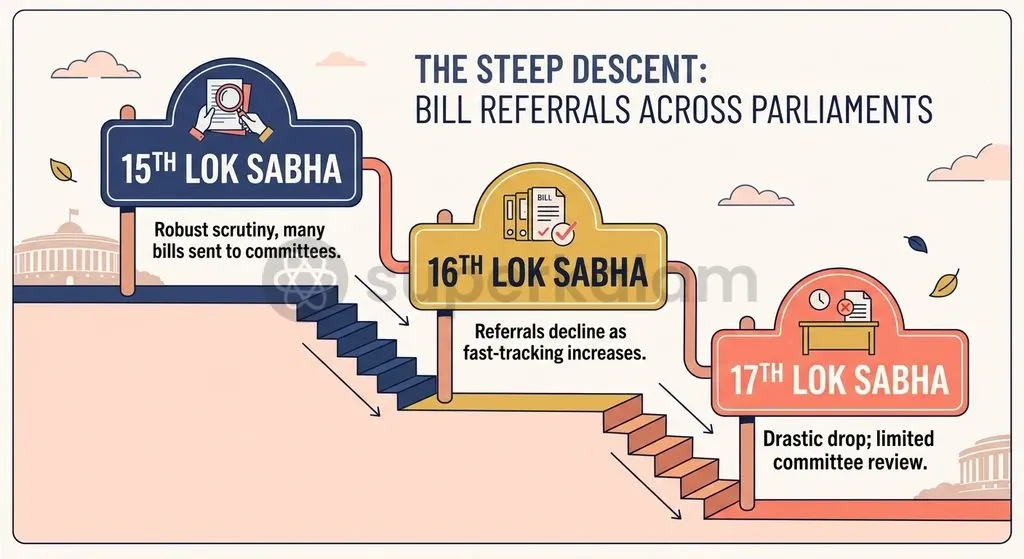
Legislative scrutiny collapses when sitting days shrink. A severe democratic deficit follows across statutory and fiscal governance. According to PRS Legislative Research, committee referrals dropped from 71% in the 15th Lok Sabha and 27% in the 16th Lok Sabha to just 16% of Bills in the 17th Lok Sabha. Bypassing committee examination allows complex legislative provisions to enter the statute book without clause-by-clause stakeholder consultation.
| Lok Sabha Tenure | Period | Proportion of Bills Referred to Committees |
|---|---|---|
| 15th Lok Sabha | 2009–2014 | 71% referred |
| 16th Lok Sabha | 2014–2019 | 27% referred |
| 17th Lok Sabha | 2019–2024 | 16% referred |
Budgetary scrutiny shows a similar decay. PRS Legislative Research reported that over 80% of expenditure demands in recent Union Budgets were passed through the 'guillotine' procedure. The guillotine bundles unexamined ministerial financial demands and votes on them without debate, leaving trillions in public funds unexamined by the House.
From an ethical perspective, truncating debate damages public trust. As noted in the 2nd Administrative Reforms Commission’s 4th Report on Ethics in Governance, elected legislators are moral trustees of sovereignty. Rushing legislation through deprives citizens of transparent scrutiny over public finances and regulatory powers.
Jürgen Habermas’s model of deliberative democracy posits that state coercion derives moral legitimacy solely through uncoerced, reasoned, and inclusive public discourse. When legislation passes through manufactured majorities in truncated sessions without deliberative contestation, the resulting laws lose normative consensus, escalating social conflict and inviting frequent constitutional challenges before the judiciary.
Discuss with Superkalam
If you were advising the Presiding Officers, how would you address the administrative argument that prolonged sessions divert civil servants from policymaking?
Ask NowComparing Practice: How Other Major Democracies Fix Their Sittings Calendar
Mature parliamentary and congressional democracies insulate their legislative schedules from executive whim through statutory calendars and independent agenda management. The Indian practice of executive-dominated calendar design remains an outlier among major constitutional democracies.
| Dimension | India (Lok Sabha & Rajya Sabha) | United Kingdom (House of Commons) | United States (House of Representatives) | Canada (House of Commons) |
|---|---|---|---|---|
| Annual Sittings | Average 55 days/year (17th Lok Sabha). | Meets approximately 140–160 days annually. | Meets roughly 130–150 days annually. | Meets roughly 130–135 days annually. |
| Calendar Authority | Executive decides via Cabinet Committee on Parliamentary Affairs. | Governed by parliamentary standing orders and standard sessional conventions. | Fixed legislative calendar established by congressional leadership. | Fixed parliamentary calendar codified under Standing Orders. |
| Minimum Quota | No statutory minimum; only 6-month ceiling under Article 85(1). | Predictable annual sittings spanning four scheduled sitting terms. | Predetermined sitting blocks set ahead of the legislative year. | Codified calendar setting mandatory sitting weeks per year. |
| Committee Referral | Discretionary; plunged to 16% in 17th Lok Sabha. | Mandatory public bill committee stage for almost all substantive primary legislation. | Universal committee referral before bills reach the chamber floor. | Automatic referral to standing committees following second reading. |
The British House of Commons relies on established conventions and standing orders to preserve approximately 140 to 160 sittings each year. The Canadian House of Commons operates under a codified sitting calendar that schedules sitting weeks well in advance, preventing sudden adjournments by the governing ministry.
Beyond floor debates, these international assemblies treat committee evaluation as a non-negotiable step in the legislative lifecycle. In Canada and the United Kingdom, ordinary legislation undergoes systematic, line-by-line committee review before returning to the floor for final passage, safeguarding technical precision and public input.

Way Forward: Fixed Parliamentary Calendars and Empowered Committees
Institutional reform must begin by establishing a predictable, codified calendar to eliminate executive discretion over legislative sittings. The National Commission to Review the Working of the Constitution (NCRWC, 2002), chaired by Justice M.N. Venkatachaliah, recommended mandating a minimum of 120 sittings annually for the Lok Sabha and 100 sittings for the Rajya Sabha.
This institutional goal has historical roots within India's own parliamentary practice. In 1955, the General Purposes Committee of the Lok Sabha recommended adopting an annual calendar of three regular sessions. While Prime Minister Jawaharlal Nehru's cabinet approved this reform in principle, it was never enacted into binding law.
Concrete structural steps are required to operationalise continuous executive accountability:
- Constitutional Amendment of Article 85: Parliament should consider Private Member Bills, such as those introduced by MPs Derek O'Brien and Manoj Kumar Jha, to establish an explicit constitutional floor of 100 to 120 sitting days per year.
- Mandatory Committee Referral: Rules of Procedure in both Houses should make bill referrals to Department-related Parliamentary Standing Committees automatic, waiving the requirement only under strict, speaker-certified public emergencies.
- Opposition Days and Protected Agendas: India should adopt the United Kingdom's convention of dedicating specific parliamentary days where Opposition parties set the deliberative agenda and select topics for debate.
- Independent Convening Power: Presiding officers, backed by a written petition from a specified threshold of members (e.g., 25% or 33% of the House), should hold statutory authority to convene special sittings independently of the Cabinet Committee on Parliamentary Affairs.
Re-establishing Parliament as a deliberative institution requires moving past the six-month loophole in Article 85(1). Codifying mandatory sitting thresholds and institutionalising committee scrutiny are essential steps to ensure that collective executive accountability under Article 75(3) remains a living constitutional reality.
Discuss with Superkalam
Why has the migration of legislative debate from the plenary floor to parliamentary committees failed to compensate for declining sitting days?
Ask NowKey Takeaways
- The 17th Lok Sabha averaged roughly 55 sitting days annually (274 sittings total), the lowest sitting record for any full-term Lok Sabha in Indian history.
- Article 85(1) mandates only that six months shall not elapse between sessions, granting the executive, through the Cabinet Committee on Parliamentary Affairs, discretionary control over parliamentary dates.
- Truncated sessions severely undermine collective executive responsibility under Article 75(3), leading to compressed debates where 35% of bills passed with under one hour of discussion.
- Committee referrals collapsed to just 16% of introduced Bills during the 17th Lok Sabha, alongside over 80% of budgetary demands being cleared without debate under the guillotine.
- The NCRWC (2002) recommended a statutory minimum of 120 annual sitting days for the Lok Sabha and 100 days for the Rajya Sabha to restore institutional oversight.
Mains Question
"When the executive controls the sittings of the body elected to hold it to account, the master sets the examiner's timetable." In the context of Article 85(1) and Article 75(3) of the Constitution, examine how the contraction of parliamentary sitting days impacts the constitutional scheme of executive accountability. (15 Marks)
Evaluate NowMains Question
'Department-related Parliamentary Standing Committees were conceived to ensure detailed, non-partisan legislative scrutiny outside the plenary glare.' In light of recent trends in committee referrals, evaluate this statement. (10 Marks)
Evaluate NowPractice MCQs
QUESTION 1
Regarding the constitutional and procedural framework governing parliamentary sittings in India, consider the following statements:
- Article 85(1) specifies that more than six months shall not elapse between the last sitting of one session and the date appointed for the first sitting of the next session.
- The Cabinet Committee on Parliamentary Affairs determines the dates and duration of parliamentary sessions before recommending them to the President.
- The Constitution mandates a statutory minimum number of 60 sitting days per calendar year for the Lok Sabha. Which of the statements given above are correct?
QUESTION 2
With reference to parliamentary devices of oversight in the Indian Parliament, consider the following statements:
- Question Hour is explicitly regulated under Rule 32 of the Lok Sabha Rules.
- In 2014, the Rajya Sabha amended its rules to shift Question Hour to 12:00 Noon.
- Zero Hour is a codified procedure under the Rules of Procedure and Conduct of Business in Lok Sabha introduced in 1962. Which of the statements given above is/are correct?
QUESTION 3
Consider the following statements regarding the functioning of the 17th Lok Sabha:
- The 17th Lok Sabha registered the lowest total number of sittings for any full-term Lok Sabha in independent India's history.
- The proportion of Bills referred to Department-related Parliamentary Standing Committees increased to over 70% during its tenure.
- More than half of the Bills passed during the 17th Lok Sabha were cleared within two weeks of their introduction. Which of the statements given above are correct?
QUESTION 4
Consider the following parliamentary devices and procedures:
- Guillotine
- Calling Attention Motion
- No-Confidence Motion Which of the above mechanisms are specifically used to enforce legislative oversight or scrutinise executive expenditure?
QUESTION 5
According to the Rules of Procedure and Conduct of Business in Lok Sabha, how many members must support a notice for leave to move a Motion of No-Confidence under Rule 198 before it can be granted?
Discuss with Superkalam
Do you think India should adopt a legally binding fixed parliamentary calendar, or does the executive require flexibility to respond to emergencies?
Ask Now