DPDP Act and Election Commission: Does Privacy Law Bind ECI Data?
As digital voter rolls risk profiling and privacy breaches, constitutional transparency under Article 324 must reconcile with mandatory data safeguards.
Nov, 2026
•11 min read
Overview
The Election Commission of India qualifies as a Data Fiduciary under Section 2(i) of the Digital Personal Data Protection Act, 2023, binding the poll panel to mandatory cybersecurity safeguards under Section 8(5) despite legacy transparency mandates under the Registration of Electors Rules, 1960. While electoral laws historically required open voter lists to prevent disenfranchisement, digitised voter registration exposes citizens to severe privacy vulnerabilities. Even where regulatory functions enjoy statutory carve-outs, the legal mandate to maintain reasonable security protections remains non-exempt under Section 17(1) of the 2023 Act. Reconciling constitutional disclosure under Article 324 with the fundamental right to privacy under Article 21 requires the poll watchdog to modernise its administrative practices through technical safeguards and data minimisation.
Why in the News: Form 6 Exposure and the Spotlight on Voter Data
The Election Commission of India faced scrutiny over digital voter data security following technical vulnerabilities detected on State Chief Electoral Officer portals. As reported by tech investigative outlets and The Hindu in November 2023, unauthenticated URL parameter tampering on certain state election portals exposed raw Form 6 voter application documents, including unredacted Aadhaar copies, contact numbers, and residential address proofs. As of March 2026, the incident highlights systemic frictions between digital voter registration drives and the statutory obligations imposed by the Digital Personal Data Protection Act, 2023 (DPDP Act).
This regulatory tension places the constitutional machinery of Article 324 directly against the privacy protections articulated under Article 21. While the Election Commission of India maintains in its official Privacy Policy that personal information will not be shared with third parties except under statutory mandates or judicial orders, web-facing electoral databases continue to collect extensive citizen records. Ensuring institutional accountability requires examining whether statutory disclosure mechanisms can coexist with contemporary data governance standards.
Discuss with Superkalam
Identify the specific sections of the DPDP Act, 2023 that define a Data Fiduciary and mandate reasonable security safeguards.
Ask NowWhat is Form 6 and What Personal Data Does It Collect?
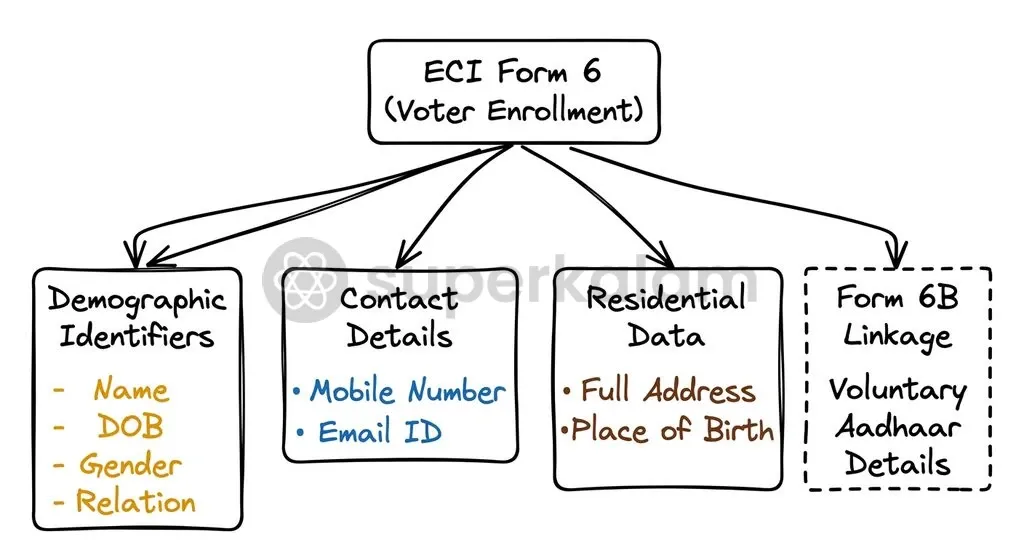
Form 6 serves as the primary statutory instrument under the Registration of Electors Rules, 1960 for citizens seeking registration as electors in assembly and parliamentary constituencies. Administered under the Representation of the People Act, 1950, this procedural gateway captures comprehensive demographic, personal, and biometric identifiers before an applicant enters the electoral roll.
Under Form 6 of the Registration of Electors Rules, 1960, the poll authority collects an applicant's full name, relative's name, mobile number, email address, date of birth, proof of age document, residential address, photograph, and disability status. In parallel, the Union Government notified Form 6B under Rule 26B of the Registration of Electors Rules, 1960, permitting existing electors to intimate their Aadhaar numbers under Section 23(5) of the Representation of the People Act, 1950 on an explicitly voluntary basis.
| Statutory Form | Governing Provision | Primary Purpose | Personal Data Captured | Legal Nature of Submission |
|---|---|---|---|---|
| Form 6 | Rule 13(1), Registration of Electors Rules, 1960 | Application for inclusion of name in the electoral roll | Full name, age, date of birth, residential address, photograph, mobile number, email, disability status | Mandatory for initial voter enrolment |
| Form 6B | Rule 26B, Registration of Electors Rules, 1960 | Intimation of Aadhaar number under Section 23(5) of the RP Act, 1950 | 12-digit Aadhaar number or alternative identity documentation | Strictly voluntary for existing electors |
The extensive scope of Form 6 transforms the electoral authority into the custodian of one of the largest demographic databases in the world. When handling such vast repositories, administrative oversight must prevent structural data leaks.
Does the DPDP Act 2023 Apply to the Election Commission of India?
The Digital Personal Data Protection Act, 2023 legally applies to the Election Commission of India because statutory definitions do not exclude constitutional authorities from personal data governance. Under Section 2(i) of the Act, a Data Fiduciary is defined as any person who alone or in conjunction with other persons determines the purpose and means of processing personal data, a classification that encompasses the poll panel.
Under Section 8(5) of the DPDP Act, 2023, every Data Fiduciary must protect personal data in its possession or control by implementing reasonable security safeguards to prevent personal data breaches. Failure to adhere to these baseline standards carries severe statutory consequences. The Schedule to the DPDP Act, 2023 empowers the Data Protection Board of India to levy financial penalties reaching up to ₹250 crore for systemic failures in implementing reasonable security safeguards.
Constitutional autonomy under Article 324 does not grant immunity from statutory law. In Mohinder Singh Gill v. Chief Election Commissioner (1977), the Supreme Court of India established that while Article 324 provides plenary powers to conduct free and fair elections, this constitutional reservoir of power cannot be exercised contrary to enacted legislation or the rule of law. Consequently, statutory obligations governing digital personal data apply directly to the administrative operations of the poll body.
Discuss with Superkalam
Explain how physical inspection of voter rolls under the 1960 Rules differs in privacy risks from searchable digital voter rolls.
Ask NowGovernment Exemptions Under DPDP Act: Where Does Election Data Stand?
The Digital Personal Data Protection Act, 2023 establishes targeted state exemptions under Section 17, but these provisions do not grant absolute administrative relief from cybersecurity requirements. Understanding the interplay between regulatory carve-outs and baseline security protections is critical for assessing state liability.
+-----------------------------------------------------------------------------------+
|                        DPDP ACT 2023: SECTION 17 EXEMPTIONS                       |
+-----------------------------------------------------------------------------------+
| Section 17(1) Regulatory Carve-Out  | Section 17(2)(a) Sovereign Exemptions       |
| -> Processing for legal rights or   | -> Blanket exemptions notified by Central   |
|    enforcing statutory duties.      |    Government for State instrumentalities.  |
| -> Section 8(1) & Section 8(5)      | -> Permitted ONLY on specified grounds:     |
|    safeguards REMAIN MANDATORY.     |    sovereignty, integrity, public order.    |
+-----------------------------------------------------------------------------------+
                                          |
                                          v
+-----------------------------------------------------------------------------------+
| Section 17(4) State Retention Powers                                              |
| -> Exempts the State from data erasure mandates under Section 8(7).               |
| -> Overrides Data Principal right to correction and erasure under Section 12(3).  |
| -> DOES NOT eliminate the requirement for reasonable cybersecurity safeguards.    |
+-----------------------------------------------------------------------------------+
Section 17(1) of the Act specifies that even where data processing is undertaken to enforce legal rights or perform regulatory functions, the core obligations under Section 8(1) and Section 8(5) regarding reasonable security safeguards remain fully non-exempt. While Section 17(2)(a) empowers the Central Government to notify blanket exemptions for state instrumentalities, such executive notifications are restricted to narrow grounds such as sovereignty, integrity of India, state security, friendly foreign relations, or the maintenance of public order. Routine voter list management does not automatically meet these national security thresholds.
Furthermore, Section 17(4) of the DPDP Act, 2023 exempts state entities from the duty to erase data under Section 8(7) once the processing purpose is fulfilled, while simultaneously restricting citizen requests for data deletion under Section 12(3). In Lakshmi Charan Sen v. A.K.M. Hassan Uzzaman (1985), the Supreme Court ruled that the preparation and revision of electoral rolls is an essential continuous statutory duty under the Representation of the People Act, 1950. This continuous duty justifies long-term registry maintenance, but it does not authorise negligible technical protection.
The Fundamental Clash: Electoral Transparency vs. Right to Privacy
Electoral transparency and digital privacy operate from competing institutional imperatives within India's constitutional framework. While electoral laws demand public scrutiny to prevent fraudulent entries, data protection law limits disclosure to safeguard individual autonomy.
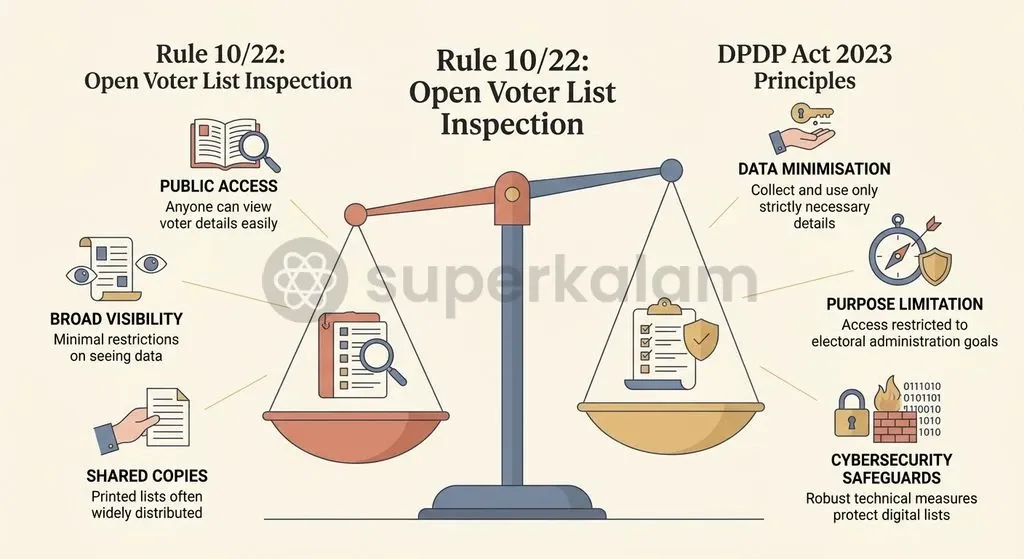
Rule 10 of the Registration of Electors Rules, 1960 mandates that draft electoral rolls be made accessible for public inspection at the office of the Electoral Registration Officer and at designated polling stations. Complementing this, Rule 22 mandates the final publication of rolls for open public scrutiny and requires supplying two complete copies free of cost to recognised political parties. These rules were designed for physical inspection within local communities, creating checks against arbitrary voter disenfranchisement.
However, an analysis by PRS Legislative Research highlights that publishing fully searchable online voter rolls containing full residential addresses, ages, and familial linkages conflicts directly with modern data minimisation and purpose limitation principles. In Justice K.S. Puttaswamy (Retd.) v. Union of India (2017), a nine-judge Constitution Bench held that any state intrusion into privacy under Article 21 must satisfy a fourfold test: legality, legitimate state aim, suitability, and necessity. Unrestricted, unredacted web distribution fails the necessity prong when less invasive verification mechanisms are available.
| Dimension | Legacy Electoral Framework (1950 / 1960) | DPDP Act, 2023 Framework |
|---|---|---|
| Statutory Core | RP Act, 1950 & Registration of Electors Rules, 1960 | Digital Personal Data Protection Act, 2023 |
| Disclosure Model | Public inspection under Rule 10; party distribution under Rule 22 | Data minimisation and strict purpose limitation |
| Access Architecture | Open public rolls with full residential and demographic data | Purpose-bound processing with restricted access controls |
| Security Standards | Physical custody by local Electoral Registration Officers | Mandatory technical safeguards under Section 8(5) |
| Statutory Remedies | Objections and claims filed under Rule 13 | Complaints before the Data Protection Board of India |
How Other Democracies Handle Voter Privacy
Democratic jurisdictions across the world reconcile electoral integrity with personal data security through statutory safeguards, restricted roll distribution, and opt-out mechanisms. Rather than publishing unredacted voter registries on open web portals, foreign electoral authorities implement access tiers.
In the United Kingdom, Regulation 93 of the Representation of the People (England and Wales) Regulations 2001 creates an edited register, known as the open register, alongside the full electoral register. Electors hold a statutory right under Regulation 93A to opt out of the open register without forfeiting their right to vote. Furthermore, Regulation 115 makes unauthorized disclosure or misuse of the full register a criminal offence, subject to a fine reaching up to level 5 on the standard scale.
Australia enforces comparable protective structures under the Commonwealth Electoral Act 1918. Under Section 104, an elector who demonstrates that public disclosure of their residential address would endanger personal safety may apply for silent elector status to suppress their address from public inspection. Under Section 91A(1), using electoral roll data for unauthorized purposes incurs a penalty of 100 penalty units, while Section 91B imposes penalties up to 1,000 penalty units for commercial exploitation of voter records.
Discuss with Superkalam
Analyse the legal basis on which the Supreme Court in Mohinder Singh Gill constrained the plenary powers of Article 324 vis-à-vis enacted laws.
Ask NowEthical Stakes: Voter Surveillance, Profiling, and Electoral Trust
Voter data protection directly impacts democratic integrity, electoral fairness, and constitutional trust. When state-held registration files become accessible in bulk formats, algorithmic manipulation threatens the foundational premise of free voting choice.
The Law Commission of India, in Report No. 255 on Electoral Reforms, warned that unrestricted bulk downloading and scraping of photo electoral rolls facilitate digital voter profiling, behavioural micro-targeting, and targeted voter suppression. Aggregated voter databases allow commercial analytics firms and political campaigns to map individual households, cross-reference commercial consumer profiles, and deploy manipulative messaging without regulatory oversight.
+-----------------------------------------------------------------------------------+
|                     VULNERABILITY TO MANIPULATION PIPELINE                        |
+-----------------------------------------------------------------------------------+
| Bulk Voter PDF Downloads (Rule 22)                                                |
| -> Unprotected, machine-readable voter lists containing name, age, and address.   |
+-----------------------------------------------------------------------------------+
                                          |
                                          v
+-----------------------------------------------------------------------------------+
| Automated Scraping & Commercial Enrichment                                        |
| -> Data analytics firms extract and cross-reference records with consumer data.   |
+-----------------------------------------------------------------------------------+
                                          |
                                          v
+-----------------------------------------------------------------------------------+
| Micro-Targeted Influence & Suppression Risks                                      |
| -> Tailored psychological appeals, polarisation, and selective voter suppression. |
+-----------------------------------------------------------------------------------+
Severe statutory violations also emerge when identity documents are exposed. Under Section 29 and Section 37 of the Aadhaar Act, 2016, public display of unmasked 12-digit Aadhaar numbers is an explicit statutory offence carrying criminal liability. Safeguarding electoral records is therefore essential to preserving public trust in constitutional institutions.
Way Forward: Building a Privacy-First Voter Registry System
Modernising electoral administration requires structural technical and legislative reforms that align legacy procedures with modern privacy law. Ensuring transparency does not necessitate publishing unredacted personal details across the open web.
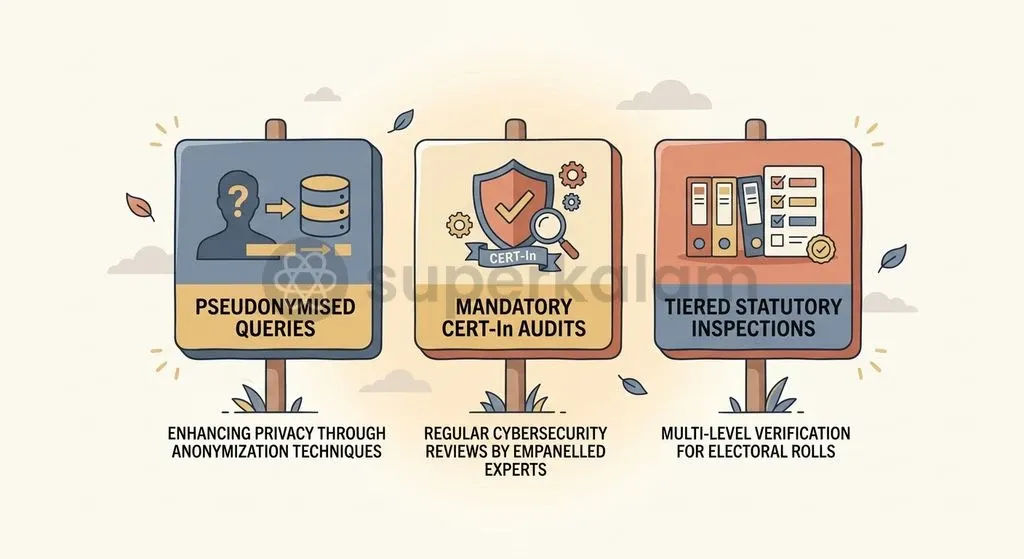
First, technical architectures must transition away from unauthenticated, downloadable PDF voter rolls. Expert recommendations by the Ministry of Electronics and Information Technology (MeitY) propose replacing bulk downloads with pseudonymised online verification, individual rate-limited search queries, and mandatory CAPTCHA protections. Electors should verify registration status using unique identifiers without exposing complete neighbourhood household directories.
Second, the poll panel must institutionalise mandatory technical security audits. In accordance with Indian Computer Emergency Response Team (CERT-In) cybersecurity directions, public-facing electoral portals must undergo comprehensive third-party audits by CERT-In empanelled agencies to identify parameter vulnerabilities before deployment.
Finally, Parliament should consider amending the Registration of Electors Rules, 1960. Formal amendments to Rules 10 and 22 could establish tiered inspection models, allowing local verification while preventing automated data harvesting. Incorporating provisions for address suppression for at-risk electors, modelled on Australia's silent elector framework, would balance public scrutiny with individual safety.
Discuss with Superkalam
Evaluate whether public inspection of complete voter registries remains necessary to ensure free and fair elections in the digital era.
Ask NowKey Takeaways
- The Election Commission of India qualifies as a Data Fiduciary under Section 2(i) of the DPDP Act, 2023, making it legally accountable for implementing reasonable security safeguards under Section 8(5).
- Section 17(1) of the DPDP Act, 2023 maintains mandatory cybersecurity requirements for state instrumentalities, meaning regulatory functions do not provide exemption from Section 8(5) obligations.
- Legacy mandates under Rules 10 and 22 of the Registration of Electors Rules, 1960 conflict with modern data minimisation principles by requiring open, searchable publication of complete voter profiles.
- As held in Mohinder Singh Gill (1977), constitutional powers under Article 324 remain subject to statutory legislation, while Puttaswamy (2017) requires state intrusions into privacy to pass the fourfold proportionality test.
- International jurisdictions, such as the UK under Regulation 93A and Australia under Section 104, deploy edited registers, opt-out models, and address suppression to reconcile transparency with privacy.
Mains Question
"Constitutional autonomy under Article 324 does not grant immunity from statutory law." In light of the Digital Personal Data Protection Act, 2023, examine the legal obligations of the Election Commission of India regarding the security of voter data. (10 Marks)
Evaluate NowMains Question
The public inspection mandates under the Registration of Electors Rules, 1960 stand in structural tension with data protection principles. Critically analyse how electoral transparency can be reconciled with the right to privacy under Article 21. (15 Marks)
Evaluate NowPractice MCQs
QUESTION 1
Consider the following statements regarding the application of the Digital Personal Data Protection (DPDP) Act, 2023 to the Election Commission of India (ECI):
- Under Section 2(i) of the DPDP Act, 2023, the Election Commission of India qualifies as a Data Fiduciary.
- In Mohinder Singh Gill v. Chief Election Commissioner (1977), the Supreme Court held that the plenary powers under Article 324 grant the ECI immunity from ordinary statutory enactments.
- Under Section 17(1) of the DPDP Act, 2023, statutory bodies performing regulatory functions remain bound by mandatory security safeguard obligations under Section 8(5).
Which of the statements given above are correct?
QUESTION 2
With reference to electoral registration procedures under the Registration of Electors Rules, 1960, consider the following statements:
- Form 6 is the mandatory statutory instrument for initial inclusion of a citizen's name in the electoral roll.
- Submission of the Aadhaar number through Form 6B under Rule 26B is strictly voluntary for existing electors.
- Draft electoral rolls are maintained under strict non-disclosure and cannot be inspected by the public prior to final publication.
Which of the statements given above is/are correct?
QUESTION 3
Consider the following statements regarding state exemptions under Section 17 of the Digital Personal Data Protection Act, 2023:
- Section 17(2)(a) permits executive notifications of blanket exemptions for state instrumentalities on grounds such as sovereignty, integrity of India, and public order.
- Section 17(4) completely exempts state entities from implementing reasonable cybersecurity safeguards under Section 8(5).
- Section 17(4) exempts the State from the mandate to erase personal data under Section 8(7) once the processing purpose is fulfilled.
Which of the statements given above is/are correct?
QUESTION 4
Under the Schedule to the Digital Personal Data Protection Act, 2023, what is the maximum financial penalty that the Data Protection Board of India can impose for systemic failure to implement reasonable security safeguards?
QUESTION 5
With reference to judicial pronouncements governing electoral administration and privacy, consider the following statements:
- In Lakshmi Charan Sen v. A.K.M. Hassan Uzzaman (1985), the Supreme Court ruled that the preparation and revision of electoral rolls is an essential continuous statutory duty.
- In Mohinder Singh Gill v. Chief Election Commissioner (1977), the Supreme Court held that the Election Commission is entirely exempt from data protection standards.
Which of the statements given above is/are correct?