Building Regularisation in India: Rule of Law and Moral Hazard
Repeated amnesties for illegal constructions compromise urban safety and planning laws, trading constitutional governance for short-term electoral gains.
Nov, 2026
•14 min read

Overview
Building regularisation policies enacted by Indian state governments grant retrospective legal immunity to unauthorised constructions upon payment of compounding fees. This mechanism converts deliberate breaches of statutory master plans into routine administrative settlements across growing municipal jurisdictions.
Policymakers often present amnesties as pragmatic measures to protect middle-class homeowners and regularise unapproved colonies. Yet recurring exemptions generate an institutionalised moral hazard. Developers and property buyers continually bypass floor space index caps and fire safety limits, banking on future executive pardons.
This structural cycle overwhelms municipal drainage networks and intensifies urban flood risks. It also compromises safety protections under Article 21 guarantees of the Constitution of India. The core challenge is rarely an absence of punitive powers. Instead, it reflects persistent political reluctance to enforce planned spatial governance.
Why in the News? The Pre-Election Push for Regularisation
State governments routinely enact building regularisation schemes and legislative moratoria immediately prior to assembly and municipal elections to placate urban voters. As of December 2023, Parliament enacted the National Capital Territory of Delhi Laws (Special Provisions) Second (Amendment) Act, 2023, extending statutory immunity against demolition and punitive action for unauthorized constructions and commercial building violations until December 31, 2026.
This enactment prolonged a special protection regime that shields non-compliant commercial establishments, unauthorised residential colonies, and unapproved village extensions from civic enforcement. State legislatures adopt an identical trajectory ahead of local voting cycles.
For instance, the Gujarat legislative assembly notified the Gujarat Regularisation of Unauthorised Development Act (GRUDA), 2022, which enabled the compounding of unauthorized residential and commercial developments constructed prior to October 1, 2022 upon payment of regularisation impact fees.
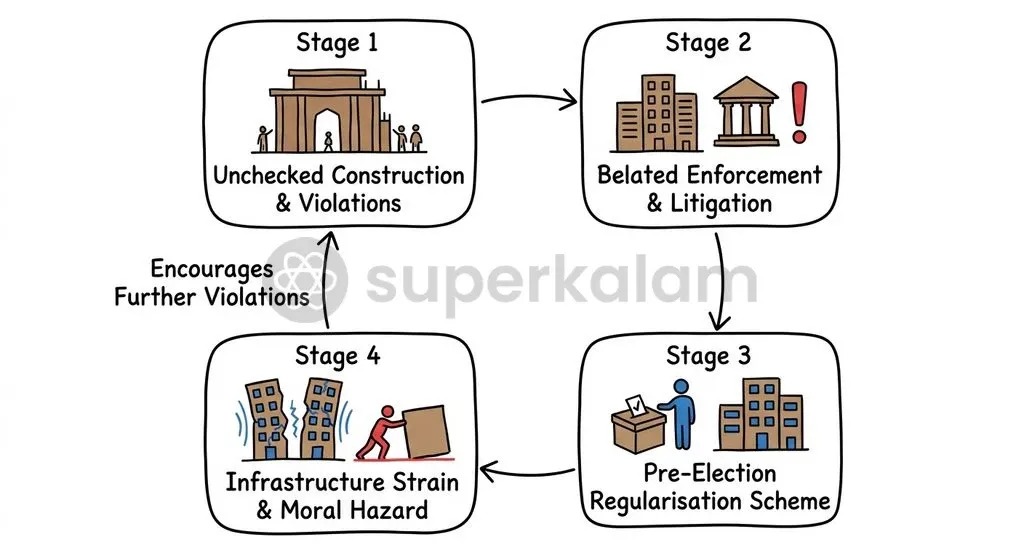
| Stage | Event in the Political Cycle | Administrative Impact |
|---|---|---|
| 1 | Unsanctioned construction | Developers build beyond sanctioned plans during municipal enforcement gaps. |
| 2 | Civic notice and litigation | Municipalities issue statutory demolition notices following complaints. |
| 3 | Pre-election amnesty scheme | State executives enact statutory pardons to court urban voting blocs. |
| 4 | Fee collection and grid stress | Authorities collect compounding fees while underlying infrastructure deficits worsen. |
These recurring interventions demonstrate how political executives treat spatial planning violations as transactional electoral currency. By trading statutory enforcement for fiscal collections and voter goodwill, the state dismantles the deterrence required to maintain the rule of law in urban governance.
Discuss with Superkalam
Recall the cutoff date established under the Gujarat Regularisation of Unauthorised Development Act (GRUDA), 2022.
Ask NowWhat Is Building Regularisation and How Does the Cycle Work?
Building regularisation is a statutory mechanism whereby municipal authorities pardon unapproved structural deviations from sanctioned master plans in exchange for compounding fees. Municipal town planning frameworks rely on Development Control Regulations (DCR). These rules establish ceilings on the Floor Space Index (FSI)—also referred to as Floor Area Ratio (FAR)—and enforce mandatory front, side, and rear building setbacks, permissible building heights, and designated land-use classifications.
Unauthorised developments breach these statutory boundaries across multiple degrees of severity:
- Setback Encroachments: Extending structural footprints into mandatory open spaces around a building, compromising natural ventilation and light.
- Floor Area Infractions: Constructing unapproved additional floors beyond permissible FSI allocations to maximise saleable square footage.
- Zoning Violations: Erecting commercial warehouses, industrial workshops, or retail hubs within zones designated strictly for residential or agricultural use.
- Unapproved Layout Colonisation: Subdividing agricultural land parcels into residential plots without trunk infrastructure, drainage reservations, or municipal sanction.
The standard operational cycle of building regularisation unfolds through four predictable phases:
| Stage of Regularisation Cycle | Administrative Mechanism | Practical Outcome on the Ground |
|---|---|---|
| 1. Unchecked Expansion | Developers flout sanctioned layout plans during active construction, exploiting weak municipal site inspections. | Illegal floors and unapproved peri-urban layouts multiply across municipal limits. |
| 2. Selective Injunction | Civic authorities issue demolition notices under municipal statutes following neighbour complaints or public interest litigation. | Developers secure interim judicial stays or exploit bureaucratic delays to stall enforcement. |
| 3. Legislative Amnesty | State governments promulgate dedicated amnesty legislation or amend town planning laws with shifting cutoff dates. | Unlawful structures obtain legal immunity upon payment of nominal compounding impact fees. |
| 4. Municipal Grid Stress | Local bodies absorb unplanned population densities without augmenting road widths, sewer capacities, or water mains. | Neighbourhood infrastructure suffers chronic degradation and acute disaster vulnerability. |
Compounding was historically devised as a narrow administrative remedy for minor, good-faith construction errors. Systematic amnesties have transformed this exception into a standard method of property development.
The Institutional Roots: Why Illegal Constructions Flourish in India
The rapid expansion of unauthorised constructions stems directly from institutional deficits within state town and country planning departments. Indian cities expand far faster than the technical apparatus meant to zone and service them.
According to an assessment published by NITI Aayog, 65% of the 7,933 urban settlements across India lacked any statutory master plan. This planning void forces millions of urban residents and developers to build in unzoned peripheries without baseline development guidelines.
Human resource shortages compound this spatial vacuum. NITI Aayog's assessment established that half of all sanctioned town planning positions across Indian states remained vacant, with an estimated national deficit of 85,000 to 90,000 qualified urban planners required to oversee urban expansion. Small and medium towns frequently operate without a single qualified urban planner on staff.
- Planning Deficit: 65% of 7,933 urban settlements operate without statutory master plans.
- Staffing Shortfall: 50% of sanctioned town planning posts remain vacant, leaving an 85,000+ planner deficit.
- Sprawl and Subdivisions: Unregulated peri-urban expansion proceeds without basic arterial reservations.
- Amnesty Pressures: Executive bodies introduce compounding legislation to retroactively accommodate unregulated settlement growth.
The crisis is also driven by acute structural shortages in formal affordable housing. The Report of the Technical Group on Urban Housing Shortage (TG-12) calculated an initial urban housing deficit of 18.78 million dwelling units, finding that 95.6% of this unmet demand was concentrated within the Economically Weaker Section (EWS) and Lower Income Group (LIG) strata. Because private developers cater disproportionately to premium market segments, low-income households find shelter almost exclusively within informal, unapproved colonies.
Furthermore, state governments have resisted devolving spatial planning powers to elected Urban Local Bodies (ULBs). Although Article 243W and the Twelfth Schedule of the 74th Constitutional Amendment Act, 1992 mandate the devolution of urban planning and land-use regulation to municipalities, most states retain these functions within unelected parastatal development authorities. These parastatals operate without grassroots democratic accountability, leaving citizens disconnected from formal planning processes.

Discuss with Superkalam
Explain how the repeated issuance of post-facto compounding schemes creates an institutional moral hazard in urban land markets.
Ask NowRule of Law vs Executive Discretion: What the Courts Have Ruled
The Supreme Court of India has consistently maintained that statutory regularisation must remain a narrow exception rather than an executive substitute for urban planning enforcement. The judiciary has repeatedly overturned sweeping state regularisation policies that compromise public safety and environment.
In Friends Colony Development Committee v. State of Orissa, the Supreme Court established that statutory compounding of building deviations is an exception intended solely for bona fide minor departures. The Court held that deliberate structural violations cannot be regularised through impact fees because they impose an unbearable burden on civic amenities.
This jurisprudence was reinforced in Consumer Action Group v. State of Tamil Nadu. The Supreme Court upheld Section 113-A of the Tamil Nadu Town and Country Planning Act, 1971 as a one-time transitional provision, but issued an explicit warning: recurrent regularisation schemes create systemic administrative collapse and endanger human life by compromising fire and safety standards.
| Landmark Supreme Court Verdict | Core Legal Ratio & Judicial Doctrine | Enforcement Mandate |
|---|---|---|
| Friends Colony Development Committee (2004) | Compounding applies strictly to bona fide minor deviations; commercial excesses cannot claim equity. | Barred regularisation of deliberate structural deviations over permissible limits. |
| Consumer Action Group (2000) | Upheld regularisation only as a strictly one-time transitional measure to relieve historical hardship. | Condemned recurring amnesty policies as an unconstitutional abandonment of planning duty. |
| Priyanka Estates International (2010) | Unlawful edifices raised in conscious contravention of sanctioned plans forfeit all equitable protection. | Ordered demolition of unauthorized floors entirely at the builder's expense. |
| Dipak Kumar Mukherjee (2012) | Judicial demolition orders must be coupled with strict departmental investigation of conniving officials. | Mandated disciplinary and penal prosecution against colluding municipal staff. |
| Esha Ekta Apartments (2013) | Flat buyers cannot assert legal protection or legitimate expectation when developers violate FSI caps. | Refused equitable protection to purchasers of unapproved upper floors. |
| Supertech Ltd. (2021) | High-rise residential towers constructed through illegal official connivance violate the rule of law. | Directed the controlled demolition of two 40-storey residential towers in Noida. |
| Maradu Municipality (2019) | Environmental protection in ecologically fragile zones overrides commercial investments. | Mandated the controlled implosion of four waterfront luxury complexes violating CRZ norms. |
The Supreme Court's ruling in Supertech Ltd. v. Emerald Court signaled heightened judicial scrutiny. By ordering the demolition of two 40-storey towers in Noida, the bench affirmed that unauthorized construction facilitated by regulatory collusion cannot be shielded under the guise of protecting commercial investment.
The Economic and Civic Moral Hazard of Repeated Amnesties
Post-facto building regularisation creates an acute economic moral hazard by rewarding unlawful developers while penalising law-abiding citizens who bear full regulatory compliance costs. Moral hazard arises when economic actors take excessive risks because they know the negative consequences will be absorbed by others or forgiven by the state.
The Economic Survey 2017-18 highlighted that regularising building deviations allows non-compliant builders to capture substantial economic rent. A developer who flouts FSI ceilings creates extra saleable area, securing outsized profits. Law-abiding developers who adhere strictly to setback limits, parking requirements, and height restrictions pay higher relative land costs per usable square metre. Repeated amnesties thus create a perverse economic subsidy for regulatory disobedience.
| Developer Strategy | Regulatory Compliance | Cost Structure | Economic Payoff |
|---|---|---|---|
| Compliant Developer | Adheres strictly to FSI, height, and setback limits. | Bears full land cost per square metre of permitted floor area. | Standard market profit margin without regulatory exposure. |
| Non-Compliant Developer | Deliberately breaches permissible floor area caps. | Pays minor retrospective compounding fees to regularise illegal space. | Captures windfall economic rent from unearned saleable area. |
Civic culture suffers a parallel erosion. Homebuyers actively purchase apartments in buildings with obvious structural deviations, confident that pre-election pressures will compel state governments to pass amnesty legislation. The expectation of relief undermines compliance with the Real Estate (Regulation and Development) Act, 2016 (RERA). When illegalities are systematically forgiven, the authority of statutory urban planning dissolves.
Discuss with Superkalam
If you were appointed Municipal Commissioner of a tier-2 city with widespread setback violations, how would you apply geospatial monitoring to prevent unauthorized construction?
Ask NowHow Post-Facto Regularisation Breaks Urban Infrastructure and Safety
Unregulated building densification systematically destroys the hydrodynamic carrying capacity and life-safety thresholds of urban settlements across India. Municipal engineering networks are calculated based on projected population densities defined in statutory master plans. When properties expand beyond these densities through illegal regularisation, underlying civil infrastructure collapses.
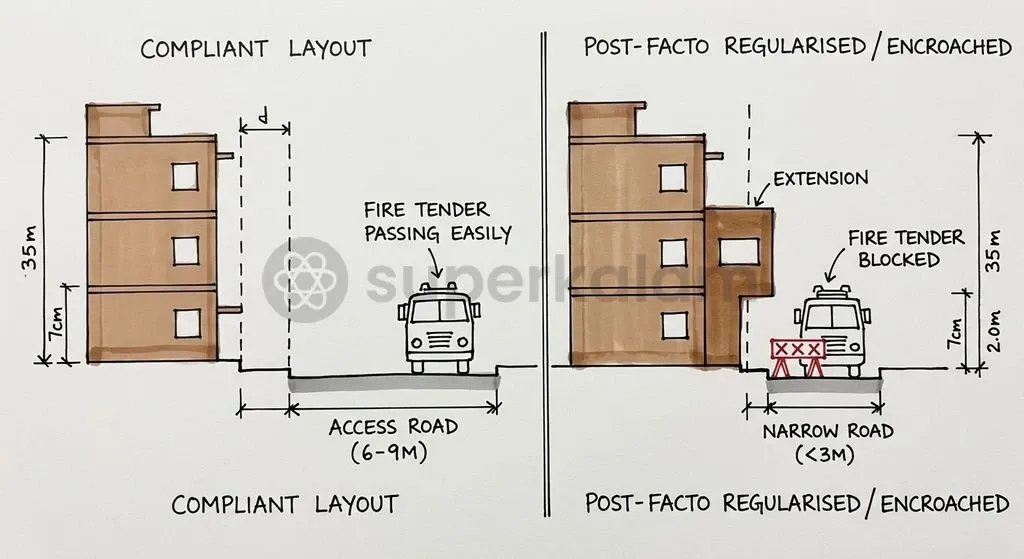
Fire safety is routinely compromised. Part 4 of the National Building Code of India (NBC 2016) mandates a minimum clear motorable access road of 6 to 9 metres around high-rise residential and commercial buildings to accommodate emergency fire tenders. When unapproved constructions encroach onto building setbacks and narrow access lanes, emergency access disappears. Densely populated regularised clusters turn into severe fire hazards.
Structural resilience during natural disasters is similarly degraded:
- Earthquake Vulnerability: Structural deviations and unpermitted vertical extensions flout mandatory ductile detailing and lateral-load resilience criteria prescribed under Part 6 of the National Building Code 2016 and IS 1893 (Part 1): 2016. Unapproved multi-storey masonry and concrete structures are particularly vulnerable to sudden shear failure in Seismic Zones IV and V.
- Storm Water Disruption: The Comptroller and Auditor General (CAG) Performance Audit on Urban Flooding in Chennai observed that unchecked regularisation of encroachments over natural waterways, marshlands, and storm water drain alignments crippled the city's hydrodynamic discharge capacity.
- Subsurface Infrastructure Collapse: Municipalities cannot widen narrow rights-of-way retrospectively to lay trunk sewer mains or water conduits. Regularised settlements face chronic sewage backflows and reliance on informal water tankers.
Compounding fees replenish state treasuries, but they cannot create physical land where roads need widening or restore natural drainage basins that have been built over.
The Ethical Dimension: Administrative Collusion and Spatial Injustice
The administration of planning regulations in Indian municipalities reveals stark ethical compromises and institutionalised inequality under Article 14 of the Constitution of India. State enforcement practices exhibit structural biases between affluent developers and impoverished informal dwellers.
The Supreme Court of India, in Re: Directions in the Matter of Demolition of Structures, observed that selective enforcement generates severe constitutional dissonance. Municipal authorities frequently deploy bulldozers against precarious informal slum settlements, citing strict compliance with public street laws. The state concurrently offers legislative moratoria, amnesty schemes, and nominal compounding fees to affluent commercial establishments, unauthorized farmhouses, and luxury waterfront enclaves.
| Settlement Category | Legal Status Under DCR | State Administrative Response | Constitutional Standard |
|---|---|---|---|
| Informal Slum Clusters | Unauthorised occupancy of municipal or public land. | Summary eviction and punitive demolition drives. | Discriminatory denial of procedural equity. |
| Commercial & Luxury Violators | Conscious structural and FSI deviations. | Pre-election legislative moratoria and regularisation schemes. | Violates Article 14 parity via selective executive leniency. |
This disparity highlights deep administrative corruption. Multi-storey unauthorized developments cannot emerge overnight without the active connivance of municipal ward engineers and local police beats. As the Supreme Court held in Dipak Kumar Mukherjee v. Kolkata Municipal Corporation, municipal officers who fail to stop known violations share direct culpability with unlawful builders. Periodic amnesties institutionalise this misconduct by monetising regulatory failure while shielding corrupt officials from disciplinary accountability.
Retrospective regularisation reduces statutory urban planning from an instrument of equitable spatial distribution to an arbitrary revenue-generating tool.
Discuss with Superkalam
Examine the tension between executive discretion to pass regularisation laws and the constitutional guarantees under Article 21 as highlighted by judicial verdicts.
Ask NowReforming Urban Planning: Practical Alternatives to Periodic Amnesties
Meaningful urban reform requires replacing reactive compounding amnesties with preventive spatial planning mechanisms and transparent technological surveillance across municipal boundaries. Ending the cycle of illegal construction requires administrative reform, inclusive land assembly, and technological enforcement.
1. Geospatial Monitoring and Early Detection
Under the Atal Mission for Rejuvenation and Urban Transformation (AMRUT), the Ministry of Housing and Urban Affairs initiated the formulation of GIS-based Master Plans for 461 cities. Municipalities must integrate very high-resolution satellite imagery with automated building permit software. By overlaying sanctioned building footprints onto satellite feeds, automated algorithms can detect unapproved structural deviations at the plinth stage, triggering immediate administrative halts before buildings are occupied.
2. Equitable Land Pooling Frameworks
Rigid public land acquisition frequently stalls urban planning and fuels unauthorized land fragmentation. States should adopt the Town Planning Scheme (TPS) model governed by the Gujarat Town Planning and Urban Development Act, 1976.
The TPS framework assembles peri-urban agricultural land through land pooling without coercive acquisition:
- Original land parcels are pooled, planned systematically, and reconstituted.
- The planning authority reserves up to 40% to 50% of the reconstituted land for arterial roads, public open spaces, social infrastructure, and affordable EWS housing.
- The remaining reconstituted plots are returned to original owners. Although parcel sizes are smaller, their commercial value increases significantly due to guaranteed infrastructure connectivity.
- This mechanism delivers serviced land for formal housing before unauthorized colonisation can take root.
3. Devolving Functions to Urban Local Bodies
State governments must fully operationalise Article 243W and the Twelfth Schedule of the 74th Constitutional Amendment Act. Planning powers must transition from non-representative parastatal development authorities to elected municipal corporations. Local ward committees must be empowered to review spatial layouts, ensuring direct public oversight over neighbourhood construction activity.
4. Establishing Personal Accountability for Municipal Engineers
Implementing the judicial mandate of Dipak Kumar Mukherjee requires fixing statutory liability on designated municipal ward engineers for uninspected deviations. State municipal acts must mandate geo-tagged, time-stamped inspection certificates at every major construction phase—foundation, plinth, lintel, and roof casting. If a building is subsequently found to have breached sanctioned limits, the assigned inspecting engineer must face automatic disciplinary action and penal proceedings. Removing official immunity will quickly collapse the builder-official nexus.
Key Takeaways
- Pre-election building regularisation amnesties, exemplified by Delhi's Special Provisions Act extensions and Gujarat's GRUDA 2022, grant retrospective immunity to illegal developments for political and fiscal gains.
- The Supreme Court has established in Friends Colony and Supertech Ltd. that compounding is strictly restricted to minor bona fide deviations and cannot condone deliberate structural infractions.
- Unchecked regularisation generates acute moral hazard, allowing non-compliant developers to capture windfall economic rents while penalising law-abiding citizens and compliant builders.
- Bypassing National Building Code rules on access roads (6 to 9 metres) and seismic standards (IS 1893: 2016) degrades fire safety, structural resilience, and urban drainage networks.
- Selective enforcement against informal settlements versus legislative protections for affluent commercial violators breaches Article 14, requiring preventive tools like AMRUT GIS master plans and Town Planning Scheme land pooling.
Mains Question
"Periodic building regularisation schemes create an institutionalised moral hazard that undermines the rule of law and spatial governance in Indian cities." Critically analyse. (15 Marks)
Evaluate NowMains Question
According to NITI Aayog, a significant proportion of urban settlements in India lack statutory master plans and qualified planners, exacerbating informal urban sprawl. In this context, examine the institutional roots of unauthorized constructions in India. (10 Marks)
Evaluate NowPractice MCQs
QUESTION 1
With reference to urban planning capacity and institutional framework in India, consider the following statements based on NITI Aayog's assessment:
- Over sixty percent of urban settlements across the country do not possess any statutory master plan.
- More than half of the sanctioned town planning positions across Indian states currently remain vacant.
- The Twelfth Schedule of the Constitution mandates the retention of spatial planning exclusively within state-level parastatal development authorities. Which of the statements given above is/are correct?
QUESTION 2
Consider the following statements regarding the judicial stance on building regularisation in India:
- In Friends Colony Development Committee v. State of Orissa, the Supreme Court ruled that compounding is strictly meant for bona fide minor departures and cannot regularise deliberate commercial deviations.
- In Consumer Action Group v. State of Tamil Nadu, the Supreme Court held that recurrent regularisation schemes cause administrative collapse and compromise public safety standards. Which of the statements given above is/are correct?
QUESTION 3
Regarding the structural shortage of urban housing in India highlighted by the Technical Group on Urban Housing Shortage (TG-12), consider the following statements:
- The initial urban housing shortage was estimated at over 18 million dwelling units.
- The vast majority of this unmet housing shortage was concentrated within the Economically Weaker Section (EWS) and Lower Income Group (LIG) categories. Which of the statements given above is/are correct?
QUESTION 4
The National Capital Territory of Delhi Laws (Special Provisions) Second (Amendment) Act, 2023, enacted by Parliament, provides statutory protection against demolition and punitive action until:
QUESTION 5
Consider the following statements regarding the Gujarat Regularisation of Unauthorised Development Act (GRUDA), 2022:
- It allowed compounding of unauthorised residential and commercial developments built prior to October 1, 2022.
- Compounding was permitted upon the payment of regularisation impact fees. Which of the statements given above is/are correct?
Discuss with Superkalam
Design an institutional roadmap to replace periodic regularisation amnesties with preventive spatial planning and personal municipal accountability.
Ask Now