Digital Census in Uttar Pradesh: Why Self-Enumeration Stumbled
When paperless census self-enumeration hit rural digital realities in Uttar Pradesh, frontline workers bore the cost of an incomplete administrative rollout.
Nov, 2026
•10 min read
Overview
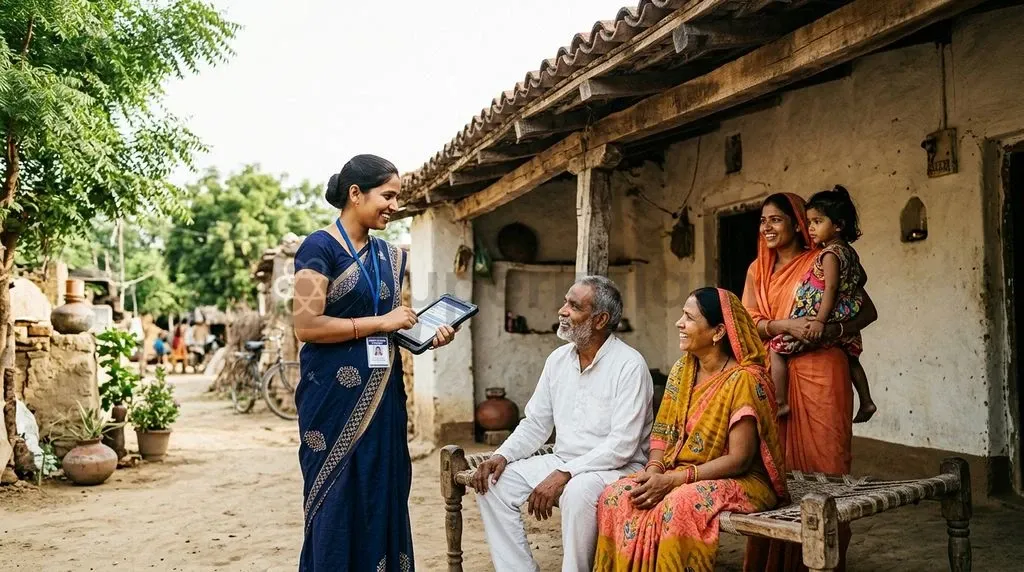
India's pioneering transition toward paperless census operations encountered severe structural resistance across Uttar Pradesh, where inadequate rural digital connectivity, pervasive device illiteracy, and citizen trust deficits transformed an intended convenience into an operational bottleneck that ultimately overwhelmed grassroots administrative workers. According to the Ministry of Home Affairs, the Phase II self-enumeration rollout for Census 2027 was designed to modernise data collection by allowing citizens to log demographic data independently. However, the pilot demonstrated that shifting administrative burdens onto digital platforms without addressing structural digital inequalities fails to displace traditional field verification. Instead of expediting national enumeration, the digital divide across Uttar Pradesh forced frontline anganwadi workers and primary teachers to manually reconcile abandoned online forms, revealing that paperless governance cannot bypass physical administrative mediation.
Why in the News: The Uttar Pradesh Digital Census Experience
The Ministry of Home Affairs launched the Phase II self-enumeration window for Census 2027 across Uttar Pradesh from 16 November to 30 November 2026. This population enumeration exercise preceded conventional door-to-door field verification, which the Office of the Registrar General and Census Commissioner of India scheduled between 1 December 2026 and 4 January 2027. Under this framework, Uttar Pradesh served as the primary demographic testing ground alongside Goa, Punjab, and non-snow-bound areas of Uttarakhand.
Initial operational data indicated profound citizen friction during the early rollout. As reported by The Times of India from the operational dashboard on 17 November 2026, residents initiated 3,25,733 self-enumeration sessions across 75 districts in the first 48 hours, but completed only 1,17,077 schedules. This left 2,08,656 forms stalled mid-way, reflecting a subdued completion rate of 35.94%.
District-level participation exposed severe geographic disparities across the state. The Times of India reported that Bareilly registered the highest volume with 10,380 completed forms, while Pratapgarh recorded the highest relative completion rate at 50.16%. Conversely, major urban hubs struggled; Lucknow posted a 24.45% completion rate with 4,736 abandoned sessions against 1,533 completions, while peripheral districts such as Sant Kabir Nagar and Siddharthnagar logged just 178 and 179 completed forms respectively.
The UP Blueprint: How Digital Self-Enumeration Was Designed to Work
The Census Rules, 1990 were amended by the central government in March 2022 to introduce legal provisions for digital self-enumeration. This statutory change permitted households to complete census schedules electronically before an enumerator arrived at their doorstep.
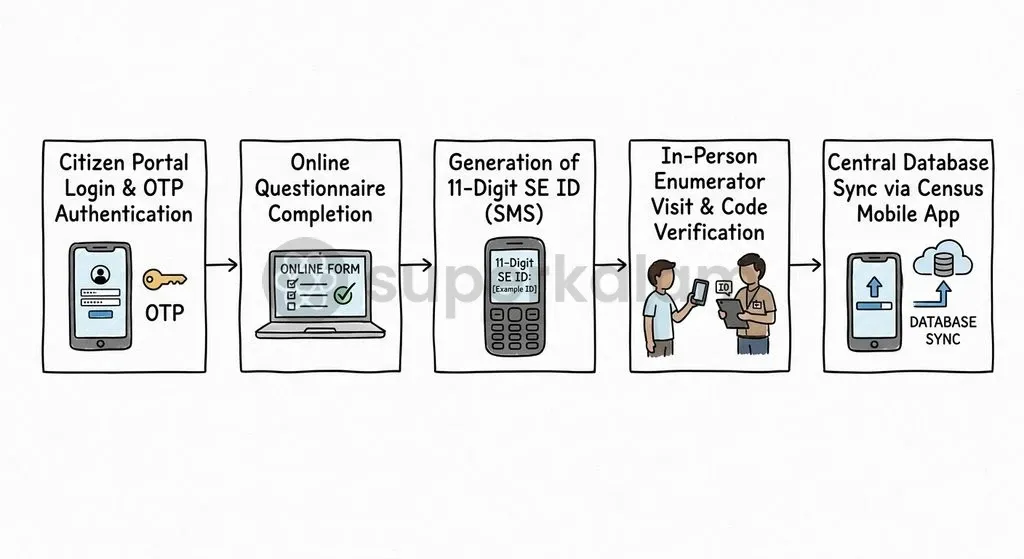
The Office of the Registrar General and Census Commissioner created the dedicated portal se.census.gov.in to operationalise this digital mandate. Supporting 16 official languages, the platform authenticates a resident through a mobile One-Time Password before opening the household schedule. Upon successful form submission, the system generates an 11-digit alphanumeric Self-Enumeration ID prefixed with the letter 'H'.
Supervisory authorities track this field activity through the Census Monitoring & Management System, an integrated platform designed by the Ministry of Home Affairs to map live verification across administrative tiers. For Phase II, authorities notified an expanded 40-question schedule that included specific queries on banking access, parental birthplaces, and caste enumeration across all communities.
| Dimension | Digital Self-Enumeration (se.census.gov.in) |
Conventional Enumerator-Led Enumeration |
|---|---|---|
| Data Entry Agent | Individual citizen or head of household | Designated field enumerator (teacher or anganwadi worker) |
| Hardware Requirement | Citizen-owned personal smartphone or desktop computer | Government-provisioned mobile device with Census Mobile App |
| Connectivity Dependency | Persistent high-bandwidth internet connectivity | Offline mobile caching with asynchronous batch synchronisation |
| Authentication Mode | Mobile One-Time Password verification | Direct physical verification at household premises |
| Primary Output | 11-digit alphanumeric Self-Enumeration ID (SE ID) | Synchronised digital census household record |
Discuss with Superkalam
Which statutory provision in the Census Act, 1948 guarantees that census responses cannot be used as judicial evidence?
Ask NowOn-the-Ground Bottlenecks: Smartphone Ownership, Connectivity, and Literacy in Rural UP
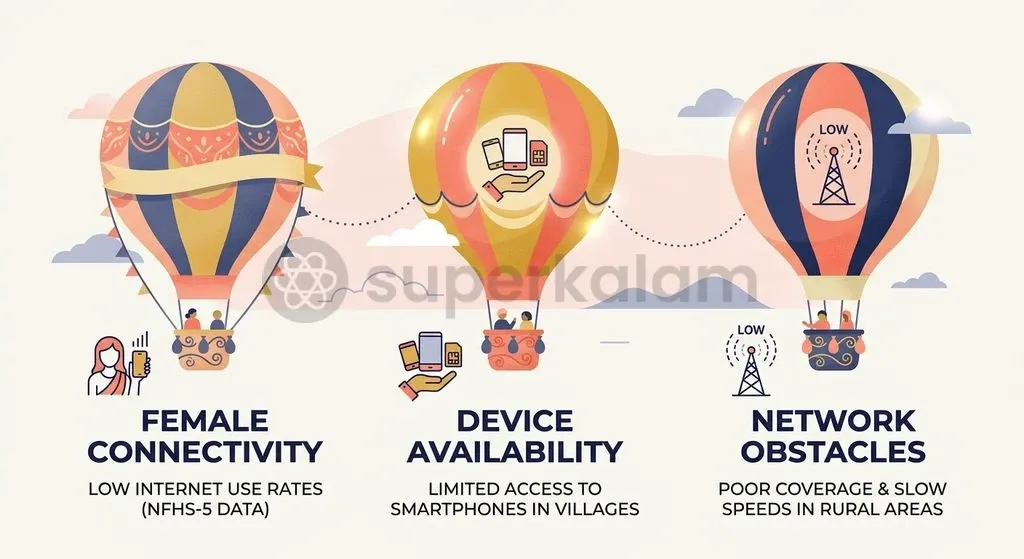
Rural households in Uttar Pradesh faced acute technological barriers when attempting to navigate the browser-based self-enumeration portal. While the Census Mobile App assigned to official enumerators contains offline caching capabilities, the citizen portal requires persistent network connectivity throughout the session. Fluctuating cellular signals across rural hamlets triggered recurring session timeouts, CAPTCHA invalidations, and sudden data loss that forced users to restart lengthy submissions.
Gendered access to digital assets compounded these connectivity hurdles. According to the National Family Health Survey (NFHS-5), only 36.7% of women in rural Uttar Pradesh have ever used the internet. Because smartphone custody remains heavily concentrated among male family heads who are frequently away for migratory labour, resident women could not access the authentication interface during standard daytime hours.
Functional digital illiteracy created an insurmountable gap for citizens attempting to complete complex statistical parameters. Entering granular information across a 40-question schedule proved taxing for non-technical users on small smartphone screens. When a single input mismatch occurred, the portal offered minimal troubleshooting guidance, causing widespread abandonment in rural communities.
The Verification Crisis: Why Enumerators Still Had to Visit UP Households
The Directorate of Census Operations in Uttar Pradesh mandated that self-enumeration does not exempt any household from physical enumerator visits. Citizens must retain their 11-digit alphanumeric SE ID and present it to the visiting official during field operations. The official enters this identifier into the Census Mobile App to cross-verify family composition and validate demographic coordinates on site.
This mandatory synchronisation workflow created parallel administrative tracks instead of eliminating manual procedures:
- Receipt of Digital Token: The household completes the online schedule and preserves the system-generated SE ID received via SMS.
- Physical Enumerator Visit: An assigned enumerator visits the physical dwelling during the scheduled door-to-door phase.
- Identifier Synchronisation: The enumerator inputs the household's SE ID into the official mobile interface.
- Data Verification: The enumerator reviews pre-filled data points directly with the family to resolve omissions or discrepancies.
- Final Server Submission: The verified record is transmitted to the central census database to close the enumeration loop.
Because over 64% of initiated sessions in Uttar Pradesh stalled during the opening days of the pilot, field staff could not rely on pre-filled records. Enumerators were forced to conduct complete, ground-up manual interviews for stalled cases, doubling the time spent per residential unit.
Discuss with Superkalam
Why did the citizen self-enumeration portal face severe session timeouts in rural areas compared to the enumerator-led mobile application?
Ask NowTrust and Data Integrity: Privacy Anxieties and System Glitches Across UP Districts
Section 15 of the Census Act, 1948 provides absolute statutory confidentiality to census declarations, prohibiting their use as judicial evidence or civil enforcement records. Despite this legal shield, field reports highlighted widespread public skepticism regarding the state's data-gathering intentions.
Ground reports from The Hindu noted that residents across multiple districts frequently refused to share mobile One-Time Passwords with visiting staff or digital portals. Families expressed acute hesitation regarding queries on the exact number of bank accounts held by household members, fearing exposure to financial cybercrime and unlawful account deductions.
Sociopolitical anxieties further undermined data integrity during the trial. Respondents exhibited persistent apprehension that questions concerning parental birthplaces and ancestral birth dates were covert mechanisms linked to citizenship verification.
Technical configuration errors on the portal exacerbated public unease. As reported by The Hindu, a predictive-text drop-down under the 'Other' religion field displayed 287 distinct religious and sect denominations, triggering public controversy before the Ministry of Home Affairs removed the feature. Such glitches weakened institutional credibility, leading many respondents to deliberately withhold sensitive details.
Institutional Fallout: What UP's Experience Means for State Administrative Machinery
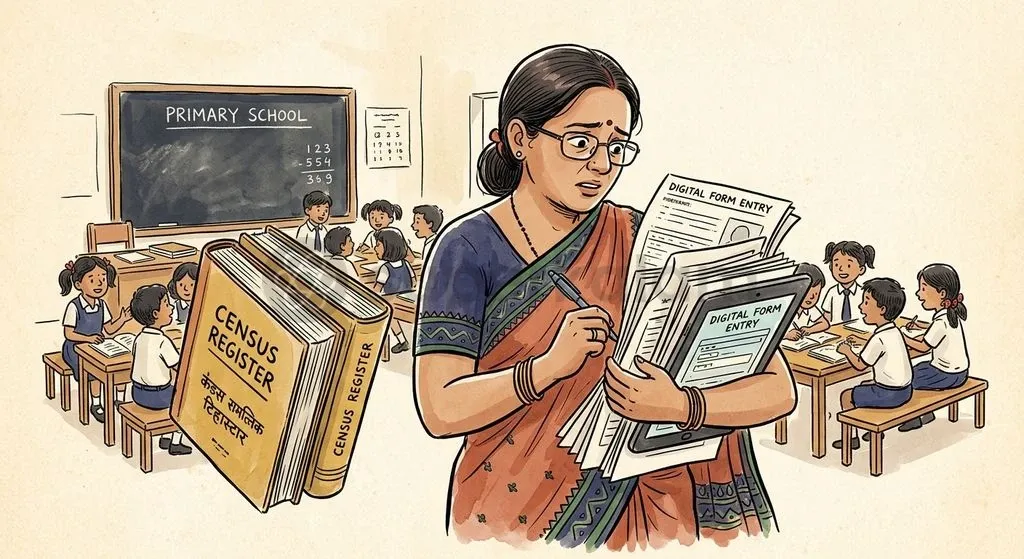
District magistrates across Uttar Pradesh responded to lagging online numbers by issuing urgent directives to field functionaries. Administrative bodies mobilised primary school teachers and anganwadi workers to accelerate digital completion rates.
Field personnel were required to visit homes during instructional school hours to persuade residents and enter information using personal mobile devices. Ground accounts reported that frontline staff operated under severe administrative pressure, including threats of disciplinary action and recorded absences if daily self-enumeration targets fell short. This redeployment disrupted regular classroom teaching in government schools and halted routine supplementary nutrition distribution across rural anganwadi centres.
The exercise underscored the operational risks of treating digital self-enumeration as a quick substitute for state presence. When digital platforms falter due to structural barriers, the administrative workload does not disappear. Instead, administrative hierarchies push compliance burdens downward onto vulnerable frontline workers who lack technical support, official equipment, or institutional grievance redressal mechanisms.
Discuss with Superkalam
How did structural patterns in household smartphone ownership and female internet usage affect the completion rates of digital self-enumeration in rural Uttar Pradesh?
Ask NowLessons from Uttar Pradesh: Fixing the Digital Divide Before the Pan-India Census
The Ministry of Electronics and Information Technology outlines service architecture principles that can resolve the technical bottlenecks observed during the state rollout. E-governance specialists suggest redesigning the citizen platform into an offline-first Progressive Web Application. This technical setup caches form sections locally on browser storage, enabling intermittent offline entry and executing asynchronous background syncing whenever an active cellular link becomes available.
Institutional reliance on primary educators requires structural realignment before nationwide deployment. E-governance policy frameworks recommend mobilising Village Level Entrepreneurs operating under the Common Services Centre scheme. Stationed across gram panchayats, these entrepreneurs possess digital infrastructure and transactional familiarity, making them ideal intermediaries for assisted digital filing.
+---------------------------------------------------------------------------------------------------+
|                        STRATEGIC ROADMAP FOR PAN-INDIA DIGITAL ENUMERATION                         |
+---------------------------------------------------------------------------------------------------+
| 1. ARCHITECTURAL UPGRADE                                                                          |
|    - Deploy offline-first Progressive Web App (PWA) architecture with local data caching.         |
|    - Enable asynchronous background data synchronization to eliminate low-bandwidth timeouts.     |
+---------------------------------------------------------------------------------------------------+
| 2. INSTITUTIONAL REALIGNMENT                                                                      |
|    - Route assisted self-enumeration through Common Services Centres (CSCs).                      |
|    - Relieve primary educators and anganwadi staff from coercive, ad-hoc digital data entry.       |
+---------------------------------------------------------------------------------------------------+
| 3. PUBLIC CONFIDENCE AND CIVIC ENGAGEMENT                                                         |
|    - Conduct grassroots campaigns highlighting statutory immunity under Section 15 of Census Act. |
|    - Engage Panchayati Raj Institutions to address citizen anxieties regarding identity data.    |
+---------------------------------------------------------------------------------------------------+
Public education campaigns must proactively address privacy anxieties well before the launch of field schedules. The central government should clearly publicise the statutory protections granted under Section 15 of the Census Act, 1948, assuring citizens that demographic data cannot be cross-referenced for punitive or police enforcement. Partnering with Panchayati Raj Institutions and ward committees will foster community trust, ensuring that India's digital census operates as an inclusive democratic inventory rather than a fraught administrative ordeal.
Discuss with Superkalam
Weigh the trade-off between mandating physical enumerator verification for all self-enumerated households versus adopting a fully paperless, unverified digital submission model.
Ask NowKey Takeaways
- The Phase II self-enumeration window for Census 2027 ran from 16 November to 30 November 2026 across Uttar Pradesh, Goa, Punjab, and non-snow-bound Uttarakhand, preceding field visits from 1 December 2026 to 4 January 2027.
- Digital self-enumeration was enabled via amendments to the Census Rules, 1990 in March 2022, permitting citizens to fill household schedules on
se.census.gov.inand generate an 11-digit alphanumeric Self-Enumeration ID. - Early operational data reported by The Times of India revealed a low 35.94% completion rate in Uttar Pradesh, where 2,08,656 of 3,25,733 initiated sessions were abandoned due to technical timeouts and literacy constraints.
- Digital self-enumeration does not exempt households from visits by field staff, as Section 15 of the Census Act, 1948 governs confidentiality while the administrative workflow mandates physical SE ID verification on the Census Mobile App.
- Structural gender inequalities (only 36.7% of rural UP women have used the internet per NFHS-5) and privacy anxieties over banking and parental birthplace data created public friction, shifting data collection back onto overburdened primary school teachers.
- Policy experts recommend deploying offline-first Progressive Web Applications, utilising Common Services Centres for assisted filing, and launching community-level trust initiatives before conducting the pan-India census.
Mains Question
The Census (Amendment) Rules, 2022 introduced digital self-enumeration to modernize national demographic data collection. In light of the Phase II pilot in Uttar Pradesh, evaluate the efficacy of the digital self-enumeration model in circumventing traditional administrative bottlenecks. (10 Marks)
Evaluate NowMains Question
'Shifting administrative burdens onto digital platforms without addressing structural digital inequalities risks disrupting essential grassroots public services while failing to guarantee data integrity.' In the context of the Phase II Census rollout in Uttar Pradesh, critically analyse the institutional and socio-technical hurdles encountered during digital enumeration. (15 Marks)
Evaluate NowPractice MCQs
QUESTION 1
Consider the following statements regarding the legal and operational framework of digital self-enumeration in India:
- The Census Rules, 1990 were amended in 2022 to provide legal backing for households to fill census schedules electronically.
- Successful completion of digital self-enumeration legally exempts a household from physical visits by field enumerators.
- Section 15 of the Census Act, 1948 confers statutory confidentiality on census declarations, barring their use as judicial evidence. Which of the statements given above are correct?
QUESTION 2
With reference to the technological infrastructure deployed for Census 2027, consider the following statements:
- The citizen self-enumeration portal ('se.census.gov.in') supports 16 official languages and authenticates users via mobile One-Time Passwords.
- Both the citizen-facing self-enumeration portal and the official Census Mobile App function exclusively on offline caching without requiring persistent connectivity.
- Field verification and live enumeration activities are mapped across administrative tiers through the Census Monitoring & Management System (CMMS). Which of the statements given above is/are correct?
QUESTION 3
Consider the following statements regarding the Phase II Census 2027 self-enumeration rollout:
- Along with Uttar Pradesh, the Phase II self-enumeration trial was initiated in Goa, Punjab, and non-snow-bound areas of Uttarakhand.
- The notified 40-question schedule for Phase II encompasses inquiries regarding banking access and caste enumeration across all communities.
- In Uttar Pradesh, more than 60 percent of self-enumeration sessions initiated in the first 48 hours were successfully completed. Which of the statements given above is/are correct?
QUESTION 4
Consider the following statements regarding demographic and digital realities observed during the Uttar Pradesh digital census rollout:
- According to the National Family Health Survey (NFHS-5), less than 40 percent of women in rural Uttar Pradesh have ever used the internet.
- Among all districts in Uttar Pradesh, Pratapgarh recorded the highest relative completion rate for self-enumeration in the initial 48-hour window. Which of the statements given above is/are correct?
QUESTION 5
Which specific statutory provision guarantees absolute confidentiality to census declarations by prohibiting their admissibility as judicial evidence or civil enforcement records?