River Sand Mining Phaseout: CEC Recommendations and Federal Impact
As the Supreme Court considers a nationwide river sand mining ban, states face a delicate balancing act between essential revenues and ecological survival.
Nov, 2026
•13 min read
Overview
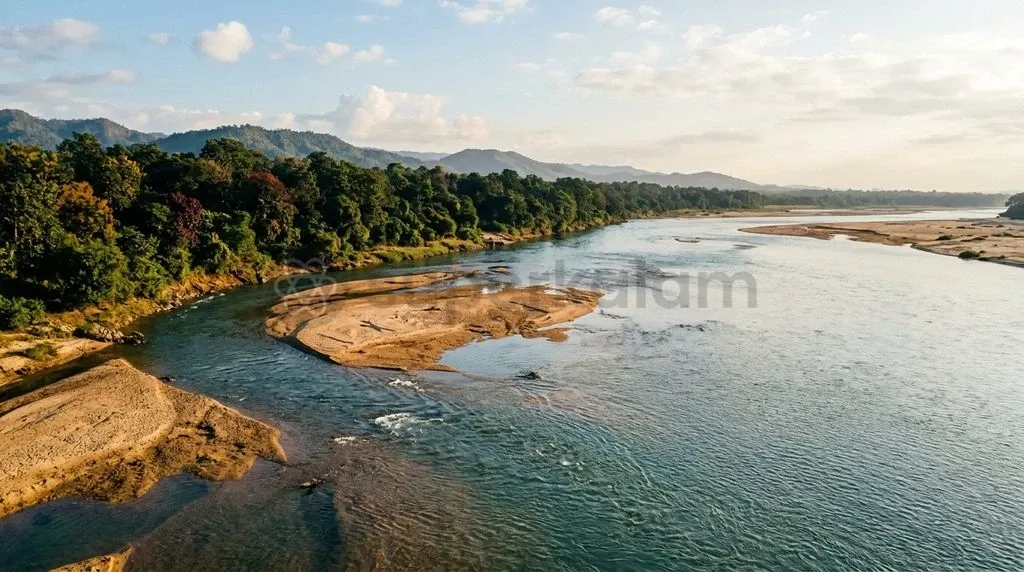
The Central Empowered Committee has recommended that the Supreme Court mandate a time-bound three-year roadmap to phase out instream river sand extraction across India, urging states to transition toward manufactured sand and reservoir desiltation under the Mines and Minerals (Development and Regulation) Act, 1957. Submitted through Report No. 36 of 2026, this intervention seeks to halt irreversible hydrological degradation, bank erosion, and aquatic habitat destruction caused by uncontrolled dredging. The proposal confronts an entrenched political economy, as sand remains a minor mineral governed primarily by State Governments for local revenue and construction needs. Shifting India's building sector toward manufactured alternatives and reservoir sediment management represents an ecological necessity, but enforcing it requires cooperative federal mechanisms, digital surveillance, and strict judicial oversight. As of November 2026, these recommendations remain advisory while the Supreme Court deliberates on issuing binding directives.
Why River Sand Mining Is in the News
The Central Empowered Committee has submitted Report No. 36 of 2026 to the Supreme Court, recommending a three-year phaseout of active river sand mining across India. The statutory panel presented its findings on 2 November 2026 during hearings in Suo Motu Writ Petition (Civil) No. 2 of 2026, which examines widespread illegal mining across fragile river corridors. As of November 2026, the Supreme Court has not yet delivered a final judgment adopting the report, leaving its proposed restrictions advisory in nature while judicial deliberations continue.
Judicial scrutiny intensified following persistent violations of environmental norms in ecologically sensitive zones like the Chambal river basin. The panel informed the court that existing regulatory regimes have failed to prevent riverbeds from being stripped beyond their natural replenishment capacity. By proposing a nationwide terminal deadline on instream riverbed extraction, the panel has elevated river sand mining from a state-level regulatory issue into a national environmental challenge.
This development directly engages the statutory mandates of the Ministry of Environment, Forest and Climate Change (MoEFCC) and tests the federal balance of mineral administration. State administrations rely heavily on sand quarry auctions for non-tax revenue, creating an inherent friction between local fiscal priorities and federal environmental mandates.
What Is the Central Empowered Committee and What Has It Recommended?
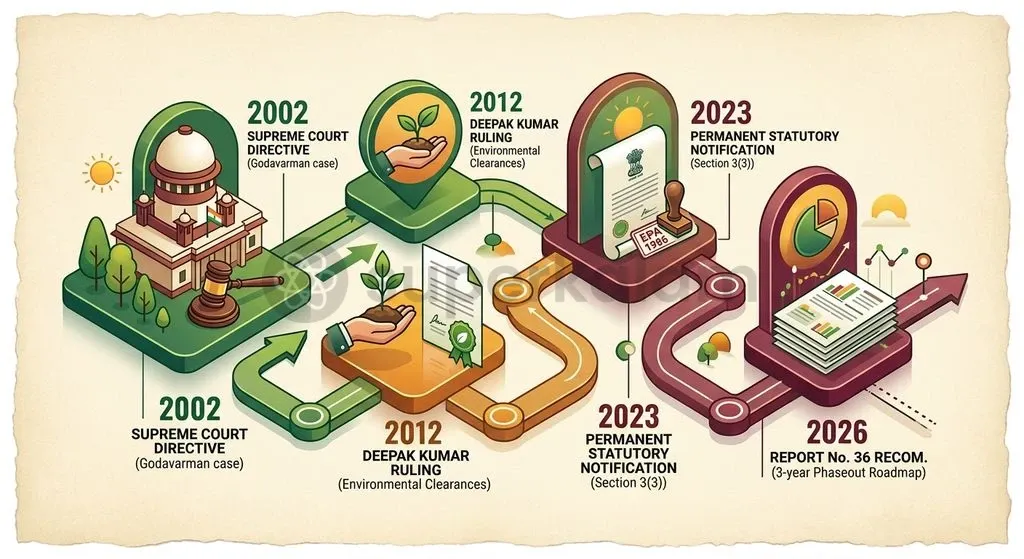
The Central Empowered Committee functions as a permanent statutory authority under the Environment (Protection) Act, 1986, mandated to advise the judiciary on ecological and wildlife conservation issues. The body owes its origins to a judicial directive issued by the Supreme Court on 9 May 2002 in T.N. Godavarman Thirumulpad v. Union of India, where it was created as an ad-hoc monitoring mechanism. The MoEFCC later formalised this institution as a permanent statutory body under Section 3(3) of the Environment (Protection) Act, 1986, through Gazette Notification S.O. 3946(E).
+-----------------------------------------------------------------------------+
|                      CENTRAL EMPOWERED COMMITTEE (CEC)                      |
|                                                                             |
|   1986: Section 3(3) of Environment (Protection) Act provides statutory base|
|   2002: Supreme Court directs creation in T.N. Godavarman Thirumulpad case  |
|   2023: MoEFCC notifies CEC as permanent statutory body (S.O. 3946(E))     |
|   2026: Submits Report No. 36 recommending 3-year river sand phaseout       |
+-----------------------------------------------------------------------------+
Report No. 36 of 2026 sets out a structural departure from traditional lease regulation by advocating a progressive phaseout timeline over three years. The panel concluded that commercial riverbed dredging cannot be made sustainable in rivers facing chronic sediment deficits. The recommendations advocate an immediate ban on instream mechanized mining, followed by a graduated contraction of mining leases in active river channels.
To prevent supply shocks in the construction sector, the committee proposed substituting river sand with alternative fine aggregates. The central pillar of this alternative strategy is a National Reservoir Sediment Management Policy. Under this framework, authorities would initiate a 10-year desiltation cycle to extract commercial-grade sand from major dam impoundments older than 15 years, simultaneously restoring dead storage capacity in silted reservoirs.
Discuss with Superkalam
Recall the statutory body under which the Central Empowered Committee was formalised in 2023, along with the relevant Act.
Ask NowWhat Exactly Changes for Riverbed Leases and Environmental Approvals?
Environmental clearances for riverbed sand mining require rigorous District Survey Reports under guidelines issued by the Ministry of Environment, Forest and Climate Change. The procedural architecture traces back to the landmark judgment in Deepak Kumar v. State of Haryana (2012), wherein the Supreme Court ruled that prior Environmental Clearance from MoEFCC or the State Environmental Impact Assessment Authority (SEIAA) is mandatory for all leases, including plots under five hectares. This verdict eliminated an earlier exemption that mining cartels exploited to avoid ecological scrutiny by fragmenting leases.
Building on that judicial foundation, the MoEFCC issued the Sustainable Sand Mining Management Guidelines (SSMMG) 2016. These rules made the preparation of District Survey Reports (DSRs) mandatory prior to any quarry auction. DSRs must map available deposits and compute annual replenishment rates using physical survey methods, ensuring that extraction quotas do not exceed the volume of sand deposited during the annual monsoon.
Administrative requirements were tightened further under MoEFCC Notification S.O. 3611(E), which directed that District Survey Reports be updated once every five years to retain legal validity for project appraisals. Later, the Enforcement and Monitoring Guidelines for Sand Mining (EMGSM) 2020 introduced mandatory post-monsoon replenishment audits, prohibited night-time excavation, and prescribed drone surveys and GPS tracking to police lease perimeters. If the Supreme Court formally adopts Report No. 36 of 2026, this regulatory framework will shift from approving extraction quotas to overseeing a structured phaseout of commercial riverbed leases.
Centre vs States: Who Controls Sand Mining Under the MMDR Act?
State Governments hold exclusive regulatory jurisdiction over sand mining leases and royalty collection under Section 15 of the Mines and Minerals (Development and Regulation) Act, 1957. The statutory framework explicitly classifies ordinary sand as a minor mineral under Section 3(e) of the Act. This statutory distinction creates a bifurcated mineral administration system, separating major industrial minerals from minor building resources.
Parliament granted state legislatures broad delegated authority to craft concession rules, auction mechanisms, and royalty structures for minor minerals. Furthermore, Section 23C of the MMDR Act, 1957, empowers State Governments to make rules for preventing illegal mining, transportation, and storage within their administrative boundaries. The Central Government retains no direct constitutional or statutory authority over minor mineral concession administration.
| Statutory Provision | Governing Authority | Regulatory Domain |
|---|---|---|
| Section 3(e), MMDR Act, 1957 | Parliament of India | Classifies sand as a minor mineral. |
| Section 15, MMDR Act, 1957 | State Governments | Frame rules for quarry leases, auctions, and royalties. |
| Section 23C, MMDR Act, 1957 | State Governments | Frame rules preventing illegal extraction, transit, and storage. |
| Section 3(3), EPA, 1986 | Central Government (MoEFCC) | Constitutes authorities like the CEC to issue environmental mandates. |
This statutory division generates persistent federal tension when national environmental mandates limit commercial quarrying. While the Union executive exercises environmental oversight through the Environment (Protection) Act, 1986, state mining departments depend on royalty receipts to support state budgets. A court-mandated prohibition on riverbed sand extraction directly curtails state fiscal autonomy under Section 15, making cooperative federal mechanisms vital for any viable transition.
Discuss with Superkalam
Explain how the Supreme Court's ruling in Deepak Kumar v. State of Haryana (2012) altered the procedural requirements for minor mineral quarry leases.
Ask NowWhy Excessive River Extraction Devastates Waterways and Groundwater
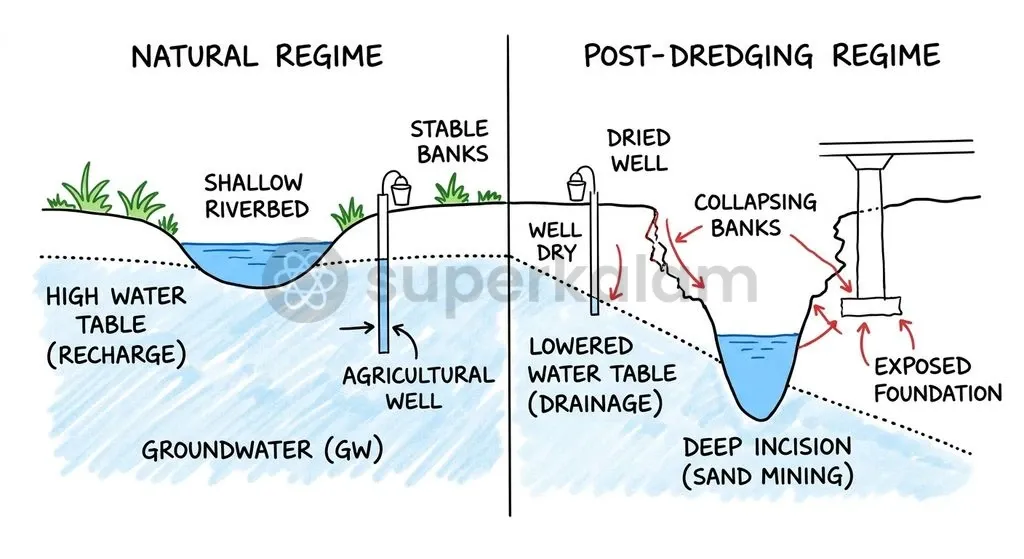
Unregulated riverbed sand extraction destroys riverine morphology, lowers adjacent water tables, and undermines civil infrastructure across major Indian river basins. River sand functions as a natural hydrologic filter and physical barrier that regulates channel velocity and stabilizes alluvial banks. When mechanised heavy excavators scrape the riverbed down to bedrock, the river channel deepens uncontrollably, triggering severe incision and bank erosion.
Deep instream scouring disrupts subterranean hydrologic connections between the active channel and adjacent riparian aquifers. As the river channel drops below the surrounding water table, subsurface groundwater flows out of floodplain farms and empties into the riverbed, drying up agricultural wells. This process of channel lowering also undermines critical infrastructure, stripping sediment away from bridge foundations and barrage aprons. A severe demonstration occurred in 2024, when uncontrolled instream dredging contributed to the structural failure of the Kalwa-Nangal bridge across the Swan River in Punjab.
Riparian ecosystems suffer severe biodiversity loss when instream mining destroys sandy shoals and shallow pools. In the National Chambal Sanctuary, illegal sand mining has degraded critical sandbanks that serve as primary basking and egg-nesting sites for the Critically Endangered Gharial (Gavialis gangeticus). Removing gravel and sandbars wipes out benthic microhabitats, destroys native fisheries, and impairs the self-purifying capacity of flowing river ecosystems.
River Sand vs Manufactured Sand (M-Sand): Key Differences and Feasibility
Manufactured sand compliant with Bureau of Indian Standards code IS 383:2016 provides an engineered, structurally viable alternative to natural riverbed aggregates in construction concrete. Natural river sand consists of smooth, rounded silica grains weathered over centuries by fluvial processes, whereas manufactured sand (M-Sand) is produced by crushing quarried granite or basalt rock through vertical shaft impactors. The industrial crushing process yields cubical particles with rough surface textures that form strong mechanical bonds with cement paste.
Bureau of Indian Standards code IS 383:2016 establishes rigorous technical specifications for manufactured fine aggregates, copper slag, and crushed stone sand. The code identifies Zone II grading fine aggregate as the structural standard required for high-grade reinforced concrete, proving that processed rock dust can completely replace river sand in modern civil engineering works.
| Evaluation Parameter | Natural River Sand | Manufactured Sand (M-Sand) | Reservoir Silt & Desilted Sediment |
|---|---|---|---|
| Origin & Production | Fluvial deposition along riverbeds and active channels. | Industrial crushing of hard rock using impact crushers. | Hydraulic dredging from sedimented dam reservoirs. |
| Grain Morphology | Rounded to sub-rounded particles with smooth surface texture. | Angular and cubical particles with rough surface texture. | Fine-grained, variable mix of silica sand, clay, and silt. |
| Impurity Content | Frequent presence of organic matter, silt, and mica. | Zero organic impurities; micro-fine dust controlled by washing. | High silt and organic fraction requiring mechanical separation. |
| Hydrological Impact | Causes river incision, aquifer depletion, and bridge instability. | Zero riverine degradation; localized hard-rock quarrying impacts. | Restores dead storage capacity and improves dam water storage. |
| Applicable Standards | IS 383:2016 (Grades Zone I to Zone IV). | IS 383:2016 (Standardised Zone II fine aggregate). | IS 383:2016 (After desiltation and grain-size grading). |
Reservoir sediment extraction provides another major source of alternative fine aggregates. An assessment by the Central Water Commission revealed that 439 major reservoirs across India have lost an average of 19.24% of their gross capacity to silt accumulation. Removing these deposits under a structured national sediment policy would reclaim millions of tonnes of construction sand while restoring critical surface water storage capacity.
Urban demolition waste provides an additional secondary material stream for the construction sector. Under the Construction and Demolition Waste Management Rules, 2016, municipal bodies and government engineering departments must procure 10% to 20% recycled aggregates in public civil projects. Expanding M-Sand production alongside C&D waste recycling reduces reliance on ecologically sensitive riverbeds.
Discuss with Superkalam
Analyse the constitutional and statutory frictions that arise between Union environmental directives under the EPA, 1986 and state non-tax revenues under Section 15 of the MMDR Act, 1957.
Ask NowWhy Sand Enforcement Fails: Mafia Control, Weak Audits, and Tech Gaps
Illegal sand mining persists because monitoring mechanisms struggle against fragmented state records, transit permit manipulation, and violent local extraction cartels. In its official assessment, the Ministry of Mines registered 95,306 cases of illegal mining covering major and minor minerals across India during the 2021-22 fiscal year. This metric highlights the structural scale of regulatory breaches occurring across state-level mining administrations.
The Central Empowered Committee found that enforcement is crippled because there is no consolidated national database tracking the volume or value of illegally dredged river sand. Individual states maintain fragmented transit registries that fail to reconcile quarry yields with consumer arrivals. Cartels exploit this data gap by reusing valid transit passes multiple times, transporting thousands of tonnes of untracked river sand under a single authorized document.
+-----------------------------------------------------------------------------+
|                     CRITICAL VULNERABILITIES IN ENFORCEMENT                 |
|                                                                             |
|   Paper Leaks: Single transit permits reused for multiple truck trips      |
|   Information Void: Lack of unified central database on illegal volumes     |
|   Physical Risk: State enforcement squads targeted by armed cartels         |
|   Inter-State Smuggling: Mineral trucks evade scrutiny across borders       |
+-----------------------------------------------------------------------------+
Technological monitoring tools deployed by central agencies have struggled to match the speed of illicit dredging. The Ministry of Mines operates the satellite-based Mining Surveillance System (MSS), developed with BISAG-N to flag unauthorized mining beyond lease perimeters. However, satellite revisit timelines and cloud cover limit rapid detection during the monsoon, when high water flows conceal illegal instream dredging.
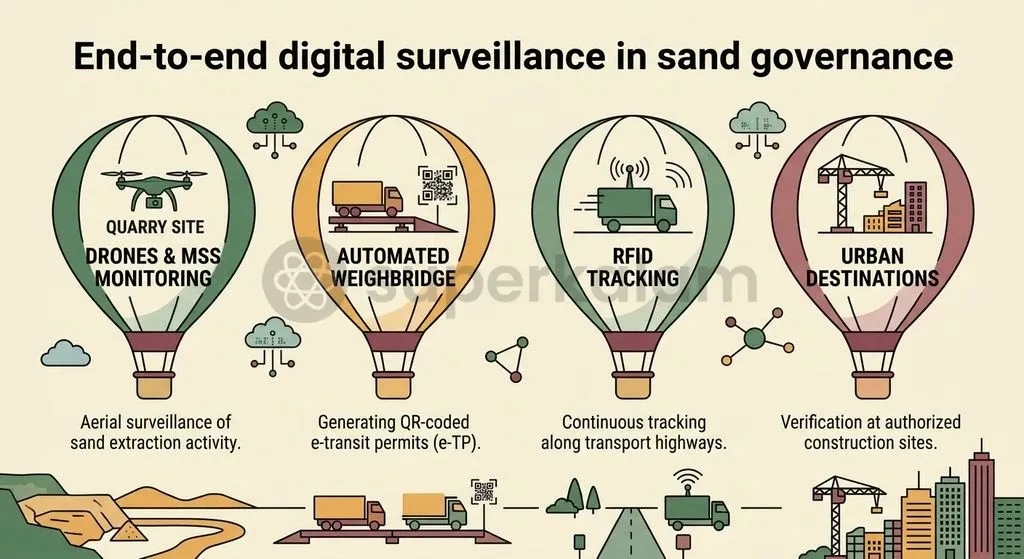
Enforcement teams also confront severe physical resistance from organised syndicates. In response to inter-state smuggling along the Chambal river corridor, the Supreme Court directed the state governments of Rajasthan, Madhya Pradesh, and Uttar Pradesh to set up joint inter-state checkpoints equipped with 24-hour CCTV systems. To close administrative loopholes, the CEC recommended mandating electronic transit permits (e-TPs) featuring tamper-proof QR codes and RFID tracking linked to end-use destinations.
Discuss with Superkalam
Weigh the feasibility of replacing active instream river sand mining with a 10-year reservoir desiltation cycle under the proposed National Reservoir Sediment Management Policy.
Ask NowThe Way Forward: Building a Transparent and Sustainable Sand Economy
Establishing a sustainable sand economy requires State Governments to transition systematically from active river dredging toward industrial manufactured sand and managed reservoir desiltation. Phasing out river sand cannot succeed through legal prohibitions alone; it demands accessible, affordable substitutes for the building industry. State industrial policies must incentivize private investment in advanced rock-crushing plants equipped with air classifiers to produce certified Zone II M-Sand under IS 383:2016.
State irrigation departments should implement the CEC's proposed National Reservoir Sediment Management Policy to systematically desilt aging dams. Desilting major barrages older than 15 years will recover valuable construction materials while reclaiming water storage capacity lost to heavy sedimentation. Reclaimed silt can be processed through automated washing and grading plants to supply urban infrastructure projects, transforming an engineering liability into an economic asset.
Real-time supply chain monitoring must replace outdated paper passes. Mining departments should integrate GPS-tracked transit vehicles, weighbridge sensors, and mandatory electronic transit permits (e-TPs) with automated national tax portals. Combining remote sensing audits with inter-state enforcement checkpoints will suppress illicit cartels, protect endangered riverine ecosystems, and secure steady fiscal revenues for state governments.
Key Takeaways
- The Central Empowered Committee submitted Report No. 36 of 2026 to the Supreme Court on 2 November 2026, proposing a three-year phased ban on commercial instream river sand mining across India.
- The CEC was originally formed by Supreme Court orders in the 2002 T.N. Godavarman case and now operates as a permanent statutory authority under Section 3(3) of the Environment (Protection) Act, 1986.
- Under Sections 3(e), 15, and 23C of the MMDR Act, 1957, sand is classified as a minor mineral, placing concession rules, royalties, and anti-smuggling enforcement under exclusive state jurisdiction.
- Prior Environmental Clearance remains mandatory for all quarry leases regardless of size, following the Supreme Court's ruling in Deepak Kumar v. State of Haryana (2012) and MoEFCC's SSMMG 2016 rules.
- Excessive instream mining causes riverbed degradation, groundwater depletion, and structural collapses, such as the Kalwa-Nangal bridge failure in Punjab in 2024.
- Bureau of Indian Standards code IS 383:2016 establishes Zone II grading M-Sand as a direct structural alternative to natural river sand in concrete production.
- Central Water Commission surveys reveal that 439 major reservoirs have lost an average of 19.24% of their gross capacity, validating reservoir desiltation as a viable sand supply alternative.
- As of November 2026, the CEC recommendations remain advisory pending a final binding judgment from the Supreme Court.
Mains Question
"A court-mandated prohibition on riverbed sand extraction directly curtails state fiscal autonomy under Section 15 of the MMDR Act, 1957, making cooperative federal mechanisms vital for any viable transition." Examine. (10 Marks)
Evaluate NowMains Question
From the landmark judgment in Deepak Kumar (2012) to the Central Empowered Committee's Report No. 36 of 2026, regulatory oversight of river sand mining has shifted from lease appraisal to an outright instream phaseout. Critically analyse the institutional and ecological factors driving this transition. (15 Marks)
Evaluate NowPractice MCQs
QUESTION 1
With reference to the regulatory framework governing sand mining in India, consider the following statements:
- Sand is classified as a minor mineral under the Mines and Minerals (Development and Regulation) Act, 1957.
- State Governments are statutorily empowered to frame concession rules and royalty structures for minor minerals under Section 15 of the MMDR Act, 1957.
- The Central Government exercises exclusive direct statutory authority over minor mineral concession administration. Which of the statements given above is/are correct?
QUESTION 2
Regarding the Central Empowered Committee (CEC), consider the following statements:
- It was initially constituted pursuant to a judicial directive of the Supreme Court in the T.N. Godavarman Thirumulpad case.
- It has been notified as a permanent statutory authority under Section 3(3) of the Environment (Protection) Act, 1986.
- In Report No. 36 of 2026, the CEC recommended an indefinite freeze on dam desiltation to protect downstream ecology. Which of the statements given above is/are correct?
QUESTION 3
Consider the following statements regarding environmental appraisal guidelines for riverbed sand mining in India:
- In Deepak Kumar v. State of Haryana (2012), the Supreme Court mandated prior Environmental Clearance for all mining leases, including those under five hectares.
- Sustainable Sand Mining Management Guidelines (SSMMG) 2016 made the preparation of District Survey Reports (DSRs) mandatory prior to quarry auctions.
- Under MoEFCC Notification S.O. 3611(E), District Survey Reports must be updated once every year to maintain legal validity. Which of the statements given above is/are correct?
QUESTION 4
Under the Mines and Minerals (Development and Regulation) Act, 1957, which statutory provision specifically empowers State Governments to make rules for preventing illegal mining, transportation, and storage of minerals?
QUESTION 5
With reference to the environmental and infrastructural impacts of instream river sand mining mentioned in the article, consider the following statements:
- Uncontrolled instream dredging lowers the active river channel, causing groundwater from adjacent floodplains to drain into the riverbed.
- Channel incision due to heavy extraction strips protective sediment from bridge foundations and barrage aprons. Which of the statements given above is/are correct?