SWIFT Alternatives: CIPS, SPFS, mBridge, and Rupee Settlement Rails
As financial sanctions accelerate de-dollarisation, emerging economies are testing alternative settlement rails to safeguard trade and strategic autonomy.
Sep, 2026
•7 min read

Overview
Geopolitical fragmentation and financial sanctions have accelerated the search for alternatives to Western financial rails. Nations are building parallel networks—including China's CIPS, Russia's SPFS, Project mBridge, and India's Special Rupee Vostro Accounts—to protect commerce from dollar weaponisation.
SWIFT is a financial messaging network, not a clearing institution. Countries seeking strategic autonomy must therefore establish sovereign rails that handle both communications and underlying liquidity settlement.
These emerging platforms bypass Western bottlenecks. However, widespread adoption faces hurdles, particularly capital account restrictions, chronic trade imbalances, and secondary sanction risks.
Why in the News: The Weaponisation of Global Finance and SWIFT Bans
Western powers severed major Russian banks from SWIFT following the 2022 escalation in Ukraine. Concurrently, authorities froze over $300 billion of the Central Bank of Russia's foreign exchange reserves. This move sparked deep concerns across emerging markets regarding the weaponisation of the US dollar.
The coordinated actions showed that access to cross-border financial plumbing can be revoked abruptly. In response, sovereign nations accelerated work on alternative clearing architectures.
Governments moved to expand bilateral trade invoicing in domestic currencies. They also stepped up trials of multi-central bank digital currency platforms to safeguard essential supply chains.
What Is SWIFT and How Does It Power Cross-Border Trade?
The Society for Worldwide Interbank Financial Telecommunication was founded under Belgian law in 1973. It operates as a member-owned cooperative. SWIFT transmits secure messages; it does not hold funds, track client accounts, or execute financial settlements.
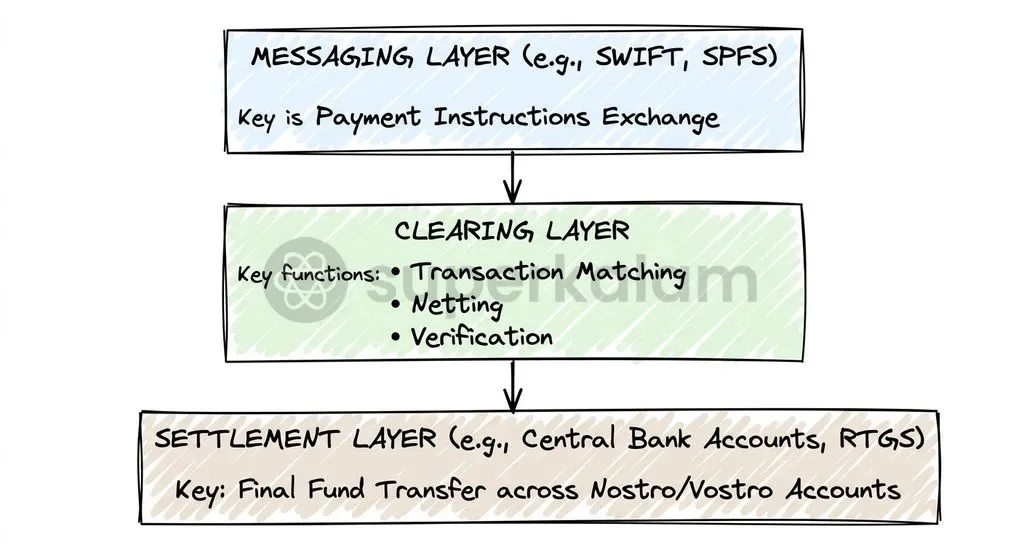
The network conveys standardised, encrypted instructions across correspondent banking channels. A typical international transfer relies on three functional layers:
- Financial Messaging: Transmitting structured payment instructions (such as MT103 or ISO 20022 formats) between institutions.
- Clearing: Reconciling, calculating, and netting payment obligations between transacting banks.
- Settlement: Moving central bank or commercial bank balances, executed via domestic real-time gross settlement systems or correspondent accounts.
Western institutions dominate correspondent banking. Most standard cross-border flows clear in US dollars through mechanisms like Fedwire. When an institution loses SWIFT access, its ability to transmit payment orders efficiently collapses, forcing it onto slower, bespoke channels.
Why Countries Are Seeking Alternatives to the Western Financial Rails
Sovereign states want independent settlement rails to reduce reliance on the greenback. Heavy dependence on Western corridors creates systemic vulnerability to unilateral regulatory actions.
Key drivers accelerating the development of alternative mechanisms include:
- Insulation from Sanctions: Unilateral sanctions can cut off market access without United Nations consensus.
- Reduction of Transaction Costs: Traditional correspondent banking incurs intermediary fees, double currency conversions, and multi-day settlement lags.
- Promotion of Local Currencies: Invoicing trade in domestic currency cuts foreign exchange exposure and reduces the need for hard-currency reserves.
- Monetary Sovereignty: Independent clearing rails protect trade in critical commodities during geopolitical tensions.
Discuss with Superkalam
Can you explain the difference between financial messaging, clearing, and settlement in a standard cross-border payment transfer?
Ask NowGlobal Contenders: Comparing CIPS, SPFS, and Project mBridge
China, Russia, and multilateral bodies have designed distinct platforms to route cross-border payments outside SWIFT:
- China's CIPS: The People's Bank of China launched the Cross-Border Interbank Payment System (CIPS) in 2015, combining messaging and real-time gross settlement for Renminbi flows. CIPS serves as a direct clearing platform that trims reliance on Western correspondent networks, though many offshore participants still connect to it using SWIFT messaging.
- Russia's SPFS: The Bank of Russia built the System for Transfer of Financial Messages (SPFS) in 2014 as a domestic messaging substitute, adopting ISO 20022 messaging formats. SPFS functions solely as a messaging network and lacks an integrated clearing or settlement mechanism.
- Project mBridge: The BIS Innovation Hub joined forces with the central banks of China, Hong Kong, Thailand, the UAE, and Saudi Arabia to build Project mBridge. It enables real-time, peer-to-peer settlement directly on a shared distributed ledger, removing correspondent intermediaries.
Discuss with Superkalam
Compare how China's CIPS and the multi-central bank Project mBridge approach the elimination of Western correspondent banking dependencies.
Ask NowComparison Table: SWIFT vs CIPS vs SPFS vs Project mBridge
Cross-border payment mechanisms vary in their operational design, settlement mechanisms, legal oversight, and settlement currencies. These differences determine whether a system merely routes communication or settles funds atomically.
| Feature / Dimension | SWIFT | CIPS | SPFS | Project mBridge |
|---|---|---|---|---|
| Lead Authority / Jurisdiction | Member-owned cooperative (Belgium) | People's Bank of China (China) | Bank of Russia (Russia) | BIS Innovation Hub and partner central banks |
| Primary Functionality | Standardised financial messaging | Messaging and settlement | Financial messaging only | Multi-CBDC payment and settlement |
| Settlement Mechanism | None (relies on correspondent banks) | Real-Time Gross Settlement (RTGS) | None (relies on domestic rails) | Distributed ledger atomic settlement |
| Primary Operating Currency | Multi-currency messaging | Chinese Renminbi (RMB) | Russian Rouble (RUB) | Multi-currency (CBDCs of member states) |
| Key Operational Scope | Global standard across 200+ territories | International RMB cross-border clearing | Russian domestic and select partner banks | Multilateral cross-border corridor |
India's Approach: Special Rupee Vostro Accounts (SRVA) and Rupee-Rouble Trade
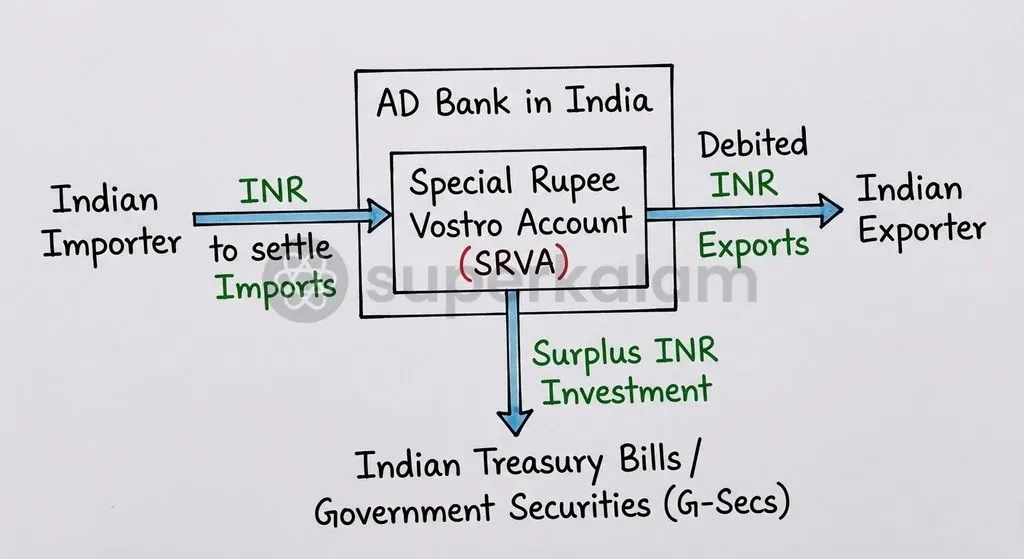
The Reserve Bank of India set up the Special Rupee Vostro Account framework via Circular No. 10 on July 11, 2022, enabling cross-border trade invoicing in Indian Rupees. The mechanism operates under the Foreign Exchange Management Act (FEMA).
The SRVA framework operates along three main tracks:
- Import Transactions: Indian importers pay in INR by crediting the foreign partner bank's Special Vostro account against invoices.
- Export Transactions: Indian exporters receive INR drawn directly from the balances held in that designated Special Vostro account.
- Surplus Investment: Foreign partner banks can invest excess Rupee balances into Indian Government Treasury Bills, sovereign bonds, or approved domestic instruments.
Discuss with Superkalam
How viable is bilateral local-currency invoicing when large trade deficits prevent the partner country from repatriating or converting surplus funds?
Ask NowIndia relied on the SRVA mechanism to sustain bilateral energy imports from Russia, safeguarding energy security amid Western sanctions. Deals settle at market-determined rates rather than the fixed, non-convertible currency matrices used during the Cold War.
Key Challenges: Currency Convertibility, Trade Imbalances, and Sanction Risks
Bilateral local-currency arrangements encounter practical barriers:
- Bilateral Trade Deficits: The massive trade imbalance in the Rupee-Rouble corridor left Russian exporters holding tens of billions in non-repatriable Rupee surpluses in Indian banks. India imports substantial crude oil volumes while exporting comparatively few manufactured goods, creating stranded balances with narrow investment avenues.
- Incomplete Capital Account Convertibility: Because the Rupee lacks full capital account convertibility, foreign entities cannot freely switch accumulated balances into major reserve currencies without regulatory friction.
- Secondary Sanctions Risk: Fear of Western enforcement prompted Indian refiners and correspondent banks to settle various non-sanctioned oil purchases using intermediate currencies like the UAE Dirham and Chinese Yuan.
Way Forward: Building Resilient Cross-Border Payment Systems for India
India must balance the internationalisation of the Rupee with macroeconomic stability. Building durable alternatives to Western payment hubs requires institutional depth rather than ad-hoc bilateral patches.
The RBI's Inter-Departmental Group Report on Internationalisation of INR laid out key strategic priorities:
- Short-Term Targets: Standardise bilateral trade invoicing, link domestic fast payment systems, and incorporate the INR into the Asian Clearing Union mechanism.
- Long-Term Objective: Secure inclusion of the Indian Rupee in the IMF's Special Drawing Rights basket.
- Multilateral Engagement: Advance the BRICS Cross-Border Payments Initiative to boost national payment interoperability, as outlined in the New Delhi Declaration of the 18th BRICS Summit.
Policymakers must navigate the Triffin Dilemma. Providing global currency liquidity can fuel capital flow volatility and constrain domestic monetary policy. Deepening domestic debt markets and expanding the Unified Payments Interface (UPI) globally offer balanced pathways forward.
Discuss with Superkalam
Propose three structural policy reforms India should implement to internationalise the Rupee without compromising domestic monetary autonomy under the Triffin Dilemma.
Ask NowKey Takeaways
- SWIFT's Core Function: SWIFT is a member-owned messaging cooperative established in Belgium; it does not execute settlements, manage bank accounts, or hold funds.
- Alternative Architectures: China's CIPS combines messaging and Renminbi settlement, Russia's SPFS provides messaging without native clearing, and Project mBridge leverages multi-CBDC shared ledgers for atomic cross-border settlement.
- India's SRVA Framework: The RBI introduced Special Rupee Vostro Accounts in July 2022 to enable INR trade invoicing and allow foreign banks to invest surplus funds in Indian government securities.
- Structural Bottlenecks: The Rupee-Rouble mechanism is constrained by a wide trade deficit, non-repatriable Rupee surpluses, secondary sanction risks, and incomplete capital account convertibility.
- Strategic Roadmap: The RBI Inter-Departmental Group recommends standardising INR invoicing and integrating regional payment rails, targeting long-term IMF SDR basket inclusion while managing the monetary trade-offs of the Triffin Dilemma.
Mains Question
The Reserve Bank of India's Special Rupee Vostro Account (SRVA) framework was introduced to facilitate bilateral trade invoicing in domestic currency and mitigate external vulnerability. In this context, evaluate the performance and structural constraints faced by the SRVA mechanism. (10 Marks)
Evaluate NowMains Question
The weaponisation of global financial messaging and clearing networks has prompted sovereign states to construct alternative cross-border settlement architectures. Critically examine the efficacy of emerging platforms such as CIPS, SPFS, and Project mBridge in establishing an autonomous international financial order. (15 Marks)
Evaluate NowPractice MCQs
QUESTION 1
With reference to global financial messaging and cross-border settlement systems, consider the following statements:
- SWIFT is an international clearing house that directly holds central bank reserves and executes atomic fund settlements.
- China's Cross-Border Interbank Payment System (CIPS) combines financial messaging with Real-Time Gross Settlement (RTGS) for Renminbi flows.
- Russia's System for Transfer of Financial Messages (SPFS) provides messaging services using ISO 20022 formats but lacks an integrated clearing and settlement mechanism.
Which of the statements given above are correct?
QUESTION 2
Consider the following statements regarding the Special Rupee Vostro Account (SRVA) framework established by the Reserve Bank of India (RBI):
- Indian importers settle transactions by crediting the foreign partner bank's Special Vostro account in Indian Rupees.
- Foreign partner banks are permitted to invest surplus Rupee balances held in SRVAs into Indian Government Treasury Bills and sovereign bonds.
- The transactions under the SRVA framework are conducted based on fixed, non-convertible currency matrices determined by the Asian Clearing Union.
Which of the statements given above is/are correct?
QUESTION 3
Regarding 'Project mBridge', consider the following statements:
- It is a multi-CBDC platform developed by the BIS Innovation Hub in collaboration with multiple partner central banks.
- It conducts real-time, peer-to-peer settlement directly on a shared distributed ledger without relying on traditional correspondent banking intermediaries.
- It operates exclusively in US Dollars to facilitate liquidity clearance for emerging markets.
Which of the statements given above is/are correct?
QUESTION 4
Consider the following statements regarding the challenges associated with local currency trade settlements and the internationalisation of the Indian Rupee:
- A chronic bilateral trade deficit can result in foreign trade partners accumulating non-repatriable Rupee surpluses in domestic banks.
- The absence of full capital account convertibility limits the ability of foreign entities to freely convert accumulated domestic currency balances into reserve currencies.
- The RBI's Inter-Departmental Group recommended the inclusion of the Indian Rupee in the IMF's Special Drawing Rights (SDR) basket as an immediate short-term target.
Which of the statements given above is/are correct?
QUESTION 5
In the context of the internationalisation of national currencies and cross-border payment reforms, the 'Triffin Dilemma' primarily refers to: