Supreme Court on CBSE Three-Language Policy: From Kothari Commission to NEP 2020
Analyze how federal boundaries and fundamental expressive rights limit state powers to enforce compulsory regional languages in central board schools.
Nov, 2026
•11 min read
Context
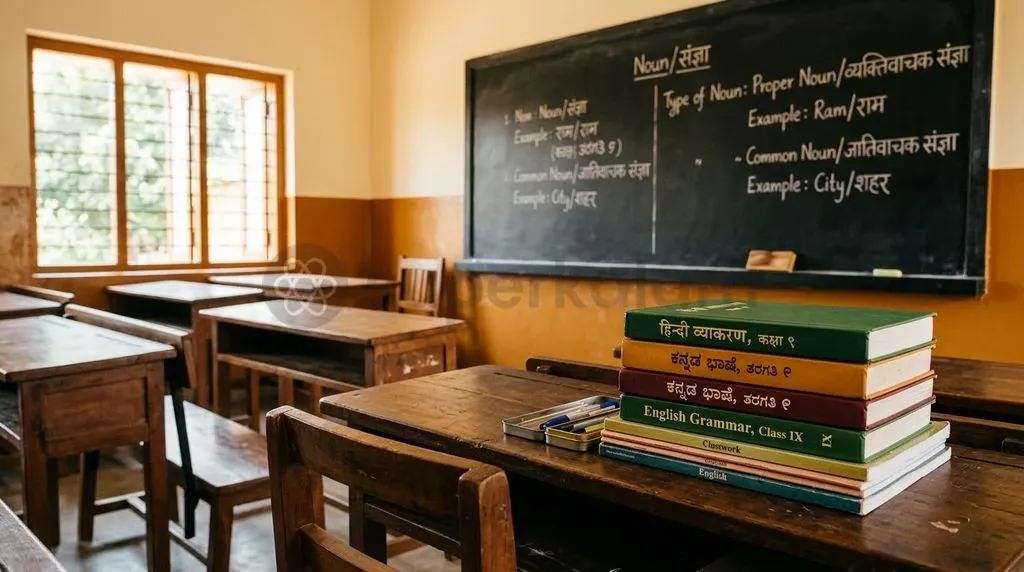
State statutes compelling central board schools to enforce local language instruction trigger a sharp constitutional clash between provincial cultural preservation and national academic uniformity. State Legislatures hold regulatory competence over school education under Entry 25 of the Concurrent List. However, that authority remains subordinated to parliamentary standards under Entry 66 of the Union List and strictly constrained by fundamental rights.
State mandates that penalise non-native students or override central curricula violate expressive rights under Article 19(1)(a) and infringe minority autonomy under Article 30(1). Resolving this friction requires examining statutory boundaries, federal distribution of power, and protected institutional guarantees.
Why Language Rules in Schools Are Sparking Court Battles
State language mandates in central board schools have triggered widespread litigation across several High Courts and the Supreme Court of India. The core friction stems from sub-national cultural legislation colliding directly with the uniform curricula prescribed by the Central Board of Secondary Education (CBSE).
State governments often seek to protect regional heritage through compulsory language statutes. For example, the Karnataka Language Learning Act, 2015 requires all schools in Karnataka, including those affiliated with CBSE and ICSE, to teach Kannada as a compulsory first or second language from Classes 1 to 10. Similarly, the Maharashtra Compulsory Teaching and Learning of Marathi Language in Schools Act, 2020 mandates the study of Marathi across all educational boards operating within the state.
Discuss with Superkalam
Recall the constitutional amendment that shifted education from the State List to the Concurrent List, and identify the specific entries involved.
Ask NowAs of November 2026, judicial scrutiny over language mandates remains intense due to their disruption of secondary schooling. On November 25, 2026, a Supreme Court bench comprising CJI Surya Kant, Justice Joymalya Bagchi, and Justice V Mohana clarified that CBSE students who have already opted for three languages may continue with their choice, while students studying two languages under transitional relaxations cannot be compelled to switch immediately.
This followed a direction on September 28, 2026, where the Supreme Court instructed CBSE to extend transitional relaxations to Class 6 students, stipulating that the newly mandated third language must be evaluated through internal school-level assessment without a Class 10 board examination. These rulings demonstrate that regional language rules cannot override student equity or disrupt established academic pipelines.
How the Three-Language Formula Works Against State Mandates
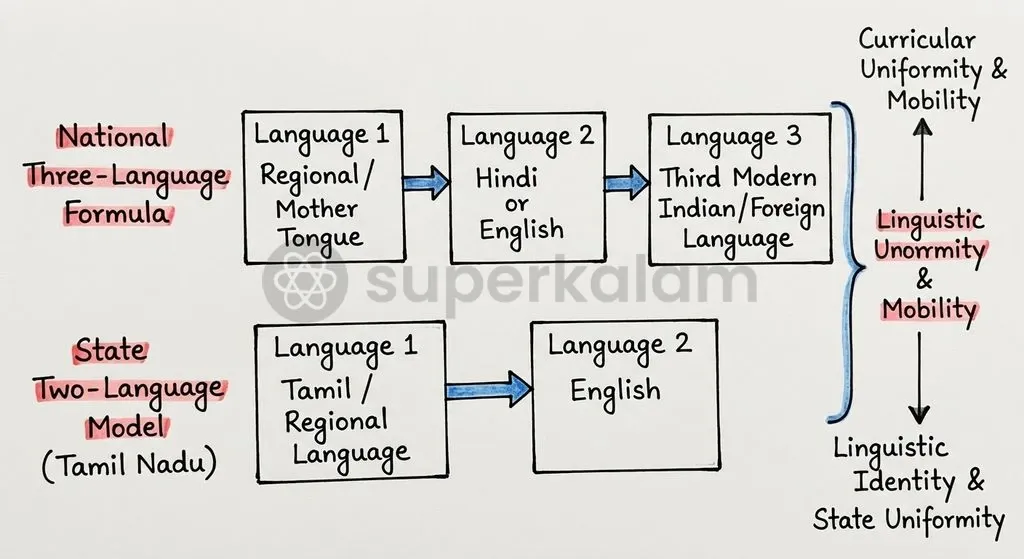
The Three-Language Formula operates as a national pedagogical guideline designed to encourage multilingualism while maintaining inter-state communicative competence. First recommended by the Central Advisory Board of Education (CABE) in 1956, the formula was formally structured by the Kothari Commission (1964–66).
Under the Kothari Commission's framework, secondary school students were expected to study:
- The mother tongue or the regional language;
- The official language of the Union (Hindi) or the associate official language (English); and
- A modern Indian or foreign language not covered above, preferably chosen from southern languages in Hindi-speaking states.
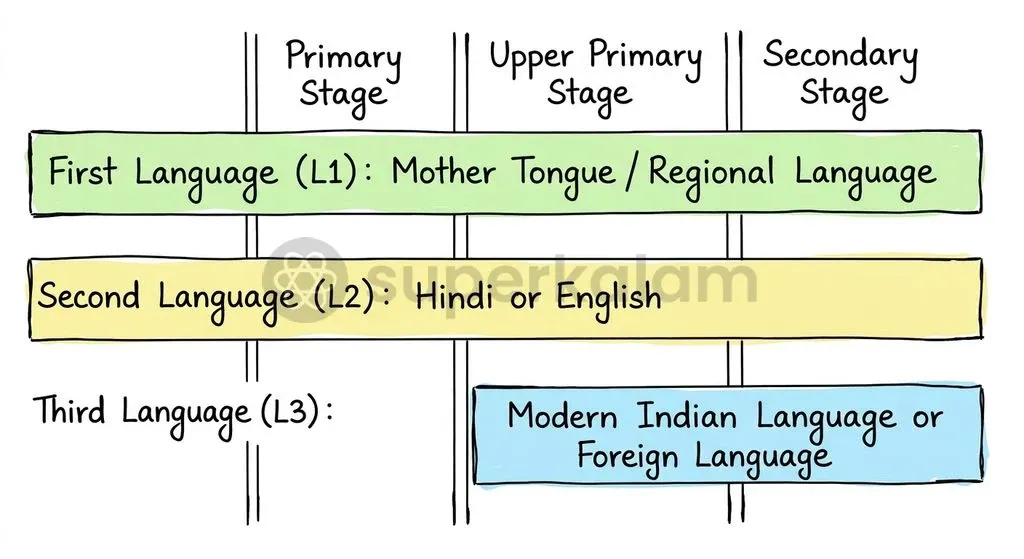
Modern iterations under the National Education Policy 2020 (NEP 2020) and the National Curriculum Framework for School Education (NCF-SE 2023) maintain this structural balance with greater flexibility. Under the CBSE Three-Language Policy aligned with NCF-SE 2023, students must study three languages (designated R1, R2, and R3), of which at least two native Indian languages (Bharatiya Bhashas) are mandatory.
NEP 2020 Paragraphs 4.11 to 4.13 encourage the mother tongue or local language as the medium of instruction up to Grade 5 or Grade 8 wherever possible. Crucially, the policy explicitly affirms that no language will be arbitrarily imposed on any state.
Friction arises because CBSE operates as an autonomous society under the Union Ministry of Education, governed by uniform pan-Indian affiliation bylaws. When a State Legislature enforces a rigid statute compelling the regional tongue as an unalterable first or second language, it directly clashes with CBSE's flexible multi-language matrix.
Constitutional Balance: State Powers vs Central Standards
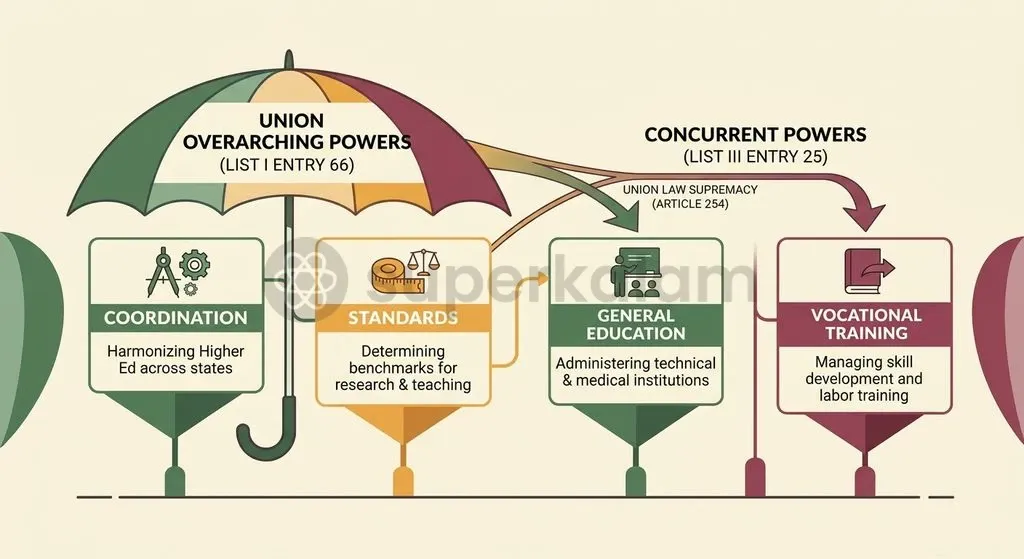
The distribution of legislative power over education reflects an evolving federal dynamic governed by the Seventh Schedule of the Constitution. Originally, education was located exclusively in the State List under Entry 11 of List II.
The Constitution (Forty-second Amendment) Act, 1976 fundamentally reshaped this jurisdiction. Section 57 of the 42nd Amendment omitted Entry 11 from List II and transferred education into Entry 25 of List III (Concurrent List), covering general education, technical education, medical education, and universities.
However, this concurrent power is not absolute. Entry 25 of List III is expressly conditioned by and subject to Entries 63, 64, 65, and 66 of List I (Union List). Under Entry 66 of List I, Parliament retains exclusive authority over the coordination and determination of standards in institutions for higher education or research and scientific and technical institutions.
Where a state law enacted under Entry 25 conflicts with central statutory schemes, the doctrine of repugnancy under Article 254 comes into play. Under Article 254(1), if any provision of a law made by a State Legislature on a Concurrent List subject is repugnant to a law enacted by Parliament, the central law prevails, and the state law becomes void to the extent of that inconsistency.
Part XVII of the Constitution reinforces this linguistic balance through specific provisions:
- Article 343: Declares Hindi in Devanagari script as the official language of the Union.
- Article 345: Permits State Legislatures to adopt one or more local languages or Hindi for internal official conduct.
- Article 350A: Directs states to endeavour to provide primary instruction in a child's mother tongue for linguistic minorities.
- Article 351: Directs the Union to promote Hindi as a medium of composite culture.
Discuss with Superkalam
Explain how the doctrine of repugnancy under Article 254 operates when a state language law conflicts with central educational standards under Entry 66 of List I.
Ask NowWhat High Courts Have Ruled on Mandatory State Languages
Judicial rulings consistently clarify that while states can incentivise regional tongues, they cannot mechanically coerce central institutions or eliminate student choice.
In a landmark decision, a Constitution Bench in State of Karnataka v. Associated Management of English Medium Primary & Secondary Schools (2014) addressed state power over school language. The bench ruled that the state lacks the power to compel private un-aided or minority schools to mandate a specific medium of instruction, such as the mother tongue or regional language, at the primary stage. The court noted that state regulatory power cannot extinguish fundamental rights of parents and children in school environments.
This legal principle was reaffirmed when higher education mandates faced legal challenges. In December 2021, the Karnataka High Court restrained the Karnataka State Government and state universities from compelling undergraduate students to select Kannada as a compulsory language under the state's NEP 2020 rollout, granting students complete freedom of linguistic choice.
Similarly, the Madras High Court addressed the accommodation of non-native students within mandatory language frameworks. In September 2025, the Madras High Court declined to admit a public interest litigation that challenged a Tamil Nadu Government Order dated December 31, 2024; the contested executive order had granted practical exemptions to CBSE, ICSE, and IB boards by allowing Tamil to be taught as an optional subject for the children of central government employees and inter-state migrants. The judiciary consistently shields students from punitive language conditions that disregard national academic mobility.
Protecting Student Choice and Linguistic Minority Rights
Compulsory regional language legislation must survive the constitutional tests imposed by Part III of the Constitution. A state's police and educational powers cannot extinguish fundamental personal freedoms or minority safeguards.
In Associated Management (2014), the Supreme Court held that the freedom of speech and expression guaranteed under Article 19(1)(a) includes the right to choose the medium of instruction in formal education. Compelling a child to write high-stakes examinations exclusively in a regional dialect impairs their fundamental expressive agency.
Furthermore, cultural and minority rights under Articles 29 and 30 impose direct legal barriers against monolithic state language laws:
- Article 29(1): Guarantees that any section of citizens residing in India with a distinct language, script, or culture has the absolute fundamental right to conserve it. A blanket regional mandate that extinguishes instruction in distinct non-state mother tongues infringes this protection.
- Article 30(1): Bestows upon all religious and linguistic minorities the fundamental right to establish and administer educational institutions of their choice. The Supreme Court in TMA Pai Foundation v. State of Karnataka (2002), read alongside Associated Management (2014), affirmed that state regulations cannot impose curricular conditions that destroy an institution's distinct minority character.
| State Regulatory Interests (Entry 25, Concurrent List) | Protected Student & School Freedoms (Part III & List I) |
|---|---|
| Regional cultural promotion | Article 19(1)(a): Expressive choice of medium and language |
| Local administrative use | Article 30(1): Minority school administrative autonomy |
| Compulsory subject statutes | List I, Entry 66: National academic coordination and standards |
| Protection of state heritage | Protection of inter-state mobility and foundational education |
From an administrative perspective, forcing non-native children to pass rigorous regional board assessments creates severe academic barriers. Children of transferable central government employees, defence personnel, and inter-state migrant labourers face immense educational vulnerability when forced to clear regional language tests without foundational schooling in that language.
Discuss with Superkalam
How would the Supreme Court's ruling in the 2014 Associated Management case apply to a private CBSE school run by a linguistic minority community?
Ask NowComparing the Paths: Two-Language Policy vs Three-Language Formula
Different states have adopted contrasting statutory models to negotiate the balance between regional preservation, English proficiency, and central guidelines.
Tamil Nadu pioneered statutory resistance to central language frameworks. In 1968, the Tamil Nadu Legislative Assembly adopted a historic resolution formalising a statutory Two-Language Policy comprising English and Tamil, officially rejecting the Three-Language Formula and eliminating Hindi from state school curricula. Decades later, the state passed the Tamil Nadu Tamil Learning Act, 2006 to mandate the teaching of Tamil across all schools in the state from Classes 1 to 10, though subsequent executive orders provided exemptions for central boards.
| Feature / Dimension | Three-Language Formula (National Model) | Statutory Two-Language Policy (Tamil Nadu Model) | Compulsory State Language Acts (Karnataka / Maharashtra) |
|---|---|---|---|
| Origin & Anchor | CABE (1956), Kothari Commission (1964–66), NEP 2020 | Tamil Nadu Assembly Resolution (1968) | State Acts (e.g., Karnataka Act 22 of 2015; Maha Act III of 2020) |
| Prescribed Structure | Three languages: R1, R2, R3 (at least two native Indian languages) | Two languages: English and Tamil exclusively | Regional language made compulsory alongside board-prescribed subjects |
| Position on Hindi | Included as Union official language option in non-Hindi states | Explicitly excluded from state-mandated curriculum | Variable; focuses primarily on mandating the local state language |
| Impact on CBSE / ICSE | Harmonious with national board syllabi and NCF-SE 2023 | Central boards operate, but face periodic state compliance orders | Mandates regional language as a compulsory subject up to Class 10 |
| Accommodation for Migrants | Flexible language substitution under transitional rules | Granted relaxations via executive orders (e.g., Tamil Nadu 2024 GO) | Frequently challenged due to lack of transitional flexibility |
Way Forward: Balancing Local Cultural Identity with Student Mobility
Resolving the friction between sub-national linguistic preservation and central board standards requires pragmatic administrative compromises. Rigid compulsion often damages student welfare without creating lasting cultural engagement.
Administrative bodies should pursue several structural reforms:
- Tiered Curricular Benchmarks: States should introduce a two-track curriculum for compulsory regional languages. Native speakers can take an advanced literature track, while non-native and transferable students complete a functional, communicative language course evaluated through internal school assessments rather than punitive board examinations.
- Harmonisation with NCF-SE 2023: Central boards and state educational departments must coordinate under the Inter-State Council mechanism to align state language acts with national curriculum frameworks, preventing mid-academic litigation.
- Protecting Cosmopolitan Mobility: State governments must institutionalise clear statutory exemptions for children of central government employees, defence personnel, and corporate migrant workers, similar to the administrative relaxations introduced in Tamil Nadu.
- Pedagogical Incentivisation Over Penalisation: Rather than threatening non-compliant schools with derecognition, states should invest in digital learning software, bilingual teaching aids, and trained language educators to make regional languages accessible and engaging.
By shifting the policy focus from coercive mandates to supportive pedagogical integration, India can safeguard its rich regional heritage while preserving inter-state student mobility and constitutional rights.
Discuss with Superkalam
Weigh the cultural objective of preserving local languages against the educational need for inter-state mobility among central government employees' children. Which interest has the judiciary prioritized?
Ask NowKey Takeaways
- State legislative competence over education originates from Entry 25 of the Concurrent List, but it remains subject to parliamentary standards under Entry 66 of List I and the repugnancy doctrine under Article 254(1).
- The Supreme Court in Associated Management (2014) established that freedom of speech and expression under Article 19(1)(a) guarantees students and parents the fundamental right to choose their medium of instruction.
- Article 30(1) protects linguistic and religious minority educational institutions from coercive state curricular conditions that destroy their institutional identity.
- On November 25, 2026, the Supreme Court clarified that CBSE students under existing three-language arrangements may retain their choices without forced transitions, reinforcing internal assessment pathways.
- The Kothari Commission (1964–66) established the Three-Language Formula, which contrasts sharply with Tamil Nadu’s statutory Two-Language Policy (English and Tamil) adopted in 1968.
Mains Question
"The constitutional relocation of education to Entry 25 of the Concurrent List was intended to balance national coherence with regional aspirations, yet state language mandates often come into conflict with central standards." Elucidate. (10 Marks)
Evaluate NowMains Question
"Compulsory state language statutes enforcing regional tongues in central board schools directly impinge upon fundamental personal freedoms and institutional minority rights." Critically examine in light of judicial pronouncements. (15 Marks)
Evaluate NowPractice MCQs
QUESTION 1
With reference to the constitutional distribution of legislative powers regarding education, consider the following statements:
- Education was originally placed in the Concurrent List under the Government of India Act framework and retained there at commencement.
- The 42nd Constitutional Amendment Act transferred education from the State List to the Concurrent List under Entry 25.
- The legislative competence of states under Entry 25 of List III is expressly subject to Entry 66 of List I. Which of the statements given above are correct?
QUESTION 2
Regarding the Three-Language Formula and its evolution in Indian school education, consider the following statements:
- The formula was initially recommended by the Central Advisory Board of Education (CABE) in 1956 and structured by the Kothari Commission.
- The Kothari Commission recommended that Hindi-speaking states preferably choose a modern foreign language as their third language.
- Under the CBSE Three-Language Policy aligned with NCF-SE 2023, at least two native Indian languages are mandatory among the three languages studied. Which of the statements given above is/are correct?
QUESTION 3
Consider the following statements regarding the Supreme Court's ruling in State of Karnataka v. Associated Management of English Medium Primary & Secondary Schools (2014):
- The freedom of speech and expression under Article 19(1)(a) includes the right of a child or parent to choose the medium of instruction in formal education.
- The State holds plenary power under Entry 25 of the Concurrent List to mandate the mother tongue as the exclusive medium of instruction in private unaided schools.
- A state language mandate cannot extinguish the fundamental rights guaranteed to citizens and minorities under Articles 19(1)(a) and 30(1). Which of the statements given above is/are correct?
QUESTION 4
Which among the following constitutional provisions directs the States to endeavour to provide adequate facilities for instruction in the mother tongue at the primary stage of education to children belonging to linguistic minority groups?
QUESTION 5
Consider the following statements regarding regional language mandates and central board schools:
- The Karnataka Language Learning Act, 2015 mandates Kannada as a compulsory first or second language in all schools, including CBSE and ICSE.
- In Yashica Bhandari Jain v. Union of India (2026), the Supreme Court ruled that students who opted for two languages under transitional relaxations must immediately be tested in the third language in the Class 10 board exam.
- The Maharashtra Compulsory Teaching and Learning of Marathi Language in Schools Act, 2020 applies across all educational boards operating within the state. Which of the statements given above is/are correct?
Discuss with Superkalam
Design an assessment and curriculum framework that allows central schools to promote the host state's language without imposing punitive academic burdens on migrant students.
Ask Now