Bank Loan Write-Offs: Why India's ₹18 Lakh Crore Relief Acts as a De Facto Waiver
While farm loan waivers draw public outrage, silent corporate write-offs quietly cost taxpayers trillions, exposing a deep credit divide across Indian banking.
Nov, 2026
•11 min read
Overview
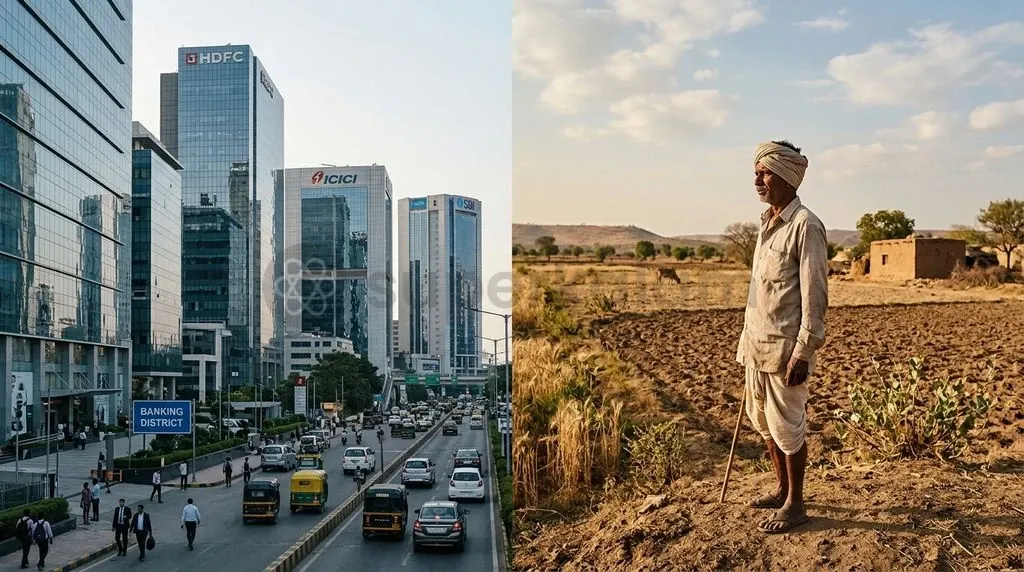
India’s commercial banking system operates on an asymmetric credit framework. While technical write-offs and agricultural debt waivers produce similar economic outcomes, they travel through starkly different institutional channels.
Scheduled commercial banks removed a staggering ₹18,07,812 crore from their active asset portfolios through balance-sheet write-offs between FY 2016-17 and FY 2025-26. The Reserve Bank of India defines a write-off as an internal accounting adjustment that preserves legal claims against defaulting borrowers. Yet commercial lenders recovered barely 14.05% of these debts over the past decade.
This systematic shortfall effectively converts technical accounting derecognition into quiet corporate debt relief. Meanwhile, public discourse routinely denounces agricultural debt waivers as fiscal recklessness, even though all state farm waivers between 2014-15 and 2018-19 totalled just ₹1.5 lakh crore.
Taxpayers ultimately foot the bill for both mechanisms. They pay directly through state revenue budgets for farmers, and indirectly through central bank recapitalisation bonds for corporate lenders. Resolving this deep structural inequity requires strict disclosure norms, an end to statutory confidentiality for mega-defaulters, and counter-cyclical credit safety nets across rural India.
Why in the News: The ₹18 Lakh Crore Bad Loan Debate
Public finance debates intensified after banking disclosures revealed that scheduled commercial banks wrote off a cumulative ₹18,07,812 crore in non-performing assets between financial years 2016-17 and 2025-26. According to the Reserve Bank of India RTI Data Disclosure, annual write-offs peaked at ₹2.39 lakh crore during FY 2018-19 before moderating to ₹1.44 lakh crore in FY 2025-26.
The volume of derecognised debt concentrates heavily among state-run lenders:
- State Bank of India: Accounted for ₹3,03,160 crore of this ten-year aggregate.
- Top Ten Lenders: Absorbed ₹11.73 lakh crore of the total volume.
- Asset Quality Shift: Pushed the gross non-performing asset (GNPA) ratio down from 11.18% in FY 2017-18 to 1.73% in FY 2025-26, as parliamentary records highlight as of November 2026.
The RBI Financial Stability Report confirms that this headline asset recovery stemmed primarily from accounting derecognition rather than cash recoveries. In practice, low recovery turns balance-sheet cleaning into an unacknowledged fiscal waiver for large corporate debtors.
Financial commentators and policymakers routinely contrast these corporate accounting adjustments with state-level agricultural debt relief programmes. Scrutiny has intensified because massive corporate write-offs coincided with substantial recapitalisation packages financed by public funds, prompting urgent calls for credit equity.
Discuss with Superkalam
How much bad debt was removed through write-offs by scheduled commercial banks between FY 2016-17 and FY 2025-26, and which single lender accounted for over ₹3 lakh crore of it?
Ask NowTechnical Write-Off vs Fiscal Waiver: The Legal and Accounting Divide
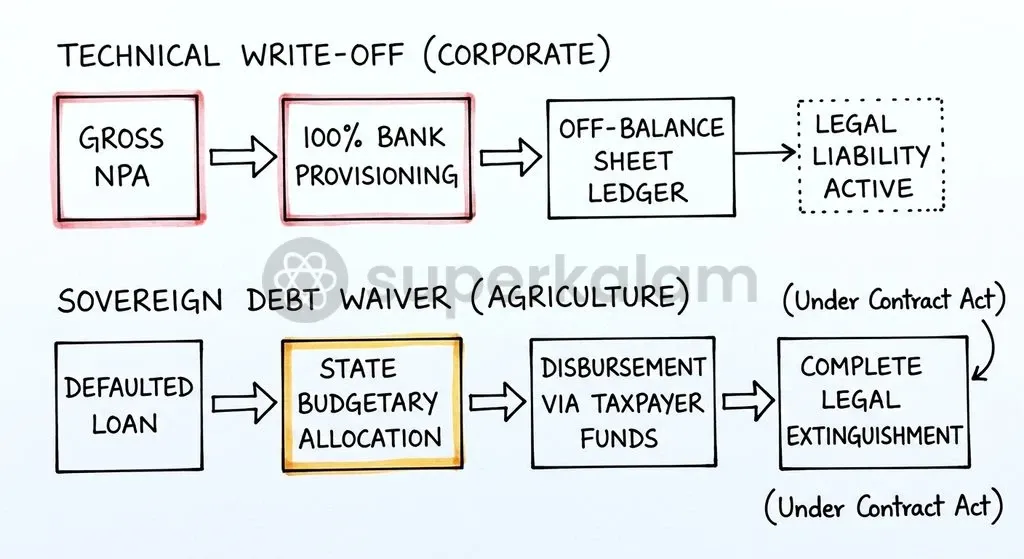
Banking law establishes a clear divide between an internal technical write-off and an explicit sovereign debt waiver. Under the Reserve Bank of India Notification - Framework for Compromise Settlements and Technical Write-offs, a technical write-off is an accounting procedure wherein non-performing assets are expunged from balance sheets without extinguishing legal claims against the borrower or stalling recovery proceedings. Commercial lenders rely on this prudential mechanism to rationalise tax liabilities and present a clean asset profile to global investors.
A debt waiver operates under contract law to achieve an unconditional cancellation of financial liabilities. A loan waiver constitutes a complete legal extinguish of debt obligations under the Indian Contract Act, 1872. The sovereign sponsor or creditor formally discharges the borrower, absorbing or reimbursing the unpaid balance directly from government revenue receipts.
| Comparative Dimension | Prudential Technical Write-Off | Sovereign Farm Loan Waiver |
|---|---|---|
| Primary Governing Framework | RBI Compromise Settlements Framework (2023) | Indian Contract Act, 1872 / State Budgetary Acts |
| Legal Status of Debt | Remains legally enforceable against borrower | Completely extinguished; borrower legally released |
| Balance Sheet Mechanics | Asset moved to off-balance-sheet memorandum ledger | Asset cleared through direct cash reimbursement |
| Tax Benefit to Lender | Deductible under Section 36(1)(vii), Income Tax Act | No special bad debt tax deduction needed |
| Immediate Funding Source | Bank equity capital and accumulated provisions | State Government consolidated revenue funds |
| Borrower Credit Rating | Reported to credit bureaus; blacklisted unless settled | Preserved or reset via state settlement certificate |
| Public Information Access | Shielded under Section 45E of the RBI Act, 1934 | Publicly notified list of agrarian beneficiaries |
Tax statutes offer commercial lenders tangible balance-sheet incentives to execute large write-offs. Section 36(1)(vii) of the Income Tax Act, 1961 allows commercial banks to treat bad debts written off as an allowable business deduction, which substantially reduces their taxable profits. Borrowers remain formally liable on bank memorandum ledgers, yet practical recovery mechanisms diverge sharply from statutory theory.
Discuss with Superkalam
Explain how the legal status of a borrower's debt under an RBI technical write-off differs from an unconditional debt discharge under the Indian Contract Act.
Ask NowSide-by-Side Reality: Who Pays the Bill and Who Walks Away?
Fiscal burdens arising from bad loans and agrarian relief land on ordinary citizens through distinct macroeconomic channels. State governments fund farm loan waivers by booking them as committed revenue expenditures, which inflates state gross fiscal deficits and curtails capital outlays for rural infrastructure. In contrast, public sector banks absorb corporate write-offs by depleting their equity capital buffers, which the Union Government subsequently replenishes using taxpayer funds.
Public funds sustained state-owned lenders through the worst of the bad loan crisis. Ministry of Finance records show that the Union Government infused about ₹3.11 lakh crore into public sector banks between FY 2016-17 and FY 2020-21, relying predominantly on recapitalisation bonds. Taxpayers shoulder the coupon payments on these sovereign instruments, quietly underwriting corporate credit failures.
| Channel | Fiscal Transmission Pathway |
|---|---|
| Corporate Write-Off | Bank provisions depleted → capital buffer eroded → Union recapitalisation bonds → citizens foot the bill |
| Agrarian Loan Waiver | Bank balance settled → direct budget outlay → state fiscal deficit expands → public capital expenditure cut |
Fiscal figures show a stark scale disparity between rural and corporate relief. Total farm loan waivers implemented across Indian states between 2014-15 and 2018-19 stood at approximately ₹1.5 lakh crore against ₹2.36 lakh crore announced. This agricultural relief accounted for under 9% of the ₹18.08 lakh crore written off by commercial banks across the last decade.
Sectoral allocations highlight this structural asymmetry. According to parliamentary disclosures by the Ministry of Finance, commercial banks wrote off ₹3,20,481 crore in credit extended to large industries and services between FY 2021-22 and FY 2025-26. Over the same five-year interval, agricultural and allied activities saw write-offs of ₹1,18,984 crore.
Discuss with Superkalam
If a commercial lender writes off ₹1,000 crore in corporate debt under Section 36(1)(vii) of the Income Tax Act, how does this accounting derecognition affect its tax liability and capital provisioning?
Ask NowThe Recovery Gap: How Low Recourse Turns Balance-Sheet Cleaning into Quiet Relief
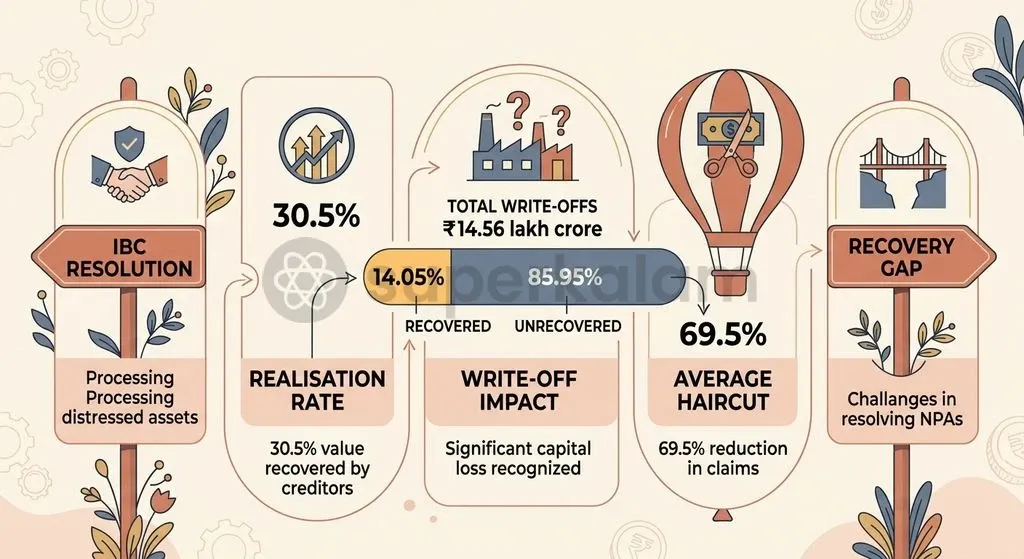
Empirical recovery records demonstrate that balance-sheet derecognition is an unacknowledged waiver for delinquent corporate borrowers. A parliamentary disclosure by the Ministry of Finance revealed that commercial banks recovered only ₹2,04,668 crore out of ₹14.56 lakh crore written off between FY 2014-15 and FY 2022-23. This performance translates to a recovery rate of 14.05%, leaving roughly 86% of written-off debt permanently unrecovered in real economic terms.
| Write-Off Component (FY 2014-15 to FY 2022-23) | Amount (₹ Lakh Crore) | Proportion of Total |
|---|---|---|
| Recovered by Banks | ₹2.05 | 14.05% |
| Unrecovered Economic Loss | ₹12.51 | ~86% |
| Total Written Off | ₹14.56 | 100% |
Statutory debt resolution mechanisms have delivered modest realisations while forcing lenders to absorb heavy haircuts. The Insolvency and Bankruptcy Board of India reported that resolution plans in 1,484 corporate insolvency cases had realised over ₹4.35 lakh crore for creditors as of June 2026, yet lenders routinely take steep haircuts under the Insolvency and Bankruptcy Code (IBC) 2016, wiping out substantial credit assets while corporate entities transitioned to new promoter groups.
Delinquency enforcement reveals profound operational disparities between large corporate entities and small agrarian borrowers:
- Corporate Resolution Safeguards: Large commercial debtors benefit from institutionalised restructuring options, Debt Recovery Tribunals (DRT), and asset sales through the National Asset Reconstruction Company Limited (NARCL).
- Enforcement Gaps: Public sector banks identified 15,930 wilful defaulters owing ₹2,85,015 crore as of June 30, 2026, yet only 7,190 cases were referred for criminal prosecution.
- Agrarian Coercion: While Section 31(i) of the SARFAESI Act, 2002 exempts agricultural land from direct commercial seizure, district administrations routinely deploy coercive state Revenue Recovery Acts and Revenue Recovery Certificates against defaulting farmers.
- Credit Blacklisting: Defaulting smallholder farmers suffer immediate exclusion from credit databases, terminating their access to subsidised credit under the Kisan Credit Card system and forcing reliance on informal moneylenders.
Statutory confidentiality provisions obscure substantial corporate compromises from public oversight. Commercial lenders relegate written-off corporate defaults to off-balance-sheet memorandum ledgers, citing customer secrecy under Section 45E of the Reserve Bank of India Act, 1934. This statutory shield protects corporate non-performing accounts from transparent civic inspection, entrenching an opaque recovery environment.
Discuss with Superkalam
Compare the recovery mechanisms deployed against corporate borrowers under the Insolvency and Bankruptcy Code with the administrative measures used against defaulting farmers under state Revenue Recovery Acts.
Ask NowThe Double Standard: Why Farm Relief Sparks Outrage While Corporate Write-Offs Escape Notice
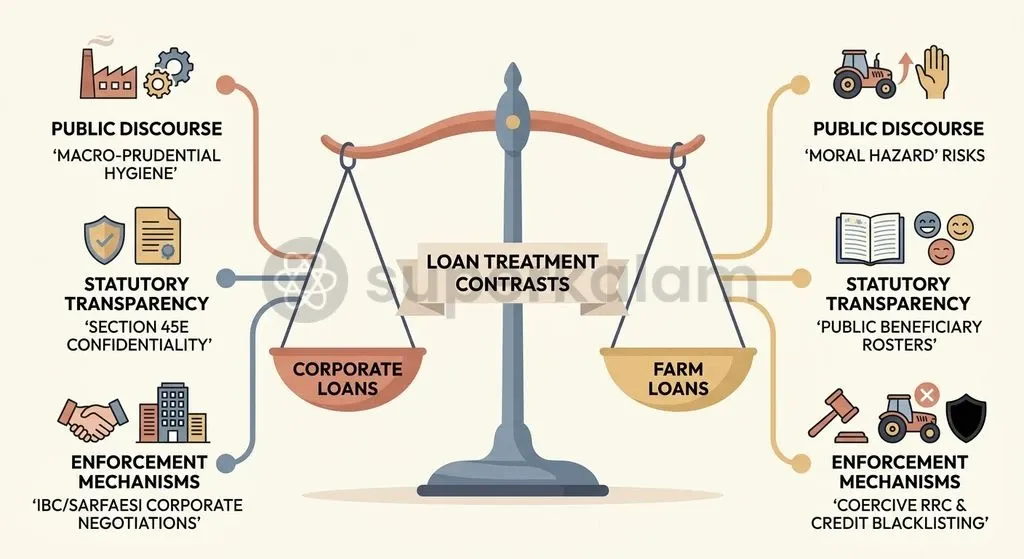
Mainstream economic commentary adopts an asymmetric posture toward rural credit distress compared to corporate financial failures. The Reserve Bank of India Mint Street Memo No. 06 explicitly highlighted how agricultural loan waivers generate moral hazard, impair rural credit culture, and destabilise sub-national public finances. Conversely, financial regulators frequently defend massive corporate write-offs as routine macro-prudential housekeeping essential for restoring banking liquidity.
This dichotomy exposes a pronounced ethical asymmetry in economic governance. Technocrats frame industrial debt crises as structural business risks arising from macroeconomic cycles, policy shifts, or global demand shocks. In sharp contrast, commentators often attribute agricultural distress to individual managerial inadequacy or regional political opportunism. That framing ignores how smallholders endure unpredictable weather, volatile wholesale commodity markets, and fragmented supply chains.
| Dimension | Corporate Loan Write-Offs | Agrarian Debt Waivers |
|---|---|---|
| Regulatory Stance | Defended as prudential hygiene | Denounced as fiscal profligacy |
| Transparency | Shielded by statutory secrecy | Beneficiary lists made public |
| Fiscal Underwriting | Subsidised via recap bonds | Constrains social infrastructure |
| Post-Default Consequence | Accompanied by haircuts under the IBC | Followed by credit blacklisting |
Institutional transparency standards highlight another troubling dimension of this dual credit regime. The identities of farming families who benefit from state debt relief are regularly compiled into public district registries. In contrast, corporate leadership teams who preside over multi-crore defaults navigate restructuring under complete statutory privacy. This asymmetry shields corporate defaults from democratic scrutiny while public discussions continue to stigmatise rural debt relief.
Discuss with Superkalam
Assess whether Section 45E of the RBI Act, 1934 should be amended to require public disclosure of all written-off corporate defaults exceeding a specific threshold.
Ask NowFixing India's Two-Tier Debt System: Clear Rules for Equitable Credit Discipline
Equitable credit administration demands structural reforms that dismantle legal asymmetries between corporate and agricultural debt resolution. Greater public disclosure of corporate loan write-offs and compromise settlements is a recurring reform demand. Introducing granular public disclosures would enhance market transparency, reinforce depositor trust, and ensure democratic accountability across public sector banks.
Regulatory oversight must also eliminate perpetual asset warehousing on bank memorandum registers. Policy proposals advocate establishing statutory sunset clauses on written-off accounts, mandating forensic investigations and time-bound asset liquidations after a fixed period. Implementing strict sunset horizons would prevent banks from quietly burying unrecovered corporate defaults while maintaining the illusion of ongoing legal recovery.
Long-term rural credit resilience requires shifting away from reactionary debt cancellations toward automated counter-cyclical buffers. Reform proposals favour transitioning to institutional safety nets featuring state-backed crop credit insurance and automated interest subvention triggers activated during certified climate disasters. Combining risk pooling with dynamic credit restructuring would insulate vulnerable agrarian households from exogenous shocks without compromising credit discipline or state fiscal stability.
- Public Disclosures (above a set threshold): Eliminates Section 45E opacity for major corporate write-offs.
- Statutory Sunset Clauses (3-Year): Mandates forensic audits and time-bound asset liquidations of warehoused debts.
- Automated Counter-Cyclical Triggers: Replaces ad-hoc farm waivers with institutional credit insurance and interest subvention.
Key Takeaways
- Scheduled commercial banks executed cumulative loan write-offs worth ₹18,07,812 crore between FY 2016-17 and FY 2025-26, driven by balance-sheet cleanup imperatives rather than cash recoveries.
- A technical write-off maintains legal claims on paper under the RBI Framework for Compromise Settlements (2023), whereas a loan waiver formally extinguishes the debt contract under the Indian Contract Act, 1872.
- Low recovery efficiency turns accounting write-offs into de facto waivers: commercial lenders recovered only 14.05% of written-off debts between FY 2014-15 and FY 2022-23, leaving ~86% unrecovered.
- Taxpayers foot the bill across both mechanisms: state governments fund farm loan waivers directly from revenue accounts, while the Union Government infused about ₹3.11 lakh crore into public sector banks via recapitalisation bonds.
- Statutory confidentiality under Section 45E of the RBI Act, 1934 conceals mega corporate defaults, whereas smallholder farmers face aggressive recovery certificates and loss of institutional credit access.
- Institutional reform requires mandatory public disclosure of corporate write-offs above a set threshold, statutory sunset clauses on unrecovered debts, and institutional counter-cyclical credit safety nets for agriculture.
Mains Question
"While a technical write-off is legally defined as an internal prudential accounting adjustment, empirical recovery rates effectively convert it into a de facto corporate debt waiver." Critically examine this statement in light of India's commercial banking practices. (15 Marks)
Evaluate NowMains Question
Contrast the fiscal and macroeconomic implications of state-level agricultural debt waivers with public sector bank corporate write-offs financed through sovereign recapitalisation bonds. Comment. (10 Marks)
Evaluate NowPractice MCQs
QUESTION 1
With reference to banking and debt resolution mechanisms in India, consider the following statements:
- A technical write-off completely extinguishes the legal liability of the borrower under the Indian Contract Act, 1872.
- Under Section 36(1)(vii) of the Income Tax Act, 1961, banks can claim bad debts written off as an allowable business deduction.
- Section 31(i) of the SARFAESI Act, 2002 specifically exempts agricultural land from direct commercial seizure by lenders. Which of the statements given above are correct?
QUESTION 2
Consider the following statements regarding bank write-offs and resolution frameworks in India:
- Non-performing assets expunged through technical write-offs are tracked off-balance-sheet in memorandum ledgers.
- The confidentiality of individual corporate borrowers whose loans are technically written off is protected under Section 45E of the Reserve Bank of India Act, 1934.
- Between FY 2014-15 and FY 2022-23, scheduled commercial banks recovered over 40% of cumulative written-off non-performing assets. Which of the statements given above is/are correct?
QUESTION 3
Regarding the fiscal and accounting treatment of debt relief in India, consider the following statements:
- Sovereign farm loan waivers are accounted for as committed revenue expenditures in state government budgets.
- Corporate write-offs by public sector banks are directly settled through state consolidated revenue funds.
- The Union Government infused about ₹3.11 lakh crore into public sector banks between FY 2016-17 and FY 2020-21 primarily through recapitalisation bonds. Which of the statements given above is/are correct?
QUESTION 4
According to RBI data cited in the article, in which financial year did annual bank write-offs peak at ₹2.39 lakh crore?
QUESTION 5
Consider the following statements regarding credit enforcement and recovery in India:
- State administrations deploy Revenue Recovery Acts and Revenue Recovery Certificates to enforce agrarian debt recoveries.
- Smallholder agricultural default triggers exclusion from credit databases, impeding access to concessional loans under the Kisan Credit Card system.
- The total farm loan waivers implemented across Indian states between 2014-15 and 2018-19 exceeded the total value of bank write-offs between FY 2016-17 and FY 2025-26. Which of the statements given above is/are correct?