PNGRB Gas Tariff Reform: Balancing Regional Equity and Pipeline Capex
As India strives to raise natural gas to 15% of its energy basket, pooling tariffs balances hinterland fuel affordability against developer returns.
Nov, 2026
•11 min read
Overview
India's Petroleum and Natural Gas Regulatory Board has redesigned the national pipeline tariff architecture. The reform balances inland regional equity with capital expenditure viability for infrastructure developers. By replacing fragmented, distance-based additive transit charges with a pooled two-zone unified structure, the regulator aims to lower delivered gas costs across landlocked northern and eastern states.
Achieving India's statutory objective of raising natural gas from approximately 6% to 15% of the primary energy basket by 2030 requires substantial private and public capital commitments. Yet the policy exposes deep structural bottlenecks:
- Under-utilised trunk lines such as the Pradhan Mantri Urja Ganga network
- Settlement deficits within developer revenue clearing mechanisms
- Indirect tax distortions from continued exclusion under the Goods and Services Tax
- Market concentration within GAIL (India) Limited
Why in the News: PNGRB Overhauls Natural Gas Pipeline Tariffs
The Petroleum and Natural Gas Regulatory Board overhauled pipeline transportation regulations in late 2026. The move aims to resolve long-standing investor friction over volume off-take risk and capacity recovery.
On November 23, 2026, the regulator published a concept paper and draft regulations for networks awarded through lowest capital expenditure bidding, according to the PNGRB Concept Paper and Draft Regulations on NGPL Bidding and Tariff Framework. The framework proposes a 14% post-tax return on normative equity over an extended 40-year pipeline lifespan. This regulatory pivot shifts throughput volume risk from pipeline developers to industrial shippers by indexing transportation tariffs to actual pipeline throughput rather than fixed normative capacity commitments.
| Dimension | Past Framework | New 2026 Proposal |
|---|---|---|
| Tariff Basis | Normative capacity determines tariff | Tariff determined on actual throughput |
| Volume Risk | Developer absorbs volume off-take risk | Shipper carries volume off-take risk |
(Regulatory shift: transitioning pipeline capex protection from developers to shippers)
Earlier, on October 8, 2026, the statutory regulator issued a public notice proposing the Draft PNGRB (Determination of Natural Gas Pipeline Tariff) Amendment Regulations, 2026, per the PNGRB Public Notice. The amendments integrate isolated, non-interconnected pipelines directly into the national Unified Tariff framework.
The draft regulations also allow pipeline entities to incorporate auditable settlement and clearing expenses from the Industry Committee into their approved revenue entitlements. As of November 2026, these interventions represent an urgent attempt to safeguard pipeline capex viability while protecting India's broader decarbonisation trajectory.
Discuss with Superkalam
Recall the two distance bands established under the revised Unified Tariff structure effective January 1, 2026.
Ask NowHow Pipeline Tariffs Worked: The Problem of Additive Distance Billing
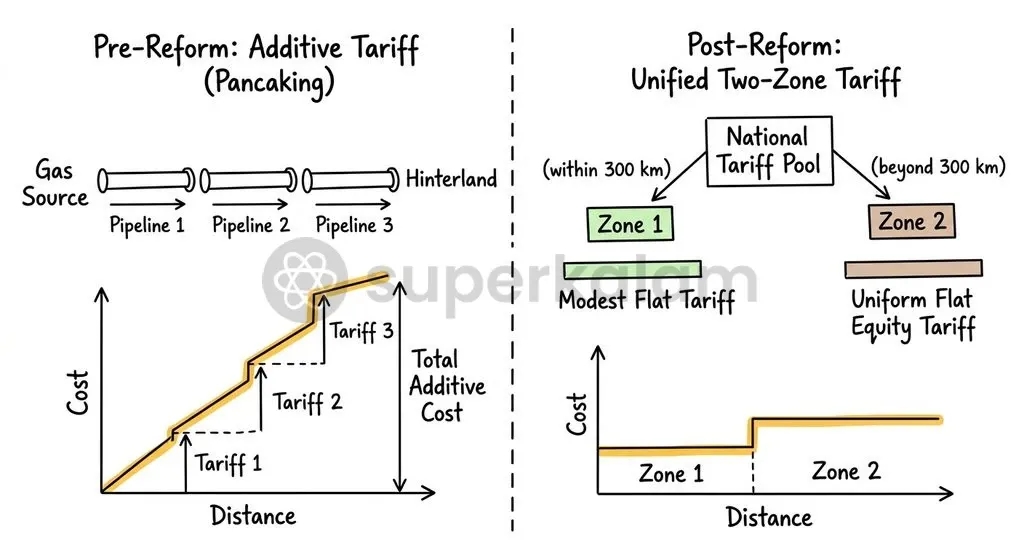
Natural gas transportation historically operated on a segmental distance-based methodology known across the energy industry as tariff pancaking. Under this legacy system authorised under the Petroleum and Natural Gas Regulatory Board Act, 2006, consumers paid cumulative transmission charges for every discrete pipeline network that handled their gas molecules between the regasification terminal and their factory gate.
A manufacturing unit situated hundreds of kilometres inland had to pay the contractual tariff of the primary importer network, followed by the full transit levy of each interconnected regional pipeline. Such additive billing penalised distance heavily. It isolated remote industrial centres from clean energy access and inflated costs for heavy industries, ceramic clusters, and fertiliser plants across central, northern, and eastern India.
Landlocked enterprises turned instead to dirtier, cheaper fuels such as petroleum coke and furnace oil to remain cost-competitive against coastal rivals. The regulatory framework produced severe geographical distortions. It concentrated gas-based manufacturing around western maritime entry points while starving inland states of viable transition fuels.
| Tariff Component | Legacy Distance-Based Regime | Unified Tariff Pooling Model |
|---|---|---|
| Tariff Mechanism | Additive segmental billing per pipeline network crossed | Pooled, distance-tiered regional zonal tariff |
| Volume Risk Carrier | Pipeline developers bound to normative capacity targets | Shippers paying tariffs adjusted for actual volume throughput |
| City Gas Entity Treatment | Standard distance rate depending on physical pipeline path | Fixed Zone 1 entry rate nationwide (₹54.00/MMBTU) |
| Inter-Pipeline Clearing | Direct bilateral commercial settlements between operators | Centralised industry clearinghouse portal based on DCF |
| Inland Economic Impact | High delivered price; disincentivised hinterland gas adoption | Reduced landed price; cross-subsidised by coastal consumers |
Inside the Unified Tariff Model: How Regional Pooling Works
The Petroleum and Natural Gas Regulatory Board executed the Unified Tariff mechanism on April 1, 2023, under the PNGRB (Determination of Natural Gas Pipeline Tariff) Second Amendment Regulations to establish a unified national gas grid. This framework ended additive billing by replacing multi-operator charges with a pooled, multi-zone structure across all interconnected pipeline networks.
To streamline regional transport tiers, the regulator amended the structure in December 2025 by consolidating the initial three distance zones into two distinct operational bands, which took effect on January 1, 2026. Distance zoning operates under a straightforward dual-tier structure:
- Zone 1: Covers all transmission distances up to 300 kilometres from the primary gas injection point or liquefied natural gas (LNG) terminal.
- Zone 2: Applies to all pipeline transit distances exceeding 300 kilometres across the interconnected national grid.
To cushion households and commuter transport, the regulatory board instituted a universal exemption for priority city gas distribution segments. Under the tariff structure active since January 1, 2026, Compressed Natural Gas (CNG) for vehicles and Domestic Piped Natural Gas (PNG-D) pay the lower Zone 1 rate of ₹54.00/MMBTU irrespective of geographic distance from the source.
An auditable industry clearinghouse portal reconciles inter-entity accounts. It collects pooled revenues from shippers and redistributes funds to ensure each operator secures its approved discounted cash flow entitlement.
Discuss with Superkalam
Explain how cross-subsidisation in the Unified Tariff mechanism lowers delivered gas prices for landlocked states.
Ask NowCoastal vs Hinterland: Who Gains and Who Pays Under the New Regime?
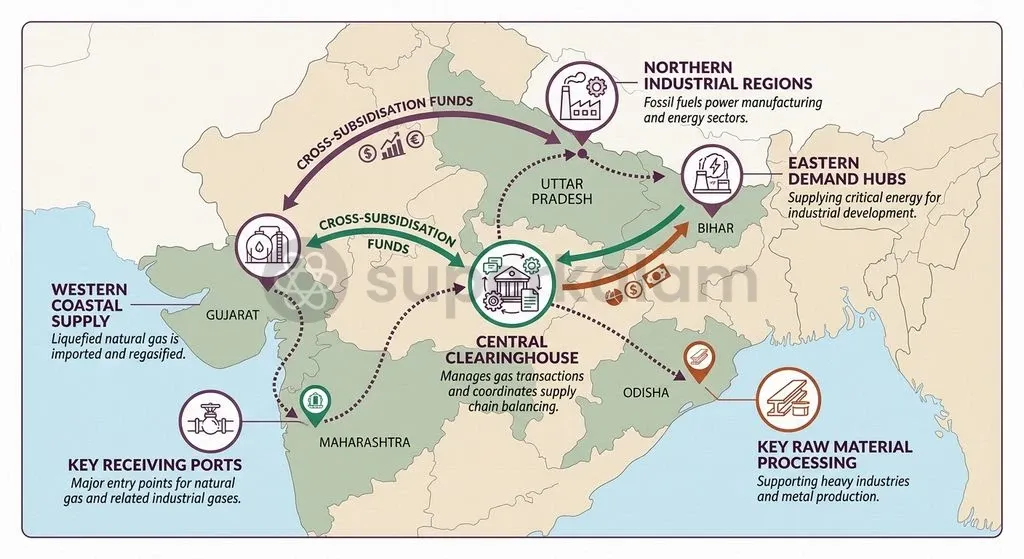
Industrial geography creates an inevitable friction between coastal manufacturing hubs and landlocked states under pooled energy pricing. The unified tariff relies fundamentally on cross-subsidisation, wherein industrial facilities proximate to western LNG terminals in Gujarat and Maharashtra pay higher transmission charges to reduce delivered fuel prices for distant units in Uttar Pradesh, Bihar, and Odisha.
This structural divide pits geographic proximity against regional equity:
- Coastal grievances: Western industrial bodies argue that blunting natural maritime proximity through policy fiat penalises capital investments deliberately sited near energy import terminals.
- Hinterland economic gains: Power plants, chemical units, and small enterprises across eastern India secure lower landed fuel prices, easing operating costs and enabling fuel switching away from coal and heavy distillates.
High landed gas prices previously choked industrial conversion in the Gangetic plains, preventing states from deploying cleaner thermal inputs. Regional parity fulfils a core macroeconomic purpose. Even so, maintaining political acceptance requires preventing excessive tariff burdens on western industrial clusters that generate significant export output.
The Structural Elephant: GAIL's Dual Identity as Carrier and Merchant
GAIL (India) Limited holds a commanding position in the domestic energy sector that complicates market development and third-party access. According to the International Energy Agency, the state-owned enterprise owns and operates over 70% of India's cross-country natural gas transmission pipelines while conducting more than 50% of domestic gas trading.
This integration creates an inherent operator-marketer structural conflict of interest. GAIL is both the neutral transmission pipeline operator and an active commercial competitor selling natural gas to industrial consumers.
This duality generates persistent administrative and operational hurdles:
- Capacity allocation bias: When pipeline capacity constraints arise, an integrated operator faces commercial incentives to prioritise internal marketing volumes over external competitors.
- Regulatory enforcement limits: Sections 11 and 22 of the Petroleum and Natural Gas Regulatory Board Act, 2006 empower the regulator to enforce common carrier regulations and mandate non-discriminatory open access.
- Compliance oversight: Enforcing open-access rules against an entity controlling physical transmission capacity alongside wholesale marketing contracts remains an enduring regulatory challenge.
Discuss with Superkalam
How might switching pipeline tariffs from normative capacity to actual throughput impact an industrial shipper during an economic slowdown?
Ask NowThe Capacity Utilization Trap: Recovering Capex on Empty Pipelines
Capital expenditure viability suffers when newly constructed cross-country pipelines operate well below rated throughput capacity. A prime example is the 3,306-kilometre Jagdishpur-Haldia-Bokaro-Dhamra Pipeline (JHBDPL), widely known as the Pradhan Mantri Urja Ganga network. Regulatory filings reveal that this flagship eastern grid transported only around 12.26 MMSCMD of gas despite crossing 96% operational status.
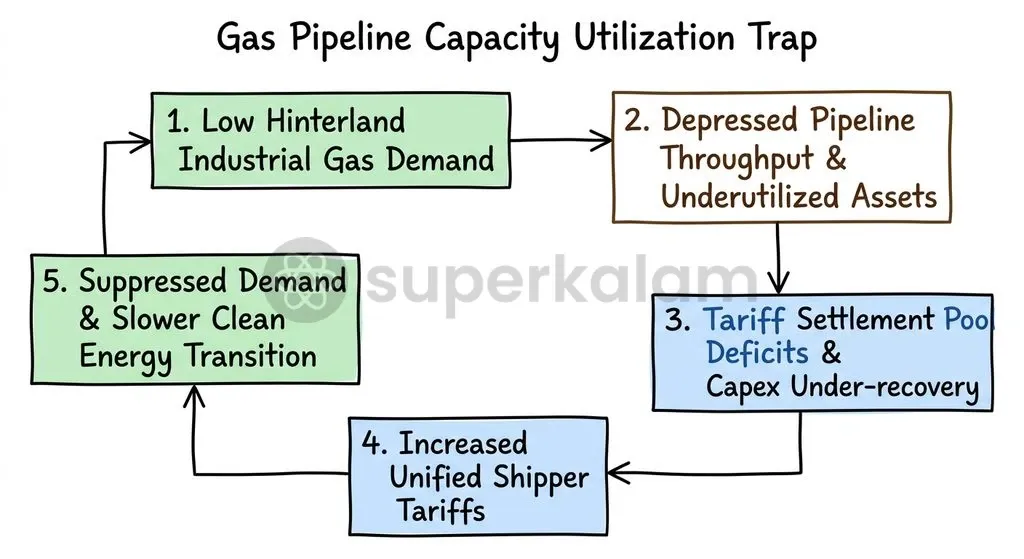
Building extensive capital-intensive trunk lines through regions lacking mature anchor industrial customers creates prolonged cash flow deficits. Under-utilised networks create serious imbalances within the Unified Tariff settlement clearinghouse. Because the unified model pools pipeline revenues to service approved discounted cash flow returns, pipelines operating at low throughput run acute operational deficits that must be offset by high-traffic pipelines.
This demand-tariff interaction produces a damaging cyclical squeeze:
- Depressed throughput: Low hinterland anchor demand leaves networks like JHBDPL carrying roughly 12.26 MMSCMD.
- Clearinghouse deficits: Under-utilised assets fail to cover revenue entitlements, drawing down pooled settlement balances.
- Tariff escalation: Deficits force upward adjustments in pooled tariffs charged to industrial shippers.
- Demand dampening: Higher landed gas costs deter downstream manufacturing adoption, reinforcing the under-utilisation trap.
If overall national gas demand stagnates, the clearinghouse pool suffers systemic shortfalls. Shifting volume risk onto shippers mitigates developer bankruptcy risks, but it simultaneously increases landed gas costs for end-users, potentially dampening consumption and worsening the throughput cycle.
Discuss with Superkalam
Analyse the trade-off coastal industrial units face between capital investment near ports and policy-driven unified national pricing.
Ask NowMissing Policy Pieces: Kirit Parikh Blueprint and the GST Exclusion Hurdle
Structural gas market reforms remain incomplete without comprehensive pricing deregulation and indirect tax rationalisation. The Kirit Parikh Committee on Fair Pricing of Natural Gas delivered an unequivocal blueprint calling for the statutory and legal unbundling of GAIL's transmission operations from its commercial trading arm. Legal unbundling would separate physical pipeline assets into an independent transport utility, eliminating commercial bias and granting private marketers genuine non-discriminatory open access.
The committee also recommended a phased elimination of the Administered Pricing Mechanism (APM) to achieve fully market-determined pricing by January 1, 2027.
Taxation distortions outside the regulatory board's remit present an equally severe barrier to fuel adoption:
- Constitutional exclusion: Natural gas remains excluded from the Goods and Services Tax framework under Article 279A(5) of the Constitution of India, leaving tax rates subject to individual state discretion.
- Disparate local levies: Transactions bear state Value Added Taxes (VAT) ranging from 3% to 24.5%, alongside a 2% Central Sales Tax (CST) on interstate trades.
- Stranded tax credits: Industrial manufacturers cannot claim Input Tax Credit (ITC) for non-GST VAT and CST against their final GST liabilities.
- Coal tax advantage: This fiscal cascading adds an embedded tax burden on natural gas, while industrial coal enjoys a uniform 5% GST rate with full input tax credit eligibility.
Discuss with Superkalam
Evaluate whether legally unbundling GAIL's pipeline transmission network from its marketing arm is necessary to achieve true common-carrier open access.
Ask NowWay Forward: Tariff Stability, True Unbundling, and Tax Parity
Targeted structural reforms across pipeline operations, corporate governance, and indirect taxation are vital to achieving India's energy goals. Reaching the statutory objective of lifting natural gas from ~6% to 15% of the primary energy basket by 2030 requires coordinated administrative action across union ministries, independent regulators, and state finance departments.
A viable roadmap requires three concrete policy interventions:
- Institutionalising Legal Unbundling: The Ministry of Petroleum and Natural Gas must implement the Kirit Parikh Committee's mandate by establishing an independent national transmission system operator. Separating GAIL's pipeline infrastructure into a pure common-carrier utility will eliminate marketing conflicts and encourage private pipeline investments.
- Harmonising National Fiscal Parity: The GST Council must exercise its mandate under Article 279A(5) to bring natural gas into the GST framework. Establishing a uniform national GST bracket with full Input Tax Credit eligibility will eliminate cascading VAT rates and restore price parity against coal.
- Calibrating Balanced Risk Allocation: The regulatory board must balance developer incentives with shipper affordability. Implementing the proposed 14% post-tax equity return and shifting throughput off-take risks to shippers must be matched by dynamic tariff reviews, ensuring coastal export clusters remain competitive while hinterland infrastructure matures.
Key Takeaways
- The Petroleum and Natural Gas Regulatory Board has transitioned India's pipeline architecture from distance-based additive transit charges to a pooled two-zone Unified Tariff regime to lower delivered gas costs across inland states.
- Under regulations effective January 1, 2026, domestic piped gas and vehicular CNG consumers pay a uniform Zone 1 rate of ₹54.00/MMBTU across India, cross-subsidised by commercial users and high-traffic routes.
- GAIL (India) Limited controls over 70% of transmission pipelines and more than 50% of gas marketing, creating a structural conflict of interest that requires statutory unbundling as recommended by the Kirit Parikh Committee.
- Newly commissioned hinterland networks face acute under-utilisation, with the 3,306-km Urja Ganga pipeline transporting only ~12.26 MMSCMD upon reaching 96% operational status, straining developer cash flows and the clearinghouse settlement pool.
- Natural gas remains outside the Goods and Services Tax under Article 279A(5) of the Constitution, subjecting consumers to cascading state VAT of 3% to 24.5% and creating a competitive disadvantage against coal.
Mains Question
'Replacing additive segmental tariffs with a pooled unified tariff framework balances regional industrial equity but creates acute frictions between coastal manufacturing clusters and inland economies.' Examine. (10 Marks)
Evaluate NowMains Question
"GAIL's dual identity as a transmission pipeline operator and an active gas merchant poses a structural impediment to fair third-party open access." Critically analyse this conflict within the statutory framework of the Petroleum and Natural Gas Regulatory Board Act, 2006. (15 Marks)
Evaluate NowPractice MCQs
QUESTION 1
With reference to the regulatory reforms introduced by the Petroleum and Natural Gas Regulatory Board (PNGRB) in late 2026, consider the following statements:
- The new bidding framework links pipeline transportation tariffs to actual pipeline throughput rather than fixed normative capacity commitments.
- Volume off-take risk is transitioned from industrial shippers to pipeline developers.
- The framework proposes a 14% post-tax return on normative equity over an extended 40-year pipeline lifespan. Which of the statements given above are correct?
QUESTION 2
Regarding the Unified Tariff mechanism for natural gas pipelines in India, consider the following statements:
- Zone 1 encompasses all transmission distances up to 300 kilometres from the gas injection point or LNG terminal.
- Compressed Natural Gas (CNG) for vehicles and Domestic Piped Natural Gas (PNG-D) pay the Zone 1 rate nationwide, irrespective of their physical transit distance.
- Inter-pipeline revenue settlements are handled via direct bilateral negotiations between individual pipeline operators. Which of the statements given above is/are correct?
QUESTION 3
Consider the following statements regarding natural gas pipeline operations in India:
- Under the legacy distance-based tariff system, known as 'tariff pancaking', consumers paid cumulative charges for each interconnected pipeline network crossed.
- Under the Petroleum and Natural Gas Regulatory Board Act, 2006, Sections 11 and 22 empower the regulator to mandate non-discriminatory open access and enforce common carrier regulations.
- GAIL (India) Limited accounts for less than 40% of cross-country natural gas transmission pipelines. Which of the statements given above is/are correct?
QUESTION 4
Under the unified tariff regime operationalized by PNGRB, what specific rate was instituted for CNG and Domestic PNG consumers irrespective of geographic distance?
QUESTION 5
Consider the following statements regarding the Jagdishpur-Haldia-Bokaro-Dhamra Pipeline (JHBDPL):
- It is also known as the Pradhan Mantri Urja Ganga network.
- It spans an operational network length of 3,306 kilometres.
- Despite achieving over 90% operational status, it transported only around 12.26 MMSCMD of gas due to lack of mature anchor customers. Which of the statements given above is/are correct?