Section 301 Tariffs: Why Trade Law Tests Indo-US Strategic Ties
Deepening defence alignment cannot insulate bilateral commerce when domestic statutory mandates empower Washington to penalise Indian trade policies.
Nov, 2026
•10 min read
Overview
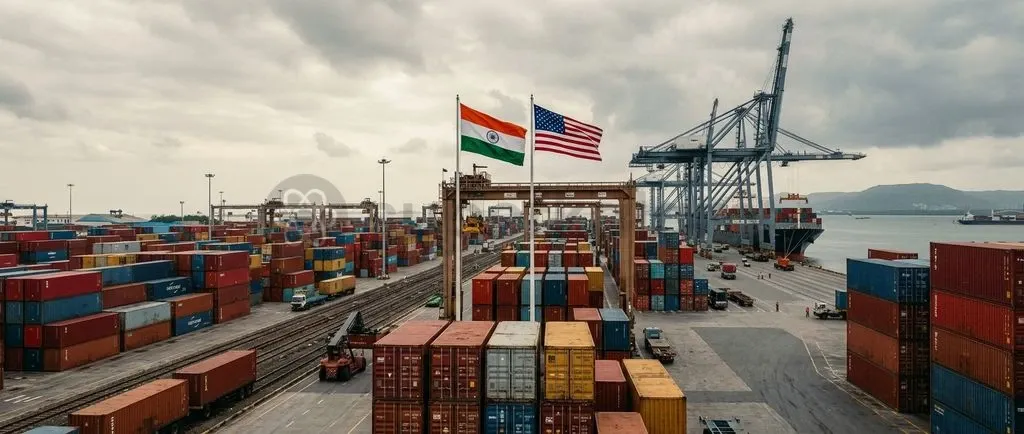
Section 301 of the US Trade Act of 1974 grants Washington unilateral authority to penalise foreign commercial practices. This power establishes a structural friction point that tests New Delhi's economic sovereignty despite accelerating diplomatic closeness.
Strategic initiatives like the Quad and the Initiative on Critical and Emerging Technology bind both democracies in the Indo-Pacific. Yet domestic trade laws answer to an independent statutory mandate run by domestic industrial lobbies.
Geopolitical convergence offers no legal immunity against tariff investigations into digital taxes, sanitary rules, and patent protections. Navigating this dynamic requires balancing strategic partnership with geoeconomic self-reliance.
Why in the News? The Return of Trade Friction Amid Strategic Closeness
The Office of the United States Trade Representative continues to subject Indian economic policies to statutory scrutiny under American trade legislation. As of April 2026, the United States has reaffirmed India's position on the Special 301 Priority Watch List. This action comes despite the resolution of historic disputes at the multilateral level.
Deepening defence and technological alignment cannot insulate commercial ties from statutory trade enforcement driven by domestic American lobbies. While bilateral working groups celebrate joint ventures in microelectronics and aerospace, industrial lobbies in Washington routinely petition for retaliatory duties against Indian tariffs.
Indian policymakers face a persistent dual challenge across two competing fronts:
- Indo-Pacific security: Anchoring regional stability and military coordination alongside Washington.
- Regulatory sovereignty: Actively defending domestic economic policy space against unilateral economic coercion.
What Is Section 301? How Washington Deploys Unilateral Trade Power
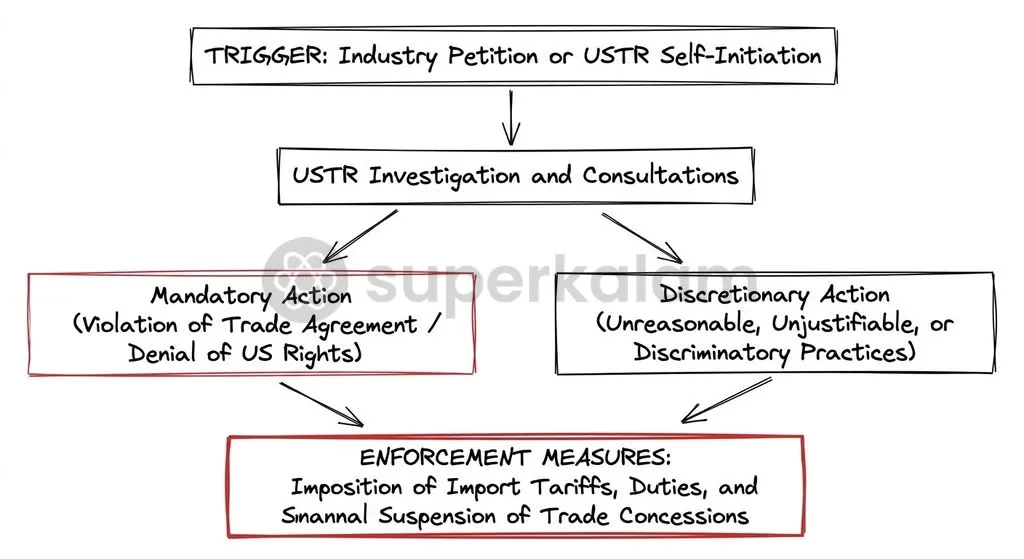
Section 301 of the US Trade Act of 1974 empowers the executive branch to enforce American rights under trade pacts and combat burdensome foreign policies. Codified at 19 U.S.C. § 2411, the statute grants the United States Trade Representative sweeping investigative authority to penalise foreign practices that violate trade pacts or are deemed unreasonable or discriminatory.
The legal framework establishes a distinct division between mandatory and discretionary actions based on the foreign measure's character:
| Statutory Category | Legal Basis under Title 19 U.S.C. § 2411 | Nature of USTR Enforcement Authority | Prescribed Retaliatory Mechanisms |
|---|---|---|---|
| Mandatory Action | 19 U.S.C. § 2411(a) | Obligatory enforcement when foreign acts violate trade agreements or are unjustifiable | Suspension of trade agreement concessions; mandatory imposition of retaliatory duties |
| Discretionary Action | 19 U.S.C. § 2411(b) | Subject to executive discretion when foreign measures are unreasonable or discriminatory | Targeted customs duties; import quotas; withdrawal of preferential trade treatment |
| Special 301 (IPR) | 19 U.S.C. § 2242 | Annual identification of foreign regimes failing to protect intellectual property rights | Watch List designations; potential escalation to formal Section 301 investigations |
Under 19 U.S.C. § 2411(a) and (b), the statutory mandate requires action when foreign policies breach trade pacts, whereas measures judged merely unreasonable trigger discretionary authority. This flexibility lets American regulators target measures that violate no formal treaty yet hinder American commercial dominance. Unlike multilateral dispute mechanisms that require consensus, this domestic statute operates unilaterally.
Discuss with Superkalam
Which four foundational military pacts have India and the United States operationalised between 2002 and 2020?
Ask NowThe Strategic Paradox: Security Convergence vs. Economic Collision
The India-US relationship presents a sharp contradiction between unprecedented defence interoperability and persistent bilateral trade conflict. New Delhi and Washington have operationalised four foundational military pacts to guarantee coordination across maritime and continental spheres.
According to the Ministry of Defence, these agreements include the General Security of Military Information Agreement (GSOMIA, 2002), the Logistics Exchange Memorandum of Agreement (LEMOA, 2016), the Communications Compatibility and Security Agreement (COMCASA, 2018), and the Basic Exchange and Cooperation Agreement (BECA, 2020).
| Strategic Pillar | Geoeconomic Friction |
|---|---|
| GSOMIA, LEMOA, COMCASA, BECA foundational defence pacts | Section 301 investigations into domestic regulatory policies |
| Quad maritime alignment across the Indo-Pacific theatre | Priority Watch List designation under annual Special 301 reviews |
| iCET technological co-production in advanced computing | Revocation of GSP benefits and recurrent tariff skirmishes |
| Bilateral interoperability and joint defence exercises | MFN tariff disputes and non-tariff SPS barriers |
Strategic bonhomie does not carry over to trade enforcement. Trade remedy mechanisms under Title 19 of the US Code are legally insulated from defence partnerships. Congressional statutes require trade agencies to respond directly to petitions filed by domestic business coalitions.
The White House cannot legally dismiss a valid industrial petition simply to preserve a diplomatic partnership. This dynamic was demonstrated on May 31, 2019, when Presidential Proclamation 9902 terminated India's beneficiary status under the Generalized System of Preferences.
That decision removed duty-free access for billions of dollars in Indian exports following lobbying by American medical device and dairy associations. Geopolitical utility in the Indo-Pacific proved incapable of protecting Indian exporters from domestic commercial retribution.
Discuss with Superkalam
How does the statutory mechanism of US Section 301 structurally differ from the WTO Dispute Settlement Mechanism?
Ask NowKey Flashpoints: Sectors Most Exposed to US Tariff Actions
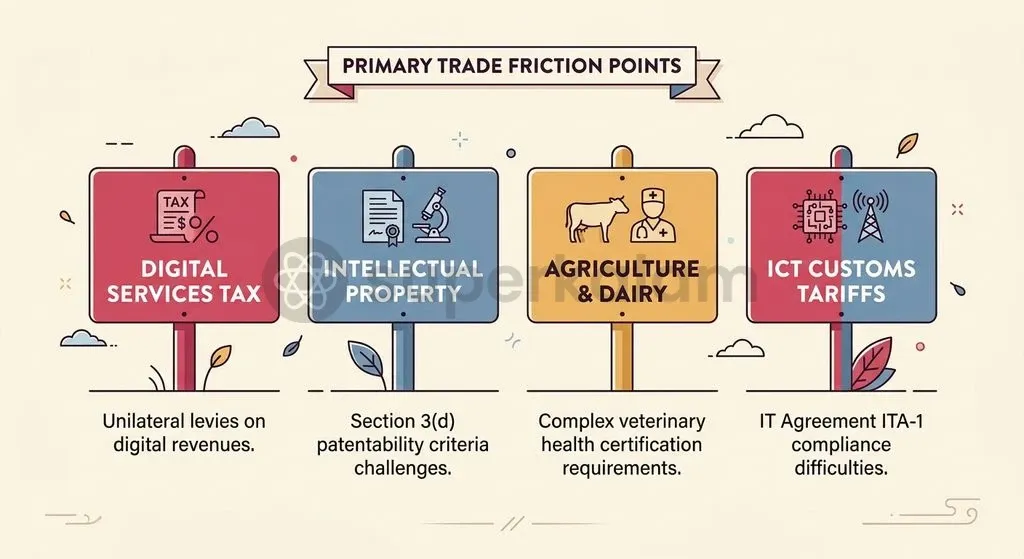
The United States Trade Representative maintains constant surveillance over Indian regulatory frameworks across digital commerce, patent law, and agriculture. Bilateral friction centres on four major regulatory domains where Indian public policy directly restricts foreign commercial access.
- Digital Services Taxation: On January 6, 2021, a formal investigation concluded that India's 2% Equalisation Levy on foreign e-commerce operators discriminated against American enterprises, noting that 72% of liable entities were American firms. The Government of India rejected these claims on January 7, 2021, maintaining that the levy provided tax parity for domestic firms. Parliament later addressed the issue through the Finance (No. 2) Act, 2024. This legislation abolished the 2% levy with effect from August 1, 2024, alongside a scheduled phase-out of the 6% advertising levy by April 1, 2025.
- Intellectual Property and Pharmaceuticals: Under Section 182 of the Trade Act of 1974, American authorities retain India on their Priority Watch List. A major point of contention remains Section 3(d) of the Indian Patents Act, 1970, which prohibits the evergreening of patents by requiring new forms of known substances to show enhanced therapeutic efficacy. This provision was upheld by the Supreme Court of India in Novartis AG v. Union of India (2013).
- Dairy and Sanitary-Phytosanitary (SPS) Standards: The Food Safety and Standards Authority of India and the Department of Animal Husbandry and Dairying mandate strict import certificates. Foreign dairy imports must carry an official certificate confirming that source herds were never fed feed containing ruminant or porcine blood meal or internal tissues. American industrial exporters reject these restrictions as non-scientific market barriers.
- Information and Communications Technology (ICT) Tariffs: Customs duties designed to encourage domestic manufacturing face constant foreign legal challenges. In April 2023, a dispute panel in DS582 determined that Indian tariffs of up to 20% on mobile components breached Article II:1(b) of the GATT 1994 by exceeding bound tariff rates. The USTR continues to cite these applied rates alongside Bureau of Indian Standards certification norms as trade barriers.
Discuss with Superkalam
Analyze why foundational defence pacts like LEMOA or BECA fail to shield Indian exporters from US trade remedies.
Ask NowMultilateral Breakdown: Why Section 301 Sidesteps the WTO
The Dispute Settlement Mechanism of the World Trade Organization was conceived to replace unilateral economic retaliation with binding multilateral adjudication. Article 23.1 and 23.2 of the Dispute Settlement Understanding explicitly prohibit member states from unilaterally declaring trade violations or imposing retaliatory trade suspensions without multilateral authorisation. Unilateral tariff actions subvert these foundational principles.
In the 1999 case US — Sections 301-310 of the Trade Act of 1974, a dispute panel reviewed the legality of this American statutory mechanism. The panel held that while Section 304 appeared prima facie inconsistent with Article 23.2(a) of the Dispute Settlement Understanding, the statute was permissible solely because Washington officially pledged through its Statement of Administrative Action to refrain from making unilateral determinations before multilateral proceedings concluded.
| Procedural Stage | WTO Dispute Settlement Mechanism | Section 301 Statutory Mechanism |
|---|---|---|
| Initiation | Mandatory bilateral consultations | Petitions from domestic industrial lobbies |
| Inquiry | Neutral panel examination | USTR executive investigation |
| Determination | Multilateral consensus and legal finding | Unilateral finding of fault by the executive |
| Sanctions | DSB-authorised retaliatory measures | Direct unilateral tariff imposition |
| Institutional Nature | Multilateral and rule-bound | Coercive and asymmetric |
That systemic balance has collapsed due to deliberate institutional obstruction. Since December 11, 2019, the WTO Appellate Body has been entirely non-functional because Washington blocked all judicial appointments under Article 17.2 of the Dispute Settlement Understanding.
With the appellate process suspended, states can easily appeal panel reports into legal limbo. Washington has exploited this breakdown to bypass multilateral processes and deploy domestic trade statutes directly.
Can High-Tech and Defense Partnerships Shield Trade Ties?
The Initiative on Critical and Emerging Technology represents a deliberate bilateral effort to insulate advanced technological sectors from commercial disputes. Launched in January 2023 under the direction of both National Security Councils, the initiative drives supply-chain collaboration across semiconductors, artificial intelligence, and defence production.
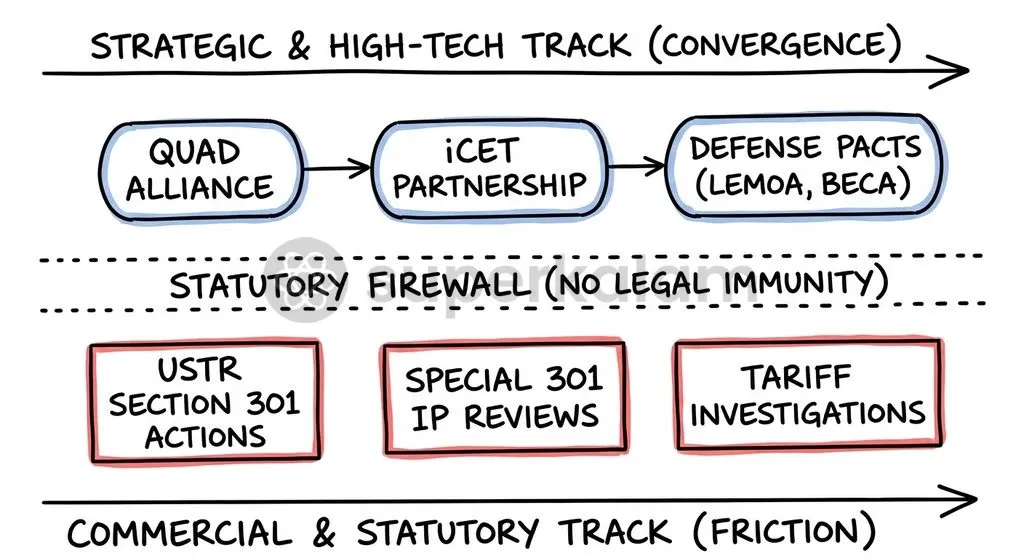
This framework attempts to establish protected zones of technological integration. However, American trade remedies and security initiatives operate along separate bureaucratic tracks:
| Dimension | High-Tech & Defence Track (iCET) | Commercial Trade Track |
|---|---|---|
| Institutional Lead | National Security Councils | USTR and Department of Commerce |
| Governing Authority | Executive bilateral arrangements | Title 19 statutory mandates |
| Primary Objective | Co-production and strategic transfers | Domestic market protection |
| Operating Logic | Geopolitical alignment and resilience | Corporate petition-driven duties |
These high-level security initiatives cannot fully shield commercial ties from domestic economic conflicts. Under American administrative law, national security initiatives do not override statutory trade reviews initiated by corporate petitions.
Bilateral talks helped terminate seven outstanding multilateral disputes during Prime Minister Narendra Modi's official state visit in 2023. Yet fundamental tensions over basic customs duties remain unresolved.
The structural divide remains clear. When trade friction escalated in 2018, Washington used Section 232 of the Trade Expansion Act of 1962 to impose tariffs of 25% on steel and 10% on aluminium. New Delhi responded in June 2019 by levying retaliatory tariffs on 28 American products.
Broad geopolitical arrangements like the Quad provide diplomatic dialogue. Yet they lack the legal authority to halt domestic tariff enforcement under Title 19.
Way Forward: Building Trade Mechanisms That Match Strategic Ambition
The India-US Trade Policy Forum offers an institutional avenue to negotiate balanced market access before tariff actions turn into open conflict. Both administrations must construct resilient dispute mechanisms rather than relying on periodic diplomatic interventions.
- Formalising Sectoral Bilateral Accords: Instead of seeking an unachievable comprehensive free trade agreement, negotiators should pursue narrow trade arrangements covering critical minerals and green energy components. Reaching bilateral consensus on technical and health certifications would protect vital trade channels from unilateral trade investigations.
- Reforming National Security Tariff Frameworks: Both governments must establish binding consultation protocols before invoking national security exceptions under trade statutes. Institutionalising advance notice requirements through the Trade Policy Forum would prevent unexpected tariff escalations against strategic partners.
- Revitalising Multilateral Dispute Functions: New Delhi and Washington should support interim appellate arrangements while negotiating broader dispute settlement reforms. Rebuilding functioning multilateral dispute mechanisms protects medium-sized economies from unilateral pressure and restores stability to international trade.
- Accelerating Domestic Regulatory Harmonisation: Indian authorities can reduce tariff vulnerabilities by aligning domestic testing procedures with international standards without weakening domestic policy goals. Reforming customs procedures reduces administrative barriers frequently highlighted in annual foreign trade reports.
Discuss with Superkalam
Evaluate whether India's abolition of the Equalisation Levy represents a strategic regulatory retreat or a pragmatic trade compromise.
Ask NowKey Takeaways
- Section 301 of the Trade Act of 1974 (19 U.S.C. § 2411) authorises unilateral retaliatory duties against foreign commercial practices deemed unreasonable or discriminatory.
- Bilateral defence pacts such as GSOMIA, LEMOA, COMCASA, and BECA operate independently from American domestic trade remedy laws.
- Parliament eliminated the 2% e-commerce Equalisation Levy on August 1, 2024, addressing a major dispute that prompted a formal Section 301 investigation in 2021.
- Section 3(d) of the Indian Patents Act, 1970 remains a central issue in intellectual property debates, keeping India on the Priority Watch List under Special 301 reviews.
- The paralysis of the World Trade Organization Appellate Body since December 2019 has encouraged the continued use of domestic trade enforcement tools.
Mains Question
"Geopolitical convergence offers no legal immunity against statutory trade enforcement driven by domestic industrial lobbies." In light of the recurring use of Section 301 and Special 301 by the United States, examine the structural contradictions between Indo-US strategic ties and bilateral trade friction. (15 Marks)
Evaluate NowMains Question
Highlighting the provisions of Section 3(d) of the Indian Patents Act, 1970 and sanitary-phytosanitary (SPS) regulations for dairy imports, elucidate why domestic regulatory standards remain key flashpoints in India's external trade relations. (10 Marks)
Evaluate NowPractice MCQs
QUESTION 1
Regarding Section 301 of the US Trade Act of 1974, consider the following statements:
- It authorizes mandatory action when foreign measures are found to violate trade agreements or are unjustifiable.
- Discretionary actions may be undertaken when foreign policies are judged to be unreasonable or discriminatory, even if they do not violate a formal agreement.
- Annual reviews regarding intellectual property rights protection regimes are conducted under Special 301. Which of the statements given above are correct?
QUESTION 2
Consider the following statements regarding the WTO Dispute Settlement Understanding (DSU) and US Section 301:
- Articles 23.1 and 23.2 of the DSU prohibit member states from unilaterally making determinations of trade violations without multilateral authorization.
- In the 1999 dispute US — Sections 301-310 of the Trade Act of 1974, the WTO panel upheld Section 304 based solely on the US commitment in its Statement of Administrative Action to refrain from unilateral determinations before multilateral proceedings concluded. Which of the statements given above is/are correct?
QUESTION 3
With reference to bilateral trade flashpoints between India and the United States, consider the following statements:
- India abolished its 2% Equalisation Levy on foreign e-commerce operators through the Finance (No. 2) Act, 2024.
- Section 3(d) of the Indian Patents Act, 1970 allows the patenting of known substances irrespective of therapeutic efficacy enhancement.
- Indian sanitary and phytosanitary rules mandate that foreign dairy imports carry certificates verifying herds were never fed feed containing ruminant or porcine blood meal. Which of the statements given above are correct?
QUESTION 4
Which of the following foundational defence agreements between India and the United States was signed earliest?
QUESTION 5
Consider the following statements regarding the revocation of India's Generalized System of Preferences (GSP) benefits by the United States:
- India's GSP beneficiary status was terminated via Presidential Proclamation 9902 in May 2019.
- The termination was preceded by petitions and lobbying from American medical device and dairy industry associations. Which of the statements given above is/are correct?