RBI Malus and Clawback: Reclaiming Bank Executive Bonuses
While RBI mandates malus and clawback to curb reckless risks, recovering disbursed bonuses tests the boundary between banking regulations and civil contracts.
Nov, 2026
•10 min read

Context
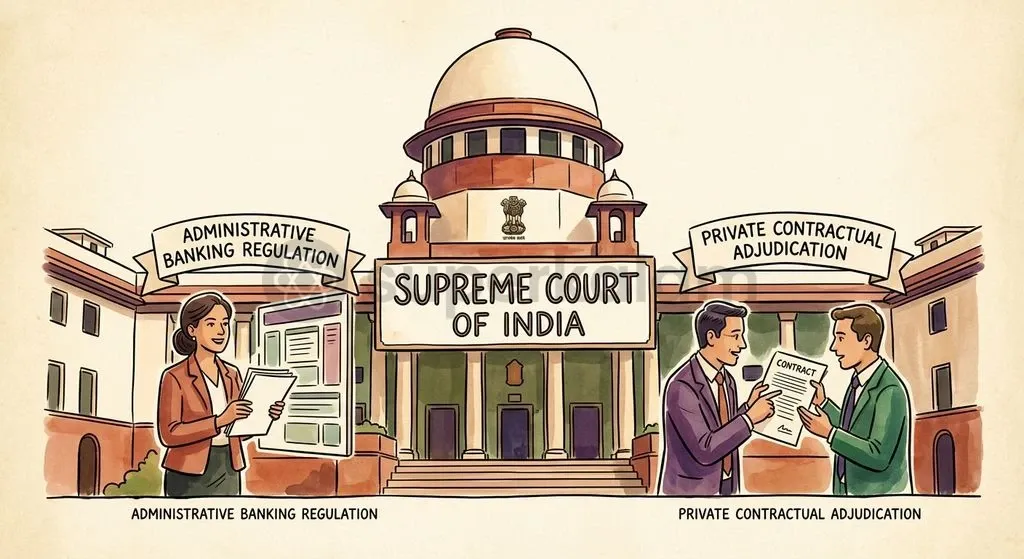
Under the Reserve Bank of India compensation framework, malus and clawback clauses serve as regulatory levers that align executive rewards with long-term banking stability by withholding unvested deferred pay or compelling the contractual return of previously disbursed bonuses. While the central bank exercises statutory oversight over executive remuneration under Section 35B of the Banking Regulation Act, 1949, executing clawbacks against bank leaders remains an intricate legal challenge. Operational bottlenecks across Section 27 of the Indian Contract Act, 1872, unyielding tax deduction rules, and boardroom inertia frequently transform regulatory deterrence into protracted civil litigation. Consequently, while malus reliably prevents unvested equity from disbursing, actual recovery of paid bonuses tests the operational boundary between administrative banking law and private contract enforcement in India.
Why Executive Pay Is Now a Core Banking Stability Issue
The Reserve Bank of India treats executive remuneration as a systemic solvency safeguard because skewed managerial incentives historically incentivised aggressive loan underwriting and balance-sheet misreporting. When executive bonuses depend primarily on short-term accounting profits, bank leaders face a profound moral hazard. Senior management can pocket substantial performance bonuses during credit expansion phases, leaving institutional depositors, taxpayers, and subsequent management teams to absorb severe loan defaults when asset quality deteriorates.
As of November 2026, the real-world enforcement of these deterrents resurfaced when the board of IndusInd Bank terminated former Managing Director and Chief Executive Officer Sumant Kathpalia. The bank invoked comprehensive malus and clawback provisions covering compensation dating back to his appointment on 24 March 2020.
Public exchange notifications reveal that this recovery action brings approximately ₹37.5 crore of cumulative fixed remuneration from FY21 to FY25 alongside RBI-approved variable cash bonuses and share awards under active review. The scale of this action mirrors global post-crisis standards established by the Financial Stability Board. Sound compensation principles require compensation deferrals and clawbacks as prudential guardrails to eliminate asymmetric risk-taking in commercial banking.
Discuss with Superkalam
Recall the minimum percentage of variable pay that the RBI mandates commercial banks must defer over at least three years for material risk takers.
Ask NowMalus vs Clawback: How Deferred Pay Is Structured to Stop Reckless Risk
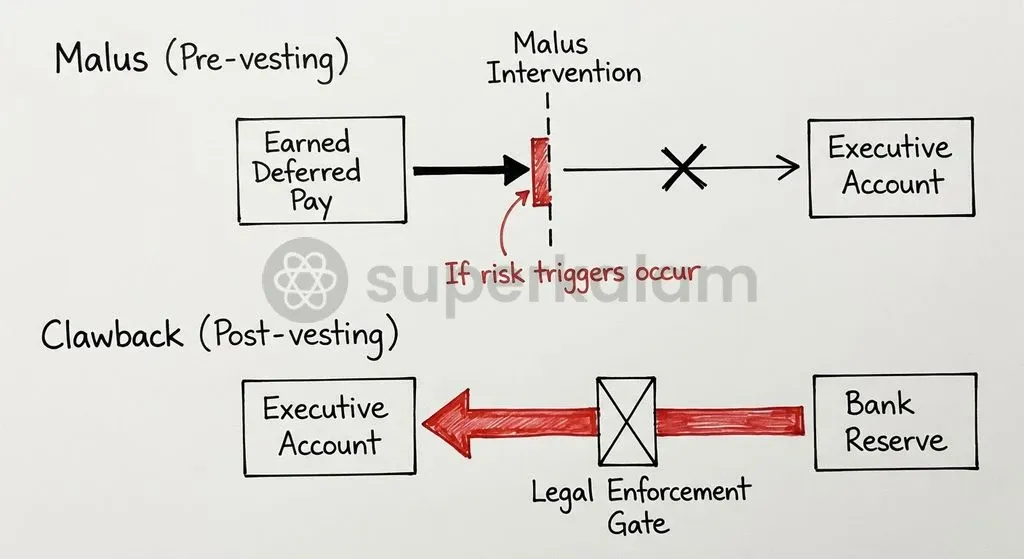
The Reserve Bank of India establishes distinct operational thresholds for malus and clawback to ensure deferred remuneration absorbs losses before and after disbursement. Under regulatory compensation guidelines, a malus arrangement permits a commercial bank to prevent the vesting of all or part of deferred variable remuneration before disbursement occurs. In contrast, a clawback mechanism operates as a contractual recovery tool requiring an executive to return previously paid or vested cash and equity remuneration.
| Dimension | Malus Mechanism | Clawback Mechanism |
|---|---|---|
| Operational Timing | Pre-vesting stage | Post-vesting and post-disbursement stage |
| Asset Location | Retained within the bank's custody | Transferred into the executive's possession |
| Execution Friction | Low; executed via internal accounting entry | High; requires voluntary return or civil litigation |
| Statutory Threshold | Automatic upon specified supervisory triggers | Invoked on termination for cause or gross misconduct |
| Tax Complications | None; income has not accrued to the individual | Severe; tax already paid without statutory refund |
The central bank's November 2019 compensation architecture enforces strict quantitative rules on private bank balance sheets. For whole-time directors and material risk takers, at least 60% of total variable pay must be deferred over a minimum period of three years. Furthermore, if variable remuneration includes cash, at least 50% of that cash bonus must be deferred unless the total cash component remains below ₹25 lakh.
Vesting of this deferred remuneration cannot commence earlier than one year from the date of grant. The guidelines require that vesting must progress no faster than on a pro-rata annual basis and occur no more frequently than once a year. In addition, the central bank caps total variable pay at a maximum of 300% of fixed pay. If variable pay exceeds 200% of fixed pay, at least 67% must be awarded through share-linked or non-cash instruments.
Supervisory rules also remove safety nets that executives might construct privately. Bank executives are strictly barred from insuring or hedging their compensation packages against downside adjustments. Commercial banks cannot offer guaranteed bonuses, permitting exceptions only as sign-on bonuses for new hires during their first year of service. Most critically, banks must mandatorily trigger malus and clawback clauses whenever assessed divergence in provisioning for non-performing assets or asset classification exceeds the regulator's public disclosure threshold.
Discuss with Superkalam
Explain how executive compensation structures based purely on short-term accounting profits create systemic moral hazards for depositors and taxpayers.
Ask NowThe Legal Teeth: RBI's Powers Under Section 35B of the Banking Regulation Act
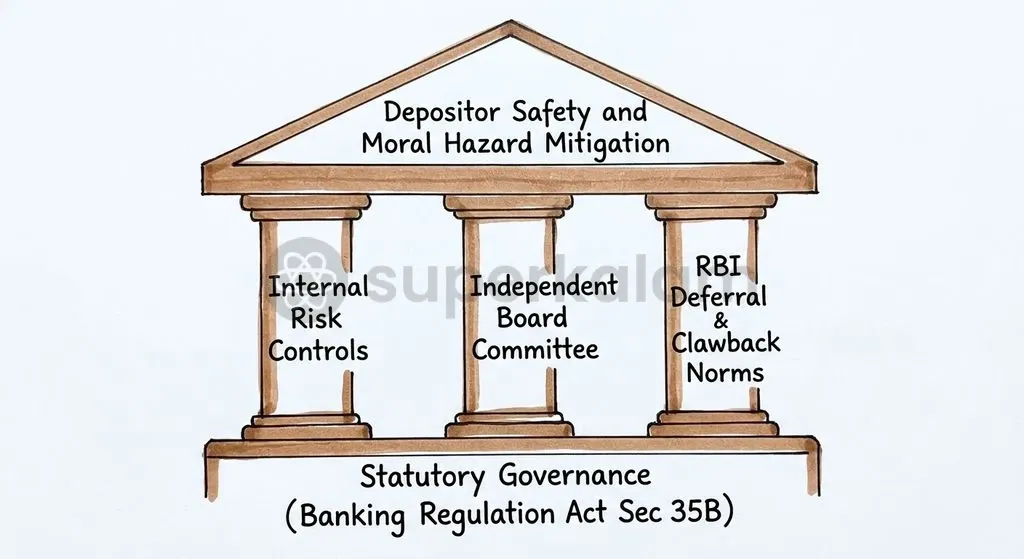
Section 35B of the Banking Regulation Act, 1949 vests the Reserve Bank of India with comprehensive statutory control over the appointment, remuneration, and post-tenure benefits of commercial bank leaders. Under Section 35B(1), any appointment, re-appointment, termination, or amendment to the remuneration of a chairman, managing director, whole-time director, or chief executive officer requires the prior approval of the regulator.
Parliament expanded this regulatory net through the Explanation to Section 35B(1). Any benefit, amenity, or perquisite conferred on a bank executive—whether during active tenure or post-termination—is legally deemed remuneration subject to central bank control. If a bank attempts to settle post-tenure claims or release retiral benefits without supervisory concurrence, the transaction remains void in law.
Beyond remuneration scrutiny, Section 36AA of the Banking Regulation Act, 1949 empowers the central bank to directly remove any chairman, director, chief executive officer, or bank officer. The regulator exercises this power when necessary in the public interest or to prevent bank affairs from being conducted in a manner detrimental to depositor interests.
This banking architecture differs notably from general corporate law under the Companies Act, 2013. Section 199 of the Companies Act provides a statutory clawback mechanism requiring companies to recover excess managerial remuneration from past or present managing directors or chief executive officers if financial statements are restated due to fraud or non-compliance. However, Section 35B operates as special banking legislation, enabling continuous regulatory intervention without waiting for formal financial restatements.
Discuss with Superkalam
Compare the execution friction between a malus clause and a clawback clause when an executive is terminated for gross financial misreporting.
Ask NowWhen Clawback Went to Court: Lessons from the ICICI Bank Precedent
Judicial rulings in the Chanda Deepak Kochhar dispute established that clawback enforcement against private bank executives operates under civil contract law rather than constitutional writ jurisdiction. When ICICI Bank moved to claw back bonuses and stock options from its former chief executive, the executive filed writ petitions challenging the revocation of her retirement benefits. Both the Bombay High Court and the Supreme Court held that the contractual relationship between a private bank and its employee falls squarely in the private realm, rendering writ petitions under Article 226 of the Constitution non-maintainable.
The bank's enforcement strategy succeeded because it anchored its actions in administrative banking statutes. ICICI Bank secured formal approval from the Reserve Bank of India in March 2019 under Section 35B(1)(b) to convert the former executive's voluntary early retirement into a termination for cause. This statutory approval stripped the executive of contractual protections attached to amicable separation.
The judicial battle culminated in December 2023 when the Supreme Court dismissed the former executive's appeal. The court refused interim relief seeking the release of retiral benefits and the restoration of 690,000 exercised employee stock options that the bank had clawed back. This outcome demonstrated that while clawback disputes must be fought through civil proceedings, statutory approval from the banking regulator provides the legal foundation for contractual recovery.
The Enforcement Bottlenecks: Tax Rules, Board Capture, and Contract Law
Contractual ambiguity under the Indian Contract Act, 1872 and rigid domestic tax provisions impede the swift recovery of disbursed executive bonuses. While malus is executed seamlessly by withholding internal entries, clawback requires compelling an individual to return funds that have already settled in their personal accounts.
Under Section 27 of the Indian Contract Act, 1872, agreements in restraint of trade, profession, or business are void. Defending executives often argue that clawback clauses act as unlawful post-employment penalties. Indian courts reject this defence when clauses are drafted as agreed terms of conditional remuneration rather than post-separation restraints. To safeguard this enforceability, central bank guidelines require executives to execute contractual deeds agreeing to clawback conditions as a mandatory prerequisite for receiving variable pay.
Taxation presents an even more stubborn practical barrier. The Income-tax Act, 1961 taxes salary and bonuses on an accrual or receipt basis, with employers depositing Tax Deducted at Source under Section 192. Crucially, the statute provides no automated refund or deduction mechanism for bonuses clawed back in subsequent financial years. When a bank seeks the return of a gross bonus, the executive faces a liquidity trap, having already surrendered 30% to 40% of that sum to the tax authorities.
Boardroom governance creates an institutional barrier. Although guidelines require the board's Nomination and Remuneration Committee to evaluate systemic risks alongside the Risk Management Committee, independent directors often hesitate to initiate clawbacks. Reluctance stems from collegial boardroom culture and fears of reputational damage. To counter this reluctance, commercial banks must publish quantitative remuneration disclosures annually, detailing the number of executives subjected to malus or clawbacks and the total value recovered.
Ethical Dilemmas: Moral Hazard and Boardroom Independence in India
The Reserve Bank of India regulates compensation structures to eliminate moral hazard, preventing bank executives from pocketing short-term upside while transferring solvency risks to depositors. When bank leadership faces no personal financial downside for bad loans, the corporate structure privatises profit and socialises risk. Stringent clawbacks establish an ethical counterweight, forcing decision-makers to retain skin in the game throughout the credit cycle.
Supervisory guidelines address this ethical dimension by safeguarding the autonomy of oversight personnel. Staff engaged in financial control, risk management, compliance, and internal audit must have their remuneration determined independently of the commercial business units they monitor. Their performance evaluations depend on function-specific governance objectives rather than bank profitability.
This framework also extends past chief executives. The central bank mandates that qualitative and quantitative criteria must identify all Material Risk Takers whose individual decisions affect bank solvency, subjecting them to identical deferral and malus rules. By establishing mutual financial vulnerability between the bank and its risk-takers, the framework discourages aggressive practices such as evergreen loan structures.
Discuss with Superkalam
Evaluate whether the civil court route is adequate for enforcing clawback recovery, or if banking statutes require a dedicated summary tribunal.
Ask NowWay Forward: Making Executive Accountability Enforceable Beyond Paper
Bridging the gap between Reserve Bank of India compensation mandates and civil recovery requires statutory alignment across corporate law, taxation, and boardroom oversight. Without institutional reforms, clawback clauses will remain potent paper deterrents that produce endless litigation rather than prompt financial recoveries.
Key policy and structural reforms include:
- Tax Code Realignment: Parliament should introduce explicit provisions within the Income-tax Act, 1961 allowing taxpayers to claim deductions or carry-back tax adjustments for compensation surrendered under statutory clawback orders.
- Dedicated Recovery Mechanisms: The central bank and the Ministry of Corporate Affairs should establish summary adjudication channels through the National Company Law Tribunal, avoiding decades of ordinary civil court delays.
- Institutionalising Board Autonomy: Nomination and Remuneration Committees must mandate independent risk audits from external compliance assessors before clearing deferred variable compensation tranches.
- Expanding Public Sector Bank Norms: While public sector bank chiefs receive predominantly fixed bureaucratic remuneration, introducing structured, long-term incentive and malus architectures can elevate governance standards across state-owned lenders.
Key Takeaways
- Malus cancels unvested deferred remuneration within the bank's custody, whereas clawback contractually reclaims cash or stock that has already been disbursed.
- Section 35B of the Banking Regulation Act, 1949 gives the central bank prior approval power over executive appointments, remuneration amendments, and post-tenure perquisites.
- Central bank guidelines mandate that at least 60% of variable pay for whole-time directors and Material Risk Takers must be deferred over a minimum period of three years.
- The Supreme Court's jurisprudence in the ICICI Bank dispute confirms that clawback against private bank executives operates under private contract law, precluding constitutional writ petitions.
- Practical enforcement of clawbacks remains severely constrained by the lack of statutory tax refund mechanisms, Section 27 contract scrutiny, and boardroom reluctance.
Mains Question
Section 35B of the Banking Regulation Act, 1949 arms the Reserve Bank of India with extensive supervisory powers over bank executive remuneration. Examine how compensation governance acts as a prudential tool for banking stability, and highlight the operational challenges faced in executing clawback provisions. (15 Marks)
Evaluate NowMains Question
"While malus reliably prevents unvested equity from disbursing, actual recovery of paid bonuses tests the operational boundary between administrative banking law and private contract enforcement in India." Elucidate. (10 Marks)
Evaluate NowPractice MCQs
QUESTION 1
With reference to the Reserve Bank of India's compensation guidelines for Whole Time Directors and Material Risk Takers in commercial banks, consider the following statements:
- A minimum of 60% of the total variable pay must be deferred over a period of not less than three years.
- Vesting of deferred remuneration can commence within six months from the date of grant on a semi-annual basis.
- The total variable pay awarded to an executive is capped at a maximum of 300% of their fixed pay. Which of the statements given above are correct?
QUESTION 2
Consider the following statements regarding the regulatory concepts of 'Malus' and 'Clawback' in Indian banking:
- A malus arrangement permits a bank to prevent the vesting of deferred variable pay before disbursement occurs.
- A clawback mechanism requires the recovery of previously paid or vested remuneration from an executive.
- Mandatory invocation of malus and clawback is triggered whenever assessed divergence in provisioning for non-performing assets exceeds the regulatory disclosure threshold. Which of the statements given above is/are correct?
QUESTION 3
Consider the following statements regarding the statutory powers of the Reserve Bank of India under the Banking Regulation Act, 1949:
- Section 35B mandates prior RBI approval for any appointment, termination, or amendment to the remuneration of whole-time directors and chief executive officers.
- The Explanation to Section 35B(1) restricts regulatory control strictly to base salaries, excluding post-termination perquisites and retiral amenities.
- Section 36AA empowers the Reserve Bank of India to directly remove any director or officer of a banking company in the public interest or to protect depositor interests. Which of the statements given above is/are correct?
QUESTION 4
Regarding the judicial precedents and legal framework governing bonus clawbacks in Indian commercial banks, consider the following statements:
- The Supreme Court established in the Chanda Deepak Kochhar dispute that writ petitions under Article 226 are maintainable against private commercial banks for executive contractual disputes.
- Clawback covenants are generally upheld against challenges under Section 27 of the Indian Contract Act, 1872 when drafted as conditional remuneration rather than unlawful restraints of trade. Which of the statements given above is/are correct?
QUESTION 5
Under the Reserve Bank of India guidelines, what condition mandates that at least 67% of an executive's variable pay must be awarded through share-linked or non-cash instruments?