IRDAI Insurance Distribution Proposals: EoM and Commissions
IRDAI's 2026 consultation proposes changes to insurer expenses and distributor pay. See the product-specific figures and glide path, not final rules.
Sep, 2026
•7 min read

Overview
As of September 2026, the Insurance Regulatory and Development Authority of India proposed a structural overhaul of insurance distribution economics. The regulator plans to reintroduce statutory commission caps and establish a multi-year glide path to progressively reduce operating expense limits across life and general insurers.
The draft framework seeks to curb runaway distribution overheads. Between recent financial cycles, corporate agent remuneration surged 125% compared to a modest 28% growth in new premiums. By capping intermediary take-rates and establishing clear operational ceilings, the regulator aims to compress policy acquisition costs and pass direct savings to consumers, creating the foundation for universal insurance coverage.
Why in the News: IRDAI's Consultation on Insurance Distribution
The Insurance Regulatory and Development Authority of India released a consultation paper titled 'Recalibrating Economics of Insurance Distribution' on 23 September 2026. This draft framework invites feedback from industry stakeholders until 25 October 2026, setting the stage for significant structural adjustments in operational cost limits across the insurance sector.
IRDAI initiated this regulatory review after identifying widening distortions in distribution expenses across the domestic market:
- Disproportionate payout growth: Between FY2022–23 and FY2024–25, distributor remuneration for life corporate agents expanded by 125% against 28% growth in new-business premiums, generating high structural cost burdens passed directly to consumers.
- Shift towards direct oversight: The regulator is moving away from board-level discretion back towards explicit statutory caps to ensure consumer protection and curb institutional mis-selling.
- Industry consultation: Stakeholder feedback remains open until 25 October 2026 before final regulatory formalisation.
Understanding Expenses of Management (EoM) in Insurance
Expenses of Management represent the statutory ceiling on operating expenses, commissions, and remuneration that insurers can incur, as defined under the IRDAI Regulations, 2024. These statutory limits are calculated as a proportion of total premium income to ensure that underwriting institutions maintain financial discipline.
High operating overheads directly erode policyholder value by inflating annual premium charges and diminishing investment returns on life products. When acquisition costs rise disproportionately, insurers allocate a smaller fraction of collected premiums toward reserves, claim settlements, and solvency buffers.
Discuss with Superkalam
Recall the proposed five-year EoM cap targets for life and general insurers under the draft IRDAI framework.
Ask Now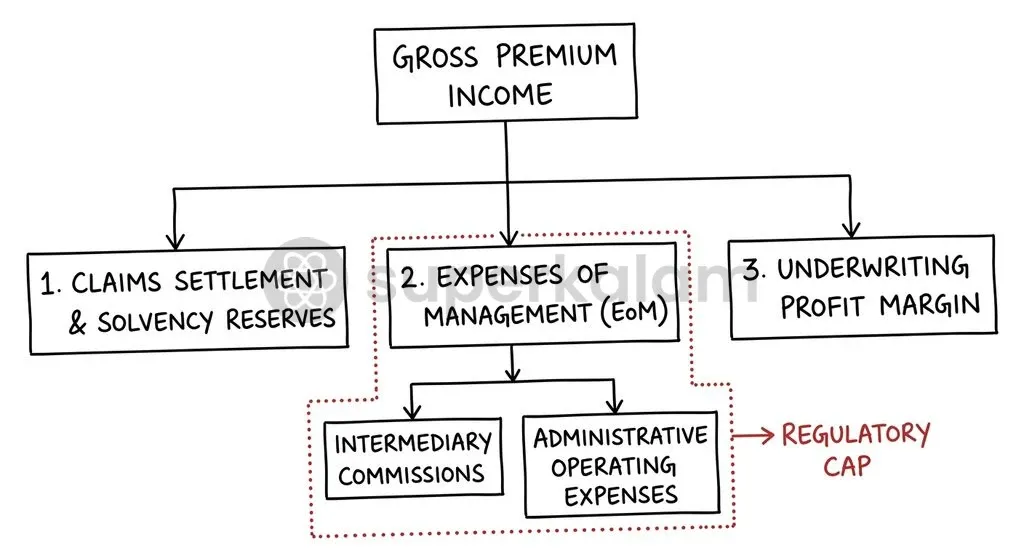
Key Proposals: Commission Reforms and the EoM Glide Path Explained
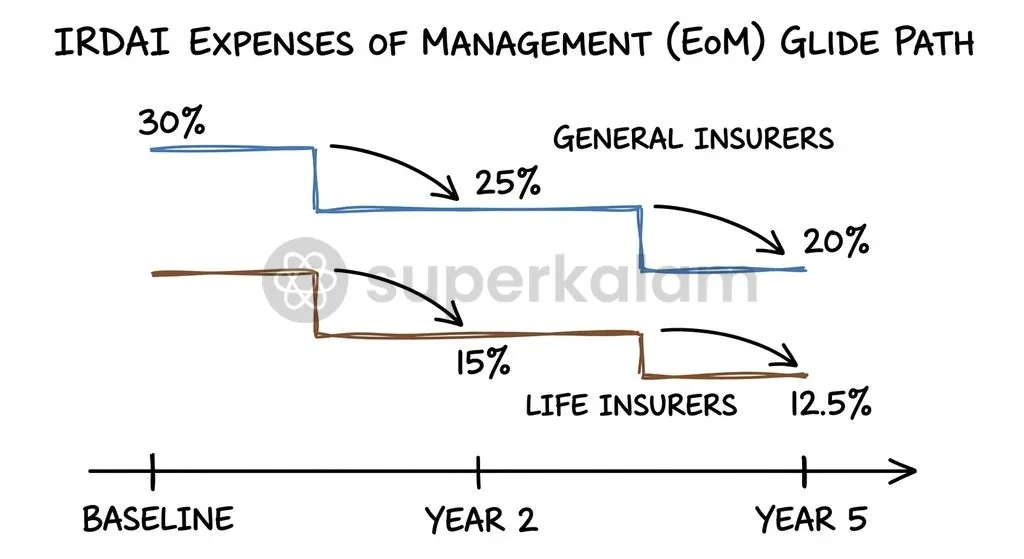
IRDAI's proposed glide path establishes a structured transition to lower company-level operational cost limits over a five-year timeline. This phased mechanism prevents sudden operational disruption while steering insurers toward leaner operating structures.
- Glide path for general insurers: The company-level Expenses of Management cap will reduce from the existing 30% of Gross Written Premium to 25% within two years and 20% of domestic GDPI within five years.
- Glide path for life insurers: The company-level ceiling will decrease to 15% of GDPI within two years and reach 12.5% within five years, replacing older product-level formulas.
- Channel-specific commission ceilings: First-year commission limits for life policies will range from 5% to 20% for distribution entities, while individual agents can earn up to 25%, with remaining remuneration distributed as trail commissions.
- Motor insurance rationalisation: Mandatory third-party motor insurance commissions are proposed to be set to zero or near-zero, while motor own-damage commissions face reductions to approximately 5%, as reported in the consultation paper on 23 September 2026.
- Comprehensive commission definition: All direct and indirect incentives, rewards, and sales contests must be integrated into a single statutory definition of commission to eliminate backdoor payouts.
To eliminate structural mis-selling, the framework mandates assigning a unique identifier to every selling agent on issued policies alongside mandatory commission clawbacks for improperly sold covers. Furthermore, banks and non-banking financial companies cannot impose volume-linked sales quotas on staff or compel borrowers to purchase bundled insurance products.
Discuss with Superkalam
Explain how high intermediary acquisition costs directly affect policyholder returns and insurer solvency reserves.
Ask NowComparing the Proposed Norms with Existing Regulations
The proposed IRDAI distribution framework replaces board-level discretion with strict, channel-specific statutory caps across both life and non-life insurance sectors. Insurers previously operated under overarching company limits, but the regulator determined that explicit micro-level caps are necessary to prevent aggressive intermediary bidding.
| Regulatory Dimension | 2023–2024 Framework | Proposed 2026 Consultation Norms |
|---|---|---|
| Commission Regulation | Board-approved commission policy within aggregate limits | Explicit product-level and channel-specific statutory caps |
| General Insurance EoM | 30% of Gross Written Premium | Five-year glide path down to 20% of domestic GDPI |
| Life Insurance EoM | Product-level expense formulas | Unified company cap falling to 12.5% within five years |
| Intermediary Rewards | Indirect contests and incentives permitted separately | Consolidated under single statutory commission definition |
| Bancassurance Rules | Internal targets set by institutional distributors | Prohibition on volume-linked employee sales targets |
| Cost Disclosure | Consolidated financial reporting | Mandatory distribution cost disclosure on commercial policy schedules |
Discuss with Superkalam
Analyse the asymmetric competitive impact that uniform EoM limits might have on established market incumbents versus new insurance entrants.
Ask NowMajor Concerns: Impact on Independent Agents and Smaller Insurers
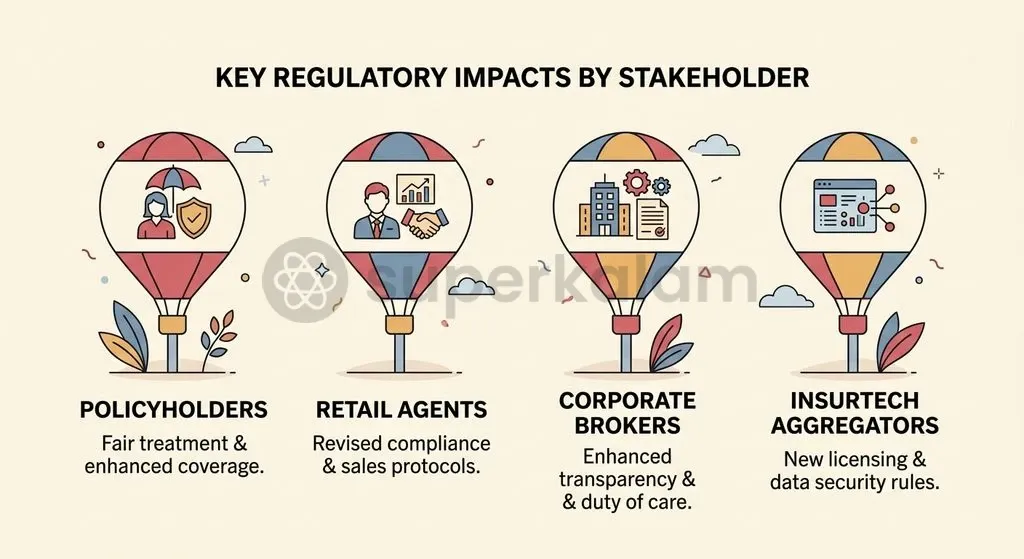
Digital aggregators and agency networks face substantial business model realignments under IRDAI's compressed commission and disclosure mandates. Following the release of the consultation paper, digital insurance distribution platforms PB Fintech and Turtlemint experienced single-day stock declines of 28% to 34% due to projected margin compression.
| Policyholder Gains | Intermediary Pressures |
|---|---|
| Reduced gross premiums | Compressed broker margins |
| Curbs on mis-selling | Lower upfront cash flow |
| Transparent cost tables | Stricter compliance load |
Smaller insurance companies contend that aggregate expense caps make it harder to scale operations against dominant market incumbents. Larger insurers benefit from mature distribution channels and extensive policyholder bases, whereas newer market entrants rely heavily on higher distributor payouts to gain initial market share.
Individual retail agents nevertheless retain structural protections under the proposed limits. Permitting individual agents to earn up to 25% in first-year life commissions recognises the intensive personal effort required to educate first-time buyers in underpenetrated geographies.
Way Forward: Balancing Financial Solvency, Intermediary Incomes, and Consumer Protection
Sustainable insurance penetration in India requires balancing intermediary livelihoods with policyholder value and institutional solvency. Regulators must implement the five-year glide path flexibly, ensuring that mid-sized and regional insurers can adjust operational workflows without facing solvency penalties.
Industry self-regulatory bodies, including the Life Insurance Council and General Insurance Council, should assist in standardising compliance frameworks. Transparent public disclosures of distribution costs will empower buyers to evaluate intermediary value, while digital platforms like Bima Sugam provide scalable avenues for low-cost distribution.
Discuss with Superkalam
Evaluate whether prescriptive statutory commission caps are more effective at curbing financial mis-selling than principles-based, board-level governance.
Ask NowKey Takeaways
- IRDAI's 2026 consultation paper proposes a five-year glide path reducing Expenses of Management caps to 20% for general insurers and 12.5% for life insurers.
- First-year life commissions will be capped at 5% to 20% for corporate entities and up to 25% for individual agents, mandating trail commissions for subsequent policy years.
- The draft framework ends the 2023–2024 board-approved commission regime, reintroducing explicit statutory caps and consolidating all incentives under one definition.
- Mis-selling safeguards include unique seller identification, mandatory commission clawbacks, and a ban on volume-linked insurance quotas for bank staff.
- The overarching goal of the reform is to reduce premium costs, curb distribution arbitrage, and accelerate progress toward the 'Insurance for All by 2047' vision.
Mains Question
"Between FY2022–23 and FY2024–25, distributor remuneration for life corporate agents expanded by 125% against a 28% growth in new-business premiums." In light of this widening disparity, examine the rationale behind IRDAI reintroducing statutory commission caps and a multi-year Expenses of Management (EoM) glide path. (10 Marks)
Evaluate NowMains Question
While the proposed IRDAI distribution reforms aim to lower acquisition costs and advance the 'Insurance for All by 2047' target, they pose structural challenges for smaller insurers and digital intermediaries. Critically analyse. (15 Marks)
Evaluate NowPractice MCQs
QUESTION 1
With reference to the Insurance Regulatory and Development Authority of India (IRDAI) proposed 2026 norms on Expenses of Management (EoM), consider the following statements:
- The draft norms propose a five-year glide path to reduce the general insurance EoM cap to 20% of domestic Gross Direct Premium Income (GDPI).
- The company-level EoM ceiling for life insurers is proposed to be reduced to 12.5% within five years.
- The proposed framework shifts regulatory oversight from explicit statutory caps to flexible board-approved commission limits.
Which of the statements given above are correct?
QUESTION 2
Consider the following statements regarding the proposed channel-specific commission ceilings under the IRDAI 2026 consultation paper:
- First-year life insurance commission limits for corporate distribution entities are proposed to range from 5% to 20%.
- Individual retail agents can earn up to 25% in first-year life insurance commissions.
- Mandatory third-party motor insurance commissions are proposed to be set to zero or near-zero.
Which of the statements given above is/are correct?
QUESTION 3
Consider the following statements regarding consumer protection and market conduct safeguards in the IRDAI distribution reform proposals:
- A unique seller identifier must be assigned to every selling agent on issued policies.
- Mandatory commission clawbacks are introduced for improperly sold insurance covers.
- Banks and NBFCs are permitted to enforce volume-linked insurance sales targets on their lending personnel.
Which of the statements given above is/are correct?
QUESTION 4
In the context of the Indian insurance sector, what is the primary purpose of defining 'Expenses of Management' (EoM)?
QUESTION 5
Consider the following statements regarding the strategic objectives behind IRDAI's distribution reforms:
- The reduction in distribution overheads is intended to compress policy acquisition costs and lower premium charges for consumers.
- The Bima Sugam platform is promoted as a digital Market Infrastructure Institution to facilitate low-cost, open-architecture insurance access.
- The overarching vision of the regulatory overhaul is aligned with the national target of 'Insurance for All by 2047'.
Which of the statements given above are correct?