Sugarcane Red Rot in UP: Co-0238 and Replacement Varieties
Red rot has affected Co-0238 sugarcane in Uttar Pradesh. See why dependence on one variety raises risk and how growers are shifting to alternatives.
Sep, 2026
•7 min read
Overview
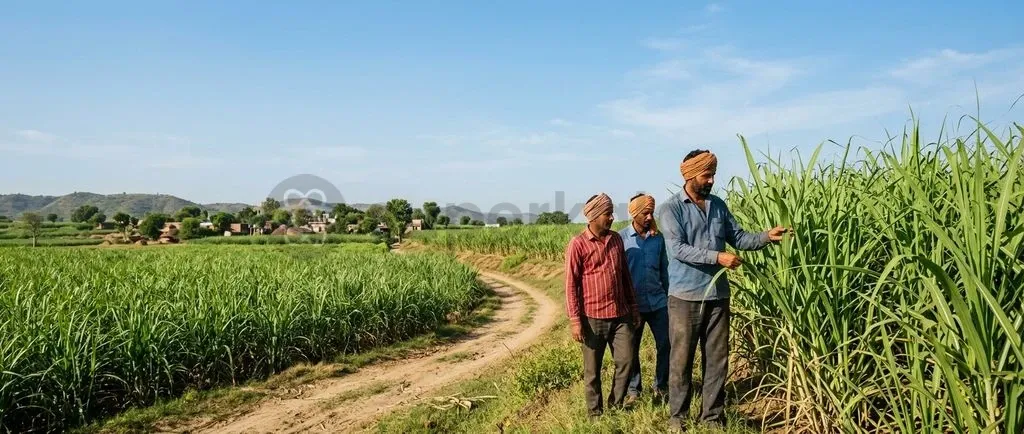
Uttar Pradesh is undergoing a massive agricultural transition. The high-yielding sugarcane variety Co-0238 (Karan 4) has suffered widespread resistance breakdown against red rot disease, caused by the fungal pathogen Colletotrichum falcatum.
To safeguard farm incomes and factory recovery rates, the state replaced over 12.38 lakh hectares of susceptible cane between 2021 and 2025. This effort rebuilds varietal biodiversity across subtropical growing zones.
Intensive monoculture previously expanded Co-0238 to cover over 80% of Uttar Pradesh's cane area. That concentration accelerated pathogen virulence through the vertifolia effect. Shifting to resilient alternatives like Co-0118 and Co-20016 proves that long-term agro-economic security demands genetic diversity over perpetual reliance on a single super-variety.
Why in the News? Red Rot Outbreak Threatens UP Sugarcane Belt
The Uttar Pradesh Sugarcane Development Department has accelerated the phase-out of landmark cane variety Co-0238 following destructive red rot outbreaks across major growing belts. The disease took a severe toll on production.
As of September 2026, state sugar production fell from 126.4 lakh tonnes in 2019–20 to 89.5 lakh tonnes in the 2025–26 season, primarily driven by red rot damage and varietal failure.
Widespread field losses across western and central mill command zones forced the rollout of emergency seed multiplication programmes and resistant cultivars. This crisis highlights how genetic monoculture can turn a thriving cash-crop belt into a vulnerable production landscape.
Discuss with Superkalam
Which fungal pathogen is responsible for sugarcane red rot, and who developed the landmark cultivar Co-0238?
Ask NowWhat Is Sugarcane Red Rot: Causes, Pathogen, and Spread
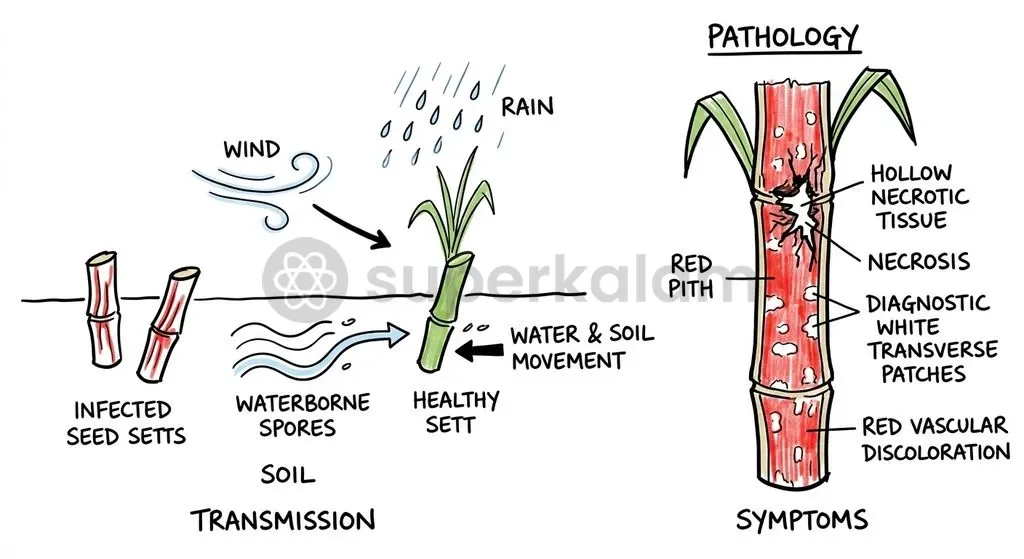
Red rot disease is an internal vascular infection caused by the hemibiotrophic fungal pathogen Colletotrichum falcatum Went. Farmers and scientists frequently call it the cancer of sugarcane. The teleomorph stage of the fungus is classified as Glomerella tucumanensis.
Primary infection starts via pathogen-carrying seed setts or fungal inoculum surviving in buried crop residues. Secondary transmission spreads quickly through irrigation flows, floodwaters, and airborne conidia that enter nodal tissues of standing stalks.
Diagnostic symptoms of red rot develop inside the cane stalk:
- Internal reddening across vascular bundles and ground tissue.
- White horizontal crossbands running perpendicular to the stalk axis.
- An alcoholic fermentation odour caused by rapid fungal conversion of sucrose into reducing sugars.
- Complete wilting of crown leaves, terminating in dry-rot hollow cavities inside affected internodes.
The Rise of Co-0238: How a Single Variety Transformed the UP Sugar Economy
Dr. Bakshi Ram bred the miracle sugarcane cultivar Co-0238 (Karan 4) at the ICAR-Sugarcane Breeding Institute Regional Centre in Karnal before its formal release in 2009 for the Northwest Zone. The variety delivered high tillering, thicker stalks, early maturity, and superior sucrose concentration.
Growers across Uttar Pradesh saw an immediate boost in field output. Average agricultural productivity jumped from under 60 tonnes per hectare to more than 80 tonnes per hectare.
Sugar mills also recorded rapid gains in processing efficiency:
- Mill sugar recovery rates rose from around 9% in 2010–11 to over 11.5% by 2019–20.
- Higher recoveries generated stronger cash flows for mills, speeding up the clearance of cane price arrears to farmers.
- Elevated per-acre returns triggered rapid adoption across subtropical North India.
Discuss with Superkalam
How does the fungal inversion of sucrose inside infected stalks translate into economic losses for both farmers and sugar mills?
Ask NowWhy Co-0238 Became Vulnerable: The Dangers of Monoculture
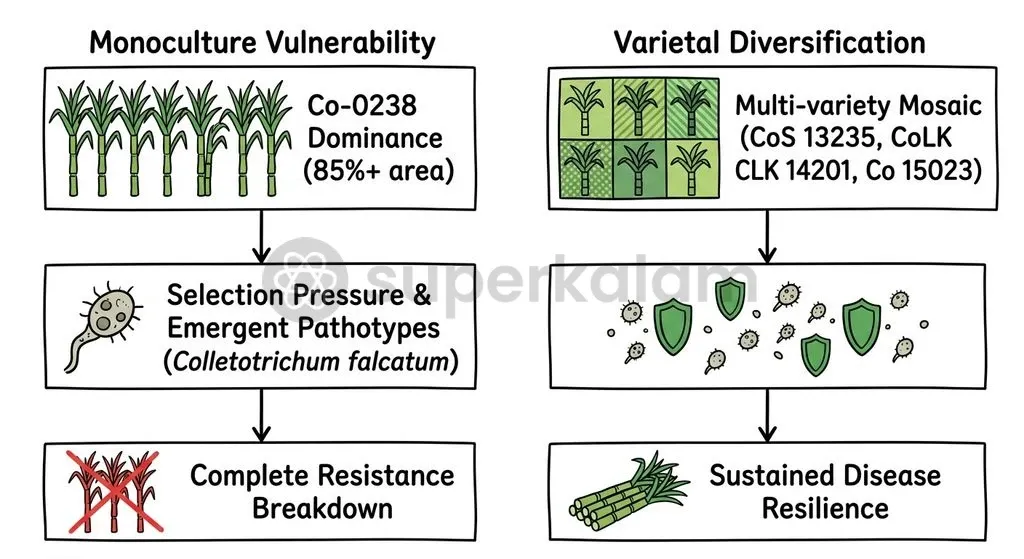
The ICAR-Sugarcane Breeding Institute documented that Co-0238 expanded to occupy 82% to 88% of the total sugarcane area in Uttar Pradesh by 2019–20. This extreme geographic concentration created a continuous genetic monoculture across millions of contiguous hectares.
Epidemiological vulnerability worsened because of continuous ratoon cropping and widespread trading of uncertified planting setts. Unbroken cultivation of a single cultivar created strong selection pressure on field pathogens. This triggered the vertifolia effect — a swift breakdown of horizontal resistance as specialized fungal mutants proliferate.
Resistance collapsed completely once a virulent new pathotype, CF13, emerged and multiplied across subtropical belts. The CF13 pathotype easily bypassed the internal defences of Co-0238, turning a former super-variety into a vulnerable host.
Co-0238 vs Proposed Replacement Varieties: Key Characteristics and Yield Metrics
The Ministry of Agriculture and Farmers Welfare collaborated with state research stations to evaluate resilient replacement cultivars against Co-0238. Moving to newer genotypes provides protection against the CF13 pathotype while maintaining field tonnage and juice recovery levels.
| Parameter / Feature | Co-0238 (Karan 4) | Co-20016 (Karan 20) | Co-0118 (Karan 2) | Co-15023 (Karan 15) |
|---|---|---|---|---|
| Breeding Institution | ICAR-SBI Karnal | ICAR-SBI Regional Centre | ICAR-SBI Karnal | ICAR-SBI Karnal |
| Red Rot Reaction (CF13 Pathotype) | Highly Susceptible | Resistant | Moderately Resistant / Resistant | Resistant |
| Average Cane Yield (t/ha) | 116.4 t/ha (in 3-year trials) | 144.6 t/ha | High commercial yield potential | Early-maturing yield standard |
| Juice Sucrose (%) at 10 Months | 18.3% | 18.7% | High early sucrose content | High early sucrose recovery |
| UP Area Share (2025–26) | 29.17% (Declining) | Entering seed multiplication pipeline | 26.02% | Expanding notified acreage |
State agricultural authorities have also notified other promising alternatives, including CoLk-14201 (Ikshu-6), CoLk-16202, CoS-13235, CoS-17231, and CoSha-19231. Planting a balanced mosaic of these varieties stops pathogens from adapting to any single genetic line.
Discuss with Superkalam
If a sugar mill command area currently cultivates 75% of its acreage under a single high-yielding cultivar, how would you restructure its varietal composition to mitigate disease vulnerability?
Ask NowEconomic Impact on Farmers, Sugar Recovery Rates, and Mills in Uttar Pradesh
The Cane Commissioner Office in Uttar Pradesh noted severe economic fallout across the rural economy as red rot tore through Co-0238 fields. Standing crop destruction forced early harvesting, reduced total tonnage, and cut into farm income.
Sugar mills suffered direct processing losses as fungal sucrose inversion damaged cane juice quality:
- Fungal enzymes inverted sucrose into non-crystallisable glucose and fructose, slashing recovery rates.
- Lower recoveries drove up industrial crushing costs per quintal of sugar.
- Total state sugar output contracted by 36.9 lakh tonnes between 2019–20 and 2025–26.
Factory zones responded by placing limits on varietal concentration. Cane experts recommend that no single cultivar should exceed **** of total acreage in any mill command area to maintain genetic resilience.
Varietal Replacement Strategy: Seed Multiplication and Transition Challenges
The ICAR-Indian Institute of Sugarcane Research (IISR) in Lucknow is rolling out decentralised seed production techniques to replace infected planting stock. Replacing seed volume across millions of hectares requires high multiplication ratios.
Modern seed multiplication methods include:
- Single-bud sett planting and bud chip settling nurseries using portray technology to minimise basic seed requirements.
- Tissue culture micropropagation to distribute certified disease-free foundation stock to registered seed producers.
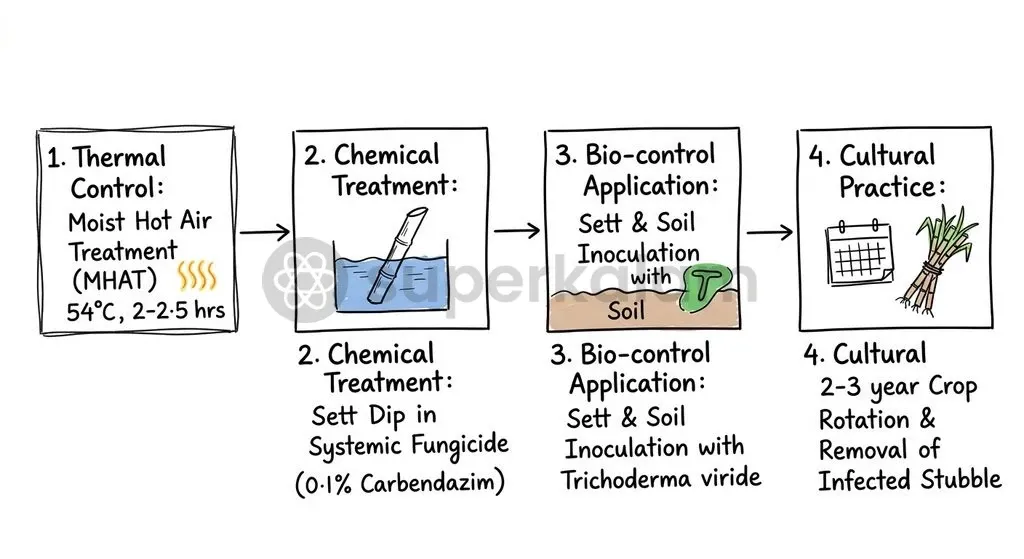
- Moist Hot Air Treatment (MHAT) of foundation setts at 54°C for 2.5 to 4 hours to kill latent internal mycelium.
Farmers encounter real logistical hurdles during varietal replacement. Infected ratoon crops carry lingering pathogen reservoirs, forcing growers to uproot and burn stubble rather than continuing traditional multi-year ratooning. Growers must also adjust to differing tillering patterns and irrigation needs of replacement varieties.
Discuss with Superkalam
Analyse the biological and agricultural factors that explain why the 'vertifolia effect' emerged so rapidly in Uttar Pradesh's sugarcane belt.
Ask NowWay Forward: Building Disease-Resilient Crop Ecosystems in India
The Department of Agriculture & Farmers Welfare promotes an integrated pest and disease management strategy combining chemical treatments, biological control, and cultural field practices. Long-term disease control requires moving past routine chemical sprays toward soil health regeneration.
Key strategies for building sugarcane resilience include:
- Chemical Sett Treatment: Dipping seed setts and drenching planting furrows with systemic fungicides like carbendazim, thiophanate-methyl, or hexaconazole before planting.
- Biological Inoculation: Applying bio-formulations of Trichoderma viride and Trichoderma harzianum at planting to suppress Colletotrichum falcatum inoculum in the rhizosphere.
- Agronomic Sanitation: Enforcing crop rotation with non-host crops like paddy or green manures such as Sesbania (dhaincha).
- Drainage Management: Using laser land levelling to eliminate waterlogging that accelerates secondary fungal spore dispersal.
- Institutional Varietal Ceilings: Mandating strict varietal zoning policies to ensure no single cultivar crosses safe saturation thresholds.
Key Takeaways
- Pathogen Biology: Sugarcane red rot is caused by the hemibiotrophic fungus Colletotrichum falcatum Went, leading to internal vascular reddening, white crossbands, and sucrose inversion.
- Economic Legacy of Co-0238: Bred by Dr. Bakshi Ram, Co-0238 elevated Uttar Pradesh sugarcane yields past 80 t/ha and sugar recovery past 11.5% before succumbing to the virulent CF13 pathotype.
- Monoculture Breakdown: Saturation of Co-0238 across 82–88% of UP cane area induced a severe vertifolia effect, causing state sugar output to decline from 126.4 lakh tonnes in 2019–20 to 89.5 lakh tonnes in 2025–26.
- Varietal Transition: UP replaced 12.38 lakh hectares of Co-0238 between 2021 and 2025, expanding resilient cultivars like Co-0118 (26.02% area in 2025–26) and advancing promising varieties like Co-20016.
- Integrated Management: Disease management requires seed sanitisation via Moist Hot Air Treatment (MHAT), Trichoderma bio-control, termination of infected ratoons, and enforcing a 40–50% varietal ceiling per factory zone.
Mains Question
'The breakdown of the landmark sugarcane variety Co-0238 in Uttar Pradesh demonstrates that extreme varietal monoculture compromises long-term agro-economic security.' Critically analyse. (15 Marks)
Evaluate NowMains Question
Discuss the agronomic and institutional strategies necessary to build disease-resilient crop ecosystems in major cash-crop belts, in light of the recent sugarcane red rot crisis. (10 Marks)
Evaluate NowPractice MCQs
QUESTION 1
With reference to the Red Rot disease in sugarcane, consider the following statements:
- It is caused by the hemibiotrophic fungal pathogen Colletotrichum falcatum.
- The characteristic diagnostic symptoms include internal reddening and white horizontal crossbands within the stalk.
- Secondary transmission occurs exclusively through airborne conidia without any role played by irrigation water.
Which of the statements given above are correct?
QUESTION 2
In the context of plant pathology and crop epidemiology, the term 'vertifolia effect' refers to:
QUESTION 3
Consider the following statements regarding the sugarcane cultivar Co-0238 (Karan 4):
- It was developed by Dr. Bakshi Ram at the ICAR-Sugarcane Breeding Institute Regional Centre in Karnal.
- Its wide adoption increased the average sugarcane productivity in Uttar Pradesh from under 60 t/ha to over 80 t/ha.
- It maintains complete genetic resistance against the newly emerged Colletotrichum falcatum pathotype CF13.
Which of the statements given above is/are correct?
QUESTION 4
With reference to the sugarcane varieties evaluated in Uttar Pradesh, consider the following statements:
- Co-20016 (Karan 20) exhibits resistance to the CF13 pathotype of red rot.
- Co-0118 (Karan 2) accounted for over 25% of Uttar Pradesh's sugarcane area in 2025–26.
- The fungal conversion of sucrose to reducing sugars during red rot infection increases factory sugar recovery rates.
Which of the statements given above is/are correct?
QUESTION 5
Which of the following sugarcane varieties have been notified or identified as resistant/alternative cultivars to replace Co-0238 in Uttar Pradesh?
- Co-15023
- CoLk-14201
- CoS-13235
- CoSha-19231
Select the correct answer using the code given below:
Discuss with Superkalam
Evaluate whether introducing strict varietal acreage ceilings (40-50%) can effectively balance short-term farm productivity with long-term ecological and economic resilience.
Ask Now