Bharat Maritime Insurance Pool: War-Risk Cover Explained
Launched in May 2026, the Bharat Maritime Insurance Pool covers cargo, vessels, liability and war risks. See its $1.5 billion size and sovereign guarantee.
Sep, 2026
•9 min read
Overview
The Union Cabinet established the Bharat Maritime Insurance Pool and the Department of Financial Services launched it as a USD 1.5 billion pool, backed by a ₹12,980 crore sovereign guarantee and an initially stated combined underwriting capacity of around ₹950 crore. This fund insulates India's foreign merchandise trade, critical energy imports, and merchant vessels from unilateral geopolitical sanctions and escalating international war-risk insurance premiums.
Anchored by the General Insurance Corporation of India (GIC Re), this financial backstop combines domestic reinsurance pooling with a ₹12,980 crore sovereign guarantee to settle catastrophic maritime liabilities. By offering cover across Hull and Machinery, Cargo, third-party Protection and Indemnity (P&I), and War Risks, the facility protects India-linked supply routes while curtailing substantial foreign exchange outflows.
Why in the News: India's Move to Insure Its Own Sea Trade
The Union Cabinet approved the Bharat Maritime Insurance Pool (BMIP) on April 18, 2026, creating a domestic risk-underwriting backstop for volatile maritime trade corridors. As of September 2026, mounting geopolitical conflicts across West Asia and Eastern Europe had exposed Indian merchant shipping to abrupt coverage cancellations by overseas insurers.
Indian energy imports and outbound container shipments faced severe operational disruption when commercial underwriters inflated war-risk surcharges. Securing domestic underwriting capacity became an imperative for safeguarding national supply chains and sustaining sovereign commercial autonomy during geopolitical conflicts.
Understanding the Basics: What Is the Bharat Maritime Insurance Pool?
The Bharat Maritime Insurance Pool is an institutional underwriting mechanism designed to protect commercial vessels and seaborne cargo against geopolitical perils, war hazards, and maritime liabilities. It pools domestic capital and state-backed guarantees to provide marine insurance lines that international commercial markets often restrict or price exorbitantly during armed conflicts.
The facility operates across four primary risk segments:
- Hull and Machinery (H&M): Covers physical damage or destruction of the ship's structure, propulsion systems, and onboard equipment.
- Cargo in Transit: Protects against loss, contamination, or war-induced destruction of goods carried across ocean routes.
- Protection and Indemnity (P&I): Underwrites third-party liabilities, including marine environmental pollution, wreck removal, and crew injury.
- War and Political Risks: Covers hostile actions, drone strikes, naval blockades, piracy, weapons of war, and geopolitical vessel detentions.
Administered under a structured governing framework, the pool provides direct underwriting access for Indian-flagged vessels, Indian-owned or Indian-controlled tonnage, and foreign-flagged ships carrying Indian import or export cargo through designated high-risk waters.
Discuss with Superkalam
What are the four primary maritime risk segments covered under the Bharat Maritime Insurance Pool?
Ask NowHow Global Marine Insurance Works: The Role of P&I Clubs and Western Dominance
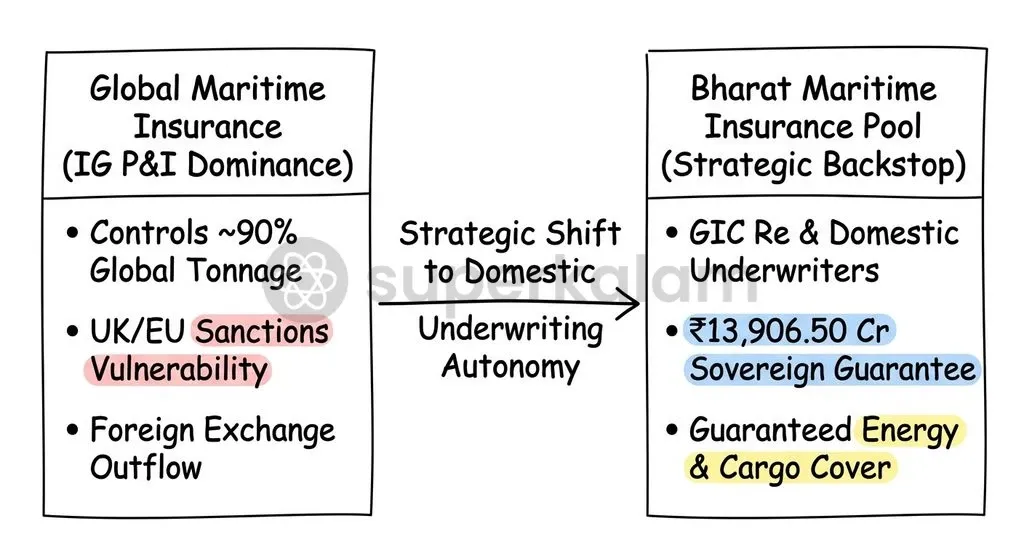
The International Group of P&I Clubs represents a mutual non-profit network of 12 to 13 Western-dominated member clubs that traditionally provides third-party liability cover for global shipping. Unlike standard commercial insurers that underwrite vessel hulls for profit, P&I clubs operate on a mutual indemnity model where shipowner members pool funds to absorb collective third-party losses.
Historically, the International Group of P&I Clubs has underwritten over 90% of global ocean-going tonnage, leaving almost all Indian merchant vessels reliant on Western financial syndicates. This concentration creates an asymmetric vulnerability for Indian foreign trade.
Because these clubs are predominantly domiciled in the United Kingdom, the European Union, and the United States, they must enforce Western sanction regimes, statutory bans, and territorial restrictions:
- Unilateral policy suspension: Clubs can suspend protection at short notice following overseas regulatory directives.
- Disrupted lawful trade: Indian vessels carrying lawful, non-sanctioned national cargo have repeatedly faced sudden insurance cancellations.
- Compliance hurdles: Exporters encounter prohibitive verification barriers that delay voyages and inflate transit costs.
Why India Needed a War-Risk Backstop: Geopolitical Tensions and Supply Chain Vulnerability
Recent conflicts revealed severe choke points in global trade financing. The Red Sea crisis and the Russia-Ukraine conflict exposed India's strategic vulnerability to unilateral cancellations and sudden premium spikes by Western marine underwriters.
Several concurrent pressures forced India to build its own underwriting shield:
- Escalating War Surcharges: Hostile drone strikes and missile attacks in the Bab-el-Mandeb strait prompted overseas insurers to label standard transit corridors as high-risk zones, sharply escalating war-risk premiums for commercial voyages.
- Sanctions Compliance Bottlenecks: The enforcement of G7 oil price cap sanctions created severe operational bottlenecks for Indian refiners sourcing crude across Eurasian routes. Western underwriters withdrew protection for vessels failing stringent documentation thresholds, threatening India's crude supply stability.
- Strategic Underwriting Autonomy: Establishing a domestic risk backstop became essential to prevent foreign syndicates from dictating terms on Indian trade corridors.
Following the operational roll-out of the BMIP framework, war-risk insurance premiums for India-linked maritime stakeholders dropped by 35% to 40% from their peak conflict levels. This reduction lowered freight surcharges, stabilised landing costs for essential commodities, and maintained commercial traffic through volatile waterways.
Discuss with Superkalam
How does Western jurisdiction over major P&I clubs directly impact India's lawful seaborne energy imports during regional conflicts?
Ask NowKey Features: Sovereign Guarantee, Coverage Scope, and GIC Re's Role
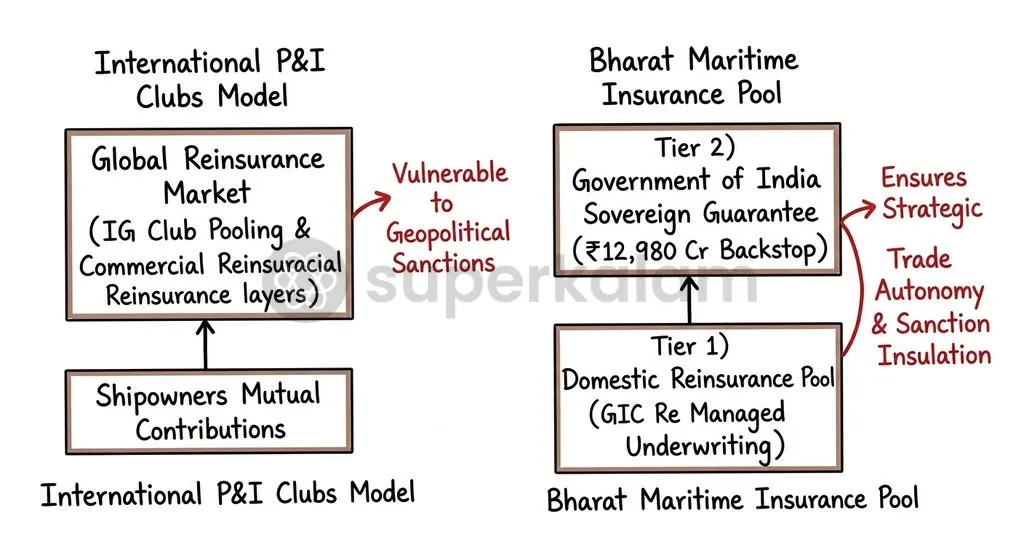
The General Insurance Corporation of India is the Pool Manager and Administrator for the USD 1.5 billion Bharat Maritime Insurance Pool facility. In this role, GIC Re enforces underwriting discipline, manages reinsurance treaty allocations, and processes claims under the oversight of a specialised Governing Body and Underwriting Committee.
The financial architecture relies on a two-tiered loss-absorption mechanism:
| Tier Level | Coverage Scope | Primary Funding Source |
|---|---|---|
| Tier-1: Primary Capital | Primary claims up to USD 100 million | Accumulated pool reserves, member contributions, and commercial market reinsurance recoveries |
| Tier-2: Sovereign Backstop | Catastrophic losses exceeding Tier-1 reserves | ₹12,980 crore (USD 1.4 billion) sovereign guarantee approved by the Union Cabinet |
The facility's coverage parameters extend across multiple vessel and cargo classes:
- Domestic fleet: Indian-flagged merchant vessels registered under the Directorate General of Shipping.
- Chartered tonnage: Foreign-flagged vessels chartered, owned, or commercially controlled by Indian entities.
- Exim trade cargo: International commercial ships transporting import or export cargo to and from Indian ports.
- High-risk corridors: Vessels transiting designated conflict zones or navigating under geopolitical sanctions regimes.
By September 7, 2026, the operational facility had underwritten over 3,000 Cargo War policies, 92 Hull War-risk policies, and 3 Protection & Indemnity policies.
Comparison: International P&I Clubs vs. Bharat Maritime Insurance Pool
The Bharat Maritime Insurance Pool differs structurally from traditional International Group P&I Clubs across institutional governance, risk-pooling models, and sovereign financial backing.
| Dimension | International Group of P&I Clubs (IG Clubs) | Bharat Maritime Insurance Pool (BMIP) |
|---|---|---|
| Institutional Form | Mutual non-profit associations owned by shipowner members | National insurance pool managed by GIC Re |
| Geographic Domicile | Concentrated predominantly in the UK, EU, US, and Japan | Domiciled in India under domestic financial regulation |
| Market Coverage | Underwrites >90% of global commercial ocean tonnage | Focuses on Indian-flagged, Indian-controlled, and India-bound/originating voyages |
| Financial Backing | Member calls, mutual pooling layers, and commercial reinsurance | Dedicated pool capital reserves backed by a ₹12,980 crore sovereign guarantee |
| Sanctions Compliance | Obligated to enforce Western unilateral sanctions and trade bans | Governed by Indian national interest and multilateral United Nations frameworks |
| Risk Scope | Primarily third-party indemnity (P&I) liabilities | Comprehensive: Hull & Machinery, Cargo, P&I, and War/Political perils |
Strategic Benefits: Trade Autonomy, Foreign Exchange Savings, and Energy Security
The Bharat Maritime Insurance Pool delivers critical strategic advantages across several dimensions of India's maritime economy:
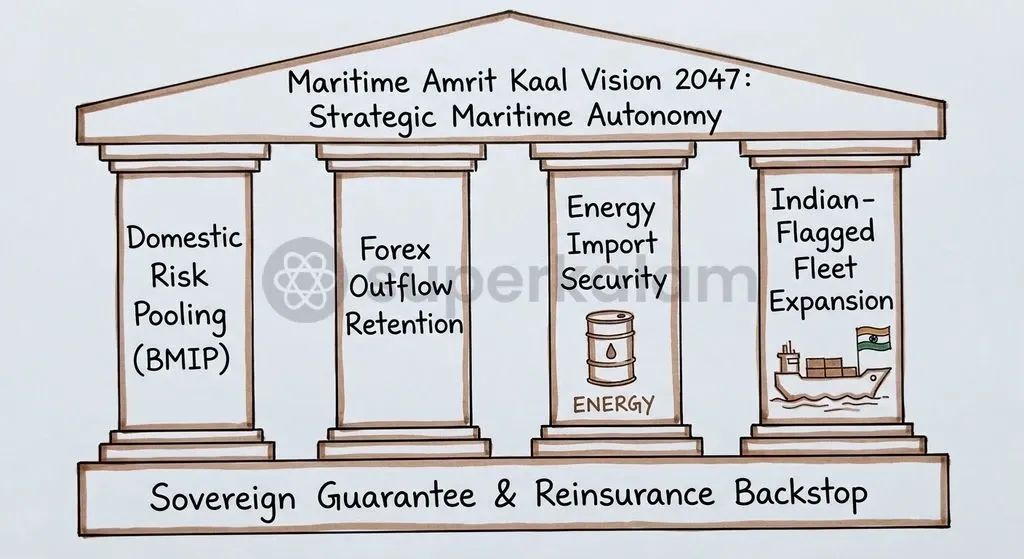
- Operational Alignment with Vision 2030: The Maritime India Vision 2030 gains direct operational support from the pool by securing national supply lines and lowering voyage expenses. Establishing domestic underwriting capacity insulates crude oil shipments from external sanctions, preserving price stability across domestic energy markets.
- Retention of Foreign Exchange: Domestic pooling retains vital financial capital within the country. Historically, Indian shipowners and exporters transferred substantial marine premium payments to overseas underwriters. The BMIP framework curtails these foreign exchange outflows by anchoring reinsurance and primary premiums within the Indian financial ecosystem.
- Boosting Domestic Tonnage and GIFT IFSC: The pool advances the Maritime Amrit Kaal Vision 2047 by encouraging shipping companies to flag vessels in India. Guaranteed access to war-risk insurance reduces maritime operational risks, encouraging domestic fleet acquisition and supporting the growth of maritime financing centres such as GIFT IFSC in Gujarat.
Discuss with Superkalam
Assess the effectiveness of a two-tiered loss-absorption model in balancing commercial reinsurance limits with sovereign fiscal exposure.
Ask NowChallenges Ahead: Building Capital Depth, Global Acceptance, and Reinsurance Limits
The Insurance Regulatory and Development Authority of India faces distinct structural hurdles in scaling the pool:
- Capital Depth vs. Catastrophic Liabilities: While the overall pool stands at USD 1.5 billion, with initially stated combined underwriting capacity of around ₹950 crore, extreme maritime disasters—such as a Very Large Crude Carrier (VLCC) collision or deep-water environmental contamination—frequently generate third-party damage claims running into billions of dollars.
- Fiscal Exposure from Sovereign Guarantees: The ₹12,980 crore sovereign guarantee represents an explicit contingent liability on the Union exchequer. A series of catastrophic maritime incidents in high-risk war zones could exhaust the initial USD 100 million tier-1 pool reserves, forcing the exchequer to absorb heavy payouts. Balancing sovereign exposure against market underwriting capacity requires strict loss-prevention audits and disciplined risk-pricing models by GIC Re.
- International Port and Legal Acceptance: Foreign port state authorities, terminal operators, and international maritime lenders often insist on third-party liability cover issued exclusively by International Group P&I Club members. Securing bilateral recognition for BMIP certificates in foreign jurisdictions requires sustained diplomatic negotiations and proof of financial solvency.
Way Forward: Strengthening India's Maritime Financial Ecosystem
The Ministry of Ports, Shipping and Waterways must institutionalise a multi-tiered strategy to transition the Bharat Maritime Insurance Pool into a full-fledged mutual protection club. The pool should progressively expand its risk capital base, migrating from a government-supported war-risk vehicle toward a self-sustaining mutual Indian P&I Club capable of competing globally.
To achieve long-term resilience, policymakers should pursue the following measures:
- Deepening Reinsurance Syndication: Diversify secondary reinsurance treaties across non-Western, Asian, and Middle Eastern reinsurance markets to distribute underwriting concentration.
- Incentivising GIFT IFSC Operations: Offer targeted tax exemptions and streamlined regulatory clearances for maritime insurance brokers and protection syndicates setting up in IFSC hubs.
- Securing Bilateral Port Recognition: Execute bilateral maritime pacts with major trade partners across Southeast Asia, Africa, and the Middle East to guarantee reciprocal recognition of BMIP-issued P&I certificates.
- Promoting Domestic Flagging: Link public sector cargo carriage mandates to Indian-flagged vessels insured through domestic pool facilities, generating consistent premium volume.
Discuss with Superkalam
What institutional and regulatory measures should India adopt to ensure foreign ports and global shipping registries universally accept BMIP indemnity certificates?
Ask NowKey Takeaways
The Bharat Maritime Insurance Pool establishes an autonomous financial shield to insulate India's maritime supply chains from external geopolitical shocks.
- Cabinet Sanction & Scale: The Union Cabinet approved the pool on April 18, 2026, with initially stated combined underwriting capacity of around ₹950 crore and a ₹12,980 crore sovereign guarantee.
- Administration & Scope: Managed by GIC Re, the facility underwrites Hull and Machinery, Cargo, Protection and Indemnity (P&I), and War Risks for Indian and India-bound commercial vessels.
- Overcoming Oligopoly: The pool provides an alternative to Western-dominated International Group P&I Clubs, which historically covered over 90% of global tonnage.
- Commercial Impact: Following operationalisation, war-risk insurance premiums for India-linked maritime stakeholders fell by 35% to 40% from peak conflict levels.
- Strategic Alignment: The initiative directly supports the Maritime India Vision 2030 and Maritime Amrit Kaal Vision 2047, conserving foreign exchange and strengthening domestic maritime hubs.
Mains Question
"Excessive reliance on Western-dominated Protection and Indemnity (P&I) clubs creates an asymmetric vulnerability for India's maritime commerce during geopolitical crises." In light of this statement, examine how the Bharat Maritime Insurance Pool (BMIP) enhances India's strategic trade autonomy. (10 Marks)
Evaluate NowMains Question
The establishment of the Bharat Maritime Insurance Pool represents a shift from passive risk absorption to active financial statecraft. Critically analyse the structural architecture of this facility and the challenges it faces in achieving global maritime acceptance. (15 Marks)
Evaluate NowPractice MCQs
QUESTION 1
With reference to the Bharat Maritime Insurance Pool (BMIP), consider the following statements:
- It functions as a domestic underwriting backstop anchored by the General Insurance Corporation of India (GIC Re).
- It provides risk coverage exclusively to Indian-flagged merchant vessels.
- It incorporates a two-tiered loss-absorption structure featuring a sovereign guarantee for catastrophic claims exceeding primary capital reserves.
Which of the statements given above are correct?
QUESTION 2
Consider the following statements regarding the International Group of Protection and Indemnity (P&I) Clubs:
- They operate primarily as mutual non-profit associations owned by shipowner members.
- They historically underwrite over 90% of global commercial ocean-going tonnage.
- Being predominantly domiciled in Western jurisdictions, they are bound to enforce unilateral Western sanctions and territorial restrictions.
Which of the statements given above is/are correct?
QUESTION 3
Which of the following risk segments are covered under the underwriting scope of the Bharat Maritime Insurance Pool?
- Hull and Machinery (H&M)
- Third-party Protection and Indemnity (P&I)
- Cargo in Transit
- War and Political Risks
Select the correct answer using the code given below:
QUESTION 4
Under the financial architecture of the Bharat Maritime Insurance Pool (BMIP), what is the threshold limit for Tier-1 primary claims absorption before the sovereign guarantee backstop is activated?
QUESTION 5
Consider the following statements regarding the strategic impact of the Bharat Maritime Insurance Pool:
- It directly supports the operational objectives of Maritime India Vision 2030.
- Following its operational roll-out, war-risk insurance premiums for India-linked maritime stakeholders declined by 35% to 40% from peak conflict levels.
Which of the statements given above is/are correct?