National Digital Tourism Stack: India's 2026 Announcement
India announced a National Digital Tourism Stack on World Tourism Day 2026. See what was stated and which design and rollout details remain open.
Sep, 2026
•7 min read

Overview
The National Digital Tourism Stack is India's open Digital Public Infrastructure for the hospitality sector. Developed by the Ministry of Tourism alongside the Open Network for Digital Commerce (ONDC), it unbundles travel services and curtails steep platform commissions. The framework links transport, accommodation, and ticketing into a unified digital ecosystem.
Built on open protocols, the architecture connects verified service providers directly with travellers without commercial lock-in. It operates atop established national rails like UPI and DigiLocker to authenticate operators and settle transactions. This initiative aims to democratise market visibility for rural homestays while steering the tourism sector toward a 10% GDP contribution by 2047.
Why in the News?
Union Minister for Tourism and Culture Gajendra Singh Shekhawat launched the National Digital Tourism Stack at Bharat Mandapam in New Delhi on World Tourism Day, September 27, 2026. The launch aligned with the United Nations Tourism theme, Digital Agenda and Artificial Intelligence to Redesign Tourism.
Alongside the stack, the Ministry unveiled the National Mission for Alternative Destinations under the Dekho Apna Desh Campaign 2.0 to ease congestion at prominent heritage sites. To accelerate ecosystem onboarding, the Ministry formalised five Memoranda of Understanding with key industry partners:
- Airbnb India (homestay integration and capacity building)
- FlixBus India (intercity road mobility)
- Glance Digital Experience (content discovery and engagement)
- Eicher Group Foundation (responsible tourism corridors)
- MakeMyTrip (catalogue onboarding and technical alignment)
What is the National Digital Tourism Stack (NDTS)?
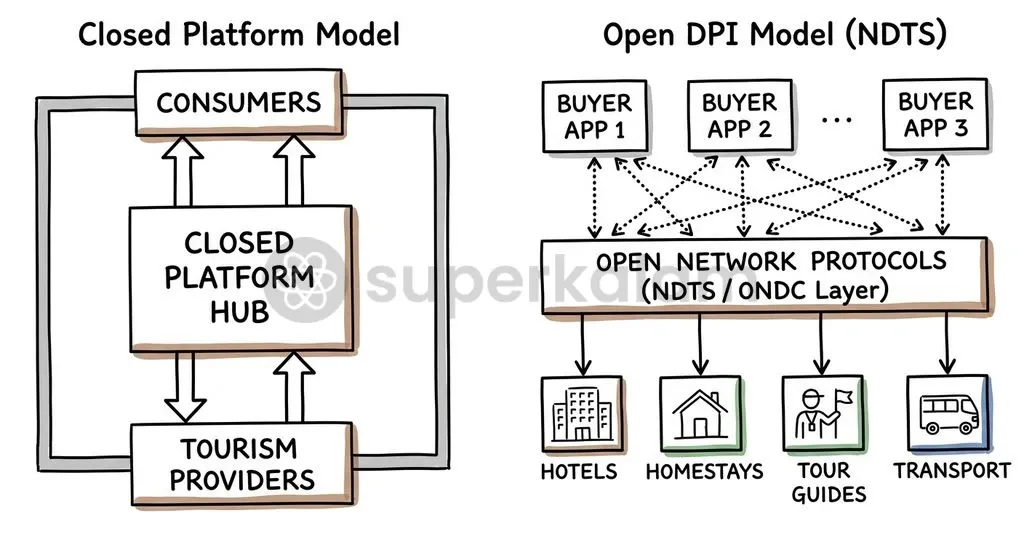
The National Digital Tourism Stack is an open Digital Public Infrastructure initiative designed by the Ministry of Tourism alongside the Open Network for Digital Commerce and the International Centre for DPI Innovation and Advancement. Rather than operating as a centralised government portal or commercial aggregator, the system provides open digital rails that allow buyers and sellers to interact transparently across diverse applications.
Commercial Online Travel Aggregators (OTAs) currently operate closed marketplaces where discovery, booking, and payment remain captive within single applications. In contrast, NDTS unbundles these services through interoperable open protocols. A traveller on any participating consumer application can discover a rural homestay or book a monument pass listed across independent supplier applications.
| Dimension | Proprietary Travel Aggregators | National Digital Tourism Stack (NDTS) |
|---|---|---|
| Network Architecture | Closed, platform-centric walled garden | Open, interoperable Digital Public Infrastructure |
| Market Access | Controlled by proprietary platform algorithms | Democratised discovery across open network nodes |
| Intermediary Costs | High commissions ranging from 15% to 30% | Unbundled, low-cost transaction processing |
| Data Ownership | Monopolised by commercial platform operators | User-controlled, consent-based data sharing |
| Ecosystem Reach | Concentrated around commercial hospitality chains | Inclusive of rural homestays, MSMEs, and local guides |
Discuss with Superkalam
Recall the GDP contribution of the tourism sector in FY 2023-24 and the policy target set for 2047.
Ask NowHow NDTS Fits into the India Stack Architecture
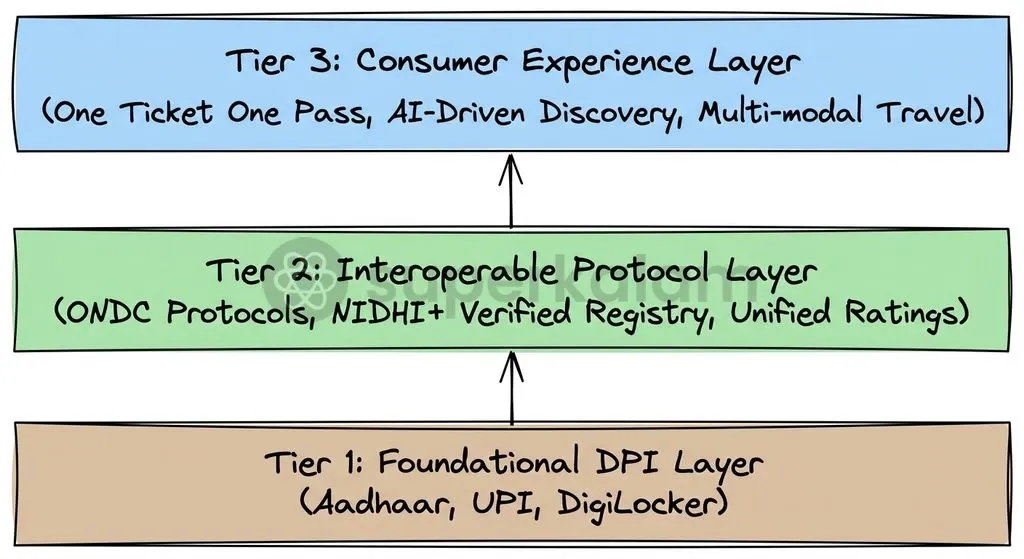
India Stack provides the identity, payments, and data-governance layers that enable NDTS to operate across public and private platforms. The tourism stack sits directly atop these population-scale rails, translating broad transaction standards into sector-specific travel solutions.
Key integration rails include:
- Verifiable Identity Layer: Utilises Aadhaar-based authentication and DigiLocker integration for instant credential checks of tour guides, vehicle operators, and homestay premises. This removes repetitive physical verification and builds institutional trust across state borders.
- Payment & Settlement Layer: Operates via the Unified Payments Interface, supporting automated split payments that distribute single-ticket proceeds simultaneously among transport operators, monument authorities, and local guides.
- Transaction Protocol Layer: Powered by open ONDC protocols, which standardise catalogue discovery and booking execution without creating centralised intermediary chokepoints.
Discuss with Superkalam
Explain how the unbundled architecture of NDTS differs from the closed ecosystem of commercial Online Travel Aggregators (OTAs).
Ask NowKey Features and Pillars of the Tourism Stack
The architecture standardises supplier credentials, discovery, payment settlement, rating registries, and consumer grievance redressal mechanisms. These modular layers ensure that regional micro-enterprises can participate without building expensive proprietary software.
The stack operates around three major functional pillars:
- One Ticket, One Pass Framework: Employs an AI-enabled framework facilitating a unified ticketing pass. Travellers combine multimodal transport, monument admissions, and guided experiences into a single interoperable QR-based credential.
- Verified Supplier Registry: Integrates with the National Integrated Database of Hospitality Industry (NIDHI+) portal. As of September 23, 2026, the NIDHI+ database registered 63,740 accommodation units, 1,450 online travel aggregators, and 15,531 tourism service providers.
- Decentralised Rating System: Enables portable, cross-platform feedback so small operators can carry their reputation across any buyer app on the network.
Why India Needs a Digital Stack for Tourism
India requires open tourism rails to democratise market visibility for unorganised micro-enterprises and overcome steep commercial platform fees. According to Ministry of Tourism data, the tourism sector contributed 5.22% to national GDP and supported 8.46 crore jobs in fiscal year 2023-24.
Expanding the sector to achieve the Union Government's target of a 10% GDP contribution by 2047 requires incorporating lesser-known regional destinations into mainstream commercial discovery.
Core structural drivers include:
- Managing High Tourism Volumes: In calendar year 2025, India recorded 428.55 crore domestic tourist visits and 2.53 crore foreign tourist visits, generating ₹2,76,831 crore in foreign exchange earnings. Open discovery distributes this economic traffic to emerging destinations.
- Eliminating Excessive Intermediary Fees: Commercial aggregators frequently charge commissions of 15% to 30%, creating severe margin pressure for rural homestays and artisanal cooperatives.
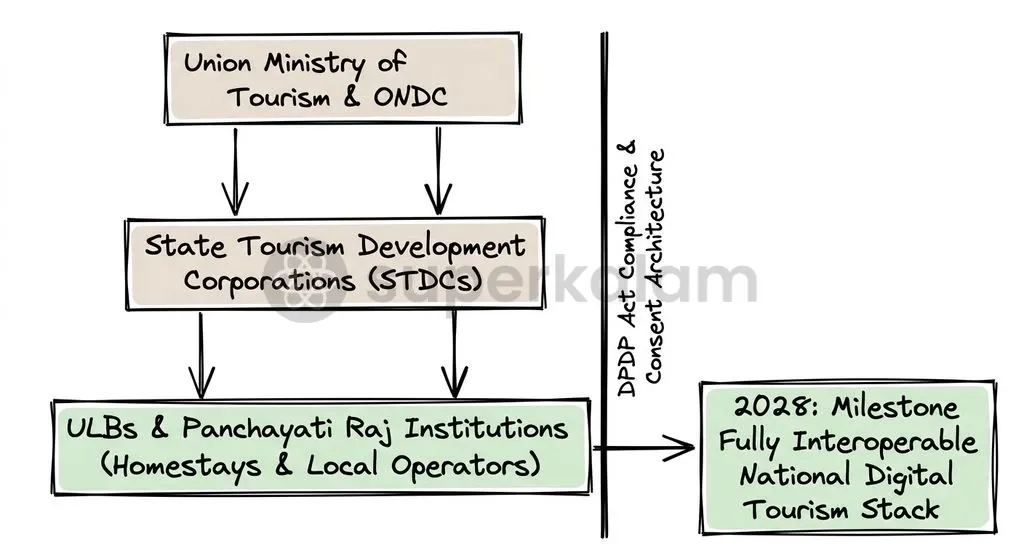
- Targeted Grassroots Onboarding: The Ministry has set a roadmap to onboard 23,000 tourism experiences and homestays onto the network by the end of 2028, with pilot rollouts commencing in January 2027.
Discuss with Superkalam
How can a rural homestay operator apply the 'One Ticket, One Pass' and UPI split payment mechanisms to partner with local transport providers?
Ask NowMajor Implementation Challenges and Data Privacy Concerns
Deploying the National Digital Tourism Stack involves navigating federal administrative friction alongside strict statutory data protection rules.
The primary operational and legal bottlenecks comprise:
- Centre-State Administrative Coordination: Tourism administration, monument licensing, local transport permits, and municipal levies operate under State Tourism Development Corporations (STDCs) and local bodies. Synchronising disparate state databases and legacy ticketing systems into a common taxonomy remains difficult.
- Uneven Digital Infrastructure: Disparities in technical readiness across state departments risk creating uneven regional adoption during initial pilot rollouts.
- Data Privacy & Statutory Compliance: Network operations must strictly adhere to the Digital Personal Data Protection Act, 2023 (DPDP Act). The statutory principles of purpose limitation and data minimisation govern passenger tracking, booking aggregation, and identity validation.
- Consent Architecture: Service providers must deploy secure consent protocols to prevent unauthorised commercial profiling and consumer data scraping across open network nodes.
Discuss with Superkalam
Analyse the structural challenges that Centre-State administrative differences present when integrating State Tourism Development Corporations into NDTS.
Ask NowWay Forward: Building an Interoperable Tourism Ecosystem
A successful national rollout requires institutional alignment, technical standardisation, and targeted capacity building across all levels of government.
Key policy priorities include:
- Institutionalising Federal Cooperation: Establishing joint technical working groups with State Tourism Development Corporations to adopt unified API specifications and booking protocols.
- Grassroots Digital Enablement: Conducting structured digital literacy campaigns to help rural homestay operators and artisanal clusters manage ONDC-enabled seller software.
- Responsive Grievance Resolution: Setting up clear, multi-tiered dispute redressal mechanisms across buyer and seller applications to protect consumer rights.
- Strict Privacy Safeguards: Enforcing verifiable compliance with the DPDP Act, 2023 to maintain strong consumer trust across all decentralised identity transactions.
Key Takeaways
- The Ministry of Tourism launched the National Digital Tourism Stack on World Tourism Day, September 27, 2026, in collaboration with ONDC and ICDIA.
- Built as an open Digital Public Infrastructure, the stack leverages UPI for payments, DigiLocker for authentication, and ONDC protocols for unbundled discovery.
- The platform incorporates a 'One ticket, One pass' framework to unify bookings across transport, accommodation, and cultural sites into a single digital credential.
- In fiscal year 2023-24, tourism contributed 5.22% to India's GDP and supported 8.46 crore jobs, with a policy target to reach 10% of GDP by 2047.
- Implementation targets include onboarding 23,000 homestays and tourism experiences by 2028, beginning with pilot deployments in January 2027.
- Addressing federal administrative friction across State Tourism Development Corporations and ensuring strict DPDP Act, 2023 compliance remain vital for long-term adoption.
Mains Question
"The transition from closed proprietary travel aggregators to an open Digital Public Infrastructure (DPI) architecture can democratise India's tourism economy." Elucidate in light of the National Digital Tourism Stack (NDTS). (10 Marks)
Evaluate NowMains Question
"While the National Digital Tourism Stack promises an unbundled and interoperable tourism ecosystem, its success hinges on overcoming federal administrative friction and strict adherence to data protection norms." Critically examine. (15 Marks)
Evaluate NowPractice MCQs
QUESTION 1
With reference to the National Digital Tourism Stack (NDTS), consider the following statements:
- It functions as a centralised government-owned Online Travel Aggregator (OTA) to replace private booking platforms.
- It leverages the open protocols of the Open Network for Digital Commerce (ONDC) to unbundle travel discovery, booking, and payment services.
- It integrates with the National Integrated Database of Hospitality Industry (NIDHI+) portal for supplier verification.
Which of the statements given above are correct?
QUESTION 2
Consider the following statements regarding the integration of the National Digital Tourism Stack with India Stack:
- It employs Aadhaar-based authentication and DigiLocker for credential verification of tour guides and homestays.
- It utilises the Unified Payments Interface (UPI) to enable automated split payments among multiple service providers from a single ticket transaction.
- The 'One Ticket, One Pass' framework generates an interoperable QR-based credential covering multimodal transport and monument admissions.
Which of the statements given above is/are correct?
QUESTION 3
According to official data from the Ministry of Tourism highlighted in the context of the National Digital Tourism Stack, consider the following statements:
- The tourism sector contributed over 15% to India's national GDP in the fiscal year 2023-24.
- The Union Government has set a policy target for tourism to contribute 10% to the national GDP by 2047.
- In calendar year 2025, domestic tourist visits in India exceeded 400 crore visits.
Which of the statements given above is/are correct?
QUESTION 4
Which of the following initiatives was launched alongside the National Digital Tourism Stack under the Dekho Apna Desh Campaign 2.0 to ease tourist congestion at prominent heritage sites?
QUESTION 5
With reference to the governance and data privacy compliance of the National Digital Tourism Stack, consider the following statements:
- Network operations must strictly adhere to the data minimisation and purpose limitation principles under the Digital Personal Data Protection Act, 2023.
- The stack bypasses State Tourism Development Corporations to maintain direct Union-level statutory control over all local tourism licensing.
Which of the statements given above is/are correct?