Spandan One Tele-ECG in Haryana: Rural Cardiac Care Case Study
Spandan One uses tele-ECG in Haryana's rural care pathway. See the reported triage model, referral needs and limits of the available evidence.
Sep, 2026
•8 min read
Overview
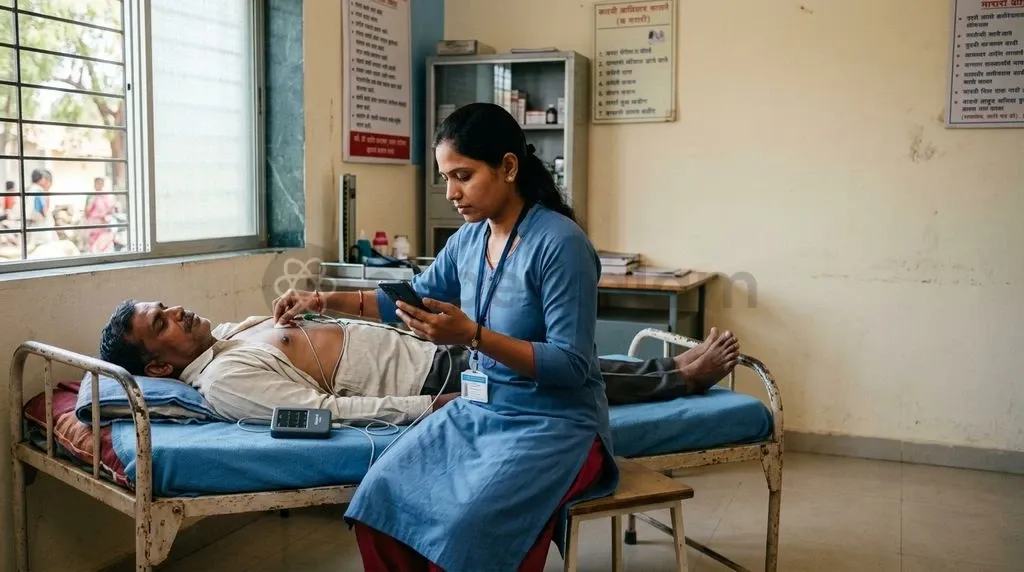
The Haryana government's Spandan One Tele-ECG initiative shows how smartphone diagnostics bridge rural specialist shortages. Remote cardiologists deliver verified interpretations within minutes across hundreds of primary clinics.
By decentralising cardiac triage across 600 public healthcare centres, the programme targets rapid ST-Elevation Myocardial Infarction identification during the golden hour. Yet digital screening alone cannot cut cardiovascular deaths without synchronised investments in rural emergency transport, essential thrombolytic drugs, and secondary hospital infrastructure.
Why Haryana's Tele-ECG Model Is in the Spotlight
The Haryana Department of Health and Family Welfare launched the Spandan One Tele-ECG initiative on 29 May 2026 under a public-private partnership with health-tech enterprise Sunfox Technologies. This statewide deployment addresses acute cardiac emergencies across rural areas where specialist cardiologists are rarely stationed at the primary care level.
As of September 2026, the Spandan ONE dashboard recorded 33,854 completed ECG tests across the state network. The operational outcomes show:
- 9,287 abnormal ECG patterns identified across rural and sub-divisional clinics.
- 1,342 critical cardiac emergencies flagged for urgent clinical intervention.
NITI Aayog has recognised the Spandan portable diagnostic device as a national healthcare best practice for deploying affordable, AI-enabled cardiac monitoring within resource-constrained public health settings. The project offers an empirical case study for evaluating how digital health innovations perform when integrated into state healthcare systems.
Discuss with Superkalam
What is the average turnaround time achieved by the centralised tele-interpretation hub under Haryana's Spandan Tele-ECG model?
Ask NowWhat Is the Spandan Tele-ECG Initiative?
The Spandan One network connects 600 public healthcare facilities across Haryana to a centralised tele-interpretation hub to facilitate rapid cardiac evaluation. The operational footprint encompasses 408 Primary Health Centres (PHCs), 121 Community Health Centres (CHCs), and 71 District Civil and Sub-Divisional Hospitals.
Under this operating framework, a compact, smartphone-linked diagnostic tool captures medical-grade electrocardiograms at the point of care. Frontline healthcare workers record standard 12-lead ECG tracings—which measure the heart's electrical activity across twelve distinct anatomical views—and upload them to a dedicated cloud platform.
The state government structured the service at a fixed cost of ₹89 per test, which covers hardware deployment, cloud transmission, and specialist medical reporting. A centralised team of qualified cardiologists interprets incoming tracings, delivering verified digital reports back to rural clinics in an average turnaround time of 2 minutes and 37 seconds.
| Dimension | Conventional Rural Cardiac Triage | Spandan Tele-ECG Model |
|---|---|---|
| Diagnostic Access | Restricted to tertiary centres or district hospitals with on-site specialists | Available at 600 decentralised PHCs, CHCs, and sub-divisional hospitals |
| Turnaround Time | Several hours to days due to transit and manual specialist queues | 2 minutes and 37 seconds average reporting time via remote cloud hubs |
| Unit Cost to System | High capital expenditure for bulky standalone hospital ECG machines | ₹89 per test inclusive of cloud transfer and tele-cardiologist review |
| Clinical Focus | Delayed detection often past the therapeutic window | Rapid identification of acute ST-Elevation Myocardial Infarction |
How Digital Cardiac Triage Works in Rural Clinics
Rural medical officers and nursing staff deploy the portable Spandan unit by attaching standard thoracic and limb electrodes to patients presenting with acute chest discomfort. The device digitises the microvoltage fluctuations of the myocardium and constructs derived 12-lead vectors via a mobile interface.
Peer-reviewed clinical validation published in Cardiology Research confirmed that smartphone-based derived 12-lead ECGs from Spandan achieve high concordance with standard ECGs for identifying acute ST-elevation myocardial infarction (STEMI) and informing percutaneous coronary intervention decisions. This diagnostic accuracy allows non-specialist medical officers at primary clinics to detect complete coronary artery occlusions without awaiting physical referral to tertiary facilities.
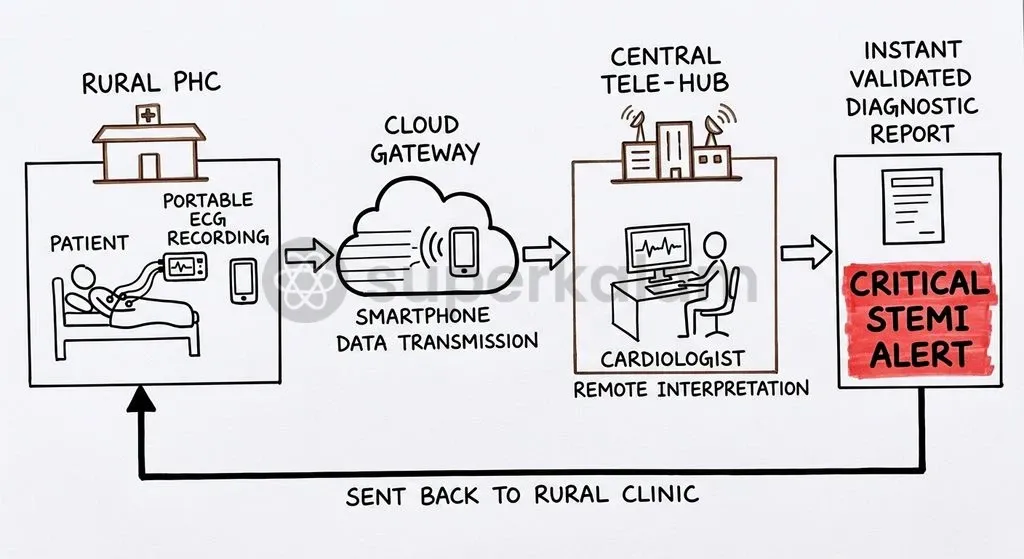
The complete workflow follows a structured four-stage digital triage pipeline:
- Point-of-Care Acquisition: Frontline healthcare workers record the 12-lead tracing using the smartphone-connected device at rural PHCs or CHCs.
- Encrypted Cloud Transmission: The diagnostic data uploads securely to the central tele-cardiology server via mobile data networks.
- Cardiologist Review: A panel of remote cardiologists reviews the rhythm strips, annotates abnormalities, and confirms acute STEMI patterns.
- Actionable Alert Dispatch: The verified diagnostic report returns to the treating rural clinic with immediate referral or medication advice.
Discuss with Superkalam
Explain how administering primary loading pharmacotherapy at rural PHCs helps bridge the geographical distance to tertiary cardiac catheterisation centres.
Ask NowThe Promise: Saving the Golden Hour and Specialist Bridging
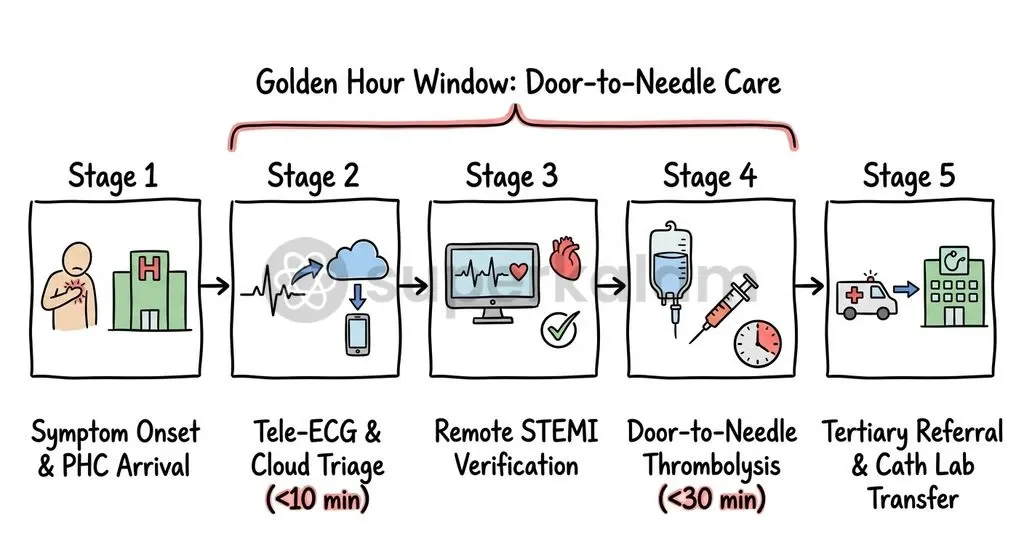
The Indian Council of Medical Research (ICMR) STEMI Guidelines define the 60-minute Golden Hour as the critical window during which prompt reperfusion therapy can prevent irreversible myocardial necrosis and mortality. In conventional rural setups, transit delays and absent diagnostic tools frequently cause patients to miss this therapeutic window.
By compressing diagnostic turnaround to under three minutes, tele-ECG networks enable medical officers to initiate early pharmacotherapy protocols. The clinical strategy relies on two sequential steps:
- Primary Stabilisation: Administering loading doses—such as dual antiplatelet therapy and thrombolytic agents like Tenecteplase—at rural clinics before moving patients to higher centres.
- Bridging Geographical Distance: Clot-dissolving therapy administered at a primary health centre restores coronary blood flow, extending the viable window for secondary transport to tertiary cardiac catheterisation laboratories.
Ground Realities: Referral Bottlenecks and Evidence Limits
The Haryana Directorate General of Health Services (DGHS) encountered immediate operational hurdles after introducing the technology across primary healthcare facilities. Systemic shortages of dedicated ECG technicians forced the health department to issue administrative directives mandating general nursing staff to operate the diagnostic devices.
Grassroots friction exposed several systemic constraints in the rural chain of survival:
- Operator Error and Artifacts: Initial deployment figures revealed that over 1,180 initial ECG tests required immediate repeat tracings because operators placed electrodes improperly.
- Ambulance Transit Delays: Critical referral survival remains severely constrained by transit delays among 108 Advanced Life Support ambulances navigating long distances between rural health outposts and tertiary cardiac facilities.
- Infrastructure Gaps: Rapid digital detection provides little clinical value if an unstable patient cannot access timely medical transport.
Discuss with Superkalam
Analyze the systemic factors that cause a gap between rapid digital screening and actual patient survival rates in rural health emergency networks.
Ask NowScreening Versus Treatment: The Infrastructure Gap
The National Programme for Prevention and Control of Non-Communicable Diseases operational framework highlights that diagnostic triage networks require functional therapeutic infrastructure at the destination facility. Detecting a fatal myocardial infarction in two minutes does not prevent cardiac arrest if the diagnosing facility lacks basic resuscitation equipment.
Peripheral health centres face clear physical limitations during acute emergencies:
- Absence of Intensive Care: Primary Health Centres across the public health system frequently lack round-the-clock intensive care beds, bedside defibrillators, and on-site catheterisation facilities.
- Clinical Distress: An acute diagnostic alert can trigger severe clinical anxiety at primary centres unable to deliver advanced hemodynamic support.
- Care Continuum Deficits: Equipping a peripheral clinic with a digital sensor creates an effective screening post, but saving lives requires a fully equipped, continuous chain of care.
Ethical and Governance Challenges in Digital Diagnostics
The National Health Authority (NHA) requires all digital health interventions under the Ayushman Bharat Digital Mission (ABDM) to maintain strict data protection standards. Tele-cardiology networks must integrate electronic health records with secure cloud architectures to guarantee end-to-end data encryption and enforce explicit patient consent mechanisms.
Remote diagnostic governance involves specific legal and clinical safeguards:
- Diagnostic Liability: When a remote cardiologist interprets an artifact-heavy tracing generated by an untrained rural operator, establishing accountability for misinterpretation requires clear institutional protocols.
- Risk of False Reassurance: A normal resting 12-lead ECG does not exclude dynamic coronary ischemia or Non-ST-Elevation Myocardial Infarction, meaning a negative screening test could lead rural practitioners to discharge patients who remain at high acute risk.
Discuss with Superkalam
Design a policy framework that state health administrations should adopt to integrate point-of-care tele-diagnostics into a comprehensive hub-and-spoke emergency care continuum.
Ask NowPolicy Lessons and the Way Forward for Rural Healthcare
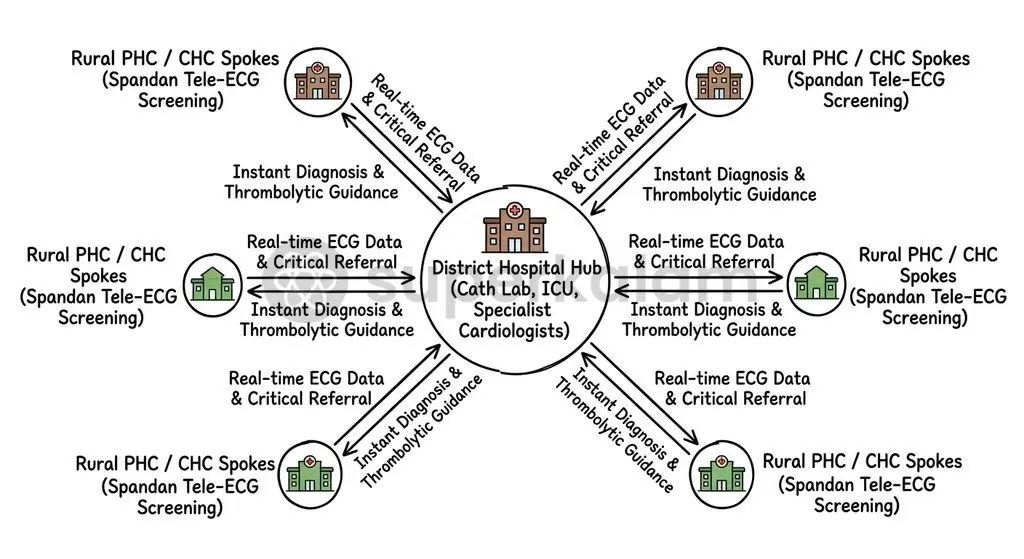
The Ministry of Health and Family Welfare recommends establishing structured hub-and-spoke STEMI networks that link rural primary spokes directly with district-level cardiac catheterisation hubs. Digital triage platforms must be the diagnostic trigger within a wider emergency ecosystem rather than operating as standalone technological interventions.
State health administrations can strengthen digital triage initiatives through four key policy reforms:
- Stocking Essential Thrombolytic Pharmacotherapy: Health departments must ensure uninterrupted supplies of weight-adjusted thrombolytics, such as Tenecteplase, alongside standard dual antiplatelet loading packs across all participating CHCs and PHCs.
- Institutionalising Dedicated Ambulance Dispatch: Emergency response systems must link the tele-ECG dashboard directly with 108 Advanced Life Support ambulance GPS trackers, automating transport dispatch the moment a critical STEMI alert is validated.
- Continuous Grassroots Technical Skilling: District health societies should institute recurring, hands-on training modules for multipurpose health workers and community health officers to eliminate electrode placement artifacts.
- Harmonising ABDM Health Information Standards: State tele-cardiology platforms must adopt universal Ayushman Bharat Health Account (ABHA) IDs, ensuring diagnostic tracings flow seamlessly into longitudinal electronic health records across primary, secondary, and tertiary tiers.
Key Takeaways
- The Haryana government deployed the Spandan One Tele-ECG initiative across 600 public healthcare facilities to deliver rapid point-of-care cardiac triage at ₹89 per test.
- Cloud-based cardiologist interpretations achieved an average turnaround time of 2 minutes and 37 seconds, aiding early detection of acute ST-Elevation Myocardial Infarction.
- As of September 2026, the statewide network evaluated 33,854 patients, detecting 1,342 critical cardiac emergencies during routine primary care triage.
- Clinical efficacy depends on pairing rapid digital detection with immediate loading doses and thrombolysis before referral delays erode the 60-minute golden hour.
- Systemic bottlenecks—including 108 ambulance transit delays, lack of primary ICU beds, and baseline operator electrode errors—highlight that tele-diagnostics must be backed by secondary health infrastructure.
Mains Question
"Digital diagnostic tools can decentralise triage during the Golden Hour, but screening without therapeutic capacity fails to reduce mortality." In light of Haryana's Spandan Tele-ECG initiative, critically analyse the operational and infrastructural bottlenecks in rural emergency cardiac care. (15 Marks)
Evaluate NowMains Question
Evaluate the role of smartphone-enabled point-of-care diagnostics in bridging rural specialist shortages within India's public healthcare system. (10 Marks)
Evaluate NowPractice MCQs
QUESTION 1
With reference to the management of acute cardiac emergencies in rural public healthcare systems, consider the following statements:
- The Golden Hour refers to the critical 60-minute window during which reperfusion therapy can prevent irreversible myocardial necrosis.
- Standard 12-lead electrocardiograms measure the heart's electrical activity across twelve distinct anatomical views.
- A completely normal resting 12-lead ECG definitively rules out dynamic coronary ischemia and Non-ST-Elevation Myocardial Infarction.
Which of the statements given above is/are correct?
QUESTION 2
Regarding the Spandan Tele-ECG initiative implemented in Haryana, consider the following statements:
- It functions under a public-private partnership between the state health department and Sunfox Technologies.
- The network connects Primary Health Centres, Community Health Centres, and Sub-Divisional Hospitals to a central tele-cardiology interpretation hub.
- The initiative utilizes standalone, bulky hospital-grade ECG machinery to eliminate operator-dependent electrode artifacts.
Which of the statements given above is/are correct?
QUESTION 3
Consider the following statements regarding the integration of digital diagnostic tools under the Ayushman Bharat Digital Mission (ABDM):
- Digital health interventions are mandated by the National Health Authority (NHA) to maintain end-to-end data encryption.
- Digital cardiac triage protocols require secondary therapeutic infrastructure, such as catheterisation laboratories, at the primary screening centre itself.
- Tele-ECG systems can be used to initiate early loading pharmacotherapy protocols before tertiary referral.
Which of the statements given above is/are correct?
QUESTION 4
Which among the following best describes the clinical objective of administering thrombolytic agents like Tenecteplase during primary cardiac stabilisation in rural clinics?
QUESTION 5
Consider the following operational constraints encountered during the deployment of rural tele-diagnostic healthcare networks:
- Operator-induced artifacts due to shortages of dedicated diagnostic technicians
- Transit delays involving Advanced Life Support ambulances over long referral routes
- Absence of round-the-clock intensive care beds and bedside defibrillators at primary health outposts
Which of the above are recognized challenges that limit the effectiveness of digital screening alone?