Digital Arrest Scam: Legal Framework, Modus Operandi, and Institutional Safeguards
As cyber syndicates weaponise fear via video calls, statutory procedural safeguards under BNSS render remote confinement an absolute legal impossibility.
Nov, 2026
•12 min read

Overview
A 'digital arrest' is an extortion scam where criminals impersonate law enforcement officers over video calls to confine victims inside their homes under psychological duress. Indian criminal law recognises no concept of remote detention.
Fraudsters use forged arrest warrants and fabricated courtroom backgrounds to threaten immediate prosecution under national security statutes. They coerce victims into liquidating life savings into fraudulent accounts. In response to these transnational syndicates, the Supreme Court of India initiated suo motu proceedings to mandate banking safeguards and institutional accountability.
Statutory criminal procedure strictly mandates physical custody, formal documentation, and legal representation. Understanding these procedural barriers remains the primary defence against cyber extortion.
Why Is the Digital Arrest Scam in the News?
The Supreme Court of India registered a suo motu writ petition titled In Re: Victims of Digital Arrest Related to Forged Documents to curb nationwide extortion by cyber syndicates impersonating law enforcement officers. According to Supreme Court records from October 2025, the bench intervened after observing criminal networks using forged warrants and emblems to subject citizens to prolonged virtual confinement.
Judicial scrutiny accelerated through consecutive directives issued to regulatory and enforcement authorities. On 4 August 2026, the Supreme Court directed the Reserve Bank of India to formulate a Standard Operating Procedure requiring commercial banks to place temporary debit holds on accounts flagged for fraudulent inflows. The bench expanded this oversight on 29 October 2026, calling upon the Reserve Bank of India to mandate full institutional indemnification for victims whenever cyber fraud succeeds due to internal banking negligence or Know Your Customer compliance failures.
| Date | Supreme Court Intervention (2025–2026) |
|---|---|
| October 2025 | Initiated Suo Motu Writ Petition (Crl.) No. 3/2025 to curb digital arrest extortion |
| 4 August 2026 | Mandated RBI SOP on temporary debit holds and fund recovery protocols |
| 29 October 2026 | Proposed bank indemnification for KYC lapses and internal monitoring failures |
High-level public interventions have similarly targeted the psychological manipulation underpinning these crimes. Prime Minister Narendra Modi addressed the threat during his 115th Mann Ki Baat broadcast on 27 October 2024, cautioning that statutory investigative agencies never contact citizens through video calls or demand financial transfers. Prime Minister Modi outlined the protective response principle "Ruko, Socho, Action Lo" (Stop, Think, Act) to encourage immediate reporting over the national cyber helpline.
Discuss with Superkalam
Which specific section of the Bharatiya Nagarik Suraksha Sanhita, 2023 mandates that an arresting officer must physically touch or confine the body of the accused?
Ask NowWhat Is a Digital Arrest and How Does the Modus Operandi Work?
A digital arrest is a multi-stage extortion mechanism that isolates individuals through visual impersonation, forged documents, and psychological intimidation. Fraudsters initiate contact via automated phone calls or messaging applications. They falsely allege that parcels containing contraband, narcotic drugs, or fake passports registered in the victim's name were intercepted by customs or police authorities.
Perpetrators swiftly escalate the encounter by moving the victim to high-definition video calls on Skype or WhatsApp. The Ministry of Home Affairs noted in a May 2024 cybercrime advisory that fraudsters operate from elaborate staging environments mimicking actual police stations, complete with state emblems, uniformed personnel, and forged summonses. Under Section 3 and Section 7 of the State Emblem of India (Prohibition of Improper Use) Act, 2005, the unauthorised commercial or coercive display of the national emblem is a punishable statutory offence.
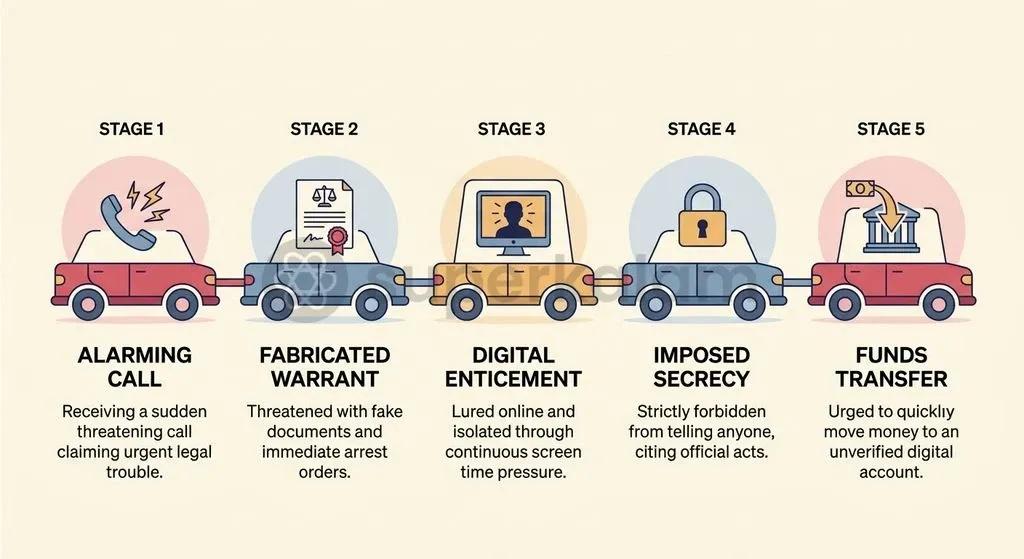
The operational workflow follows a rigid coercive sequence designed to eliminate independent verification:
- Initial Accusation and Threat: Scammers inform the victim of impending arrest for serious offences such as money laundering, terror financing, or narcotics trafficking.
- Fabrication of Judicial Authority: Fraudulent arrest orders, non-bailable warrants, and asset seizure notices bearing forged seals of the Central Bureau of Investigation or Enforcement Directorate are transmitted digitally.
- Imposition of Digital Confinement: Scammers order the victim to keep the video camera active continuously, prohibiting them from leaving the room or disconnecting the call.
- Enforced Secrecy: Fraudsters invoke false provisions of the Official Secrets Act to terrorise victims, warning that informing family members or legal counsel will invite immediate military or federal detention.
- Asset Liquidation: The victim is directed to transfer funds to designated "RBI verification accounts" or "clearing escrow accounts" under the fraudulent assurance that the money will be refunded after clearance.
The psychological profile of victims reveals deliberate targeting. A policy report published by NITI Aayog in April 2025 highlighted that these syndicates disproportionately target elderly citizens and retired professionals living in nuclear arrangements. Scammers exploit systemic isolation, unfamiliarity with cyber tools, and deep social deference to judicial authority.
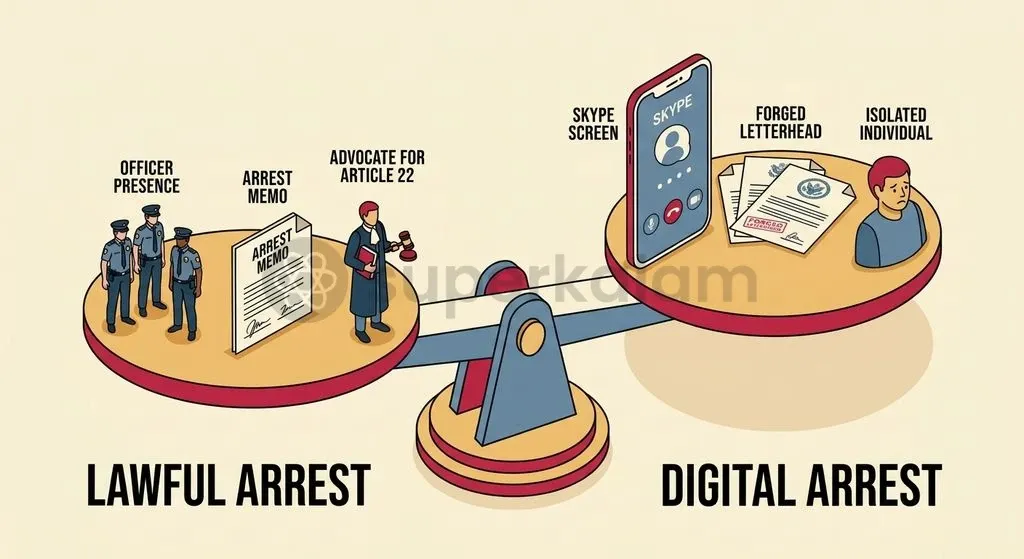
| Procedural Dimension | Lawful Statutory Arrest | Fraudulent 'Digital Arrest' Scam |
|---|---|---|
| Legal Basis | Bharatiya Nagarik Suraksha Sanhita, 2023 | Non-existent; strictly illegal and punitive extortion |
| Physical Custody | Mandatory physical touch or confinement (Section 35, BNSS) | Remote video confinement over Skype or WhatsApp |
| Documentation | Formal arrest memo attested by independent witness (Section 36, BNSS) | Forged warrants and notices sent over messaging apps |
| Legal Representation | Right to consult an advocate during questioning (Section 38, BNSS) | Enforced secrecy with threats of prosecution for seeking advice |
| Financial Demand | Government agencies never demand money for bond or verification | Demands immediate fund transfers to personal or mule bank accounts |
Why Is 'Digital Arrest' Legally Impossible Under Indian Law?
Indian criminal jurisprudence contains zero statutory provisions permitting virtual custody, remote detention, or electronic arrest over telecommunication channels. The procedural framework established under the Bharatiya Nagarik Suraksha Sanhita (BNSS), 2023 strictly defines the physical mechanics and constitutional prerequisites of a valid arrest.
Section 35 of the Bharatiya Nagarik Suraksha Sanhita, 2023, which replaced Section 46 of the Code of Criminal Procedure, 1973, establishes that an arresting officer must physically touch or confine the body of the accused, unless there is voluntary submission to custody. This statutory mandate renders any claim of arrest over a video screen an absolute legal impossibility.
Statutory safeguards further mandate direct local verification that cannot occur across a digital screen. Under Section 36 of the Bharatiya Nagarik Suraksha Sanhita, 2023, an arresting officer must prepare a formal arrest memo on the spot. This document must be attested by at least one witness who is a member of the arrested person's family or a respectable member of the locality.
Section 38 of the Bharatiya Nagarik Suraksha Sanhita, read with Article 22(1) of the Indian Constitution, guarantees an arrested person the fundamental right to consult an advocate of their choice during interrogation.
Constitutional guidelines established by the Supreme Court reinforce these physical protections. In D.K. Basu v. State of West Bengal (1997), the Supreme Court laid down binding arrest parameters. The bench mandated that an arrestee's designated relative or friend be notified within 8 to 12 hours of detention. It also required medical examinations every 48 hours. Coercive video confinement violates each of these guidelines, exposing perpetrators to severe prosecution under the Bharatiya Nyaya Sanhita (BNS), 2023:
- Section 204, BNS, 2023: Criminalises the impersonation of a public servant, carrying rigorous imprisonment.
- Section 308, BNS, 2023: Penalises extortion committed by putting individuals in fear of death, grievous hurt, or prosecution.
- Section 66D, Information Technology Act, 2000: Punishes cheating by personation through computer resources with imprisonment up to three years.
- Section 111, BNS, 2023: Provides comprehensive provisions to prosecute multi-jurisdictional syndicates under organised crime charges.
Discuss with Superkalam
How do digital arrest perpetrators manipulate the psychological state of victims to prevent them from seeking independent legal verification?
Ask NowKey Cases: What Delhi Police's Real-Time Interventions Reveal
Rapid intelligence coordination can neutralise cyber extortion before victims transfer funds. In March 2026, the Intelligence Fusion and Strategic Operations (IFSO) unit of Delhi Police established the Proactive Victim Identification and Protection Team. This tactical cell tracks sudden, atypical transaction sequences into high-risk accounts to dispatch officers directly to victims' residences during live extortion calls.
Field operations conducted by Delhi Police illustrate the efficacy of real-time intervention models:
- Inter-State Account Freezing (October 2026): The Financial Monitoring Cell of Delhi Police traced an active mule account in Hyderabad that was receiving simultaneous deposits from several senior citizens across five states. Rapid intervention prevented the diversion and financial loss of ₹1.53 crore.
- Cambodia Syndicate Dismantling (October 2026): Delhi Police IFSO dismantled an international cyber syndicate operating through overseas handlers based in Cambodia. The operation resulted in the arrest of 11 operatives and the freezing of ₹1.96 crore extorted from a retired government scientist.
These physical rescues show that technical tracking across the banking system is essential. However, immediate physical outreach is often necessary to break the intense psychological paralysis induced by digital arrest handlers.
The Institutional Architecture: How India's Cyber Crime System Responds
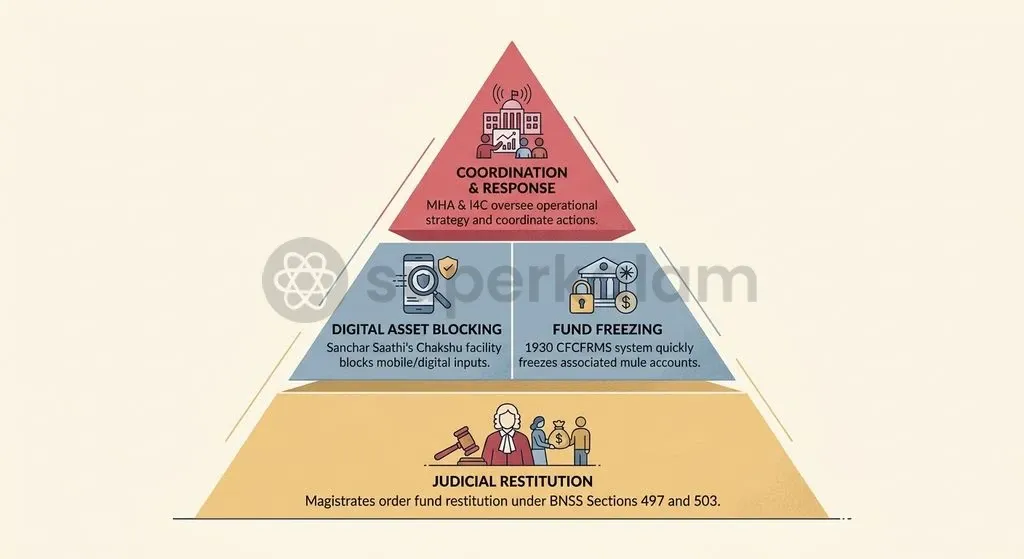
The Ministry of Home Affairs oversees a multi-agency enforcement ecosystem built to intercept digital fraud and restore defrauded assets. The Indian Cyber Crime Coordination Centre (I4C), established as the national operational hub, was upgraded by the Ministry of Home Affairs into an Attached Office on 1 July 2024 to coordinate inter-state operational responses against organised cybercrime networks.
Data submitted by I4C to the Supreme Court indicates visible progress in curtailing scam frequencies:
| Year / Period | Formal Digital Arrest Complaints Reported (I4C Data) |
|---|---|
| 2024 | 1,23,672 complaints |
| 2025 | 58,239 complaints |
| H1 2026 | 16,377 complaints |
Financial restitution relies on integrated communications and banking platforms designed to act during the critical initial window:
- CFCFRMS and Helpline 1930: The Citizen Financial Cyber Fraud Reporting and Management System (CFCFRMS), accessible via the 1930 helpline, directly links police control rooms with scheduled commercial banks. Ministry of Home Affairs data shows that the platform saved over ₹11,158 crore across 32.80 lakh complaints as of 30 June 2026.
- MHA Standard Operating Procedure (January 2026): On 2 January 2026, the Ministry of Home Affairs issued an updated SOP standardising complaint verification, lien markings on fraudulent accounts, and expedited restitution pathways.
- Judicial Asset Restitution: Under Sections 497 and 503 of the Bharatiya Nagarik Suraksha Sanhita, 2023, magistrates possess express statutory authority to order the unconditional release and restitution of frozen defrauded funds directly to verified victims.
Discuss with Superkalam
If a senior citizen receives a video call displaying official seals and threatening immediate prosecution over a contraband parcel, how should they apply the 'Ruko, Socho, Action Lo' framework?
Ask NowStructural Loopholes: Mule Accounts, Cross-Border Networks, and VOIP Routing
Transnational cyber syndicates exploit domestic banking vulnerabilities and cross-border regulatory gaps. Fraudsters rely on digital communication anonymity and layered accounts to launder extortion proceeds within minutes of transfer.
To disrupt the communication infrastructure used by scammers, the Central Government blocked more than 6.69 lakh SIM cards, 1.32 lakh mobile device IMEI numbers, 1,700 Skype IDs, and 59,000 WhatsApp accounts by late 2024. The Department of Telecommunications also deployed the Chakshu facility under the Sanchar Saathi portal, enabling citizens to flag suspicious calling numbers, phishing SMS links, and spoofed international voice calls.
Despite aggressive telecommunication sweeps, enforcement agencies encounter persistent systemic bottlenecks:
- Mule Account Proliferation: Extorted funds are routed into layered domestic accounts opened using forged credentials or acquired from vulnerable individuals for nominal commissions. High-speed transfers fragment large sums into fractional amounts before banking risk algorithms flag the transactions.
- Cross-Border Sanctuaries: Investigations by I4C and state police units have identified criminal call hubs located in Southeast Asian countries, primarily Cambodia, Laos, and Myanmar. These operations present severe extradition, sovereignty, and diplomatic hurdles during live asset recovery.
- Voice Over Internet Protocol Routing: Scammers mask actual originating locations through automated calling bots and caller ID spoofing software, presenting authentic local police control room numbers to target screens.
Way Forward: Closing the Legal, Technical, and Public Awareness Gaps
Combating digital arrest syndicates demands stringent banking accountability alongside technical deterrence and broad public education. Lenders must transition from retrospective complaint logging to automated, predictive blocking of unusual high-value outflows originating from elderly retail depositors.
Implementing the Supreme Court's October 2026 guidance regarding institutional indemnification aligns commercial banking incentives directly with fraud prevention. When financial institutions bear legal and financial liability for monitoring lapses, investments in fraud detection and real-time Know Your Customer authentication will expand rapidly. At the same time, the Reserve Bank of India has continually reiterated that neither central bank officials nor investigative agencies operate regulatory verification accounts. Commercial banks must actively reinforce this fact across online banking portals.
| Reform Pillar | Strategic Measure for Cyber Defence |
|---|---|
| Institutional | Strict RBI-mandated indemnification for bank monitoring and KYC lapses |
| Technical | Real-time mule network graph analysis and automated account freezes |
| Legal | Bilateral extradition pacts targeting Southeast Asian cybercrime hubs |
| Grassroots | Community cyber-wardens protecting isolated retirees and senior citizens |
Cross-border legal cooperation must also be reinforced through formal multilateral agreements. India must strengthen regional cyber intelligence partnerships with Southeast Asian nations to target transnational call hubs, sever unregulated cryptocurrency conversion corridors, and secure the repatriation of illicit assets. Domestically, integrating rural administrative bodies, resident welfare associations, and senior citizen forums into institutional reporting pipelines will build grassroots resilience against psychological cyber manipulation.
Discuss with Superkalam
Analyse the structural vulnerabilities within commercial banking systems that allow mule accounts to receive and divert extorted funds before intervention occurs.
Ask NowKey Takeaways
- Statutory Impossibility: Digital arrest has no legal existence under Indian law; Section 35 of the Bharatiya Nagarik Suraksha Sanhita, 2023 mandates actual physical touching or confinement of the body for a valid arrest.
- Procedural Mandates: Under Section 36 and Section 38 of the BNSS, an arrest requires an arrest memo attested by an independent witness and guarantees the immediate right to consult an advocate.
- Judicial Oversight: In SMW (Crl.) No. 3/2025, the Supreme Court directed the adoption of standard operating procedures for temporary account debit holds and proposed mandatory bank indemnification for institutional negligence.
- Enforcement Scale: The Indian Cyber Crime Coordination Centre reported a drop in digital arrest complaints from 1,23,672 in 2024 to 16,377 in the first half of 2026, while the CFCFRMS platform has saved over ₹11,158 crore as of June 2026.
- Statutory Penalties: Impersonating law enforcement and extorting funds via digital means invites strict prosecution under Sections 111, 204, and 308 of the Bharatiya Nyaya Sanhita, alongside Section 66D of the Information Technology Act.
Mains Question
"Statutory criminal procedure strictly mandates physical custody, formal documentation, and legal representation, rendering any notion of virtual confinement a legal impossibility." In light of the Bharatiya Nagarik Suraksha Sanhita (BNSS), 2023 and the D.K. Basu guidelines, elucidate how statutory safeguards protect citizens against coercive cyber extortion. (10 Marks)
Evaluate NowMains Question
Observing nationwide cyber extortion networks operating through forged emblems and mule accounts, the Supreme Court in In Re: Victims of Digital Arrest Related to Forged Documents mandated proactive banking interventions and institutional indemnification. Critically examine the institutional and enforcement mechanisms deployed to curb digital arrest syndicates in India. (15 Marks)
Evaluate NowPractice MCQs
QUESTION 1
Consider the following statements regarding the legal framework governing arrests in India:
- Under Section 35 of the Bharatiya Nagarik Suraksha Sanhita, 2023, an arresting officer must physically touch or confine the body of the accused unless there is voluntary submission to custody.
- Section 36 of the Bharatiya Nagarik Suraksha Sanhita, 2023 mandates that an arrest memo must be attested by at least one witness who is a family member or a respectable member of the locality.
- The Bharatiya Nagarik Suraksha Sanhita, 2023 explicitly permits virtual custody and remote detention over encrypted video telecommunication channels during preliminary inquiries. Which of the statements given above are correct?
QUESTION 2
With reference to the Supreme Court guidelines laid down in D.K. Basu v. State of West Bengal (1997), consider the following statements:
- The arresting authority is required to notify an arrestee's designated relative or friend within 8 to 12 hours of detention.
- The guidelines mandate that an arrested person must undergo a medical examination every 48 hours during detention. Which of the statements given above is/are correct?
QUESTION 3
Consider the following statements regarding institutional and regulatory actions against cyber extortion in India:
- The Indian Cyber Crime Coordination Centre (I4C) was upgraded by the Ministry of Home Affairs into an Attached Office on 1 July 2024.
- The Supreme Court directed the Reserve Bank of India to formulate a Standard Operating Procedure requiring commercial banks to place temporary debit holds on accounts flagged for fraudulent inflows.
- Under the State Emblem of India (Prohibition of Improper Use) Act, 2005, displaying the national emblem in video calls is strictly civil in nature and incurs no penal consequences. Which of the statements given above are correct?
QUESTION 4
Under the Bharatiya Nyaya Sanhita (BNS), 2023, which of the following sections specifically penalises the impersonation of a public servant?
QUESTION 5
Consider the following statements regarding the modus operandi of 'digital arrest' scams in India:
- Fraudsters frequently invoke fabricated provisions of the Official Secrets Act to enforce secrecy and isolate the victim from legal counsel.
- According to a NITI Aayog policy report, cyber syndicates disproportionately target elderly citizens and retired professionals residing in nuclear arrangements. Which of the statements given above is/are correct?
Discuss with Superkalam
Evaluate the Supreme Court's proposal to mandate full institutional indemnification by commercial banks for cyber fraud losses caused by KYC compliance failures.
Ask Now