SEBI KYC Overhaul: Interoperability and AML Compliance
SEBI's onboarding overhaul reduces investor friction, spotlighting the tension between frictionless market access and statutory anti-money laundering vigilance.
Nov, 2026
•8 min read

Overview
India's capital markets regulator has overhauled investor onboarding rules to eliminate friction while preserving financial integrity. On 25 November 2026, the Securities and Exchange Board of India rationalised the risk management framework across KYC Registration Agencies, taking effect from 24 December 2026.
This reform centralises supplementary investor data and introduces attribute-level data portability. It enforces strict operational timelines to curb drop-offs in demat and mutual fund accounts. By balancing speed against statutory requirements under the Prevention of Money Laundering Act, the framework tackles a longstanding puzzle: expanding retail market access without blunting regulatory vigilance.
Why in the News?
The Securities and Exchange Board of India notified circular HO/38/14/(25)2026-MIRSD-POD3 on 25 November 2026 to overhaul client onboarding across capital market intermediaries. As of November 2026, this regulatory update rationalises the risk management framework governing KYC Registration Agencies with operational enforcement starting 24 December 2026.
The initiative directly targets a persistent bottleneck flagged by a SEBI consultation paper. Repetitive document submissions across brokers and asset managers cause high investor drop-offs in demat accounts and mutual funds.
Discuss with Superkalam
Within how many working days must an intermediary upload onboarding data to the KRA system following verification?
Ask NowThe regulatory intervention resolves these market frictions while anchoring verification practices to statutory compliance standards under the Prevention of Money Laundering Act, 2002.
The Structural Hurdle: Why Uniform KYC Remained Elusive Across Regulators
India's financial regulatory architecture historically evolved along sectoral silos. This created parallel Know Your Customer regimes anchored in distinct legal mandates. In the securities market, KYC Registration Agencies operate under the SEBI (KYC Registration Agency) Regulations, 2011, enacted pursuant to powers under Section 30 of the SEBI Act, 1992.
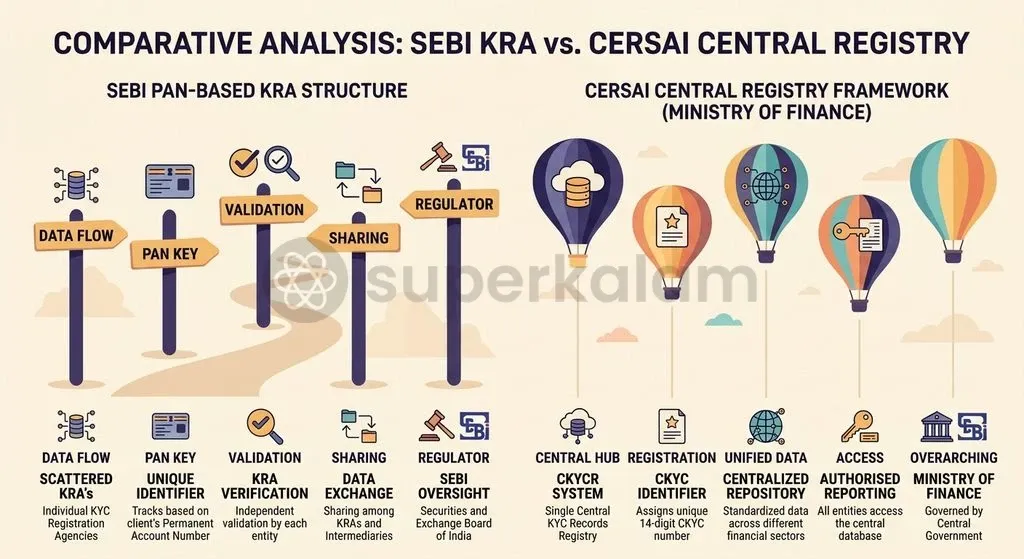
In contrast, the Central KYC Records Registry operates across all financial sectors under Section 73 read with Rule 9 and Rule 9A of the Prevention of Money-laundering (Maintenance of Records) Rules, 2005. Administered by the Central Registry of Securitisation Asset Reconstruction and Security Interest of India pursuant to central government notification S.O. 3183(E) of 26 November 2015, the CKYCR rests on a different legal footing from SEBI's KRA network.
| Regulatory Dimension | SEBI KRA Framework | CERSAI CKYCR Framework |
|---|---|---|
| Statutory Basis | Section 30 of SEBI Act, 1992 | Section 73, PML (Maintenance of Records) Rules, 2005 |
| Administering Authority | SEBI-registered KRAs | CERSAI under Ministry of Finance |
| Primary Scope | Capital market intermediaries | Cross-sectoral financial institutions |
| Core Identifier | PAN-centric capital records | Central KYC Identifier (CKYC ID) |
This structural division created parallel verification repositories across banks, insurers, pension funds, and stockbrokers. Consequently, retail investors faced repetitive identity checks each time they entered a new financial sector.
Discuss with Superkalam
How does attribute-level validation and portability at the KRA level eliminate duplicate documentation across capital market entities?
Ask NowInside the New Framework: How KRA and CKYC Interoperability Works
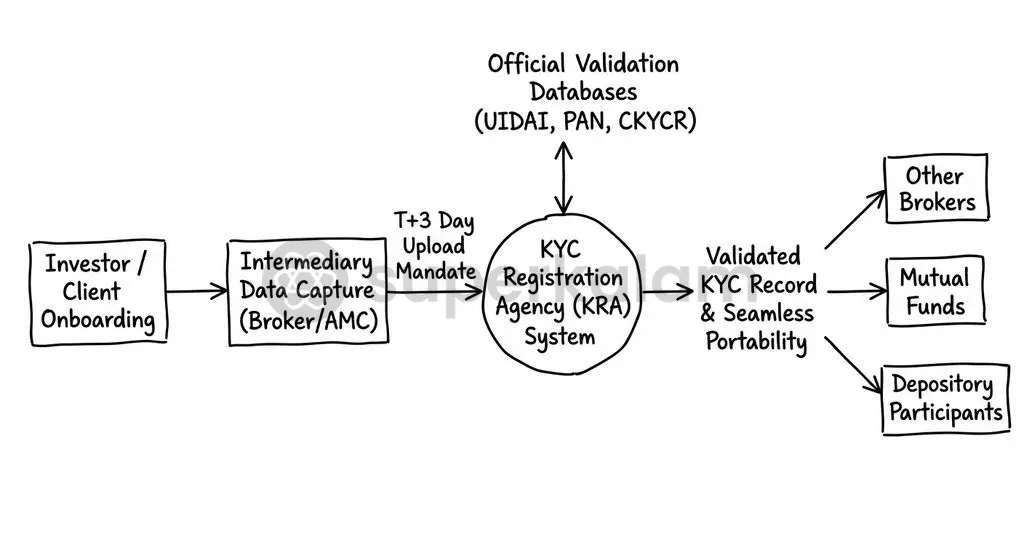
SEBI's updated framework streamlines capital market entry by ending duplicate documentation. Common supplementary client information gathered in Part II of the Account Opening Form—such as income range, occupation, Politically Exposed Person status, and declarations under FATCA and CRS—is now centralised at the KRA level. Intermediaries must upload Part I and specified Part II onboarding data to the KRA system within three working days of completing initial verification.
- Verification Completion: The intermediary completes initial client identity verification.
- KRA Upload: Intermediary uploads Part I and Part II data to the KRA system within three working days, capturing the CKYC ID, DIGIPIN where available, and OVD expiry dates.
- Attribute Verification: The KRA validates client details against official databases. Once verified, the profile is marked 'validated' and gains full mutual portability across SEBI-regulated entities.
The circular closes the technical divide between brokers and the central registry. Intermediaries must capture and upload the Central KYC Identifier, Digital Postal Index Number where available, and the expiry dates of Officially Valid Documents to the KRA system. This operationalises Ministry of Finance Notification S.O. 4697(E). That notification amended PML Rules to allow SEBI-registered entities to upload, update, and retrieve KYC records with CKYCR directly or routed through a KRA.
Operational reforms under the circular include:
- Portability of Validated Records: Client profiles whose attributes, including either current or permanent address, have been verified against official databases are classified as 'validated' and are fully portable across all SEBI-regulated entities.
- Transparent Attribute Diligence: KRAs are mandated to share attribute-wise validation information with intermediaries to maintain transparent, auditable client diligence profiles.
- Optional Mobile Re-verification: Intermediary re-verification of mobile numbers is made optional if the KRA system confirms the contact detail is already verified and seeded with Aadhaar.
- Simplified Name Updates: Clients can execute legal name updates in the KRA system using an updated PAN and Aadhaar, eliminating previous requirements for marriage certificates, gazette notifications, or sworn affidavits.
- Dormancy and Delinking Governance: Non-mutual fund intermediaries must notify the KRA within five working days of an account closure, prompting record updates within two working days. Mutual funds must report zero-balance folios inactive for six consecutive months within five working days, and unconsummated downloads exceeding 21 working days must be delinked within five working days.
Cross-border onboarding has also been streamlined. Resident Overseas Citizens of India and foreign nationals no longer need to submit overseas address proof if their Indian residential address is verified. In addition, individual Persons Resident Outside India from FATF-compliant jurisdictions can complete onboarding through video client identification without physical presence in India.
The Policy Tension: Capital Market Deepening versus AML and CFT Vigilance
Regulators face a delicate balancing act. Easing onboarding expands retail participation, but it must not create regulatory blind spots that enable illicit capital flows or shell corporations.
Statutory mandates set non-negotiable boundaries:
- Non-delegable CDD Liability: Under Rule 9(2) of the Prevention of Money-laundering (Maintenance of Records) Rules, 2005, the ultimate responsibility for customer due diligence rests exclusively with the reporting entity. Intermediaries cannot delegate this legal liability to third parties.
- Ownership Transparency: Rule 9(3) sets a 10 percent ownership threshold for identifying the Beneficial Owner of an incorporated entity or trust.
- Global Compliance Standards: The Financial Action Task Force obligates jurisdictions under Recommendation 10 and Recommendation 17 to enforce risk-based customer due diligence, keeping ultimate liability with the financial institution.
Discuss with Superkalam
A foreign national residing in India applies for a demat account with a verified Indian address. How should the intermediary handle overseas address proof under the revised guidelines?
Ask NowInternational reviews keep scrutiny high. In its 2024 Mutual Evaluation Report, the FATF placed India in the 'regular follow-up' category. The report commended India's digital identity infrastructure, but it flagged uneven beneficial ownership checks and CDD updates in non-bank entities. SEBI's validation protocols ensure that onboarding convenience does not weaken statutory AML compliance.
Inter-Regulatory Friction: What Stands in the Way of a Truly Single Financial KYC?
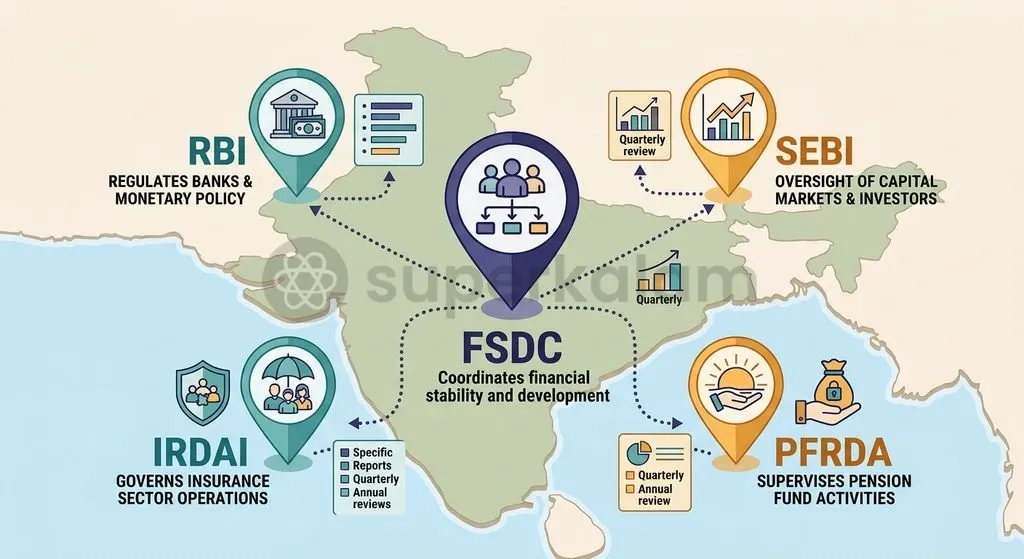
Harmonising customer verification across India's financial architecture faces operational hurdles due to differing sectoral mandates. The Financial Sector Legislative Reforms Commission previously recommended establishing an interoperable customer verification architecture and statutory legal recognition for single digital KYC across all financial regulators.
To resolve lingering administrative barriers, the Financial Stability and Development Council constituted an expert committee to formulate a unified, interoperable KYC ecosystem spanning banking, insurance, pensions, and securities.
Progress toward a single national verification system contends with specific sectoral divergences:
- Identifier Mandates: SEBI enforces mandatory Permanent Account Number verification for capital market access, whereas the Reserve Bank of India's Master Direction on KYC allows Form 60 declarations for opening basic, low-risk bank accounts.
- Periodic Review Cycles: Regulatory frameworks across the RBI, SEBI, IRDAI, and PFRDA enforce divergent re-KYC schedules; banking norms mandate two-year reviews for high-risk accounts, while SEBI recently rationalised review intervals for Foreign Portfolio Investors and low-risk entities.
- Acceptance of Documents: Variations persist across sectors regarding the threshold verification required for simplified versus full customer due diligence, leading institutions to conduct independent checks rather than rely on cross-sectoral records.
Because Rule 9(2) prevents intermediaries from shifting legal liability to third-party databases, institutions frequently duplicate verification checks to shield themselves from statutory regulatory penalties.
Discuss with Superkalam
Compare the statutory bases and institutional scopes of SEBI's KRA regime and CERSAI's CKYCR framework to explain why parallel verification repositories emerged.
Ask NowWay Forward: Building a Unified Financial Identity Without Surveillance Gaps
A workable single-window onboarding regime must bridge inter-agency differences while safeguarding financial oversight. Implementing the recommendations of the FSDC expert committee provides an actionable roadmap to harmonise standards across the RBI, SEBI, IRDAI, and PFRDA.
Operational reforms should focus on several priorities:
- Harmonising Statutory Due Diligence: The central government should standardise definitions of simplified due diligence and alignment rules for Officially Valid Documents across PML Rules to eliminate sectoral discrepancies.
- Establishing Safe-Harbour Protections: Regulators should amend legal frameworks to grant reporting entities safe-harbour protections when relying on verified records from accredited repositories, clarifying boundaries under Rule 9(2).
- Dynamic Risk Categorisation: Intermediaries should transition toward automated data-sharing protocols that update changes in beneficial ownership and tax status across repositories in real time.
- Strengthening Beneficial Ownership Tracking: Institutions must enhance compliance with the 10 percent beneficial ownership threshold to address concerns raised in the 2024 FATF mutual evaluation.
Pairing SEBI's KRA network with CERSAI's central registry will allow India to deepen financial inclusion while maintaining effective financial surveillance.
Key Takeaways
- SEBI issued circular HO/38/14/(25)2026-MIRSD-POD3 on 25 November 2026 to overhaul client onboarding and rationalise KRA risk management frameworks effective 24 December 2026.
- Common supplementary onboarding details in Part II of the Account Opening Form are centralised at the KRA level, reducing repetitive documentation for demat and mutual fund investors.
- Fully validated records with address verification against official databases achieve complete portability across SEBI-regulated intermediaries.
- Interoperability between SEBI KRAs and CERSAI's CKYCR is facilitated by Ministry of Finance Notification S.O. 4697(E), enabling both direct and KRA-routed uploads to the central registry.
- The FSDC expert committee is formulating a unified, cross-sectoral KYC framework spanning banking, securities, insurance, and pensions.
- Reporting entities retain non-delegable legal liability for customer due diligence under Rule 9(2) of the PML Rules, aligning with FATF Recommendations 10 and 17.
Mains Question
"While interoperable digital identity architectures reduce friction in retail market participation, statutory mandates ensure that ultimate customer due diligence liability remains strictly non-delegable." In light of the revised SEBI KRA framework and the Prevention of Money-laundering (Maintenance of Records) Rules, 2005, critically examine the policy tension between capital market deepening and AML/CFT compliance. (15 Marks)
Evaluate NowMains Question
The divergence in statutory mandates between SEBI-regulated KYC Registration Agencies and the CERSAI-administered Central KYC Records Registry highlights the persistence of sectoral regulatory silos in India's financial sector. Elucidate the administrative and regulatory hurdles to achieving a unified financial KYC architecture. (10 Marks)
Evaluate NowPractice MCQs
QUESTION 1
With reference to the Know Your Customer (KYC) regulatory architecture in India, consider the following statements:
- KYC Registration Agencies (KRAs) are established pursuant to powers under Section 30 of the SEBI Act, 1992.
- The Central KYC Records Registry (CKYCR) operates under the Prevention of Money-laundering (Maintenance of Records) Rules, 2005, and is administered by CERSAI.
- Under Rule 9(2) of the PML (Maintenance of Records) Rules, 2005, reporting entities can legally delegate the ultimate liability for customer due diligence to registered KRAs. Which of the statements given above are correct?
QUESTION 2
Consider the following statements regarding the revised SEBI framework for client onboarding across capital market intermediaries:
- Intermediaries must upload Part I and specified Part II onboarding data to the KRA system within three working days of completing initial verification.
- Updating a client's legal name in the KRA system mandatorily requires the submission of a gazette notification or sworn affidavit.
- Intermediary re-verification of mobile numbers is optional if the KRA system confirms the contact detail is verified and seeded with Aadhaar. Which of the statements given above is/are correct?
QUESTION 3
Regarding Anti-Money Laundering (AML) standards and cross-border onboarding under recent financial regulations, consider the following statements:
- Under the Prevention of Money-laundering Amendment Rules, 2023, the ownership threshold for identifying the Beneficial Owner of an incorporated entity or trust is set at 10 percent.
- Resident Overseas Citizens of India (OCIs) are exempted from submitting overseas address proof if their Indian residential address is verified.
- The Financial Action Task Force (FATF) 2024 Mutual Evaluation Report placed India in the 'enhanced follow-up' category due to gaps in digital identity infrastructure. Which of the statements given above is/are correct?
QUESTION 4
Consider the following operational requirements prescribed by SEBI for governance of inactive or delinked KYC records:
- Mutual funds must report zero-balance folios inactive for six consecutive months within five working days.
- Non-mutual fund intermediaries must notify the KRA within five working days of an account closure.
- Unconsummated KYC data downloads exceeding 21 working days must be delinked within five working days. Which of the statements given above are correct?
QUESTION 5
Which of the following represents a primary structural divergence between SEBI and RBI regulatory mandates that hinders a single, unified financial KYC ecosystem?
Discuss with Superkalam
Weigh the benefits of retail market entry simplification against the statutory risks of non-delegable customer due diligence under the Prevention of Money Laundering Act.
Ask Now