State Legislative Councils: Why 22 States Reject an Upper House
While six states use upper houses for executive leverage, twenty-two reject them as expensive, powerless chambers vulnerable to partisan abolition.
Oct, 2026
•10 min read
Overview
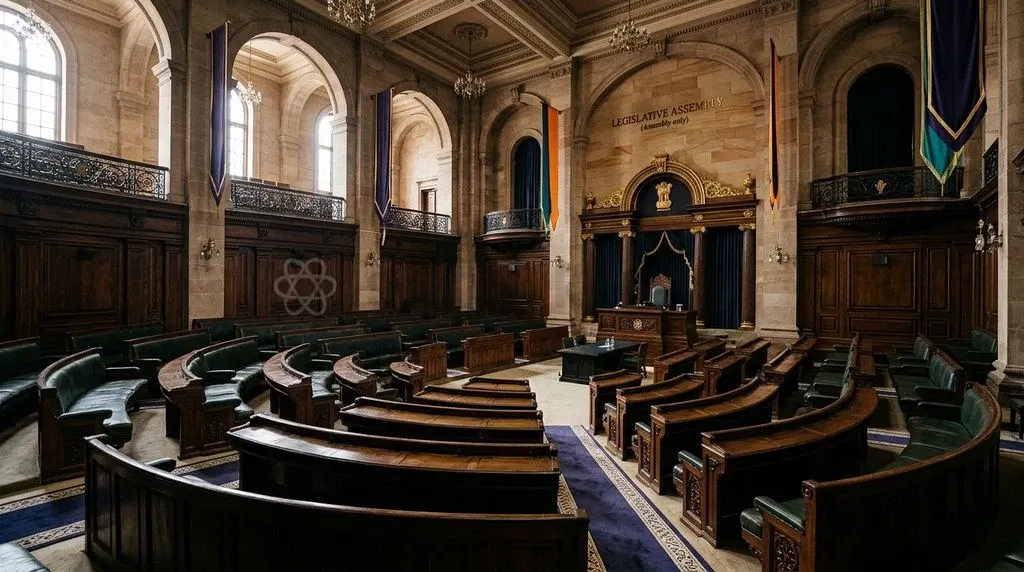
State Legislative Councils remain an institutional rarity in India. Twenty-two states consciously reject them as redundant, expensive deliberative bottlenecks that lack substantive constitutional authority. This leaves only six bicameral states operating upper houses for coalition management and indirect executive appointments.
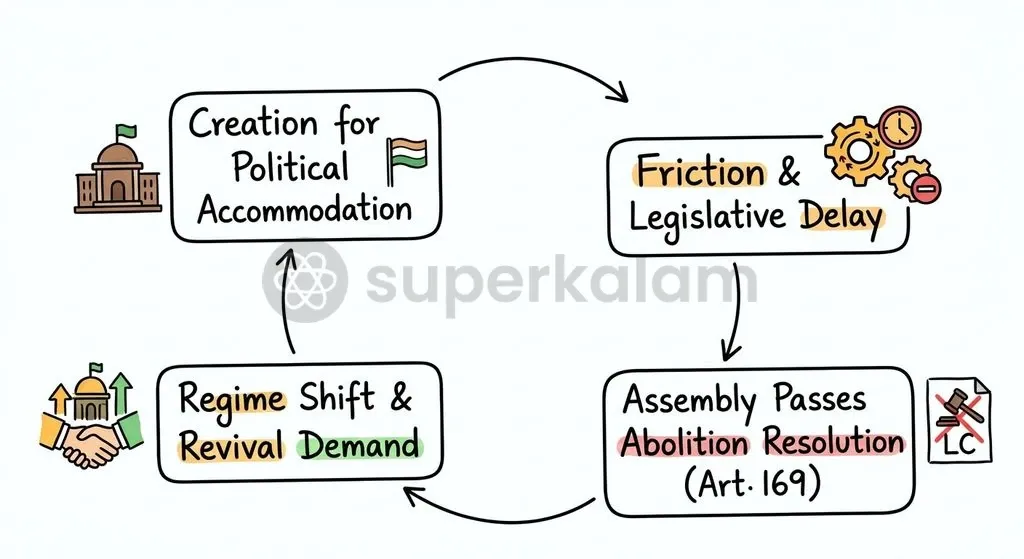
The framers deliberately avoided mandating provincial bicameralism. Under Article 169, state assemblies can establish or abolish upper chambers with parliamentary concurrence.
Devoid of the federal safeguards enjoyed by the Rajya Sabha, the Vidhan Parishad possesses no legislative veto power, cannot vote on state finances, and exerts zero control over cabinet survival. The chamber is not a genuine check on populist excess. Instead, it is an avenue for indirect executive appointments and defeated politicians.
Why in the News: The Push-and-Pull Over Councils in West Bengal and Andhra Pradesh
Recent political manoeuvres demonstrate how state ruling parties treat Legislative Councils as expendable political instruments rather than permanent deliberative bodies.
- West Bengal (revival bid): As of October 2026, West Bengal's statutory resolution under Article 169 to revive its upper chamber remains without parliamentary legislation, following its adoption by the state assembly in July 2021. The state government sought to re-establish the chamber fifty-two years after its initial abolition to accommodate senior leaders and coalition allies.
- Andhra Pradesh (abolition reversal): The Andhra Pradesh Legislative Assembly passed a statutory resolution on 27 January 2020 to abolish its Legislative Council after the opposition-dominated chamber referred contentious decentralisation bills to a select committee. On 23 November 2021, the same assembly rescinded the abolition resolution once the governing party attained numerical control of the upper house.
These recurring disputes expose a persistent reality: state upper chambers rarely survive on deliberative merits alone. Ruling parties champion or discard them depending on which faction controls their benches.
The Constitutional Paradox: Why the Framers Made the Upper House Optional Under Article 169
The Constituent Assembly deliberately rejected compulsory bicameralism for states, designing Article 169 to allow state legislatures to establish or dismantle upper houses at will. During the constitutional drafting process, provincial delegates disagreed sharply over the necessity and financial viability of provincial second chambers.
The Provincial Constitution Committee, chaired by Sardar Vallabhbhai Patel in June 1947, resolved that bicameralism must be decided individually by each province rather than imposed uniformly across the Union.
Defending this flexibility on 6 January 1949, Dr B.R. Ambedkar informed the Constituent Assembly that the second chamber was introduced purely as an experimental measure and denied permanent constitutional status. Dr Ambedkar stressed that if an upper house proved troublesome or unnecessary, a simple procedure should allow a state to rid itself of the institution.
Under Article 169(1), Parliament holds the power to abolish or create a Legislative Council by ordinary law, provided the process clears two statutory thresholds:
- The Legislative Assembly passes a resolution supported by a majority of total membership.
- The resolution secures a two-thirds majority present and voting.
Unlike constitutional amendments under Article 368, Parliament enacts this institutional restructuring through a simple majority.
Discuss with Superkalam
Recall the two specific majority thresholds an assembly resolution must clear under Article 169 before Parliament can abolish or create a Legislative Council.
Ask NowThe Survival Map: Why Six States Retain Their Legislative Councils
As of October 2026, Article 168(1)(a) of the Constitution confirms that only six states—Uttar Pradesh, Bihar, Maharashtra, Karnataka, Andhra Pradesh, and Telangana—maintain an active Vidhan Parishad. These states share distinct political realities. They have large territorial populations, deep factional party networks, and competitive coalition dynamics that demand institutional channels for patronage.
Article 171(1) caps the total strength of a Legislative Council at one-third of assembly membership, while establishing an absolute statutory floor of 40 members. The composition balances diverse regional segments through indirect elections and executive nominations.
| Category / Electorate | Constitutional Proportion | Nominating or Electing Body |
|---|---|---|
| Local Authorities | One-third (1/3) | Municipalities, Zilla Parishads, and District Boards |
| Legislative Assembly (MLAs) | One-third (1/3) | Members of the Legislative Assembly (non-MLAs elected) |
| Governor's Nominees | One-sixth (1/6) | Nominated for literature, science, art, cooperative movement, social service |
| Graduates Constituency | One-twelfth (1/12) | Registered graduates of at least three years' standing |
| Teachers Constituency | One-twelfth (1/12) | Teachers of at least secondary school level (three years' standing) |
All compositional quotas derive strictly from Article 171(3) of the Constitution of India.
Beyond regional representation, the Vidhan Parishad is an indispensable tool for executive management under Article 164(4). This clause allows an individual to serve as a minister for six consecutive months without holding a seat in the state legislature. Rather than subjecting factional heads to direct elections, governing parties routinely secure their legislative tenures through upper-house vacancies.
Prominent chief ministers have frequently relied on this mechanism to assume office. Notable beneficiaries include Nitish Kumar in Bihar, Yogi Adityanath upon his initial appointment in Uttar Pradesh in 2017, and Uddhav Thackeray in Maharashtra in 2020.
Discuss with Superkalam
Explain why the constitutional powers granted to a State Legislative Council under Article 197 prevent it from acting as a co-equal house like the Rajya Sabha.
Ask NowThe Case for Abolition: Why 22 States Treat Vidhan Parishads as Costly and Redundant
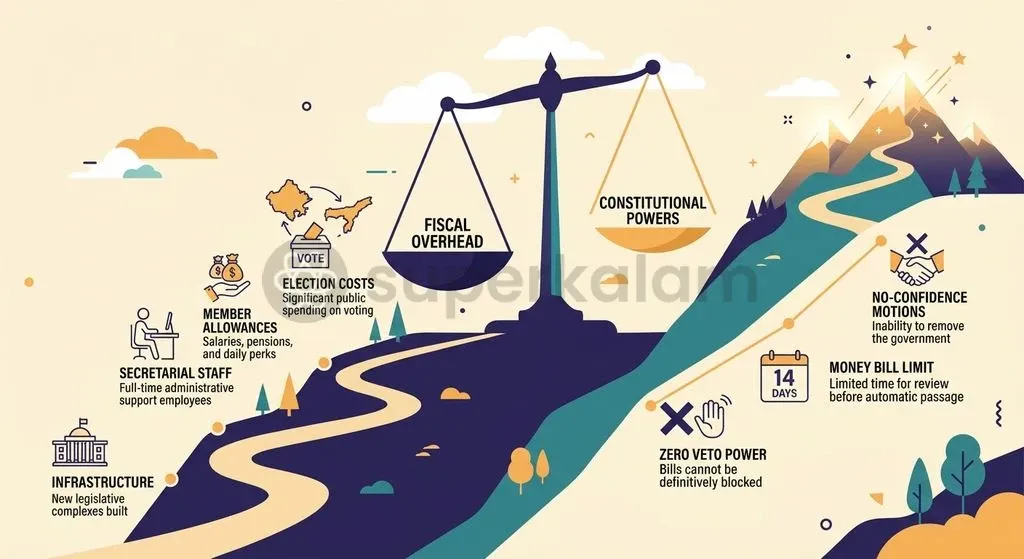
Twenty-two Indian states reject Legislative Councils because their substantial administrative overhead yields almost no constitutional influence over legislative scrutiny or executive governance. For most states, maintaining a second chamber represents an unjustifiable fiscal drain on limited public exchequers.
Official state memoranda submitted during parliamentary reviews in 2013 highlight this financial burden:
- Rajasthan's capital outlays: Establishing a Legislative Council required a projected ₹100 crore expenditure.
- Assam's dual cost structure: Assam faced a ₹68 crore initial establishment cost alongside a ₹19 crore recurring annual commitment.
- Administrative duplication: Duplicating secretariats, member allowances, pensions, and electoral machinery produces zero tangible governance outcomes.
Because popular sovereignty resides squarely in the Legislative Assembly, the second chamber frequently degenerates into an echo chamber. It repeats lower-house debates without altering final legislative texts.
Discuss with Superkalam
Apply the provisions of Article 164(4) to explain how ruling parties use Legislative Council vacancies to appoint individuals who did not contest or win direct assembly elections as ministers.
Ask NowPolitical Tool or Deliberative Chamber? What Tamil Nadu, Punjab, and Bengal Teach Us
State governments across Tamil Nadu, Punjab, and West Bengal have repeatedly demonstrated that Legislative Councils face immediate dissolution whenever they challenge executive power. Historical precedent confirms three major cycles of partisan creation and abolition:
- Tamil Nadu (abolition and aborted revival): Parliament enacted the Tamil Nadu Legislative Council (Abolition) Act, 1986, dissolving the state's 54-member upper house on 1 November 1986 after Chief Minister M.G. Ramachandran's AIADMK administration clashed with the DMK-led upper house opposition. Decades later, Parliament passed the Tamil Nadu Legislative Council Act, 2010 to restore the body under a DMK initiative. The revival collapsed in June 2011 when the returning AIADMK government of J. Jayalalithaa rescinded the assembly resolution before the Union brought the statute into effect.
- West Bengal and Punjab (post-1967 realignment): Following the 1967 general elections, newly formed non-Congress United Front coalitions viewed Congress-dominated second chambers as hostile political impediments. Consequently, Parliament abolished both chambers in 1969 through the West Bengal Legislative Council (Abolition) Act, 1969 and the Punjab Legislative Council (Abolition) Act, 1969.
- Andhra Pradesh (twenty-two-year hiatus): Chief Minister N.T. Rama Rao spearheaded abolition in 1985 through the Andhra Pradesh Legislative Council (Abolition) Act, 1985, only for Chief Minister Y.S. Rajasekhara Reddy to revive the council twenty-two years later in March 2007 via the Andhra Pradesh Legislative Council Act, 2005.
Discuss with Superkalam
Analyse the political motivations behind the abolition and revival resolutions passed in Andhra Pradesh between January 2020 and November 2021.
Ask NowStructural Weakness: Why the Council Can Never Match the Rajya Sabha
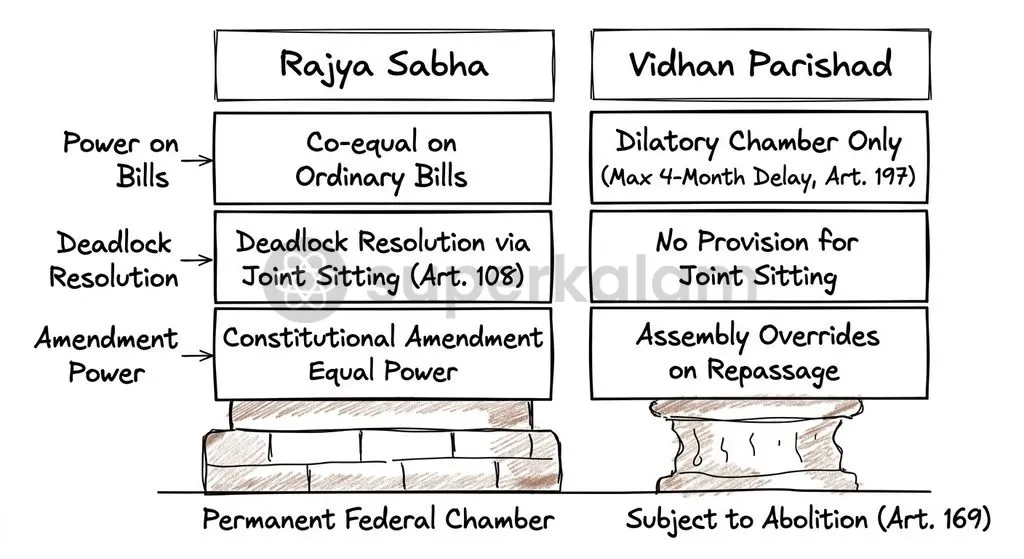
The Legislative Council lacks the constitutional stature of the Rajya Sabha because Articles 197 and 198 reduce the provincial upper chamber to a purely delaying body. While the Rajya Sabha embodies the federal principle by protecting state interests and exercising co-equal authority over non-financial legislation, the Vidhan Parishad possesses no such sovereign footing.
Under Article 197, a Legislative Council cannot veto an ordinary bill passed by the Legislative Assembly. The council can delay legislation for up to three months during its first consideration, and for one additional month if the assembly passes the bill a second time. After a cumulative delay of four months, the bill automatically becomes law in the form determined solely by the Legislative Assembly.
Part VI, Chapter III of the Constitution provides no provision for a joint sitting to resolve state-level legislative deadlocks. This guarantees absolute assembly supremacy.
| Dimension | Rajya Sabha (Union Second Chamber) | State Legislative Council (Vidhan Parishad) |
|---|---|---|
| Constitutional Standing | Permanent federal chamber mandated by Article 80; cannot be abolished. | Optional chamber under Article 169; abolished by Parliament upon assembly resolution. |
| Delay on Ordinary Bills | Can stall legislation indefinitely; disagreements lead to a joint sitting (Article 108). | Maximum delay capped at four months (3 + 1); no veto power (Article 197). |
| Deadlock Resolution | Joint sitting under Article 108 presided over by the Lok Sabha Speaker. | No joint sitting provision exists; assembly's will prevails unilaterally. |
| Money Bills | 14-day delay (Article 109); cannot alter financial allocations without Lok Sabha agreement. | 14-day delay (Article 198); deemed passed as approved by the assembly. |
| Executive Accountability | Ministers defend policies, but no-confidence motions remain exclusive to Lok Sabha. | Council of Ministers is collectively responsible solely to the assembly (Article 164(2)). |
The financial and political subjugation of the council is equally comprehensive. Under Article 198, money bills cannot originate in the Legislative Council, and the chamber must return them within fourteen days without amendment powers. Finally, Article 164(2) mandates that the state cabinet answers exclusively to the Legislative Assembly, leaving the upper chamber incapable of unseating an executive through a motion of no-confidence.
The Road Ahead: Building a Clear National Policy on State Upper Houses
Parliamentary Standing Committees and administrative reform commissions urge the Union Government to establish an objective national policy to curb opportunistic restructuring of state upper houses. The prevailing framework allows political parties to treat constitutional machinery as an instrument of short-term convenience.
Key institutional bodies have proposed concrete structural remedies:
- Uniform national criteria: In its 67th and 70th Reports, the Parliamentary Standing Committee on Personnel, Public Grievances, Law and Justice insisted that the Union Government formulate a uniform national policy governing the creation and abolition of State Legislative Councils. The committee warned that without clear parameters, councils would continue to be revived or dismantled at the arbitrary discretion of shifting legislative majorities.
- Direct representation for local bodies: The Second Administrative Reforms Commission (ARC) examined composition in its Sixth Report, Local Governance: An inspiring journey into the future (2007). The Commission recommended amending Article 171 to transform existing Legislative Councils into Councils of Local Governments elected exclusively by local bodies, while abolishing graduate and teacher constituencies.
The ARC reasoned that graduate and teacher electorates represent colonial relics that undermine universal franchise. Restructuring the council as a direct voice for panchayats and urban municipalities would provide the institution with an authentic constitutional rationale.
Discuss with Superkalam
Weigh the high fiscal expenditures cited by states like Rajasthan and Assam against the potential benefits of nominated expert representation to evaluate whether state upper houses are justified.
Ask NowKey Takeaways
- As of October 2026, Article 168(1)(a) confirms that only six states—Uttar Pradesh, Bihar, Maharashtra, Karnataka, Andhra Pradesh, and Telangana—maintain an active Legislative Council.
- The framers designed the second chamber under Article 169 as a purely voluntary and experimental institution, allowing Parliament to create or abolish it upon an assembly resolution passed by a special majority.
- Unlike the Rajya Sabha, the Vidhan Parishad possesses no veto power over ordinary legislation under Article 197, holding only a maximum delaying capacity of four months across two successive passages.
- The Constitution provides no mechanism for a joint sitting to resolve legislative disputes between state chambers, ensuring that the will of the Legislative Assembly unilaterally prevails.
- State governments frequently utilise the chamber under Article 164(4) as an indirect conduit to appoint unelected leaders and defeat-prone party figures to ministerial berths.
- The Second Administrative Reforms Commission recommended amending Article 171 to scrap graduate and teacher constituencies, reconstituting the chamber exclusively as a voice for local self-government.
Mains Question
"Devoid of the federal safeguards enjoyed by the Rajya Sabha, the Vidhan Parishad possesses no legislative veto power, cannot vote on state finances, and exerts zero control over cabinet survival." Critically examine the structural and constitutional weaknesses of State Legislative Councils compared to the Rajya Sabha. (10 Marks)
Evaluate NowMains Question
The Constituent Assembly designed Article 169 to allow state legislatures to establish or dismantle upper houses at will, terming bicameralism at the provincial level 'purely as an experimental measure'. In light of the historical cycles of abolition and revival in states like Andhra Pradesh, Tamil Nadu, and West Bengal, elucidate how Legislative Councils have functioned more as political instruments for coalition management than as sober deliberative bodies. (15 Marks)
Evaluate NowPractice MCQs
QUESTION 1
With reference to the creation and abolition of Legislative Councils under Article 169 of the Constitution of India, consider the following statements:
- The Legislative Assembly must pass a resolution supported by a majority of the total membership and a two-thirds majority of members present and voting.
- The parliamentary legislation abolishing or creating a Legislative Council requires a special majority under Article 368.
- The Constituent Assembly intended the upper house in states to be an experimental measure rather than a permanent constitutional fixture. Which of the statements given above are correct?
QUESTION 2
Regarding the composition of a State Legislative Council under Article 171 of the Constitution, consider the following statements:
- The total strength of the Council cannot exceed one-third of the total membership of the Legislative Assembly, nor be less than 40 members.
- Members elected by the Legislative Assembly account for one-third of the total council strength.
- One-sixth of the total members are nominated by the Governor from fields including the cooperative movement. Which of the statements given above is/are correct?
QUESTION 3
Consider the following statements regarding the legislative powers of a State Legislative Council over ordinary bills under Article 197:
- The Legislative Council can delay an ordinary bill passed by the Assembly for a maximum period of three months on its first consideration.
- If the Assembly passes the bill a second time, the Council can cause a further delay of up to one month.
- The Legislative Council exercises an absolute legislative veto if it rejects the bill twice. Which of the statements given above is/are correct?
QUESTION 4
As of October 2026, which of the following groups of states retain an active Legislative Council under Article 168(1)(a) of the Constitution?
QUESTION 5
Consider the following statements regarding the institutional history of State Legislative Councils:
- Following the 1967 elections, Parliament passed Acts abolishing the Legislative Councils of both West Bengal and Punjab in 1969.
- Tamil Nadu's Legislative Council was dissolved in 1986 under the Tamil Nadu Legislative Council (Abolition) Act, 1986.
- The Andhra Pradesh Legislative Council was abolished in 1985 and remained defunct for twenty-two years until its revival in 2007. Which of the statements given above are correct?