Special Session of Parliament: Who Can Call It? Article 85 Explained
While other democracies empower lawmakers to convene, India's executive retains sole authority over legislative sittings, leaving parliamentary scrutiny vulnerable.
Oct, 2026
•10 min read
Context
Under India's constitutional framework, the executive holds a near-total monopoly over the legislative calendar. Parliament can only meet when the government decides to summon it under Article 85(1).
Democracies like Germany and the United States grant lawmakers constitutional mechanisms or fixed dates to convene automatically. In contrast, Indian Members of Parliament cannot compel a sitting outside of a narrow emergency-disapproval provision. This arrangement leaves an institutional imbalance: the executive determines when its own scrutiny occurs.
Why the Debate Around Special Sessions Keeps Resurfacing
Executive discretion over parliamentary sittings sparks regular friction between ruling governments and opposition parties. As of October 2026, controversies regarding surprise parliamentary agendas have intensified calls to institutionalise a predictable calendar. The fundamental tension is structural: the executive controls the very forum designed to hold it accountable.
This dynamic creates tangible operational hurdles for lawmakers:
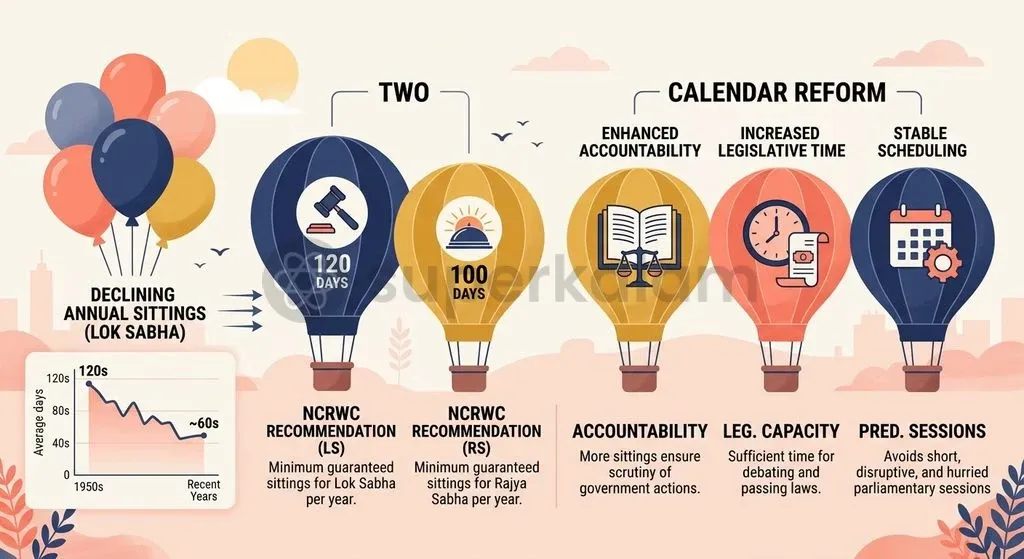
- Secular decline in sittings: According to data compiled by PRS Legislative Research, the 17th Lok Sabha sat for only 274 days across its full five-year term, marking the lowest sitting tally for any full-term Lok Sabha in Indian history.
- Truncated notice windows: Under Lok Sabha Secretariat administrative practice, the Union government typically provides a minimum 15 days' notice before convening a regular session and at least three days' notice for a short or special session, as reported in October 2026.
- Constrained legislative scrutiny: When governments invoke truncated notice periods, opposition parties argue that diminished preparation time weakens parliamentary debates. Lawmakers face constrained windows to examine complex bills, debate national priorities, or demand administrative accountability.
Discuss with Superkalam
What is the maximum time interval permitted by Article 85(1) between two consecutive sessions of Parliament?
Ask NowWhat Does Article 85 Say About Summoning Parliament?
Article 85 governs the frequency and life of parliamentary sessions through presidential authority. The constitutional mechanics operate through specific textual safeguards:
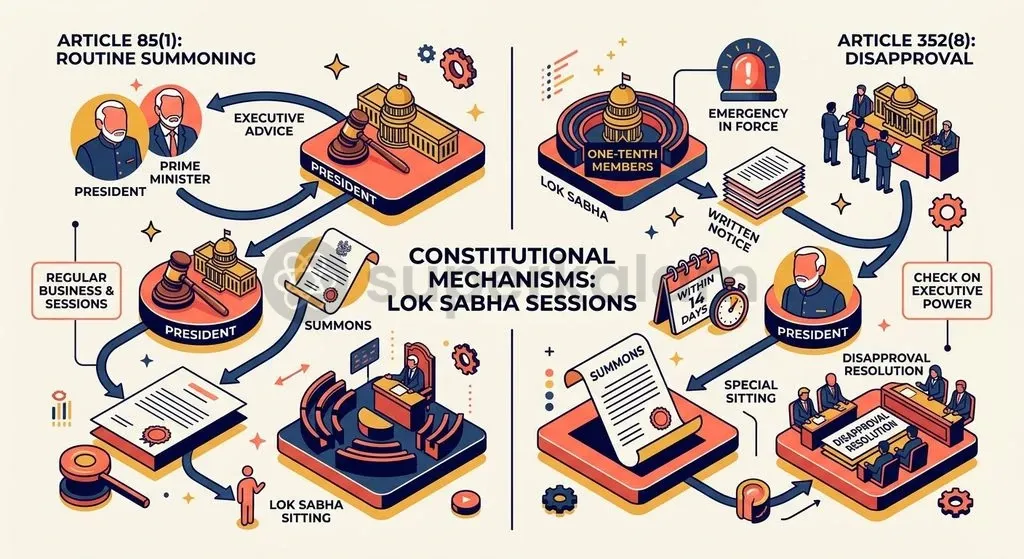
- Article 85(1) convening mandate: The President summons each House to meet at such time and place as the President thinks fit. However, six months must not intervene between the last sitting in one session and the date appointed for the first sitting in the next session.
- Absence of a sitting floor: The six-month rule originated as a safeguard against prolonged legislative suspensions. Yet it inadvertently operates as a ceiling rather than an active operational target. The text does not mandate a minimum number of working days or an annual schedule, allowing a government to satisfy the requirement with just two brief sittings a year.
- Article 85(2) termination powers: Article 85(2) complements the convening power by authorising the President to prorogue either House or dissolve the Lok Sabha.
While presiding officers regulate daily proceedings, the formal life and termination of each session remain an executive prerogative executed through presidential notifications.
Who Decides the Dates: The Cabinet, the President, or the Speaker?
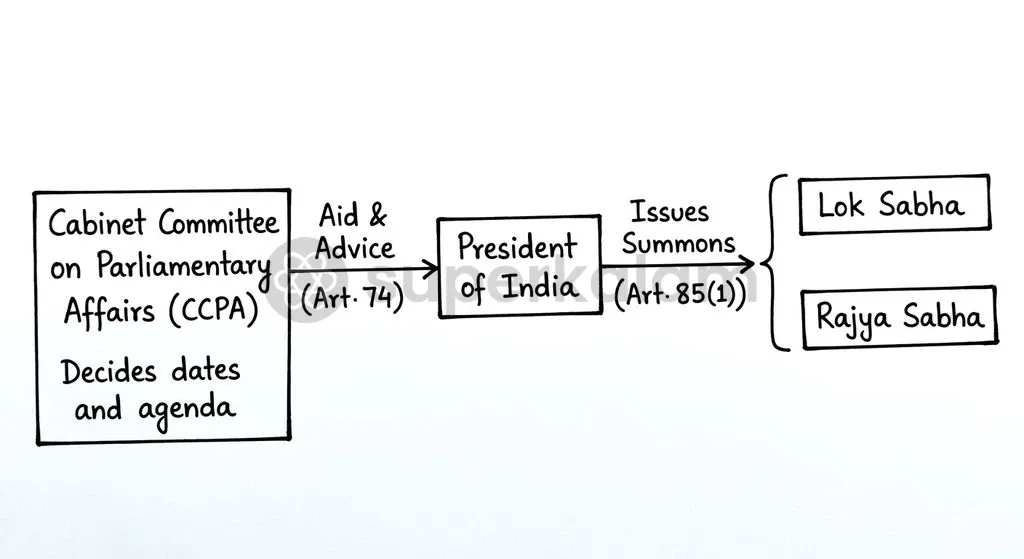
The Cabinet Committee on Parliamentary Affairs (CCPA) determines the commencement date, duration, and agenda of any session before making a formal recommendation to the President. Under the Government of India (Allocation of Business) Rules, 1961, this ministerial committee exercises real operational power behind legislative scheduling.
Constitutional doctrine establishes that the President possesses no independent discretion when issuing a summons. Under Article 74(1), the President must act strictly on the aid and advice of the Council of Ministers headed by the Prime Minister.
Judicial precedents have repeatedly affirmed this distribution of authority:
- Shamsher Singh v. State of Punjab (1974): A seven-judge Constitution Bench held that the President is a constitutional head who must exercise all formal powers, including convening the legislature, solely on ministerial aid and advice rather than personal discretion.
- Nabam Rebia v. Deputy Speaker (2016): A five-judge Constitution Bench reiterated that the discretionary summoning power cannot be exercised independently by a constitutional head without ministerial advice, extending the principle established in Shamsher Singh to legislative calendars.
Presiding officers and parliamentary minorities lack the authority to convene either House. As confirmed in Kaul and Shakdher's Practice and Procedure of Parliament, the Speaker of the Lok Sabha and the Chairman of the Rajya Sabha manage chamber order but cannot summon a session. Lok Sabha Speaker Om Birla reiterated on 22 October 2026 that presiding officers have no constitutional power under Article 85 to summon or prorogue Parliament, as that authority rests strictly with the executive recommending action to the President.
A distinct procedural distinction exists between adjournment and formal prorogation:
| Power / Action | Authority | Constitutional / Statutory Ground | Operational Effect |
|---|---|---|---|
| Summoning | President (on CCPA advice) | Article 85(1) & Article 74(1) | Commences a new parliamentary session. |
| Adjournment Sine Die | Presiding Officer (Speaker / Chairman) | Rules of Procedure (Lok Sabha Rule 15) | Suspends chamber sittings indefinitely without ending the session. |
| Prorogation | President (on CCPA advice) | Article 85(2)(a) | Terminates the session; fresh business requires a new summons. |
| Reconvening an Adjourned House | Presiding Officer (on executive request) | Kaul & Shakdher Parliamentary Practice | Resumes an unprorogued session on two to three days' notice. |
Under parliamentary conventions recorded by Kaul and Shakdher, when a House is adjourned sine die without formal prorogation, the government can request the Speaker to reconvene sittings on short notice without issuing a fresh presidential summons.
Discuss with Superkalam
How does the six-month rule under Article 85(1) inadvertently allow the executive to operate with a reduced number of sittings?
Ask NowWhy the Constitution Does Not Define a 'Special Session'
The Constitution of India nowhere defines or formally mentions the term "special session" in its text. Any extraordinary meeting summoned by the Union government is promulgated under the general provisions of Article 85(1), carrying the identical constitutional status of a regular session.
Lawmakers have only one explicit mechanism to compel a sitting outside executive discretion:
- Article 352(8) emergency disapproval: Introduced by the 44th Constitutional Amendment Act of 1978, this clause requires a special sitting within 14 days if not less than one-tenth of Lok Sabha members submit written notice disapproving a National Emergency.
- Absence of general recall rights: Outside this emergency exception, non-governmental members cannot force Parliament to assemble.
- Executive prerogative: Whether public discourse terms an extraordinary meeting a special session or a commemorative sitting, the formal procedure remains tethered to executive discretion under Article 85(1).
How India Compares: Why Other Democracies Let Lawmakers Call Sessions
Democratic legislatures across the world employ varied constitutional models to ensure executive branches cannot suppress legislative meetings. While India mirrors Westminster traditions in granting convening power to the executive, other major democracies secure institutional autonomy through constitutional calendars or minority recall rights.
Under the Twentieth Amendment to the United States Constitution, the US Congress convenes by direct constitutional mandate on 3 January every year unless lawmakers enact an alternative date by law. The American executive cannot postpone, cancel, or suspend regular congressional sessions, safeguarding the legislature's calendar from presidential interference.
In Germany, Article 39(3) of the Basic Law obliges the President of the Bundestag to convene parliament whenever one-third of its members, the Federal Chancellor, or the Federal President demands it. This constitutional rule ensures that legislative minorities holding at least 33 per cent of seats can force an immediate debate on critical public emergencies.
The United Kingdom relies on executive primacy, though parliamentary practice limits arbitrary scheduling. Under Standing Order No. 13 of the UK House of Commons, the Speaker may recall the House during an adjournment only upon formal representation made by government ministers demonstrating that the public interest requires it.
| Country | Summoning Authority | Minority or Lawmaker Recall Right | Fixed Constitutional Calendar |
|---|---|---|---|
| India | President on Cabinet (CCPA) advice | None (except Article 352(8) on National Emergency) | No (only 6-month maximum interval) |
| United States | Automatic constitutional mandate | Independent legislative scheduling | Yes (convenes 3 January under 20th Amendment) |
| Germany | Bundestag President | Mandatory if requested by one-third of members | Yes (ongoing legislative terms) |
| United Kingdom | Crown on ministerial advice | Ministers request Speaker recall under Standing Order 13 | Predictable sessional patterns |
Discuss with Superkalam
Compare the recall mechanism of the German Bundestag with India's Article 352(8) to analyze how minority rights differ in compelling legislative debates.
Ask NowThe Cost of Executive Monopoly: Shorter Sittings and Bypassed Scrutiny
Concentrating calendar control within the executive branch enables governments to compress sittings and bypass scrutiny. Because ministers determine how many days the legislature meets, political convenience can dictate the depth of parliamentary oversight.
The impact of this executive monopoly unfolds across several institutional dimensions:
- Diminished oversight instruments: Question Hour, Zero Hour, and special adjournment motions face sharp reductions when sitting days contract.
- Bypassed legislative review: Abbreviated sessions encourage the passage of complex legislative measures through voice votes with minimal floor debate and insufficient committee examination.
- Routinely breached state benchmarks: PRS Legislative Research records that states such as Karnataka, Uttar Pradesh, and Odisha established statutory or rules-based targets of 40 to 90 annual sitting days, yet state governments routinely breach these targets without legal sanction.
Because state governors act on the advice of chief ministers under provisions analogous to Article 85, state cabinets retain unfettered discretion over convening their assemblies.
What Law Commissions and Experts Propose: Fixing the Parliamentary Calendar
The National Commission to Review the Working of the Constitution (NCRWC, 2002) recommended fixing a statutory minimum of 120 sitting days per year for the Lok Sabha and 100 days for the Rajya Sabha. The Commission also proposed that state legislative assemblies with fewer than 70 members meet for at least 50 days annually, while larger state assemblies meet for a minimum of 90 days.
Efforts to establish a predictable annual timetable date back to the early years of the Republic. In 1955, the Lok Sabha's General Purposes Committee recommended a predictable annual calendar with three regular sessions: a Budget Session from February to May, an Autumn Session from July to September, and a Winter Session from November to December. While the Jawaharlal Nehru Cabinet accepted this framework in principle, the three-session convention was never codified into binding constitutional or statutory law.
Private Member Bills introduced in Parliament, including proposals placed before the Rajya Sabha in 2024 and 2025, have consistently sought an amendment to Article 85 to mandate a minimum threshold of 100 to 120 sittings per year. Establishing a legally binding calendar would prevent governments from truncating sessions during politically sensitive periods.
Reforming the parliamentary calendar requires a multi-pronged institutional restructuring:
- Constitutional amendment to Article 85: Mandate a statutory floor of at least 100 to 120 annual sitting days for Parliament, paired with enforceable targets for state legislative assemblies.
- Minority convening mechanisms: Adopt a provision similar to Germany's Basic Law allowing a designated threshold of lawmakers, such as one-fourth or one-third of the House, to compel a sitting for pressing public concerns.
- Fixed sessional timetables: Codify commencement and adjournment dates well in advance so standing committees, lawmakers, and civil society can plan legislative scrutiny effectively.
Discuss with Superkalam
Design a constitutional or procedural mechanism for India that balances the executive's legislative agenda with the opposition's right to demand debate on urgent national issues.
Ask NowKey Takeaways
- Executive control over Article 85: The President formally summons and prorogues Parliament under Article 85, but Article 74(1) and the Supreme Court's ruling in Shamsher Singh require that this power be exercised strictly on the advice of the Union Cabinet.
- Role of the CCPA: The Cabinet Committee on Parliamentary Affairs (CCPA) determines the dates, duration, and agenda of parliamentary sessions before communicating its decision to the President.
- Absence of 'Special Session' definition: The Constitution of India does not define or mention a "special session"; all sittings are held under Article 85(1), with the sole exception of Article 352(8) where one-tenth of Lok Sabha members can demand a sitting to disapprove an Emergency.
- Presiding officers lack summoning power: The Speaker of the Lok Sabha and the Chairman of the Rajya Sabha manage chamber proceedings and can adjourn sittings, but neither they nor the opposition can summon Parliament.
- Global contrast in legislative autonomy: Unlike the United States Congress, which convenes automatically under the 20th Amendment, or the German Bundestag, which can be recalled by one-third of its members, India's legislature cannot independently convene itself.
- Reform proposals: The NCRWC (2002) recommended mandating a minimum of 120 sitting days for the Lok Sabha and 100 days for the Rajya Sabha, reflecting long-standing reform demands to curb executive monopoly over legislative timing.
Mains Question
"The structural framework of Article 85, read with Article 74, has entrenched an executive monopoly over the legislative calendar, compromising the oversight function of Parliament." Critically examine. (150 words) (10 Marks)
Evaluate NowMains Question
"Unlike democracies such as Germany and the United States that provide constitutional guarantees or minority recall rights, Indian lawmakers lack institutional mechanisms to compel parliamentary sittings." In this context, evaluate the need to reform the summoning mechanism of Parliament in India. (250 words) (15 Marks)
Evaluate NowPractice MCQs
QUESTION 1
With reference to the constitutional provisions and conventions governing parliamentary sessions in India, consider the following statements:
- The term 'special session' is explicitly defined under Article 85 of the Constitution of India.
- Under Article 85(1), a period of not more than six months must intervene between the last sitting in one session and the date appointed for the first sitting in the next session.
- The Speaker of the Lok Sabha possesses independent constitutional authority under Article 85 to summon or prorogue Parliament. Which of the statements given above is/are correct?
QUESTION 2
Consider the following statements regarding the summoning of legislative bodies in India and comparative jurisdictions:
- Under the 44th Constitutional Amendment Act of 1978, a special sitting of the Lok Sabha must be convened within 14 days if not less than one-tenth of its members submit a written notice disapproving a National Emergency.
- Under the Twentieth Amendment to the United States Constitution, the US Congress convenes by direct constitutional mandate on 3 January every year unless changed by law.
- In Germany, the Basic Law mandates that the President of the Bundestag must convene parliament if at least one-tenth of its members demand it. Which of the statements given above are correct?
QUESTION 3
Regarding the distribution of powers related to parliamentary proceedings in India, consider the following statements:
- The Cabinet Committee on Parliamentary Affairs (CCPA) determines the dates and duration of parliamentary sessions under the Government of India (Allocation of Business) Rules, 1961.
- In Shamsher Singh v. State of Punjab (1974) and Nabam Rebia v. Deputy Speaker (2016), the Supreme Court ruled that the constitutional head can exercise personal discretion independently of ministerial advice when summoning the legislature.
- An adjournment sine die terminates the formal life of a parliamentary session, requiring a fresh presidential summons to reconvene. Which of the statements given above is/are correct?
QUESTION 4
Which of the following bodies or institutional mechanisms exercises the actual operational authority to decide the commencement date, agenda, and duration of a Parliament session before recommending it to the President of India?
QUESTION 5
Consider the following statements regarding the functioning of the 17th Lok Sabha:
- According to data compiled by PRS Legislative Research, the 17th Lok Sabha sat for only 274 days across its full five-year term.
- The sitting tally of the 17th Lok Sabha was the lowest for any full-term Lok Sabha in Indian history. Which of the statements given above is/are correct?