Special Executive Magistrates under BNSS: Police Remand vs Separation of Powers
When police officers act as executive magistrates and order preventive detention, executive convenience clashes with due process and the separation of powers.
Oct, 2026
•9 min read

Overview
Section 15 of the Bharatiya Nagarik Suraksha Sanhita, 2023 allows state governments to vest preventive detention powers in police officers designated as Special Executive Magistrates. This creates an acute constitutional conflict. An investigating authority simultaneously adjudicates personal liberty without independent judicial oversight.
Urban police commissionerates rely on Sections 126 to 130 of the Sanhita to preserve public order swiftly. Yet this arrangement directly compromises the separation of powers under Article 50 of the Constitution. It weakens procedural guarantees of natural justice and fair inquiry protected under Article 21, exposing citizens to executive remand without independent trial protections.
Why Special Executive Magistrates Are Back in the Spotlight
Recent judicial rulings and police remands have brought executive magistracy under renewed focus across two major jurisdictions:
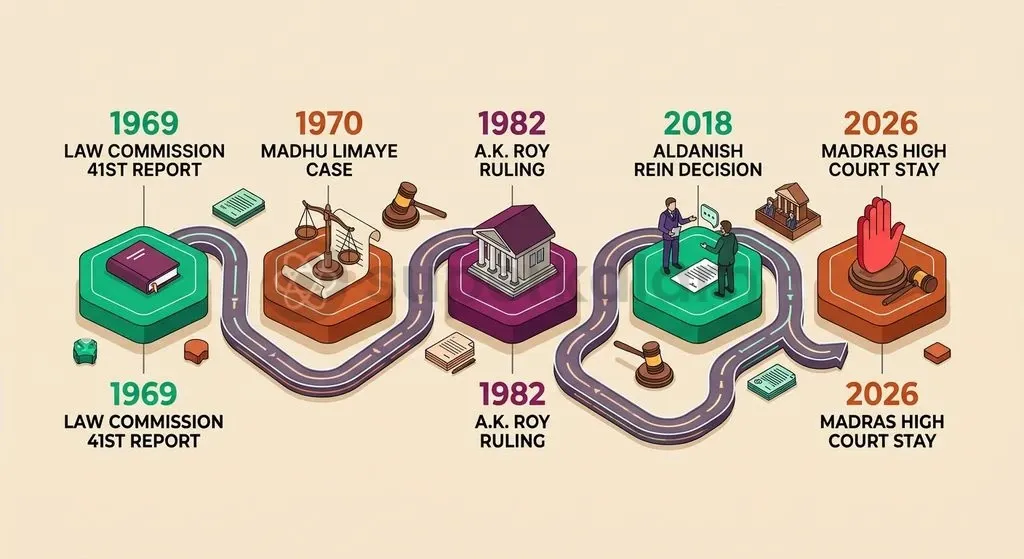
- Madras High Court stay (April 2026): The High Court stayed a Tamil Nadu government order conferring magisterial powers on police officers under the BNSS. The ruling reaffirmed that an enforcement agency cannot neutrally assess the legality of its own preventive actions.
- Delhi Police remand controversy (October 2026): Delhi Police Assistant Commissioners of Police acting as executive magistrates remanded Cockroach Janta Party activists to judicial custody under Section 126 and Section 135(3) of the BNSS. A Special Executive Magistrate court in Delhi later granted bail to the activists.
- Delhi High Court procedural warning (2026): On 23 October 2026, in Neha v. State (NCT of Delhi), the court dismissed AISA president Neha Bora's writ petition, holding that there was sufficient material before the magistrate for the Section 126 BNSS notice at this stage. It also made clear that a bond is not automatic and must follow the procedural safeguards of the Sanhita.
Preventive police detention is not an isolated administrative tool. As of October 2026, statutory continuity between the old criminal code and the new Sanhita has intensified constitutional scrutiny over whether police commissionerates should continue exercising these preventive detention powers.
Discuss with Superkalam
Recall the minimum police rank authorised under Section 15 of the BNSS to be appointed as a Special Executive Magistrate.
Ask NowFrom CrPC to BNSS: What Powers Do Special Executive Magistrates Hold?
Section 15 of the Bharatiya Nagarik Suraksha Sanhita, 2023 authorises the State Government to appoint Executive Magistrates or police officers not below the rank of Superintendent of Police as Special Executive Magistrates for specific local areas. The provision directly replaces Section 21 of the repealed Code of Criminal Procedure, 1973.
Meanwhile, Section 16 of the BNSS governs the local jurisdiction of Executive Magistrates, which remains subject to the administrative control of the District Magistrate.
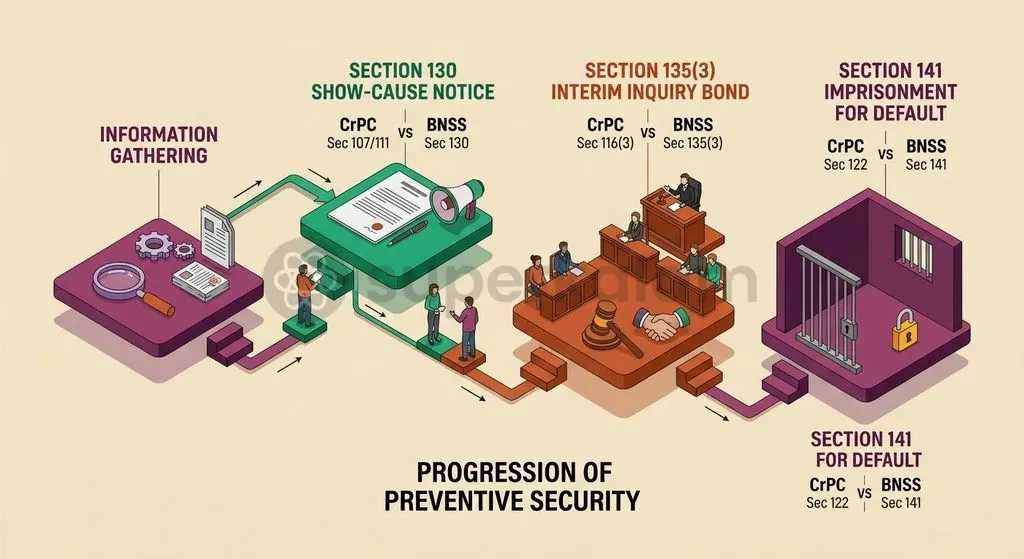
Executive Magistrates derive their enforcement capabilities from the preventive justice framework codified in Chapter X of the BNSS. These provisions allow officers to demand financial security, execute peace bonds, and commit non-compliant citizens to prison.
| Statutory Subject | CrPC, 1973 Provision | BNSS, 2023 Provision | Procedural Scope and Legal Power |
|---|---|---|---|
| Special Executive Magistrates | Section 21 | Section 15 | State government appoints officers for particular areas or specific executive functions. |
| Jurisdiction of Magistrates | Section 22 | Section 16 | District Magistrate defines territorial limits under state government guidelines. |
| Security for Keeping the Peace | Section 107 | Section 126 | Show-cause notices issued to execute bonds to prevent breaches of peace. |
| Habitual Offender Bonds | Section 110 | Section 129 | Good-behaviour bonds demanded from suspect classes for periods up to three years. |
| Order Setting Terms | Section 111 | Section 130 | Mandatory written order stating information received, bond amounts, and surety terms. |
| Interim Custody Orders | Section 116(3) | Section 135(3) | Inquiry stage power requiring interim security and detaining individuals until furnished. |
| Imprisonment for Default | Section 122 | Section 141 | Direct detention in prison for failure to furnish required financial security. |
| Urgent Prohibitory Orders | Section 144 | Section 163 | Written emergency directions issued to prevent obstruction, annoyance, or danger. |
Under Section 130 of the BNSS, an Executive Magistrate must provide a written order specifying the exact information received and the character of required sureties. If the noticee fails to furnish security during the inquiry stage, Section 135(3) permits immediate detention in custody. Section 141 allows magistrates to commit defaulted individuals to prison, transforming preventive administrative processes into formal deprivation of liberty.
The Urban Commissionerate Problem: When Investigators Act as Magistrates
Section 70 of the Delhi Police Act, 1978 exemplifies how statutory enactments empower executive governments to confer Executive Magistrate authorities upon Assistant Commissioners of Police and higher officers. Urban commissionerates in metropolitan cities like Delhi, Mumbai, and Bengaluru bypass the traditional district collectorate system. Senior police officers perform twin functions: supervising investigations while simultaneously adjudicating preventive bond hearings.
This dual institutional role violates the foundational natural justice maxim nemo judex in causa sua (no person shall judge their own cause). The commissionerate model consolidates conflicting roles within one department:
- Complainant and investigator: The local police gather intelligence, file reports, and initiate preventive proceedings under Section 126 of the BNSS.
- Adjudicator and custodian: Senior police officers issue summonses, assess surety solvency, and order executive detention.
Unchecked authority invites severe abuse through excessive surety amounts and unverified personal bond rejections. Marginalised populations bear the brunt of these summary procedures.
The Supreme Court observed in Sukanya Shantha v. Union of India (2024) that habitual offender laws historically targeted wandering and marginalised communities.
Empirical studies by the Criminal Justice and Police Accountability Project confirm that preventive sections are disproportionately deployed against Vimukta and Denotified Tribes, including the Pardhi and Kanjar communities.
Discuss with Superkalam
Explain why exercising both investigative and magisterial functions compromises the legal maxim 'nemo judex in causa sua'.
Ask NowExecutive Necessity vs Separation of Powers: The Constitutional Conflict
Article 50 of the Constitution of India provides a Directive Principle of State Policy obligating the State to separate the judiciary from the executive in public services. While Directive Principles are non-justiciable under Part IV, the Supreme Court has repeatedly recognised separation of powers as an essential facet of constitutional democracy. Vesting penal remand powers in active police officers breaches this institutional equilibrium.
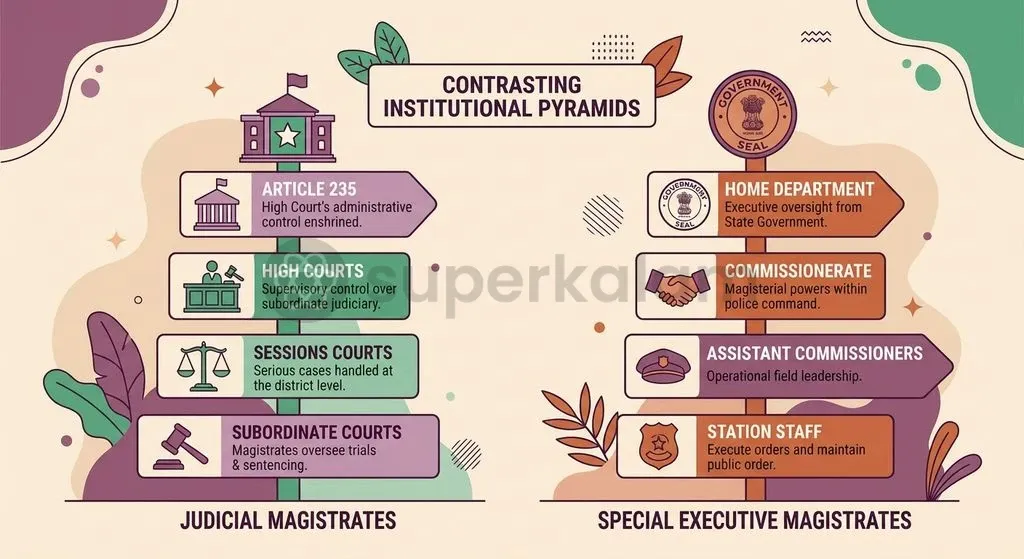
Judicial Magistrates maintain independence because their appointments, postings, and disciplinary actions remain vested in High Courts under Article 235 of the Constitution. In stark contrast, Special Executive Magistrates operate under the direct administrative hierarchy of state home departments and senior police leadership.
| Comparison Dimension | Judicial Magistrate (First Class) | Special Executive Magistrate (Police / Administrative) |
|---|---|---|
| Constitutional Oversight | Supervised by the High Court under Article 235 of the Constitution. | Subordinate to the State Executive, District Magistrate, or Police Commissioner. |
| Primary Statutory Role | Adjudicating criminal trials, assessing evidence, and issuing judicial remands. | Maintaining public order, preserving peace, and executing preventive bonds. |
| Institutional Insulation | Protected by judicial tenure and independent service conditions. | Subject to departmental postings, executive promotions, and political priorities. |
| Liberty Deprivation Grounds | Custody orders require formal charges and strict evidentiary compliance. | Preventive detention arises from subjective apprehension of public disorder. |
The conflict deepens when examined through Article 21 due process standards. In P. Sathish Kumar v. State (2023), the Madras High Court established that executive notifications assigning remand authorities to police officers subvert constitutional boundaries.
Police officers inherently operate under institutional pressures to suppress crime swiftly. This operational mindset makes them structurally ill-suited to protect an accused person's civil liberties.
Discuss with Superkalam
Analyse the structural differences in independence between a Judicial Magistrate First Class under Article 235 and a Special Executive Magistrate.
Ask NowWhat the Courts and Law Commissions Have Said About Executive Overreach
The Law Commission of India's 41st Report recommended the strict functional bifurcation of criminal courts to prevent executive officers from exercising judicial penal powers. The Commission observed that while executive officers must retain administrative powers to disperse assemblies and avert riots, trials and personal liberty adjudications belong exclusively to independent judicial magistrates.
Constitutional courts have intervened repeatedly to construct procedural fences around preventive executive powers:
- Substantive Inquiries Over Hasty Orders: In Madhu Limaye v. Sub-Divisional Magistrate, Monghyr (1970), the Supreme Court upheld the constitutional validity of peace bonds only on the condition that magistrates conduct genuine inquiries and enforce strict procedural safeguards.
- Fair Procedure Under Article 21: The Supreme Court affirmed in A.K. Roy v. Union of India (1982) that executive detentions must always satisfy fair, just, and reasonable procedural standards.
- Scrutiny of Mechanical Remands: In Aldanish Rein v. State of NCT of Delhi (Delhi High Court, 1 November 2018), a public interest petition on preventive detention under Sections 107 and 151 of the CrPC, the court examined a Special Executive Magistrate's order sending a man to judicial custody mechanically. Delhi State Legal Services Authority data before the court showed 1,119 persons held under those sections for more than seven days between July 2017 and June 2018.
- Reasonable Opportunity for Sureties: In Pravin Vijaykumar Taware v. Special Executive Magistrate (2009), the Bombay High Court ruled that magistrates cannot arbitrarily send individuals to jail without providing adequate time to furnish solvent sureties.
Fixing the Balance: Clear Limits for Executive Magistracy
The National Police Commission previously emphasised that police forces cannot operate effectively without public trust. That confidence erodes when enforcement agencies wield unchecked judicial prerogatives. Reconciling public peace with procedural fairness requires two immediate structural reforms:
- Bifurcate intelligence and adjudication: State governments must separate preventive intelligence gathering from final bond adjudication. When police officers identify an imminent threat under Section 126 or Section 129 of the BNSS, the show-cause notice should be placed before an independent Judicial Magistrate or revenue-cadre Executive Magistrate. Divesting police officers of judicial powers terminates the conflict of interest inherent in urban commissionerates.
- Institutionalise legal aid and personal bonds: Persons ordered to furnish security under Section 130 of the BNSS can be held in custody if they cannot arrange sureties. Legal aid at this stage reduces that risk. Standardising personal recognisance bonds for socio-economically disadvantaged individuals eliminates custodial abuse and upholds procedural justice.
Discuss with Superkalam
Evaluate whether preventive remand powers should be entirely stripped from executive officers and vested solely in judicial magistrates.
Ask NowKey Takeaways
- Statutory Framework: Section 15 of the BNSS, 2023 replaces Section 21 of the CrPC, enabling state governments to appoint Executive Magistrates or senior police officers as Special Executive Magistrates.
- Commissionerate Controversy: Designating Assistant Commissioners of Police as magistrates under statutes like Section 70 of the Delhi Police Act creates a direct conflict of interest, violating the natural justice maxim nemo judex in causa sua.
- Preventive Penal Powers: Sections 126, 129, 130, 135(3), and 141 of the BNSS empower executive magistrates to seek peace bonds, demand sureties for up to three years, and jail defaulted individuals.
- Constitutional Tension: Vesting remand and imprisonment powers in executive police personnel breaches the separation of powers directive under Article 50 and violates procedural fairness guaranteed by Article 21.
- Judicial Fences: The Supreme Court in Madhu Limaye (1970) and the Delhi High Court in Aldanish Rein (2018) stressed that preventive remands need an active inquiry and recorded reasons rather than mechanical orders.
Mains Question
"Conferring preventive remand powers on police officers functioning as Special Executive Magistrates compromises the mandate of Article 50 and procedural due process under Article 21." Examine. (10 Marks)
Evaluate NowMains Question
'The urban commissionerate system blurs the institutional boundary between the investigator and the adjudicator, creating structural risks for civil liberties.' Critically analyse in light of the preventive justice provisions under Chapter X of the BNSS. (15 Marks)
Evaluate NowPractice MCQs
QUESTION 1
With reference to the provisions of the Bharatiya Nagarik Suraksha Sanhita (BNSS), 2023, consider the following statements:
- Section 15 of the BNSS authorises the State Government to appoint police officers not below the rank of Superintendent of Police as Special Executive Magistrates.
- The local jurisdiction of Executive Magistrates is determined by the High Court under Section 16 of the BNSS.
- Section 135(3) of the BNSS empowers an Executive Magistrate to direct the detention of a person in custody during the inquiry stage if they fail to furnish interim security. Which of the statements given above are correct?
QUESTION 2
Consider the following statements regarding the institutional distinction between Judicial Magistrates and Special Executive Magistrates under the Indian constitutional and legal framework:
- The appointments, postings, and disciplinary control of Judicial Magistrates are vested in High Courts under Article 235 of the Constitution.
- Special Executive Magistrates function outside the administrative supervision of the High Court and report within the executive hierarchy.
- The 41st Report of the Law Commission of India recommended that executive officers should retain final adjudication powers over personal liberty to swiftly maintain public order. Which of the statements given above is/are correct?
QUESTION 3
Consider the following statements regarding preventive justice and executive powers under the criminal law framework in India:
- Under Section 126 of the BNSS, an Executive Magistrate can require a person likely to disturb the peace to execute a bond for up to one year.
- In Sukanya Shantha v. Union of India (2024), the Supreme Court observed that habitual offender laws historically targeted wandering and marginalised communities.
- Section 126 of the BNSS mandates good-behaviour bonds for habitual offenders for periods extending up to five years. Which of the statements given above is/are correct?
QUESTION 4
Which of the following provisions of the Bharatiya Nagarik Suraksha Sanhita, 2023 empowers an Executive Magistrate to issue an emergency written direction to prevent obstruction, annoyance, or danger to human life?
QUESTION 5
With reference to the urban police commissionerate model and natural justice principles, consider the following statements:
- Section 70 of the Delhi Police Act, 1978 permits conferring Executive Magistrate powers upon Assistant Commissioners of Police.
- Combining the roles of investigating police officer and preventive remand magistrate violates the maxim 'nemo judex in causa sua'.
- In P. Sathish Kumar v. State (2023), the Madras High Court ruled that executive notifications assigning remand authorities to police officers subvert constitutional boundaries. Which of the statements given above are correct?