Shamonda Virus: First Human Case, Vectors, and Spillover Risks
The fatal French case underscores how climate change shifts midge habitats and drives zoonotic spillover, testing One Health surveillance frameworks.
Oct, 2026
•9 min read

Context
The Shamonda virus case reported in France on 22 October 2026 marks the first documented human infection caused by this vector-borne veterinary pathogen. It shows how shifting climate regimes alter vector ranges and trigger zoonotic spillover events across Europe. According to the European Centre for Disease Prevention and Control (ECDC) News Release, the infection occurred in a severely immunocompromised patient who subsequently died.
The virus presents minimal direct epidemic risk to the broader human population due to an absence of secondary transmission. Even so, the event is an ecological warning signal. It demonstrates that animal-restricted pathogens can cross species barriers when shifting environmental baselines expand the geographical footprint of biting insect vectors.
Why in the News: France Reports Its First Human Infection
On 22 October 2026, French health and agriculture authorities confirmed the world's first documented human case of Shamonda virus infection. The patient, who was severely immunocompromised, received treatment at Hospices Civils de Lyon and died in early October 2026.
As of October 2026, epidemiological assessments indicate that this development represents an isolated transmission event rather than the start of an uncontrolled community outbreak.
Key regional developments surrounding the case include:
- Livestock epizootic: A study published in the Emerging Infectious Diseases journal established that an outbreak of Shamonda orthobunyavirus emerged in Central European dairy herds in mid-June 2026 across southern Germany and Switzerland before expanding into Western Europe.
- Regional animal circulation: During the summer of 2026, Shamonda virus had circulated widely among domestic farm animals across eastern France.
- Suspected exposure route: Preliminary findings indicate that the patient acquired the infection through a midge bite in eastern France.
Discuss with Superkalam
Can you identify the insect vector responsible for transmitting the Shamonda virus between hosts?
Ask NowWhat Is the Shamonda Virus?
The Shamonda virus is an enveloped, negative-sense single-stranded RNA virus classified within the genus Orthobunyavirus, family Peribunyaviridae, and the Simbu serogroup. This biological classification places it alongside several well-known veterinary pathogens that circulate primarily among wild and domestic ruminants.
Veterinary researchers first isolated the Shamonda virus in 1965 from cattle in Nigeria near the University of Ibadan. For decades, scientific literature documented the pathogen exclusively within livestock populations across Africa and Asia before its eventual emergence in European herds.
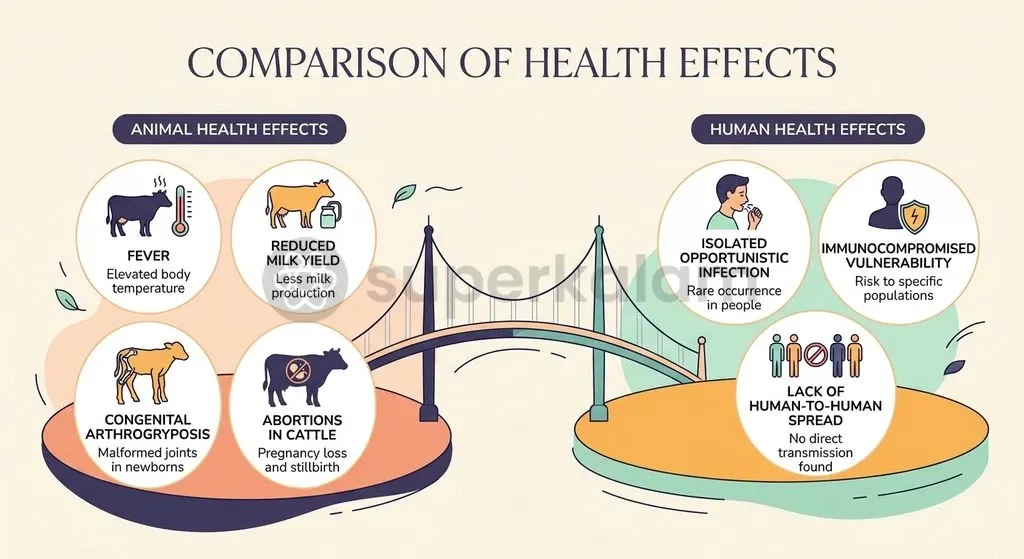
In ruminants, infection produces distinct clinical symptoms depending on the age and gestational status of the animal. According to a World Organisation for Animal Health (WOAH) Technical Brief, the virus manifests in herds through:
- Acute adult illness: High fever, severe diarrhoea, and sudden drops in commercial milk yield among adult dairy cattle.
- Teratogenic damage: Severe congenital malformations in developing foetuses following gestational infection.
- Reproductive losses: Elevated rates of spontaneous abortions and stillbirths among pregnant livestock.
Medical science has not developed targeted pharmaceutical countermeasures against this pathogen. The World Health Organization confirmed that there are currently no approved antiviral treatments or licensed human or veterinary vaccines available against Shamonda virus.
How the Virus Spreads: Vectors and Animal Reservoirs
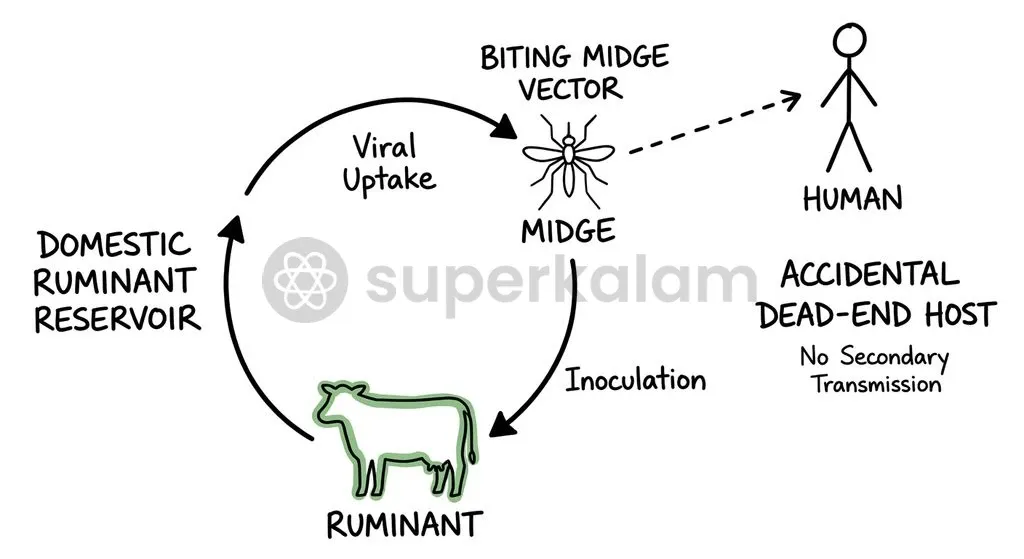
Transmission of the Shamonda virus occurs biological-vector style through biting midges of genus Culicoides (Diptera: Ceratopogonidae) rather than through direct contact. The pathogen does not spread via airborne droplets, bodily fluid contact, or contaminated surfaces between animals or humans.
The ecological maintenance of the virus relies on a continuous transmission cycle operating between biting midges and susceptible livestock reservoirs:
- Vector feeding: A female Culicoides midge ingests the virus while taking a blood meal from an infected viremic animal.
- Biological incubation: The virus replicates within the salivary glands and tissues of the insect vector over an extrinsic incubation period.
- Pathogen inoculation: The infective midge bites an uninfected host, transmitting the pathogen through saliva during subsequent blood feeding.
- Viremia in livestock: Ruminants develop circulating viral loads, allowing naive midges feeding on them to acquire the pathogen and perpetuate the cycle.
Humans represent accidental, dead-end hosts within this transmission cycle. Because human viral loads remain insufficient to re-infect biting midges, the chain of transmission terminates with the infected individual.
Discuss with Superkalam
Explain how dead-end host physiology prevents the secondary spread of the Shamonda virus among humans.
Ask NowHow Shamonda Compares with Other Bunyaviruses
Prior to the 2026 French case, the Simbu serogroup within the genus Orthobunyavirus was recognised almost exclusively for causing veterinary disease, as noted in The BMJ News & Analysis. Related members such as Schmallenberg virus and Akabane virus caused widespread agricultural disruptions without demonstrating clinical significance in humans.
| Feature / Metric | Shamonda Virus | Schmallenberg Virus | Akabane Virus |
|---|---|---|---|
| Genus & Family | Orthobunyavirus (Peribunyaviridae) | Orthobunyavirus (Peribunyaviridae) | Orthobunyavirus (Peribunyaviridae) |
| Primary Vector | Culicoides biting midges | Culicoides biting midges | Culicoides biting midges |
| Primary Animal Targets | Cattle, sheep, and goats | Cattle, sheep, and goats | Cattle, sheep, and goats |
| Documented Human Cases | Single documented fatal case (France, 2026) | No documented human disease | No documented human disease |
| Key Clinical Pathology | Teratogenesis and milk loss in animals; opportunistic infection in immunocompromised humans | Fetal arthrogryposis-hydranencephaly syndrome in ruminants | Congenital arthrogryposis and hydranencephaly in livestock |
This comparison highlights that while physical disease characteristics in ruminants remain similar across the Simbu serogroup, Shamonda virus demonstrated an unusual capacity to establish opportunistic infection in an immunocompromised human host.
Why Global Health Agencies Rate the Public Risk as Low
Public health institutions have moved to contextualise the French incident, avoiding unwarranted public alarm while maintaining targeted surveillance. The European Centre for Disease Prevention and Control assessed the broader public health risk to the general human population as minimal.
Two primary scientific factors justify this low-risk categorisation:
- Absence of secondary human transmission: There is zero documented evidence of sustained secondary human-to-human transmission through respiratory droplets, physical contact, or common vehicles.
- Dead-end host physiology: The concentration of virus in human blood remains too low to sustain vector competence, preventing local biting midges from spreading the pathogen from person to person.
Consequently, while the case represents an important development for medical documentation, it does not possess the epidemiological characteristics required to seed a broad human epidemic. The clinical risk concentrates primarily within individuals experiencing severe immunosuppression who reside near active livestock transmission zones.
Discuss with Superkalam
Analyse how warmer winters and extended warm seasons contribute to the expansion of Culicoides midge populations into new geographical zones.
Ask NowThe One Health Angle: Climate, Midges, and Animal Spillover
The emergence of the Shamonda virus in Europe illustrates how environmental change reshapes global pathogen geography. Ecological research demonstrates that rising global temperatures and extended warm seasons facilitate the northward geographical expansion and prolonged biting activity of Culicoides vector populations.
Climate warming fuels this animal-to-human transmission dynamic in three distinct stages:
- Reduced overwintering mortality: Milder winters allow larger insect populations to survive, causing midge densities to rise earlier in spring and persist into autumn.
- Ecotone expansion: Shifting thermal zones expand the geographical overlap between vector populations, agricultural livestock hubs, and human communities.
- Heightened spillover odds: When pathogens circulate intensively within livestock across this active ecotone, the statistical probability of an accidental spillover bite to a nearby human increases significantly.
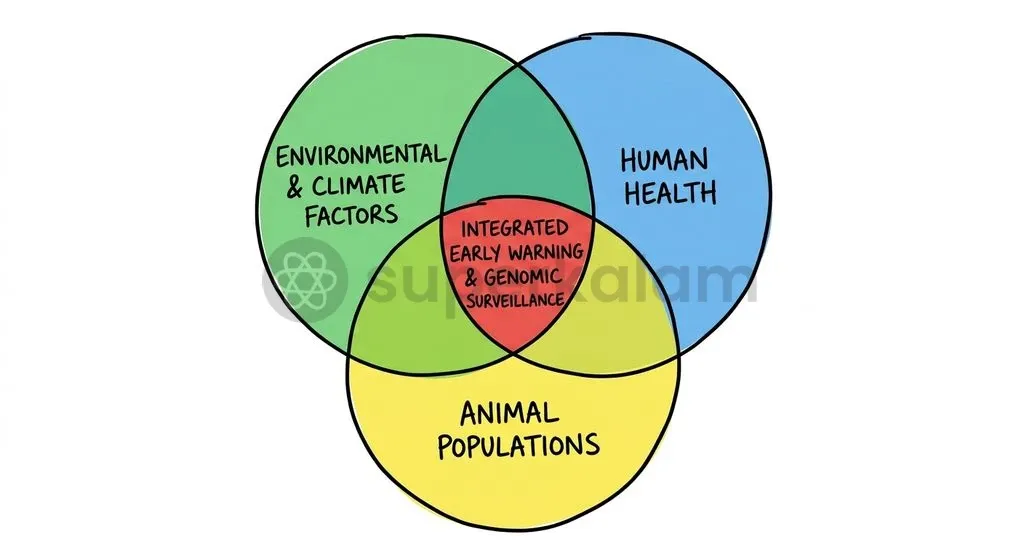
Addressing these risks requires moving past isolated public health agencies to adopt a unified One Health approach. This framework integrates veterinary diagnostics, entomological monitoring, and clinical human surveillance.
India's Surveillance Readiness and Institutional Framework
India maintains substantial institutional capacity to monitor vector-borne arboviruses and animal diseases. The Government of India established the National One Health Mission, steered by the Office of the Principal Scientific Adviser (OPSA), coordinating 16 central ministries and departments to build integrated pandemic preparedness.
To lead operational efforts, the Union Cabinet in February 2024 approved the creation of a Director post at the Scientist H level for the National Institute of One Health in Nagpur. This institutional network operationalises real-time pathogen tracking across several complementary platforms:
- High-containment diagnostics: India's National One Health Mission deploys a network of 23 BSL-3 laboratories, sentinel syndromic surveillance sites, and cross-sectoral interface monitoring across slaughterhouses, bird sanctuaries, and wildlife habitats.
- Predictive disease forecasting: The ICAR National Institute of Veterinary Epidemiology and Disease Informatics (ICAR-NIVEDI) in Bengaluru operates the dynamic, GIS-enabled National Animal Disease Referral Expert System (NADRES v2) to forecast vector-borne livestock diseases two months in advance.
- Vector mapping: Surveillance of forest landscapes and wildlife sanctuaries by ICAR-NIVEDI identified 18 distinct species of Culicoides midges, confirming that domestic livestock-wildlife ecotones in India harbour rich vector-reservoir ecosystems.
- Targeted arbovirus tracking: India monitors midge-transmitted orbiviral diseases through the ICAR All India Network Programme on Bluetongue, tracking dominant biting midge vector species such as Culicoides oxystoma and Culicoides imicola across peninsular states.
- Inter-ministerial data convergence: Inter-ministerial data sharing connects human health data from the Integrated Disease Surveillance Programme (IDSP) with livestock health records from the National Digital Livestock Mission (NDLM).
This integrated diagnostic architecture positions Indian health authorities to detect anomalous vector-borne patterns before local transmission cycles establish themselves in livestock or human communities.
Discuss with Superkalam
Evaluate whether India's multi-ministerial One Health institutional architecture is adequately structured to intercept novel veterinary arboviruses before spillover occurs.
Ask NowWay Forward: Building Early Warning Systems for Novel Pathogens
Managing emerging vector-borne zoonoses requires shifting surveillance strategies from post-outbreak containment to preemptive early-warning detection. Because vector territories expand alongside climatic warming, national health systems must implement targeted structural reforms.
Health and veterinary departments should deploy targeted surveillance interventions:
- Operationalise joint human-animal syndromic tracking: Integrate daily data flows between IDSP and NDLM, triggering field investigations whenever dairy herds experience sudden milk drops or clustered abortions alongside atypical human febrile illnesses.
- Scale entomological and vector competence mapping: Expand vector monitoring programmes using light traps across agricultural zones to track Culicoides population spikes, seasonal shifts, and microclimate variations.
- Strengthen clinical awareness in high-risk zones: Provide clinical guidance to rural tertiary care centres and infectious disease wards on screening severely immunocompromised individuals who present with unexplained fever or neurological signs following agricultural exposure.
- Invest in genomic and multiplex diagnostics: Equip regional BSL-3 laboratory clusters with generic orthobunyavirus PCR assays and metagenomic sequencing capabilities to detect untyped pathogens directly from veterinary samples.
- Deploy targeted farm-level vector management: Support dairy farmers with physical and biological midge management strategies, including manure treatment, standing-water drainage around sheds, and vector-resistant housing.
Integrated, cross-sectoral surveillance systems allow public health authorities to detect novel pathogens while they circulate in animal reservoirs, preventing accidental spillover events from threatening broader community health.
Key Takeaways
- French health authorities confirmed the first documented human infection of Shamonda virus on 22 October 2026 in an immunocompromised patient who died at Hospices Civils de Lyon.
- Shamonda virus is an enveloped, negative-sense single-stranded RNA virus of the genus Orthobunyavirus, family Peribunyaviridae, and the Simbu serogroup, first isolated from Nigerian cattle in 1965.
- Transmission occurs via biting midges belonging to the genus Culicoides, with no documented capacity for direct animal-to-animal or human-to-human transmission.
- The broader public health risk remains minimal because humans act as dead-end hosts who do not develop the sustained viremia required to perpetuate transmission.
- India monitors vector-borne livestock diseases through institutional mechanisms including the National One Health Mission, ICAR-NIVEDI's NADRES v2 forecasting system, and the All India Network Programme on Bluetongue.
Mains Question
"The documented spillover of the Shamonda virus into an immunocompromised individual highlights how changing climate baselines can alter vector ecology and bridge species barriers." In this context, examine the environmental mechanisms facilitating the emergence of novel vector-borne zoonoses. (10 Marks)
Evaluate NowMains Question
India's National One Health Mission seeks to build cross-sectoral pandemic preparedness across human, animal, and environmental domains. In light of emerging livestock-associated arboviruses, evaluate the institutional readiness and operational scope of this framework. (15 Marks)
Evaluate NowPractice MCQs
QUESTION 1
Consider the following statements regarding the Shamonda virus:
- It is an enveloped, negative-sense single-stranded RNA virus belonging to the genus Orthobunyavirus and family Peribunyaviridae.
- It spreads primarily through airborne droplets and contaminated bodily fluids between humans.
- Humans act as dead-end hosts because viral loads in human blood are insufficient to sustain vector competence. Which of the statements given above is/are correct?
QUESTION 2
With reference to vector-borne bunyaviruses of the Simbu serogroup, consider the following statements:
- Shamonda virus was first isolated from cattle in Nigeria in 1965.
- Schmallenberg and Akabane viruses share Culicoides biting midges as their primary vector.
- Commercial vaccines and approved antiviral therapies are widely available to prevent infection in livestock. Which of the statements given above is/are correct?
QUESTION 3
Consider the following statements regarding India's institutional framework for zoonotic pathogen surveillance:
- The National One Health Mission is steered by the Office of the Principal Scientific Adviser (OPSA) coordinating 16 central ministries and departments.
- The National Institute of One Health has been established in Nagpur to lead operational One Health initiatives.
- The surveillance framework utilizes a network of 23 BSL-3 laboratories to track cross-sectoral interface risks. Which of the statements given above is/are correct?
QUESTION 4
According to the World Organisation for Animal Health (WOAH), Shamonda virus manifests in ruminant herds through which of the following clinical pathologies?
- High fever and severe diarrhoea in adult cattle
- Drops in commercial milk yield
- Teratogenic damage and spontaneous abortions in pregnant livestock Select the correct answer using the code given below:
QUESTION 5
Regarding the public health risk assessment of the Shamonda virus following the documented case in France, consider the following statements:
- The European Centre for Disease Prevention and Control (ECDC) assessed the public health risk to the general human population as minimal.
- Sustained secondary transmission between humans was identified in healthcare workers caring for the patient. Which of the statements given above is/are correct?