Section 9D MMDR Act Explained: How Centre Capped State Mineral Taxes
Parliament's insertion of Section 9D restricts sub-national mineral levies, sparking a crucial debate on fiscal federalism and State revenue autonomy.
Sep, 2026
•9 min read
Overview
The Mines and Minerals (Development and Regulation) Amendment Act, 2026 introduced Section 9D to cap State-level mineral taxes. Parliament asserted its authority under Entry 50 of the State List to prevent cascading raw material costs across industrial supply chains.
This statutory move directly counters the fiscal autonomy reaffirmed by the Supreme Court of India in the landmark 2024 Mineral Area Development Authority ruling.
By conditioning State tax levies on Central rules and nullifying uncollected retrospective demands, Parliament altered the balance of fiscal federalism in the mining sector. The amendment seeks national economic uniformity while triggering fresh constitutional friction over State resource revenues.
Why is Section 9D of the MMDR Act in the News?
Parliament enacted the Mines and Minerals (Development and Regulation) Amendment Act, 2026 in August 2026 to regulate sub-national taxation on minerals. The legislative timeline unfolded rapidly:
- August 12, 2026: Lok Sabha passed the amendment Bill.
- August 13, 2026: Rajya Sabha approved the legislation.
- August 17, 2026: The President of India granted formal assent, notified via The Gazette of India Extraordinary (Part II—Sec. 1, No. 36) by the Ministry of Law and Justice.
As of August 2026, this statutory intervention establishes a formal Union framework restricting the power of State Governments to levy taxes and cesses on mineral rights. Unregulated, overlapping sub-national levies threaten domestic industrial competitiveness. Consequently, Parliament invoked its constitutional powers of limitation to check production costs.
The legislative amendment directly responds to the fiscal uncertainty that followed recent judicial pronouncements regarding sub-national resource taxation. State Governments in major mining corridors had initiated separate tax demands on mineral-bearing lands, raising serious concerns over production cost inflation across domestic manufacturing sectors.
Discuss with Superkalam
Which legislative entries in the Seventh Schedule divide powers between the Centre and States regarding mining and mineral taxation?
Ask NowWhat is Section 9D and How Does It Restrict State Taxation?
Section 9D(1) of the Mines and Minerals (Development and Regulation) Act, 1957, inserted via the 2026 Amendment, bars State Governments from imposing any tax, cess, or levy on mineral rights or mineral-bearing lands except under conditions prescribed by the Central Government. The Union Government derives this rulemaking power through an amendment to Section 13 of the principal Act, according to The Mines and Minerals (Development and Regulation) Amendment Act, 2026 (Gazette of India).
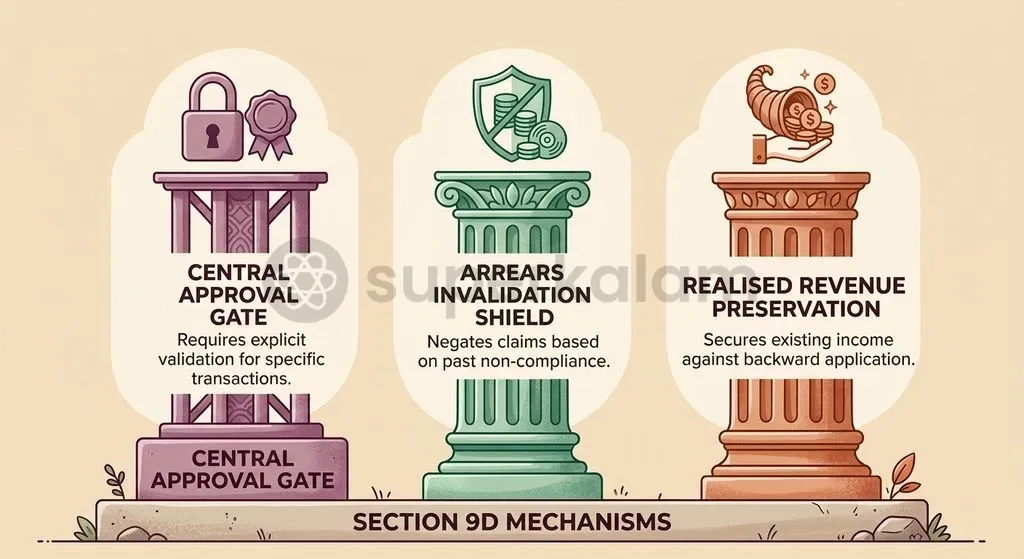
The statutory mechanism operates through three distinct structural interventions:
- Mandatory Central Pre-conditions: Section 9D(1) prohibits any State-level levy on mineral rights or mineral-bearing lands unless it strictly conforms to ceilings and conditions notified by the Central Government.
- Invalidation of Uncollected Arrears: Under Section 9D(2), any State tax, cess, or levy on mineral rights or mineral-bearing lands that was not deposited with or recovered by a State Government prior to the 2026 amendment is deemed invalid at all times.
- Protection of Realised Revenues: Section 9D(2) provides that tax amounts already collected and deposited into State treasuries prior to the amendment need not be refunded, preserving past fiscal receipts.
The 2026 Amendment also amends Section 2 of the principal 1957 Act to bring the regulation of mineral bearing lands alongside mines under Union declaration and control. However, regulatory and taxing powers over nearly 50 minor minerals, including sand, gravel, building stones, and marble, remain entirely with State Governments and are unaffected by Section 9D, according to a PIB Release on MMDR Amendment long-term stability.
| Statutory Dimension | Pre-2026 Legal Position | Post-2026 Regime Under Section 9D |
|---|---|---|
| State Taxing Competence | Plenary power under Entry 50 List II, absent express Parliamentary limits | Subordinated to conditions and ceilings prescribed by Central rules under Section 13 |
| Scope of Union Control | Limited to mines and mineral development under Section 2 declaration | Extended explicitly to cover mineral bearing lands under amended Section 2 |
| Past Tax Arrears | Recoverable retrospectively from April 1, 2005 under Supreme Court directions | Unrecovered past dues deemed invalid; only realised collections protected |
| Minor Minerals Exemption | Exclusively regulated and taxed by State Governments | Fully retained under State jurisdiction for nearly 50 minor minerals |
Constitutional Backdrop: The Battle Over Entry 50 of the State List
The Seventh Schedule of the Constitution of India divides legislative competencies concerning mines, land, and mineral taxation between Parliament and State Legislatures. This federal division generates structural friction between Union economic regulation and State revenue autonomy.
According to The Constitution of India, Seventh Schedule, three specific legislative entries govern this constitutional domain:
- Entry 54 of List I (Union List): Confers exclusive legislative competence upon Parliament over the regulation of mines and mineral development, to the extent declared expedient in the public interest by law.
- Entry 50 of List II (State List): Grants State Legislatures the power to levy taxes on mineral rights, subject to any limitations imposed by Parliament by law relating to mineral development.
- Entry 49 of List II (State List): Assigns State Legislatures exclusive authority over taxes on lands and buildings, interpreted by constitutional benches to include all lands, including mineral-bearing tracts.
State Governments argue that Entry 50 of List II provides an inherent fiscal power necessary for sub-national resource mobilisation. Conversely, the Union Government contends that the opening words of Entry 50 ("subject to any limitations imposed by Parliament") explicitly empower Parliament to impose statutory caps via mineral legislation.
Discuss with Superkalam
Explain the difference between a statutory royalty and a tax on mineral rights as clarified by the Supreme Court in the 2024 MADA judgment.
Ask NowFrom MADA Judgment to Legislative Ceiling: How the Law Evolved
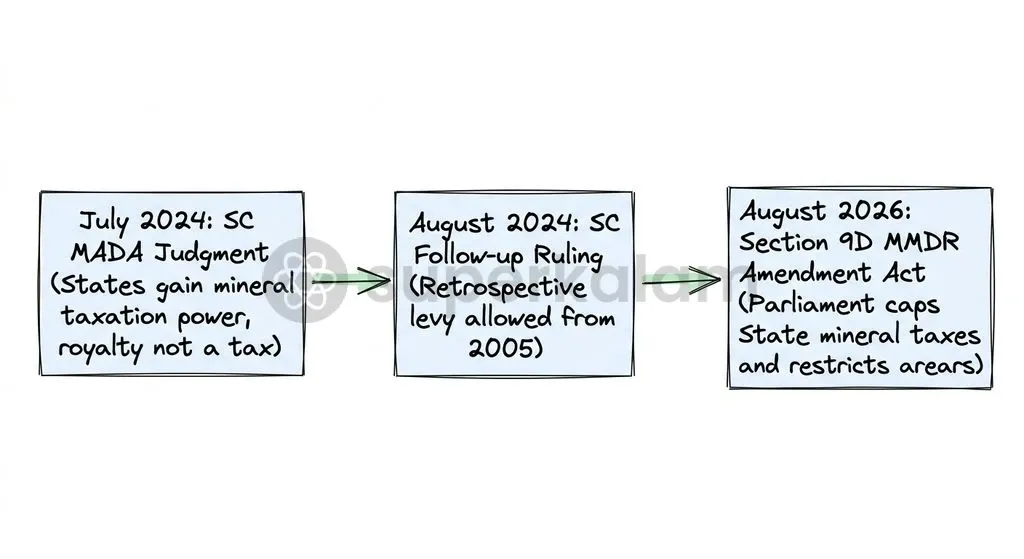
The Supreme Court of India settled a decades-old constitutional dispute in July 2024 through a 9-judge Constitution Bench in Mineral Area Development Authority (MADA) v. Steel Authority of India Ltd. (2024 INSC 554). By an 8:1 majority, the bench ruled that royalty paid under Section 9 of the MMDR Act is not a tax, but a contractual consideration paid by the lessee to the mineral owner for extracting minerals.
The evolution from the judicial verdict to the statutory cap followed key legal turning points:
- July 2024 (MADA Ruling): The Supreme Court held that the legislative power to tax mineral rights resides with the States under Entry 50 List II unless Parliament enacts specific limitations within a mineral development statute, as held in MADA v. SAIL (2024 INSC 554).
- August 2024 (Retrospectivity Order): The bench permitted States to recover past tax arrears retrospectively from April 1, 2005 across a staggered 12-year payment schedule beginning April 1, 2026, ordering a full waiver of interest and penalties.
- August 2026 (Statutory Ceiling): Parliament enacted Section 9D under the MMDR Act to supply the precise statutory limitation contemplated by the court, using Entry 54 List I powers to bind State taxing competence.
Centre vs States: Key Arguments on Fiscal Autonomy and Ease of Doing Business
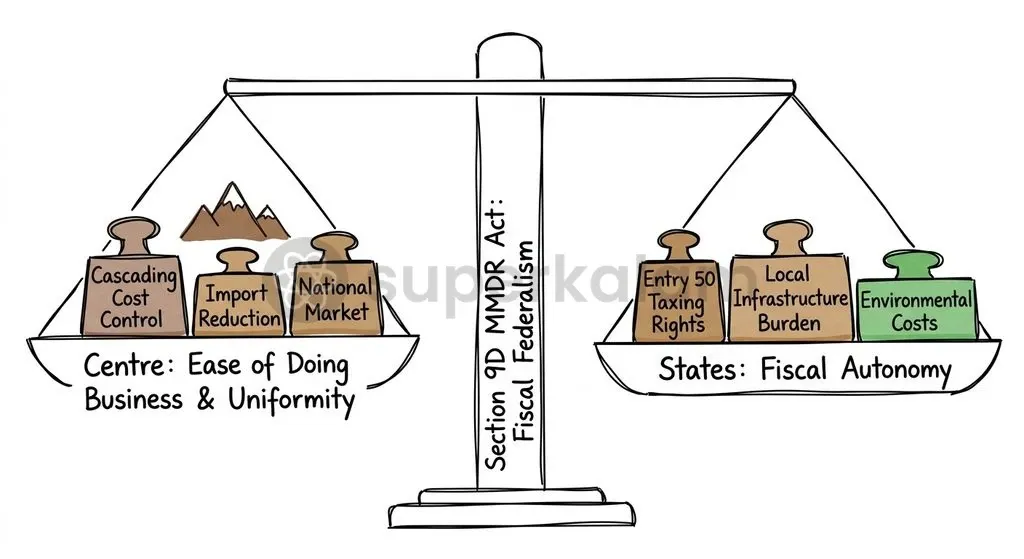
The debate over Section 9D reflects competing economic philosophies: national cost harmonisation versus sub-national fiscal sovereignty. Both perspectives invoke constitutional principles and economic data to justify their positions.
The Union Government's Justifications
The Union Government highlights the danger of cumulative, uncoordinated sub-national taxation on industrial raw materials:
- Multiplicity of Levies: Mining firms were already subject to approximately 14 separate taxes, fees, and statutory levies, including royalty, auction premiums, District Mineral Foundation (DMF) charges, NMET contributions, GST, and dead rent.
- Surging State Receipts: Mineral revenues accruing to State Governments grew by 354% since the introduction of mandatory e-auctions under the 2015 amendment, yielding over ₹7 lakh crore including coal, with approximately 90% of all revenues going directly to States.
- Import Vulnerability: Unregulated State cesses risk inflating prices of steel, aluminium, and cement. India imported minerals worth ₹10,12,529 crore in FY 2025-26, making domestic manufacturing vulnerable to import substitution if local raw material costs escalate.
Discuss with Superkalam
If a State Government introduces a local green cess on iron-ore-bearing land today, what statutory hurdles would it face under Section 9D?
Ask NowThe States' Objections
Mineral-rich States contend that Section 9D undermines the constitutional division of taxation powers:
- Localised Externalities: States such as Odisha, Jharkhand, Chhattisgarh, and Karnataka face severe environmental degradation, tribal displacement, and infrastructure wear from non-renewable extraction.
- Fiscal Instruments: State administrations maintain that mineral cesses are essential fiscal tools to fund ecological remediation and local development.
- Jurisdictional Encroachment: Expanding Union control to mineral-bearing lands under Section 9D allegedly encroaches upon Entry 49 of List II, setting up a likely constitutional challenge before the Supreme Court.
Impact on Mineral-Rich States and Mining Industry Costs
The introduction of Section 9D reshapes cost structures and revenue expectations across the mining landscape:
- Shielding Industrial Balance Sheets: By nullifying unrecovered tax arrears, Section 9D insulates core public and private sector enterprises from sudden balance-sheet shocks. Industrial manufacturers gain cost predictability, preventing supply chain disruptions in infrastructure projects and capital goods production.
- Curtailing State Retrospective Gains: Mineral-bearing States lose an anticipated source of substantial retrospective revenue authorised by the judiciary. These States must now rely on competitive e-auction premiums, DMF funds, and statutory royalties rather than creating autonomous fiscal levies on major minerals.
Way Forward: Balancing Cooperative Federalism with National Economic Uniformity
The Union Government must reconcile the national imperative for uniform raw material pricing with the legitimate revenue requirements of mineral-rich States. A purely legislative ceiling risks recurrent litigation unless accompanied by institutional consensus-building.
Policy experts recommend establishing a specialised intergovernmental body on the lines of the GST Council or activating the Inter-State Council under Article 263 to collaboratively determine mineral tax caps and revenue-sharing mechanisms. Such an institutional platform would enable States and the Centre to agree upon banded cess rates linked to market prices.
Parliament should also ensure that the rules framed under Section 13 provide transparent, predictable formulas for any State-level levies. Compensatory mechanisms, such as targeted infrastructure grants for mining corridors, can preserve cooperative federalism while maintaining national economic stability.
Discuss with Superkalam
Analyse the trade-off between ensuring raw material cost predictability for national manufacturing and preserving fiscal autonomy for mineral-rich States.
Ask NowKey Takeaways
- Legislative Action: The MMDR Amendment Act, 2026, which received Presidential assent on August 17, 2026, inserted Section 9D to cap State mineral taxation.
- Statutory Mechanism: Section 9D(1) bars States from levying taxes or cesses on mineral rights or mineral-bearing lands without Central permission, while Section 9D(2) invalidates uncollected past tax arrears.
- Constitutional Balance: The law operates at the intersection of Entry 54 List I (Union mineral regulation) and Entry 50 List II (State mineral taxes subject to Parliamentary law).
- Judicial Context: The amendment follows the Supreme Court's 9-judge bench ruling in MADA v. SAIL (2024), which held that royalty is not a tax and upheld State taxing powers absent Parliamentary limits.
- Economic Dimensions: Section 9D protects industries from ~14 overlapping levies and reduces import pressures, while mineral revenues to States have already surged 354% under e-auctions since 2015.
- Impending Challenge: State Governments argue that regulating mineral-bearing lands encroaches upon Entry 49 List II, indicating potential constitutional review.
Mains Question
The insertion of Section 9D in the MMDR Act seeks to balance national industrial competitiveness with sub-national taxation powers. Examine how this statutory ceiling impacts fiscal federalism in mineral-bearing States. (10 Marks)
Evaluate NowMains Question
"By extending Union regulatory control over mineral-bearing lands and capping sub-national levies, the MMDR Amendment Act, 2026 addresses supply-chain cost predictability while generating constitutional friction." Critically analyse. (15 Marks)
Evaluate NowPractice MCQs
QUESTION 1
With reference to Section 9D of the Mines and Minerals (Development and Regulation) Act, 1957, inserted via the 2026 Amendment, consider the following statements:
- It prohibits State Governments from imposing any tax, cess, or levy on mineral rights or mineral-bearing lands except under conditions prescribed by the Central Government.
- It invalidates uncollected past tax arrears while protecting tax amounts already collected and deposited into State treasuries prior to the amendment.
- It strips State Governments of all regulatory and taxing powers over minor minerals like sand, gravel, and marble. Which of the statements given above is/are correct?
QUESTION 2
Consider the following statements regarding the constitutional distribution of legislative powers concerning mines and mineral taxation:
- Entry 54 of List I gives Parliament power over the regulation of mines and mineral development to the extent declared expedient in the public interest by law.
- Entry 50 of List II confers an unqualified and absolute power on State Legislatures to tax mineral rights without any Parliamentary limitation.
- Entry 49 of List II assigns State Legislatures authority over taxes on lands and buildings, covering mineral-bearing tracts. Which of the statements given above is/are correct?
QUESTION 3
Regarding the Supreme Court's 2024 ruling in Mineral Area Development Authority (MADA) v. Steel Authority of India Ltd., consider the following statements:
- An 8:1 majority held that royalty paid under Section 9 of the MMDR Act is a tax rather than a contractual consideration.
- The Court affirmed that the legislative power to tax mineral rights resides with the States under Entry 50 of List II unless limited by Parliament.
- The Court permitted States to recover past tax arrears retrospectively from April 1, 2005 across a staggered 12-year payment schedule with a waiver of interest and penalties. Which of the statements given above is/are correct?
QUESTION 4
Consider the following statements regarding the statutory changes introduced by the MMDR Amendment Act, 2026:
- Section 2 of the principal 1957 Act was amended to bring mineral-bearing lands alongside mines under Union declaration and control.
- The Central Government derives rulemaking power to prescribe tax conditions under an amendment to Section 13 of the principal Act. Which of the statements given above is/are correct?
QUESTION 5
Which of the following reasons was highlighted by the Union Government to justify the insertion of Section 9D in the MMDR Act?