Section 199A Motor Vehicles Act: Parental Liability & Juvenile Driving Laws
As fatal underage crashes trigger parental arrests, Section 199A tests how vicarious criminal liability and child protection laws balance on Indian roads.
Nov, 2026
•9 min read
Overview
Section 199A of the Motor Vehicles Act, 1988 creates statutory vicarious criminal liability for parents and vehicle owners when a minor commits a motoring offence. The statute mandates up to three years of imprisonment, hefty financial penalties, and vehicle de-registration to curb impunity on public roads. Parliament introduced this strict deterrent to ensure road safety by making guardians legally accountable for entrusting dangerous machines to unlicensed adolescents.
By reversing the ordinary burden of proof through a legal presumption of parental consent, the provision treats the vehicle as a hazardous instrument and parental negligence as a direct threat to public safety.
Why in the News?
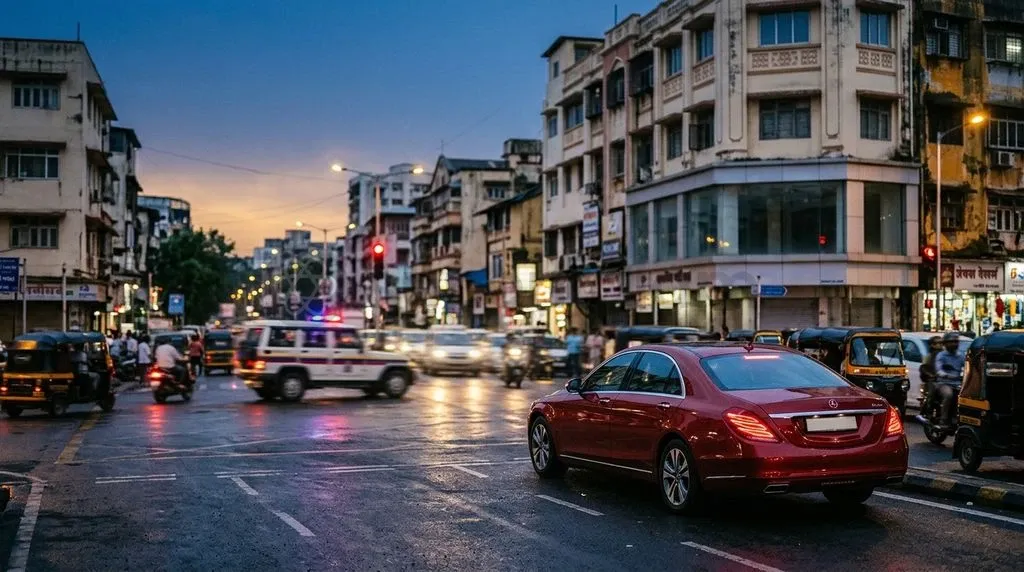
Recent fatal crashes involving adolescents operating high-end luxury cars have forced Section 199A of the Motor Vehicles Act, 1988 into intense legal and public scrutiny. In May 2024, Pune Police invoked Section 199A alongside child neglect provisions under the Juvenile Justice Act to arrest the father of a 17-year-old involved in a fatal crash.
More recently, as reported by The Indian Express and Onmanorama on 28 October 2026, Kochi City Police booked an Additional District Judge under Section 199A after his 17-year-old son fatally struck a scooterist while driving the family vehicle. These enforcement actions demonstrate a clear shift toward holding guardians directly accountable for enabling dangerous driving by minors.
Discuss with Superkalam
For what duration is a vehicle's registration certificate cancelled under Section 199A(4) following a juvenile motoring contravention?
Ask NowWhat Is Section 199A of the Motor Vehicles Act?
Section 199A of the Motor Vehicles Act, 1988 is a statutory mechanism that criminalises parental neglect by holding guardians or vehicle owners vicariously liable for offences committed by juveniles. Parliament inserted this provision through the Motor Vehicles (Amendment) Act, 2019 to close enforcement gaps where minor drivers escaped severe punishment while vehicle owners faced negligible consequences.
Under Section 199A(1), whenever a juvenile commits an offence under the Act, the guardian or the registered owner is deemed guilty of the contravention. The provision moves beyond the general penalty under Section 180 of the Act, which merely penalises allowing unauthorised persons to drive with up to three months of imprisonment or a five thousand rupee fine. Section 199A recognises that entrusting a motor vehicle to a child creates an unacceptable social risk.
| Provision Dimension | General Unauthorised Driving (Section 180) | Juvenile Offence Liability (Section 199A) |
|---|---|---|
| Target Entity | Any vehicle owner allowing an unlicensed person | Guardian of the juvenile or owner of the vehicle |
| Imprisonment Term | Up to 3 months | Up to 3 years |
| Statutory Fine | Up to ₹5,000 | ₹25,000 |
| Registration Penalty | None specified | Mandatory 12-month cancellation |
| Juvenile Consequence | General motor vehicle penalties | Licence bar until age 25 |
| Evidentiary Rule | Standard prosecution burden | Rebuttable statutory presumption of consent |
Legal Threshold: When Does a Guardian or Vehicle Owner Become Liable?
The legal threshold under Section 199A(1) triggers automatically the moment an underlying contravention is established against a minor. The statute does not require the prosecution to prove active physical facilitation or subjective criminal intent on the part of the guardian.
The Explanation to Section 199A(1) establishes an explicit statutory presumption that the juvenile operated the motor vehicle with the consent of their guardian or the registered owner. This statutory device relieves investigating agencies of proving how the adolescent obtained the car keys.
Section 199A(3) carves out an exception: liability does not attach if the juvenile held a valid learner's licence or driving licence for that specific class of vehicle. However, in Kerala, the High Court established critical procedural guardrails in Sharafudheen v. State of Kerala (2024). The court held that recording the juvenile's contravention in the police General Diary and submitting a Social Background Report before the Juvenile Justice Board are mandatory conditions precedent before prosecuting guardians. Furthermore, as ruled in Usman v. State of Kerala (2024), proceedings against an owner cannot stand unless the juvenile is formally proceeded against under the Act.
Discuss with Superkalam
In what manner does the statutory presumption of consent in Section 199A invert the conventional burden of proof in criminal jurisprudence?
Ask NowPenalties and Repercussions: Jail Time, Fines, and Vehicle Impoundment
Section 199A imposes multi-layered punitive consequences that target the guardian, the motor vehicle, and the juvenile's future driving eligibility.
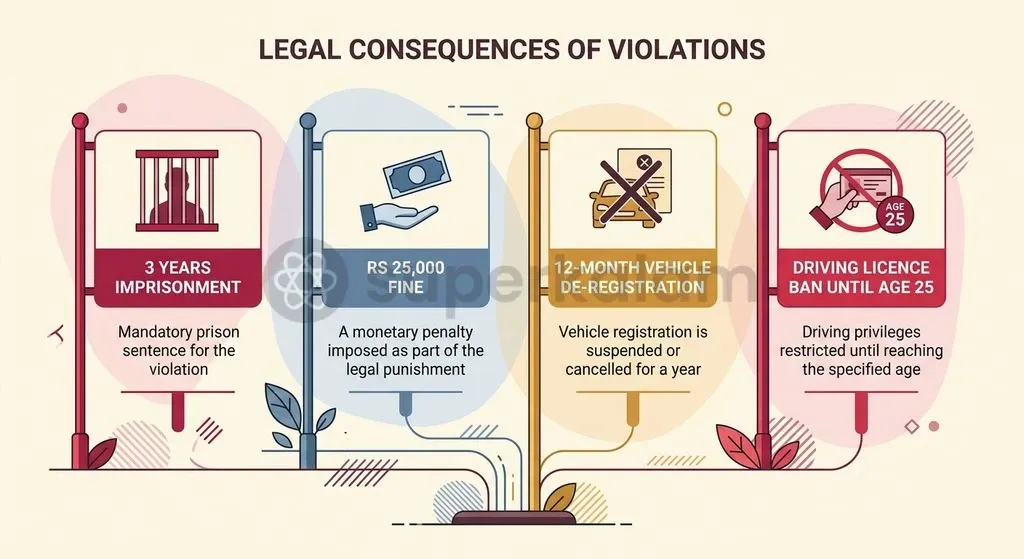
- Custodial and Financial Sanctions: Under Section 199A(2), a guardian or vehicle owner found guilty faces imprisonment for a term extending up to three years alongside a mandatory fine of twenty-five thousand rupees.
- Statutory De-Registration: Under Section 199A(4) read with Section 53(5A), transport authorities must cancel the certificate of registration of the offending vehicle for twelve months.
- Long-Term Licencing Disqualification: Under Section 199A(5), the offending juvenile is legally barred from obtaining a learner's licence or regular driving licence until reaching twenty-five years of age.
- Third-Party Financial Liability: The Supreme Court established the 'pay and recover' doctrine in National Insurance Co. Ltd. v. Swaran Singh (2004). While insurance firms compensate road crash victims initially, they retain the full right to recover payouts from the vehicle owner if the car was entrusted to an unlicensed juvenile.
How Section 199A Intersects with the Juvenile Justice Act, 2015
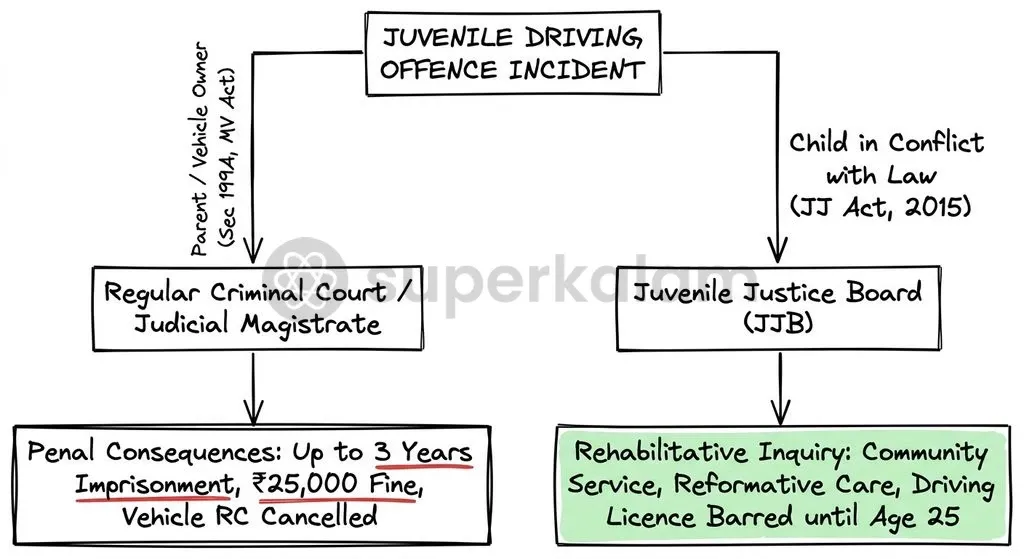
The enforcement of Section 199A operates at the intersection of general transport laws and statutory protections guaranteed to children. Section 199A(6) of the Motor Vehicles Act explicitly mandates that while a juvenile may be fined, all proceedings against the minor must be conducted strictly under the Juvenile Justice (Care and Protection of Children) Act, 2015.
This intersection creates a distinct procedural track for the adolescent. Even when a fatal crash occurs, the Supreme Court's ruling in Shilpa Mittal v. State of NCT of Delhi (2020) governs the classification of offences. The court held that offences lacking a prescribed minimum sentence of seven years cannot be categorised as 'heinous offences' under Section 2(33) of the JJ Act. Because unintentional vehicular manslaughter lacks this mandatory minimum threshold, it falls into the category of 'serious offences', leaving the matter exclusively under the jurisdiction of the Juvenile Justice Board (JJB).
Under Section 15 read with Section 18(3) of the JJ Act, preliminary assessments to transfer a child aged 16 to 18 years to an adult Children's Court apply only to heinous offences. Consequently, the adolescent cannot be tried directly as an adult in standard criminal courts for accidental vehicular collisions, concentrating the primary punitive weight of the criminal law onto the guardian.
Discuss with Superkalam
If a minor accesses car keys kept inside a locked drawer without permission, how can a guardian demonstrate 'due diligence' before the court?
Ask NowBurden of Proof: Available Defences for Parents and Guardians
The statutory structure of Section 199A deliberately places the legal burden of exoneration upon the parent or registered owner. Once the prosecution shows that an unlicensed juvenile operated the motor vehicle, the statutory presumption of consent applies.
The proviso to Section 199A(1) limits guardians to two narrow statutory defences:
- Absence of Knowledge: Proving affirmatively that the contravention occurred without the guardian's or owner's knowledge.
- Exercise of Due Diligence: Demonstrating that the guardian or owner exercised all due diligence to prevent the child from using the vehicle.
Meeting this evidentiary threshold requires verifiable proof rather than passive assertions. A parent cannot discharge this burden by merely showing they left the car keys on a table or instructed the minor not to drive. Due diligence requires affirmative protective steps, such as securing access to keys and actively monitoring the vehicle's availability.
Enforcement Gaps: Why Underage Driving Persists Across Indian Cities
Enforcement of Section 199A continues to struggle against infrastructure deficits and inconsistent administrative practices across states. According to the Ministry of Road Transport and Highways report 'Road Accidents in India 2022', over-speeding caused 72.3% of total road accidents and 71.2% of total road fatalities nationwide.
Three main administrative bottlenecks hinder uniform enforcement:
- Patchy Electronic Infrastructure: Adoption of automated speed cameras and electronic challans under Section 136A remains non-uniform across municipal limits.
- Informal Access and Permissiveness: Parental indulgence and informal key access frequently prioritise domestic convenience over statutory compliance.
- Procedural Bottlenecks: Delays and incomplete documentation between investigating police units and Juvenile Justice Boards stall Section 199A prosecutions.
Section 136A of the Motor Vehicles Act mandates state governments to install electronic monitoring systems, including speed cameras and automated monitoring infrastructure. Addressing persistent compliance gaps, the Supreme Court in S. Rajaseekaran v. Union of India (2024) directed all states to immediately operationalise Section 136A and Rule 167A of the Central Motor Vehicles Rules to automate violations. Without complete electronic monitoring, policing underage driving relies on manual checkpoints, which remain vulnerable to influence and arbitrary checks.
Ethical Dimension: Parental Responsibility, Privilege, and Public Safety
The legal framework of Section 199A reflects the ethical principles of criminal vicarious liability and strict social defence. From a normative standpoint, the law departs from subjective mens rea (guilty mind) because motor vehicles operate as inherently hazardous machines in shared public spaces.
Entrusting an automobile to an untrained adolescent creates an acute moral hazard. Affluent guardians who grant high-powered motor vehicles to minors externalise lethal risks onto vulnerable road users, treating public infrastructure as a playground of privilege.
This dynamic challenges public faith in administrative equality. When influential families leverage their status to shield children from accountability, the state's failure to enforce Section 199A undermines the rule of law. Vicarious liability is an ethical corrective: it demands that the duty of care within private family life aligns with the public interest in life and bodily safety.
Discuss with Superkalam
How does the deterrence mechanism of Section 199A differ from the traditional unauthorised driving penalties under Section 180 of the Motor Vehicles Act?
Ask NowWay Forward: Reforming Road Safety and Juvenile Accountability
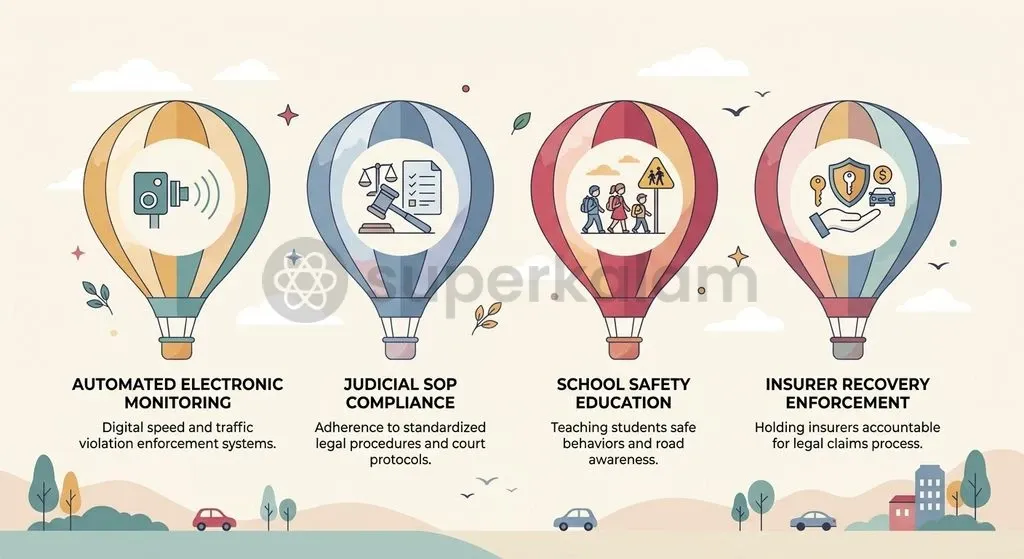
Securing lasting compliance requires combining strict digital enforcement, clear legal procedures, and early institutional education.
- Universal Automated Enforcement: State governments must implement Section 136A by deploying artificial intelligence-enabled speed cameras that log infractions and link them to vehicle ownership databases automatically.
- Standard Operating Procedures for Police: Investigating agencies should adopt clear protocols that standardise General Diary entries and Social Background Reports, meeting the requirements set by the Kerala High Court in Sharafudheen (2024).
- Institutional Educational Outreach: School curricula should integrate road safety and ethical driving modules, as recommended by the Supreme Court Committee on Road Safety, to instil early civic responsibility.
- Third-Party Civil Recovery Enforcement: Insurance regulators should streamline claims recovery processes under Swaran Singh (2004), ensuring that negligent owners bear the full financial burden of crashes caused by minors.
Key Takeaways
- Legislative Origin: Parliament introduced Section 199A via the Motor Vehicles (Amendment) Act, 2019 to establish statutory vicarious liability for parents and vehicle owners.
- Severe Penalties: Guardians face up to three years of imprisonment and a fine of ₹25,000, alongside a mandatory one-year vehicle de-registration under Section 199A(4).
- Juvenile Disqualification: Adolescents who commit an offence under the Act are disqualified from receiving a driving licence until age 25 under Section 199A(5).
- Legal Presumption: The law presumes parental consent, leaving guardians with only two defences: demonstrating absence of knowledge or proving the exercise of all due diligence.
- Juvenile Justice Protections: Under Shilpa Mittal (2020), fatal crashes lacking a seven-year minimum sentence cannot be classified as heinous offences, keeping the minor's proceedings before the Juvenile Justice Board.
Mains Question
"By establishing statutory vicarious criminal liability and reversing the ordinary burden of proof, Section 199A of the Motor Vehicles Act seeks to balance road safety deterrence with juvenile welfare." Examine. (10 Marks)
Evaluate NowMains Question
In the light of the Supreme Court's ruling in Shilpa Mittal v. State of NCT of Delhi (2020), critically analyse the operational intersection between Section 199A of the Motor Vehicles Act, 1988, and the Juvenile Justice (Care and Protection of Children) Act, 2015, in addressing fatal road crashes caused by minors. (15 Marks)
Evaluate NowPractice MCQs
QUESTION 1
With reference to Section 199A of the Motor Vehicles Act, 1988, consider the following statements:
- It creates statutory vicarious criminal liability for the guardian or registered owner when a motor vehicle offence is committed by a juvenile.
- The offending juvenile is barred from obtaining a learner's licence or regular driving licence until reaching the age of twenty-one.
- The certificate of registration of the offending motor vehicle is subject to mandatory cancellation for a period of twelve months. Which of the statements given above are correct?
QUESTION 2
Consider the following statements regarding the legal defences and evidentiary rules under Section 199A of the Motor Vehicles Act, 1988:
- The statute creates an explicit legal presumption that the juvenile operated the motor vehicle with the consent of their guardian or owner.
- A vehicle owner is absolved of liability if the juvenile held a valid learner's licence for that class of vehicle.
- A guardian can discharge the burden of proof simply by demonstrating that verbal instructions were given to the minor not to drive. Which of the statements given above is/are correct?
QUESTION 3
Regarding the intersection between Section 199A of the Motor Vehicles Act, 1988, and the Juvenile Justice (Care and Protection of Children) Act, 2015, consider the following statements:
- Section 199A(6) requires that all proceedings against the juvenile must be conducted strictly under the Juvenile Justice Act, 2015.
- In Shilpa Mittal v. State of NCT of Delhi (2020), the Supreme Court ruled that offences without a prescribed minimum sentence of seven years cannot be categorised as 'heinous offences'.
- An adolescent aged 16 to 18 years involved in a fatal accidental vehicular crash can be directly transferred to an adult Children's Court for trial under Section 15 of the JJ Act. Which of the statements given above is/are correct?
QUESTION 4
In the context of judicial precedents interpreting motor vehicle liability, the 'pay and recover' doctrine established in National Insurance Co. Ltd. v. Swaran Singh (2004) implies that:
QUESTION 5
Consider the following statements regarding the enforcement requirements under the Motor Vehicles Act, 1988:
- In Sharafudheen v. State of Kerala (2024), the High Court held that submitting a Social Background Report before the JJB is a mandatory condition precedent before prosecuting guardians under Section 199A.
- Under Section 180 of the Act, permitting an unauthorised person to drive attracts imprisonment of up to three years.
- Section 136A of the Act mandates state governments to install electronic monitoring systems, including automated speed cameras. Which of the statements given above is/are correct?