Section 125A RPA: Supreme Court Ruling on False Affidavits
While the Supreme Court empowered voters to directly prosecute false candidate affidavits, structural statutory loopholes still shield convicted politicians.
Oct, 2026
•9 min read

Overview
In a landmark ruling affirming democratic accountability, the Supreme Court held that private citizens possess the legal standing to prosecute election candidates under Section 125A of the Representation of the People Act, 1951 for submitting false affidavits. Ordinary voters can now initiate criminal complaints directly before a magistrate. They do not need prior government sanction or approval from returning officers.
Yet enforcement remains incomplete. Section 125A stays structurally toothless because its six-month maximum penalty fails to trigger statutory disqualification under Section 8 of the Representation of the People Act, 1951. Genuine electoral transparency demands statutory amendments that classify false declarations as disqualifying corrupt practices.
Why in the News: The Supreme Court's Position on False Affidavits
The Supreme Court ruled in Sri Rajkumar Madki v. Dr. Shailendra Beldale (2026 INSC 1138) that private citizens have unambiguous locus standi to lodge private criminal complaints against candidates under Section 125A of the Representation of the People Act, 1951.
As of October 2026, the apex court clarified that criminal courts can take direct cognizance of candidate misrepresentation. A formal complaint from the Returning Officer is not required. Administrative guidelines or press notes from the Election Commission of India cannot displace statutory criminal procedure.
This judgment empowers ordinary electors. However, the legal victory remains incomplete without legislative reform linking criminal conviction to legislative disqualification.
What Is Section 125A of the Representation of the People Act?
Section 125A of the Representation of the People Act, 1951 is the penal provision that criminalises electoral deceit. It punishes candidates who supply false information or conceal material facts during nomination.
A candidate commits an offence by failing to supply information under Section 33A, providing false details, or concealing material facts. Under Rule 4A of the Conduct of Elections Rules, 1961, every candidate must submit a sworn affidavit in Form 26 to the Returning Officer.
This sworn declaration covers four mandatory areas:
- Criminal antecedents: Pending charges framed by a court for offences punishable with imprisonment for two years or more, alongside past convictions.
- Financial standing: Movable and immovable assets, liabilities, and public dues of candidates, their spouses, and dependent children.
- Educational qualifications: The highest completed academic credentials and institutional history.
- Government contracts: Sourced commercial engagements with the state or public sector undertakings.
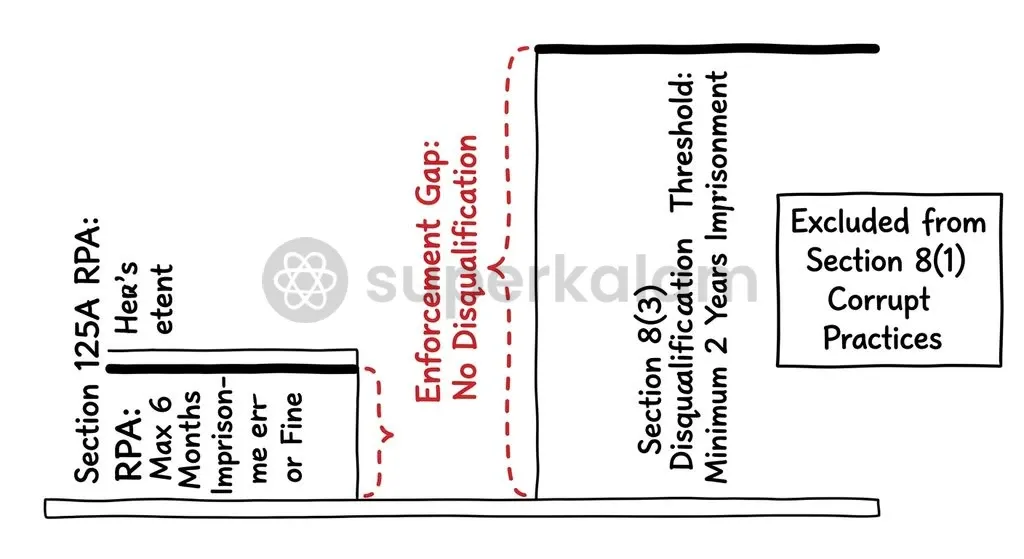
The statutory penalty entails imprisonment for a term extending up to six months, or a fine, or both. Because this maximum term is modest, it leaves candidate misconduct outside the standard disqualification mechanisms governing parliamentary representation.
Discuss with Superkalam
What are the four mandatory areas of disclosure required from election candidates under Form 26?
Ask NowCan a Common Voter Prosecute Candidates for Filing False Affidavits?
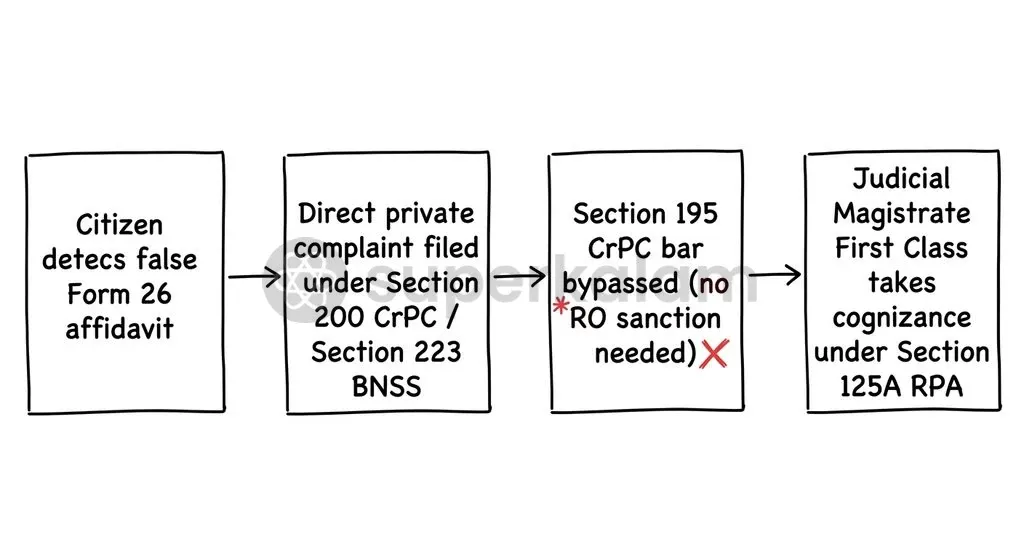
Voters hold full statutory authority to file private criminal complaints against candidates under Section 200 of the Code of Criminal Procedure, 1973 (now Section 223 of the Bharatiya Nagarik Suraksha Sanhita, 2023).
In Sri Rajkumar Madki v. Dr. Shailendra Beldale, the Supreme Court rejected claims that Section 195(1) of the CrPC (now Section 215 BNSS) creates a procedural bar against private complaints. The bench clarified this distinction on specific statutory grounds:
- Limited scope of Section 195(1): The restriction applies exclusively to specified Indian Penal Code offences committed against public servants.
- Legislative intent: When Parliament amended Section 195 CrPC in 2006, it was fully aware of Section 125A—enacted in 2002—and deliberately chose not to include it within the restricted category requiring a public servant's complaint.
Judicial magistrates must therefore process a citizen's complaint under regular criminal procedure. Returning Officers often lack the investigative tools to verify declarations during the short scrutiny window. By affirming citizen standing, the apex court ensured that candidates cannot shield false disclosures behind administrative delays.
Discuss with Superkalam
How does the Supreme Court distinguish the procedural barrier of Section 195(1) CrPC from complaints filed under Section 125A of the RPA?
Ask NowJudicial Evolution: From the Right to Know to Mandatory Disclosures
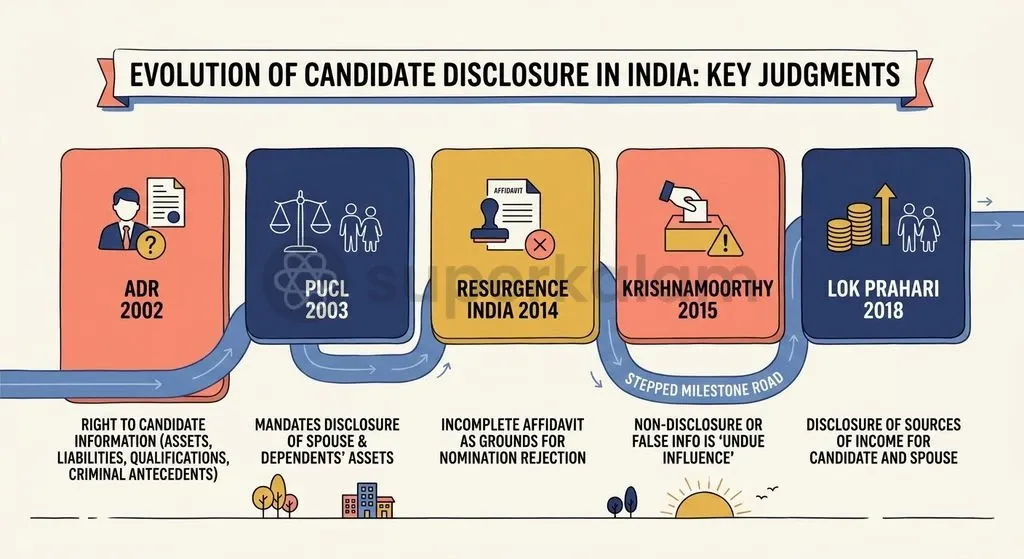
Constitutional jurisprudence has transformed candidate disclosure from an administrative formality into an enforceable guarantee under Article 19(1)(a).
The framework requiring candidates to disclose their background emerged through sustained public interest litigation over two decades:
| Landmark Judgment | Legal Principle Established | Constitutional / Statutory Basis |
|---|---|---|
| Union of India v. ADR (2002) | A voter's right to know candidate antecedents, assets, and education is a fundamental right. | Article 19(1)(a) of the Constitution |
| PUCL v. Union of India (2003) | Struck down Section 33B of the RPA 1951, which attempted to blanket candidates from disclosure mandates. | Article 19(1)(a) of the Constitution |
| Resurgence India v. ECI (2014) | Leaving blank spaces in Form 26 renders affidavits nugatory; Returning Officers must reject incomplete nominations. | Rule 4A, Conduct of Elections Rules, 1961 |
| Krishnamoorthy v. Sivakumar (2015) | Non-disclosure or concealment of criminal records constitutes undue influence, vitiating free franchise. | Section 123(2) of the RPA 1951 |
| Lok Prahari v. Union of India (2018) | Expanded Form 26 to mandate disclosure of income sources and public contracts for candidates, spouses, and dependents. | Article 19(1)(a) and Rule 4A |
The Supreme Court reiterated in Resurgence India (2014) that blank entries defeat disclosure. If candidates leave columns empty despite reminders, the Returning Officer must reject the nomination at scrutiny.
Section 125A Prosecution vs Election Petitions: How They Differ
Dispute resolution under the Representation of the People Act, 1951 bifurcates into distinct tracks: penal sanctioning under Section 125A versus challenging election validity through an Election Petition.
A candidate or citizen unearthing false affidavits must select their legal remedy carefully, as the two mechanisms operate under divergent forums, timelines, and consequences:
| Dimension | Criminal Prosecution (Section 125A RPA) | Election Petition (Section 80 & 81 RPA) |
|---|---|---|
| Primary Objective | Punishing criminal perjury and concealment of required facts. | Challenging the legal validity of the election outcome. |
| Adjudicating Forum | Court of Judicial Magistrate (under CrPC / BNSS). | The High Court exercising designated election jurisdiction. |
| Locus Standi | Any citizen or voter possessing knowledge of the offence. | Strictly a candidate or an elector registered in that constituency. |
| Statutory Limitation | Strict one-year limit under Section 468(2)(b) CrPC (Section 514(2)(b) BNSS). | Strictly within 45 days from the declaration of election results. |
| Legal Outcome | Fine or imprisonment up to six months; does not unseat candidate. | Can unseat the returned candidate or declare the election void. |
Criminal prosecution under Section 125A holds an elected lawmaker criminally liable without unseating them. Conversely, an Election Petition under Section 81 can invalidate an entire election. However, the petitioner must prove that the concealment materially affected the result.
Discuss with Superkalam
If a citizen uncovers undisclosed state contracts of an elected MLA fourteen months after the election, what legal barrier under Section 468(2)(b) CrPC would they face?
Ask NowWhy False Disclosures Persist: Weak Penalties and Enforcement Loopholes
Statutory disqualification provisions contain major structural gaps. Consequently, candidates convicted under Section 125A rarely lose their legislative seats.
Three legal hurdles protect dishonest candidates from removal:
- Omission from Section 8(1): Conviction under Section 8(1) triggers immediate six-year disqualification regardless of the sentence. Parliament omitted Section 125A from this list.
- Section 8(3) two-year threshold: For unlisted offences, disqualification requires imprisonment for not less than two years. Because Section 125A carries a six-month ceiling, a conviction can never meet this mark. A convicted lawmaker can simply pay a fine, serve a short sentence, and stay in office.
- Tight limitation period: Section 468(2)(b) of the CrPC (now Section 514(2)(b) BNSS) imposes a strict one-year limitation period on offences carrying prison terms under one year. If investigators uncover hidden assets twelve months after nomination day, magistrates cannot take cognizance.
Ethical Dimension: Probity, Public Trust, and Informed Choice in Elections
Electoral misrepresentation subverts democratic trust by deceiving voters on sworn instruments.
Democratic governance depends on the personal probity of legislators. As the Supreme Court observed in Krishnamoorthy v. Sivakumar (2015), filing a false affidavit degrades public integrity. It normalises perjury at the legislative threshold and erodes the moral authority needed to uphold the rule of law.
Concealment also breaches constitutional morality and the ethical foundation of informed consent. Withholding assets, state contracts, or criminal records corrupts the choices of electors. It turns democratic balloting into a skewed contest shaped by illicit influence.
Discuss with Superkalam
Compare the legal outcomes and procedural constraints of filing an Election Petition under Section 81 versus a criminal complaint under Section 125A.
Ask NowWay Forward: Law Commission and Election Commission Reform Proposals
Institutional recommendations from the Law Commission and Election Commission outline the legislative amendments necessary to turn Section 125A into an effective deterrent.
Both bodies have submitted specific proposals to eliminate the statutory loopholes governing false affidavits:
- Enhance penal term to two years: The Law Commission of India in its 244th Report on Electoral Disqualifications (February 2014) recommended amending Section 125A to enhance the sentence to a minimum of two years' imprisonment. The Election Commission of India has similarly urged the Union Government to raise the imprisonment term to at least two years and delete the alternative fine provision.
- Include in Section 8(1): The 244th Report recommended listing Section 125A under Section 8(1) of the Representation of the People Act, 1951. This change would mandate an automatic six-year disqualification upon conviction, ending the anomaly where perjurers continue serving in legislatures.
- Declare as corrupt practice: The Law Commission advised amending Section 123 of the Representation of the People Act, 1951 to classify filing a false affidavit as an express corrupt electoral practice, providing grounds to invalidate elections in an Election Petition.
- Extend statutory limitation period: Raising the statutory sentence to two years automatically extends the limitation period under the Bharatiya Nagarik Suraksha Sanhita from one year to three years, giving citizens and agencies sufficient time to uncover undisclosed assets and foreign accounts.
Discuss with Superkalam
Should Section 125A of the RPA be incorporated under Section 8(1) to mandate immediate disqualification upon conviction? Weigh the necessity of electoral probity against the risk of frivolous political litigation.
Ask NowKey Takeaways
- The Supreme Court held in Sri Rajkumar Madki v. Dr. Shailendra Beldale (2026 INSC 1138) that private citizens and voters have locus standi to prosecute candidates under Section 125A RPA 1951.
- Private complaints under Section 125A bypass the procedural restrictions of Section 195(1) CrPC (Section 215 BNSS) because the provision is not an Indian Penal Code offence.
- Section 125A carries a maximum sentence of six months' imprisonment or fine, which fails to trigger disqualification under Section 8(3) of the Representation of the People Act, 1951.
- Election Petitions under Section 81 RPA must be filed in the High Court within 45 days, whereas Section 125A criminal proceedings operate under a one-year limitation before a Magistrate.
- The Law Commission (244th Report) and the Election Commission of India recommend increasing the sentence under Section 125A to at least two years and including it under Section 8(1) for automatic disqualification.
Mains Question
"The citizen's right to know candidate antecedents under Article 19(1)(a) remains impaired when statutory enforcement lacks disqualification consequences." In light of the Supreme Court's verdict in Sri Rajkumar Madki v. Dr. Shailendra Beldale, critically analyse the efficacy of Section 125A of the Representation of the People Act, 1951 in checking electoral deceit. (15 Marks)
Evaluate NowMains Question
Differentiating between criminal prosecution under Section 125A and Election Petitions under Section 81 of the Representation of the People Act, 1951, elucidate how non-disclosure of criminal antecedents vitiates the purity of elections. (10 Marks)
Evaluate NowPractice MCQs
QUESTION 1
Consider the following statements regarding Section 125A of the Representation of the People Act (RPA), 1951:
- It penalises candidates who fail to supply information under Section 33A or conceal material facts during nomination.
- The statutory penalty includes imprisonment extending up to two years, thereby attracting automatic disqualification under Section 8(3) of the RPA, 1951.
- The Supreme Court has ruled that a private citizen has locus standi to file a criminal complaint directly before a magistrate under this section without prior sanction from the Returning Officer.
Which of the statements given above are correct?
QUESTION 2
With reference to electoral jurisprudence and mandatory candidate disclosures in India, consider the following statements:
- In Union of India v. ADR (2002), the Supreme Court recognized the voter's right to know candidate antecedents as part of Article 19(1)(a).
- In Resurgence India v. ECI (2014), the Supreme Court directed that leaving columns blank in Form 26 cannot be a ground to reject a nomination paper.
- In Krishnamoorthy v. Sivakumar (2015), the concealment of criminal records by a candidate was held to constitute 'undue influence' under Section 123(2) of the RPA, 1951.
Which of the statements given above is/are correct?
QUESTION 3
Consider the following statements regarding the differences between a prosecution under Section 125A of the RPA, 1951 and an Election Petition:
- A prosecution under Section 125A is adjudicated before a Judicial Magistrate, whereas an Election Petition lies before the High Court.
- An Election Petition must be filed strictly within 45 days from the declaration of election results, whereas a Section 125A prosecution is governed by a one-year limitation period.
- A successful conviction under Section 125A automatically unseats the returned candidate, while an Election Petition only imposes a criminal fine.
Which of the statements given above are correct?
QUESTION 4
Under Rule 4A of the Conduct of Elections Rules, 1961, candidates are required to submit an affidavit in Form 26. Which of the following mandatory disclosure areas was specifically expanded through the Supreme Court's ruling in Lok Prahari v. Union of India (2018)?
QUESTION 5
Why does a conviction under Section 125A of the Representation of the People Act, 1951 generally fail to result in the disqualification of an elected lawmaker?
- Section 125A is omitted from the offences listed under Section 8(1) of the RPA, 1951.
- The maximum sentence prescribed under Section 125A is six months, which falls below the two-year imprisonment threshold mandated under Section 8(3) of the RPA, 1951.
- The Code of Criminal Procedure bars courts from imposing both imprisonment and fine simultaneously for electoral deceit.
Select the correct answer using the code given below: