SC Split on CEC Selection Law: The Article 145(3) Mandate Explained
A split Supreme Court bench sent the challenge to the 2023 CEC appointment law to the CJI, raising the Article 145(3) Constitution Bench question.
Oct, 2026
•9 min read
Overview
A two-judge bench of the Supreme Court delivered a split verdict on challenges to the Chief Election Commissioner and other Election Commissioners Act, 2023. The central question was whether the dispute must go to a five-judge Constitution Bench under Article 145(3).
The 2023 statute replaced the Chief Justice of India on the selection panel with a Union Cabinet Minister. That adjustment gave the executive a structural executive majority over all appointments.
Justice Satish Chandra Sharma held that interpreting parliamentary power under Article 324(2) requires a five-judge bench. In contrast, Justice Dipankar Datta held that the Anoop Baranwal ruling had already settled the baseline for institutional neutrality. Both judges nevertheless recommended that the Chief Justice of India constitute a Constitution Bench directly to eliminate procedural delays.
Why in the News?
The Supreme Court of India delivered a split verdict on 23 September 2026 concerning the constitutional validity of the Chief Election Commissioner and other Election Commissioners Act, 2023. The petitions challenged the legislative replacement of the judicial member on the selection panel with a cabinet minister nominated by the Prime Minister.
As of September 2026, the Division Bench comprising Justice Dipankar Datta and Justice Satish Chandra Sharma diverged on whether the petition raised a substantial question of law under Article 145(3). Although the judges differed on the procedural threshold for referral, they unanimously requested the Chief Justice of India to place the matter before a five-judge Constitution Bench to avoid prolonged litigation.
How We Got Here: From Anoop Baranwal to the 2023 Act
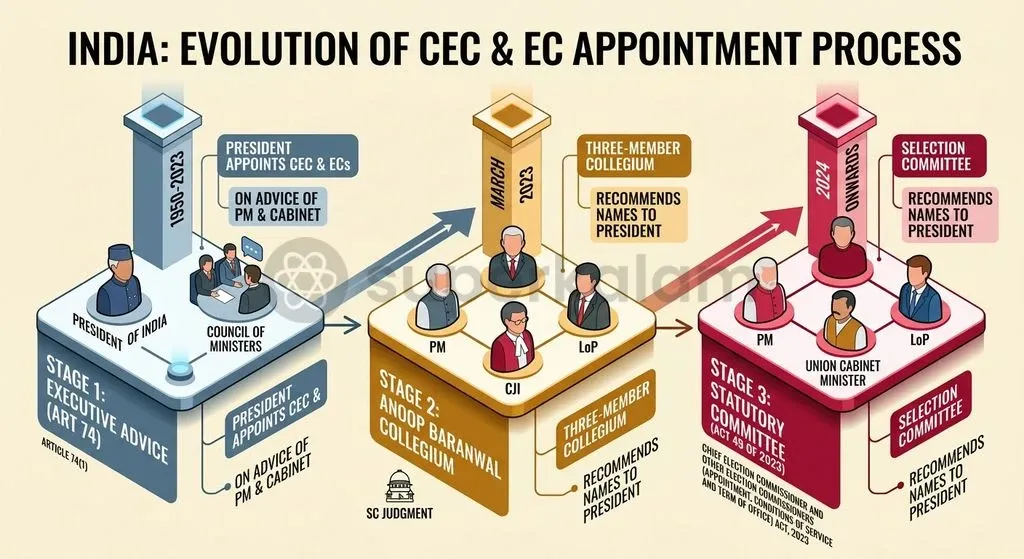
Article 324(2) provides that the appointment of the Chief Election Commissioner and other Election Commissioners shall be made by the President, subject to any law made by Parliament. From 1950 until late 2023, Parliament enacted no dedicated appointment statute.
Key milestones trace how the appointment framework evolved:
- Executive Discretion (1950–2023): For over seven decades, appointments operated under Article 74(1), where the President acted on the aid and advice of the Union Cabinet.
- The Anoop Baranwal Ruling (March 2023): A five-judge bench ruled that free and fair elections and the rule of law form core components of the basic structure. The court established an interim panel comprising the Prime Minister, the Leader of the Opposition, and the Chief Justice of India until Parliament enacted a law.
- The 2023 Enactment (December 2023): Parliament passed the Chief Election Commissioner and other Election Commissioners (Appointment, Conditions of Service and Term of Office) Act, 2023 (Act No. 49 of 2023). The statute received Presidential assent on 28 December 2023 and took effect on 2 January 2024, replacing the judicial interim panel.
Discuss with Superkalam
Which articles of the Constitution govern the appointment of Election Commissioners and the minimum bench strength for substantial constitutional questions?
Ask NowWhat the 2023 Selection Panel Changed
The 2023 Act altered the institutional composition and procedure for appointing members of the Election Commission of India. Section 6 and Section 7 establish a two-tier screening hierarchy:
- The Search Committee (Section 6): Headed by the Minister of Law and Justice, alongside two members not below the rank of Secretary to the Government of India, tasked with shortlisting five candidates.
- The Selection Committee (Section 7(1)): Comprises the Prime Minister as Chairperson, the Leader of the Opposition in the Lok Sabha, and a Union Cabinet Minister nominated by the Prime Minister.
- Procedural Autonomy (Section 8(2)): Authorises the Selection Committee to regulate its own procedure and consider persons outside the shortlisted panel prepared by the Search Committee.
Critics challenged this framework because the Prime Minister and a nominated Cabinet Minister secure a permanent executive majority. This setup leaves the Leader of the Opposition unable to block unilateral executive choices.
The Constitutional Puzzle: The Article 145(3) Mandate
Article 145(3) of the Constitution mandates that cases involving a substantial question of law regarding constitutional interpretation must be heard by a minimum of five judges. This requirement ensures that structural questions receive collective deliberation from a full Constitution Bench.
The Division Bench had to resolve a pivotal procedural question: did testing the 2023 statute raise an entirely fresh constitutional issue, or did it merely require applying established principles from Anoop Baranwal? That divergence forms the crux of the split verdict.
Discuss with Superkalam
How does substituting the Chief Justice of India with a Union Cabinet Minister fundamentally alter the institutional balance of the selection panel?
Ask NowUnderstanding the Split Verdict: Divergence on Bench Strength
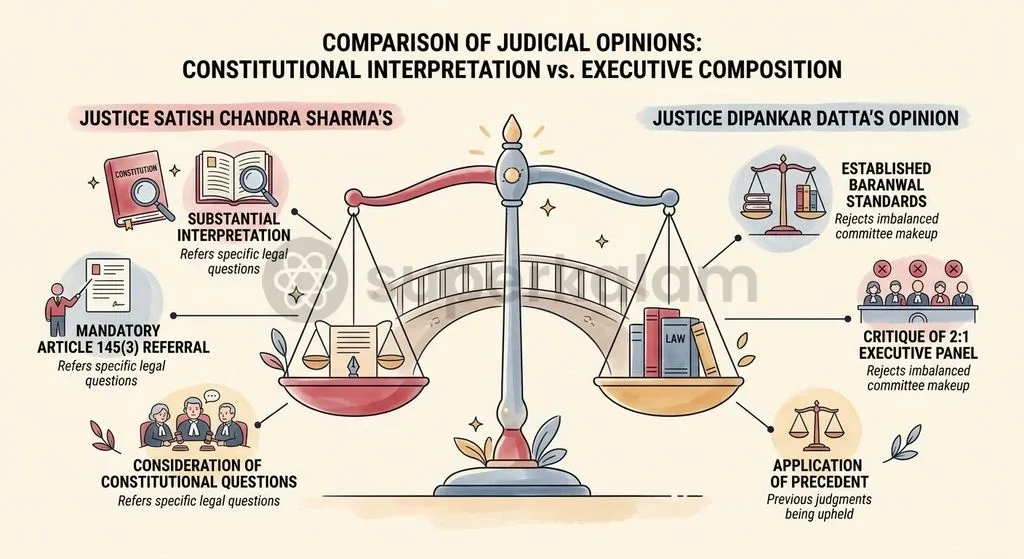
The Division Bench in Dr. Jaya Thakur v. Union of India divided sharply on the necessity of invoking Article 145(3). The two opinions reflect contrasting views on judicial precedent:
- Justice Satish Chandra Sharma's View: Testing the legislative validity of Sections 6, 7, and 8 of the 2023 Act directly engages parliamentary power under Article 324(2). Justice Sharma determined that such an inquiry raises an unresolved substantial question that cannot bypass Article 145(3).
- Justice Dipankar Datta's View: No reference under Article 145(3) was necessary because the five-judge bench in Anoop Baranwal had already articulated the governing baseline. Applying settled law to determine whether a statutory collegium ensures institutional insulation requires no novel constitutional interpretations.
- The Impartiality Concern: Justice Datta observed that a panel with a two-to-one executive balance fails the perception test of impartiality. A subordinate Cabinet Minister cannot act as an independent institutional counterweight to the Prime Minister.
Despite this disagreement, both judges issued a joint order requesting the Chief Justice of India to consider constituting a permanent five-judge Constitution Bench. Lingering references in the registry for five to over twenty years cause institutional embarrassment to the judiciary.
Comparing the Appointment Frameworks
The transition from the Anoop Baranwal judicial directive to the statutory scheme under Act No. 49 of 2023 highlights key institutional shifts across committee structures and procedural safeguards.
| Parameter | Anoop Baranwal Directive (March 2023) | CEC & ECs Act, 2023 (Act No. 49 of 2023) |
|---|---|---|
| Legal Basis | Judicial ruling under Article 142/324(2) | Statutory enactment under Article 324(2) |
| Search Mechanism | No statutory search committee specified | Three-member Search Committee led by Law Minister |
| Selection Panel Composition | Prime Minister, Leader of Opposition, Chief Justice of India | Prime Minister, Leader of Opposition, Union Cabinet Minister |
| Executive Balance | One executive member out of three (1:3 ratio) | Two executive members out of three (2:3 ratio) |
| Discretionary Selection | Restricted to collegium consensus | Selection Committee may consider unlisted names |
| Removal Protection | Differentiated: CEC protected under Art 324(5); ECs lack parity | Retains constitutional distinction under Article 324(5) first proviso |
Discuss with Superkalam
If a disputed election decision is challenged before an executive-dominated Election Commission, how does the ethical principle of 'nemo judex in causa sua' apply?
Ask NowInstitutional Independence vs Executive Prerogative
The legal debate over the 2023 Act balances legislative power under Article 324(2) against basic structural guarantees:
- Executive Prerogative Stance: The Union of India maintains that Anoop Baranwal served explicitly as a stopgap measure until Parliament enacted a statute. Under the separation of powers, deciding the composition of statutory selection panels belongs strictly within legislative discretion.
- Petitioners' Independence Argument: Challengers argue that Parliament cannot enact a statute that undermines the institutional independence demanded by the basic structure doctrine. An electoral body picked by an executive majority invites institutional capture.
- Asymmetrical Removal Protections: Under Article 324(5) first proviso, the Chief Election Commissioner cannot be removed except like a Supreme Court Judge. Conversely, Election Commissioners can be removed by the President solely on the recommendation of the CEC. Without equivalent tenure safeguards across the board, selection panel neutrality remains the primary bulwark against executive overreach.
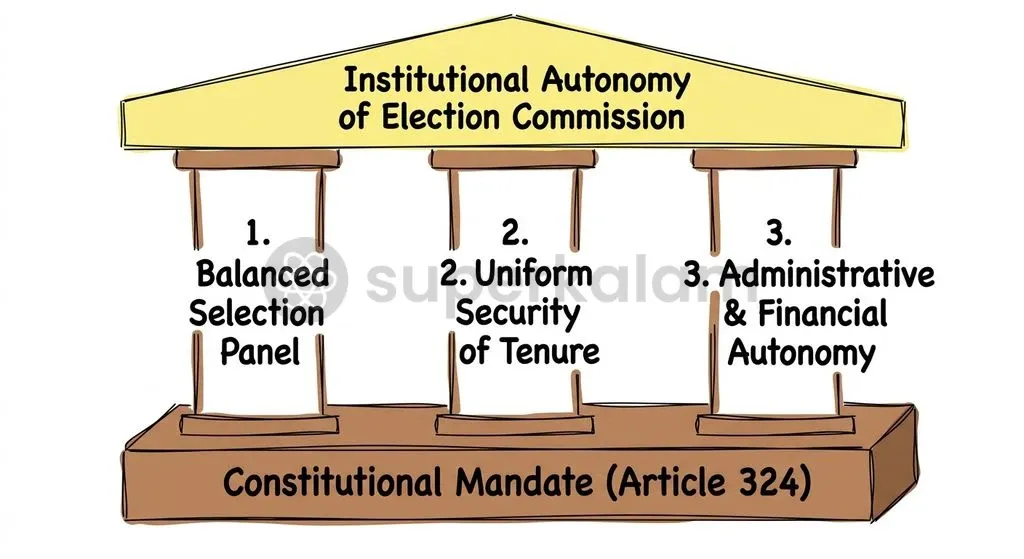
Ethical and Democratic Stakes: GS Paper 4 Dimensions
Public trust in democratic governance depends on the perceived fairness and moral integrity of the electoral umpire. Regulatory authorities must satisfy Caesar's wife standard by remaining free from both actual bias and the reasonable perception of bias.
A selection panel weighted in favour of the incumbent executive introduces a systemic conflict of interest. When the political executive selects the authority responsible for enforcing the Model Code of Conduct, the principle of nemo judex in causa sua (no one should be a judge in their own cause) is compromised.
Institutional fidelity requires structural designs that outlast shifting political majorities. Genuine independence requires statutory safeguards that insulate decision-makers from executive patronage rather than relying solely on personal probity.
Discuss with Superkalam
Compare the legal reasoning of Justice Satish Chandra Sharma and Justice Dipankar Datta on whether Article 145(3) should be invoked.
Ask NowGlobal Standards and Expert Recommendations
Independent electoral bodies across leading constitutional democracies rely on diversified, cross-branch selection mechanisms to prevent majoritarian control over election management.
Expert committees in India have consistently advised against concentrated executive control over Election Commission appointments:
- Dinesh Goswami Committee (1990): Recommended that the Chief Election Commissioner be appointed by the President in consultation with the Chief Justice of India and the Leader of the Opposition.
- Second Administrative Reforms Commission (2007): Recommended a broad collegium comprising the Prime Minister, Lok Sabha Speaker, Leader of the Opposition in the Lok Sabha, Law Minister, and Deputy Chairman of the Rajya Sabha.
- Law Commission of India (255th Report, 2015): Proposed a three-member collegium consisting of the Prime Minister, the Leader of the Opposition, and the Chief Justice of India for all commission appointments.
Way Forward
Resolving the institutional impasse requires reconciling Parliament's legislative authority under Article 324(2) with the constitutional requirement of an independent election watchdog.
- Broadening the Selection Collegium: Parliament can amend Section 7(1) of the 2023 Act to include non-executive institutional actors, such as the Chief Justice of India or the Speaker of the Lok Sabha, restoring institutional balance.
- Mandating Bipartisan Consensus: Requiring unanimity or a special majority within the Selection Committee would prevent unilateral appointments by the executive majority.
- Harmonising Removal Protections: Extending the constitutional removal protections of Article 324(5) to Election Commissioners would insulate all commissioners from post-appointment executive pressure.
- Institutionalising a Permanent Constitution Bench: Acting on the Division Bench's recommendation to establish a standing five-judge bench would ensure timely resolution of structural constitutional questions without multi-year pendency.
Key Takeaways
- Article 324(2) empowers Parliament to legislate the appointment framework for Election Commissioners, ending the convention of executive appointments under Article 74(1).
- The Chief Election Commissioner and other Election Commissioners Act, 2023 replaced the Chief Justice of India with a Union Cabinet Minister on the selection panel.
- The Supreme Court Division Bench delivered a split verdict on whether the challenge to the 2023 Act required referral to a five-judge Constitution Bench under Article 145(3).
- Justice Satish Chandra Sharma favoured referral under Article 145(3), whereas Justice Dipankar Datta held that Anoop Baranwal had already settled the constitutional principles governing institutional neutrality.
- The Law Commission's 255th Report and the Dinesh Goswami Committee had both recommended multi-member collegiums including the Chief Justice of India and the Leader of the Opposition.
Mains Question
"A selection mechanism that ensures an executive majority undermines the perception of institutional neutrality essential for an electoral umpire." In light of the Chief Election Commissioner and other Election Commissioners Act, 2023 and judicial pronouncements, critically examine this statement. (15 Marks)
Evaluate NowMains Question
Explain the constitutional significance of the Article 145(3) mandate in resolving substantial questions of law, with reference to the Supreme Court's split verdict in Dr. Jaya Thakur v. Union of India. (10 Marks)
Evaluate NowPractice MCQs
QUESTION 1
With reference to the Chief Election Commissioner and other Election Commissioners (Appointment, Conditions of Service and Term of Office) Act, 2023, consider the following statements:
- The Search Committee is headed by the Cabinet Secretary and comprises two other members not below the rank of Secretary to the Government of India.
- The Selection Committee is headed by the Prime Minister and includes the Leader of the Opposition in the Lok Sabha and the Chief Justice of India.
- The Selection Committee is authorized to regulate its own procedure and may consider persons outside the shortlisted panel prepared by the Search Committee.
Which of the statements given above is/are correct?
QUESTION 2
Consider the following statements regarding the constitutional provisions governing the Election Commission of India:
- Under Article 324(2), the appointment of the Chief Election Commissioner and other Election Commissioners is made by the President, subject to any law made by Parliament.
- Under the first proviso to Article 324(5), both the Chief Election Commissioner and other Election Commissioners enjoy identical removal protections similar to a Supreme Court judge.
- Article 145(3) of the Constitution mandates that cases involving a substantial question of law as to the interpretation of the Constitution must be decided by a bench of not less than five judges.
Which of the statements given above are correct?
QUESTION 3
In the split verdict concerning the Chief Election Commissioner and other Election Commissioners Act, 2023 (Dr. Jaya Thakur v. Union of India), what was the primary point of legal divergence between Justice Dipankar Datta and Justice Satish Chandra Sharma?
QUESTION 4
Consider the following statements regarding the appointment mechanisms of the Election Commission of India:
- In Anoop Baranwal v. Union of India (2023), the Supreme Court ruled that free and fair elections and the rule of law form part of the basic structure of the Constitution.
- The interim collegium established in the Anoop Baranwal judgment provided for a selection panel comprising the Prime Minister, the Leader of the Opposition, and the Chief Justice of India.
- Prior to the enactment of Act No. 49 of 2023, appointments to the Election Commission operated on the aid and advice of the Union Cabinet under Article 74(1).
Which of the statements given above are correct?
QUESTION 5
Under Section 6 of the Chief Election Commissioner and other Election Commissioners (Appointment, Conditions of Service and Term of Office) Act, 2023, how many candidates is the Search Committee tasked with shortlisting for consideration by the Selection Committee?
Discuss with Superkalam
Between legislative supremacy under Article 324(2) and institutional neutrality under the basic structure doctrine, which principle holds greater weight for democratic survival?
Ask Now