National Tribunals Commission: 2026 Rules & Judicial Reforms
The statutory creation of the National Tribunals Commission resolves three decades of constitutional friction over executive control and judicial independence.
Oct, 2026
•11 min read

Overview
The enactment of the Tribunals Reforms Act, 2026 and the notification of its accompanying rules formally establish the National Tribunals Commission. This creates an independent statutory body to insulate quasi-judicial appointments, administrative oversight, and infrastructure management from executive parent ministries.
According to the Ministry of Law and Justice, this framework addresses long-standing institutional deficiencies by instituting uniform service conditions, a five-year tenure, and a proactive six-month recruitment mandate. By removing administrative dependence on departments that are frequently the primary litigants before tribunals, the reform reinforces the separation of powers under Article 50 of the Constitution.
Why in the News? The Push for Independent Tribunal Governance
As of September 2026, the Ministry of Law and Justice notified the National Tribunals Commission Rules, establishing an independent statutory framework to govern appointments, tenure, and infrastructure across India's tribunal network.
This legislative shift addresses key institutional triggers:
- Statutory Replacement: Parliament enacted the Tribunals Reforms Act, 2026 in August 2026 to repeal and replace the contentious Tribunals Reforms Act, 2021, as confirmed by the Press Information Bureau.
- Judicial Invalidation: In Madras Bar Association v. Union of India, the Supreme Court struck down key clauses of the 2021 enactment for violating the basic structure doctrine and judicial independence. The Bench ruled that re-enacting struck-down clauses breached institutional integrity.
- Institutionalised Oversight: The framework formally operationalises the National Tribunals Commission (NTC), insulating bodies like the Central Administrative Tribunal (CAT) and the National Company Law Appellate Tribunal (NCLAT) from executive control.
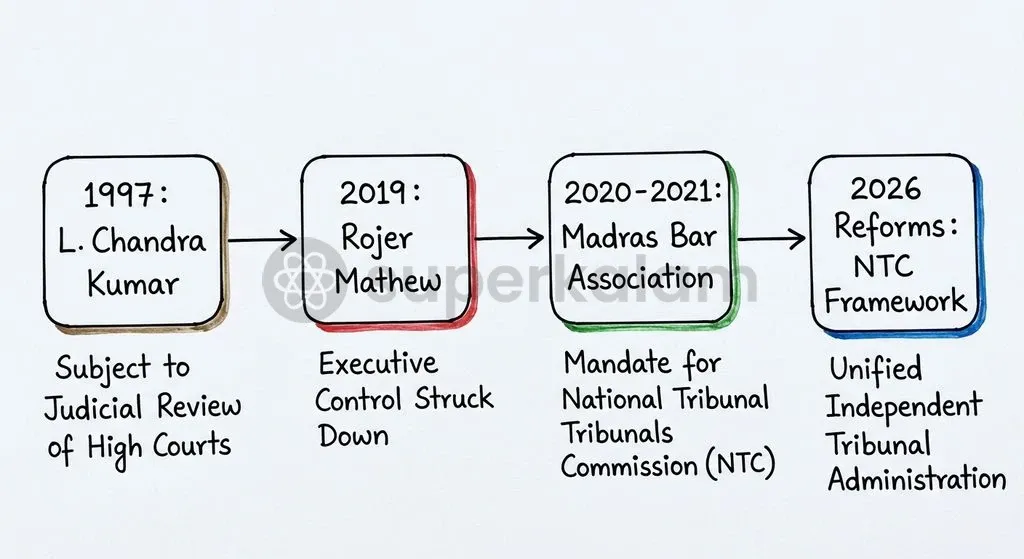
Constitutional Foundations: Article 323A, Article 323B, and the Rise of Tribunals
Part XIV-A of the Constitution was inserted by the 42nd Constitutional Amendment Act, 1976, introducing Articles 323A and 323B to empower the creation of specialised administrative and subject-specific tribunals. These provisions aimed to reduce court arrears by transferring technical disputes to specialised benches possessing domain expertise.
A distinct constitutional division governs these two provisions regarding legislative competency and functional scope:
- Article 323A authorises Parliament exclusively to establish administrative tribunals for adjudicating disputes relating to the recruitment and conditions of service of public servants under the Union or State governments.
- Article 323B empowers both Parliament and State Legislatures, within their respective legislative competencies, to establish tribunals for specific subjects, including taxation, foreign exchange, industrial disputes, land reforms, and ceiling on urban property.
The constitutional boundary of tribunals underwent an authoritative reset in L. Chandra Kumar v. Union of India (1997). A seven-judge Constitution Bench held that the power of judicial review under Articles 226/227 (High Courts) and Article 32 (Supreme Court) forms an untrammelable basic feature of the Constitution.
Consequently, tribunal decisions cannot bypass High Court scrutiny and remain subject to the supervisory jurisdiction of a Division Bench of the respective High Court.
Discuss with Superkalam
Which Constitutional Amendment Act inserted Part XIV-A (Articles 323A and 323B) into the Constitution of India?
Ask NowThe Battle Over Judicial Independence: What the Supreme Court Struck Down in the 2021 Law
The Supreme Court of India invalidated central provisions of the Tribunals Reforms Act, 2021 because they compromised the functional autonomy of judicial officers and tribunal members. Executive dominance over appointment committees and short tenures violated the core constitutional mandate of separation of powers.
| Struck-Down Statutory Clause | Constitutional Defect & Impact |
|---|---|
| Four-Year Tenure Limit | Deterred qualified advocates and compromised institutional stability. |
| 50-Year Minimum Age Bar | Excluded young legal talent and breached equal opportunity standards. |
| Executive Selection Weight | Allowed sponsoring ministries to control benches deciding their own disputes. |
| Legislative Overrule Pattern | Re-enacted statutory clauses previously declared unconstitutional by the court. |
In Madras Bar Association v. Union of India (2021), the Supreme Court struck down provisions of the preceding 2021 Ordinance that prescribed a restrictive four-year tenure and a 50-year minimum age limit for appointments. The Bench reasoned that a short four-year tenure makes members dependent on executive reappointment, discouraging distinguished senior advocates from seeking judicial appointments.
When Parliament re-enacted these identical provisions within the Tribunals Reforms Act, 2021, the Supreme Court struck them down as unconstitutional. The judiciary affirmed that the legislature cannot overrule a judicial declaration of unconstitutionality without removing the underlying constitutional defect.
Discuss with Superkalam
How does removing administrative control from parent executive ministries protect the institutional impartiality of tribunals?
Ask NowComparison: Tribunals Reforms Act, 2021 vs. The New 2026 Framework
The Tribunals Reforms Act, 2026 comprehensively overhauls the contested 2021 framework by replacing fragmented executive administration with an independent statutory supervisory commission. The table below details the structural changes introduced by the 2026 framework.
| Institutional Parameter | Tribunals Reforms Act, 2021 (Struck Down/Repealed) | Tribunals Reforms Act, 2026 & Rules Framework |
|---|---|---|
| Administrative Body | Dispersed control under individual parent executive ministries | Centralised under the National Tribunals Commission |
| Tenure of Members | Restrictive 4-year term (invalidated by Supreme Court) | Standardised 5-year term (up to 70 years of age) |
| Minimum Age Threshold | Mandatory 50-year minimum age limit | Removed arbitrary age floors to attract capable young advocates |
| Vacancy Initiation Timeline | Ad-hoc notifications causing chronic multi-year vacancies | Mandatory selection initiation 6 months prior to vacancy |
| Remuneration Structure | Unequal allowances across different tribunals | Uniform salary of ₹2,50,000 (Chairpersons) and ₹2,25,000 (Members) |
| Appointment Protocol | Search-cum-Selection Committees with heavy executive weight | Central Government appointment strictly following mandatory CJI consultation |
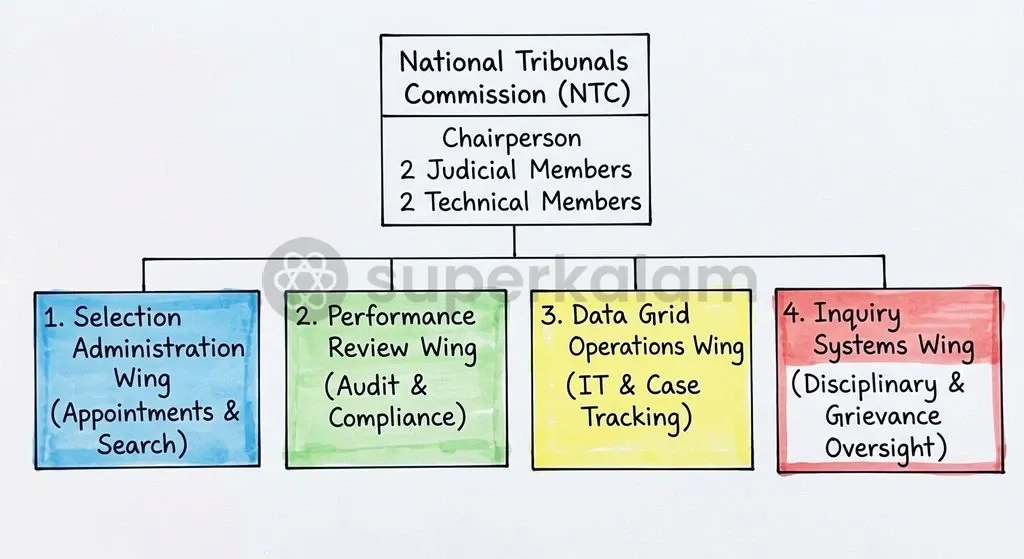
Inside the National Tribunals Commission: Mandate, Structure, and Oversight
The National Tribunals Commission operates as an autonomous five-member statutory authority tasked with delivering unified governance across India's quasi-judicial ecosystem. Section 3 of the Tribunals Reforms Act, 2026 mandates that the body operates independently of executive ministries to guarantee objective oversight.
The composition of the National Tribunals Commission comprises:
- A Commission Chairperson, who must be a retired Supreme Court Judge or a retired High Court Chief Justice.
- Two Judicial Members, appointed from distinguished judicial backgrounds.
- Two Technical Members, selected for their specialised administrative and domain expertise.
All appointments of the Chairperson and Judicial Members are executed by the Central Government strictly after mandatory consultation with the Chief Justice of India. The Chairperson and Members hold office for a secure term of five years or until attaining the age of 70 years, whichever is earlier.
Under the notified 2026 Rules, monthly compensation is fixed at ₹2,50,000 for the Chairperson and ₹2,25,000 for Members, standardising pay parity with higher judiciary counterparts.
The statutory responsibilities assigned to the Commission under the 2026 framework include:
- Proactive Recruitment Administration: Initiating selection exercises at least six months before a vacancy occurs to eliminate operational paralysis caused by unfilled benches.
- Performance and Disciplinary Inquiries: Conducting independent inquiry mechanisms and appraisals regarding misconduct allegations against tribunal members.
- Infrastructure and Digital Monitoring: Operating the National Tribunals Data Grid to track case disposal rates, pendency spikes, and resource allocation across all functional benches.
Discuss with Superkalam
If a specialised tribunal delivers an order, explain why an aggrieved party must approach the Division Bench of the High Court under Articles 226/227 before appealing to the Supreme Court.
Ask NowKey Landmark Judgments Defining Tribunal Administration in India
Judicial jurisprudence spanning nearly three decades has established strict constitutional limitations on executive authority over tribunal management. The Supreme Court has repeatedly intervened to ensure that tribunalisation does not dilute the standard of justice delivered by traditional courts.
- L. Chandra Kumar v. Union of India (1997): A seven-judge Constitution Bench struck down clauses excluding High Court jurisdiction, ruling that judicial review under Articles 226/227 and 32 is an untrammelable part of the basic structure.
- Rojer Mathew v. South Indian Bank Ltd. (2019): A five-judge Constitution Bench struck down the Tribunal Rules, 2017 framed under the Finance Act, 2017 due to executive encroachment, and directed the Union Government to conduct a comprehensive Judicial Impact Assessment of tribunals.
- Madras Bar Association v. Union of India (2020): The Supreme Court directed the Union to establish the National Tribunals Commission as an independent statutory umbrella body to supervise appointments and administration across all benches.
- Madras Bar Association v. Union of India (2021): The Court invalidated short four-year tenures and minimum age restrictions, stressing that short terms undermine judicial independence.
- Madras Bar Association v. Union of India (2025/2026): The Supreme Court struck down key sections of the 2021 Act for unconstitutionally re-enacting provisions that were previously held to violate judicial independence and separation of powers.
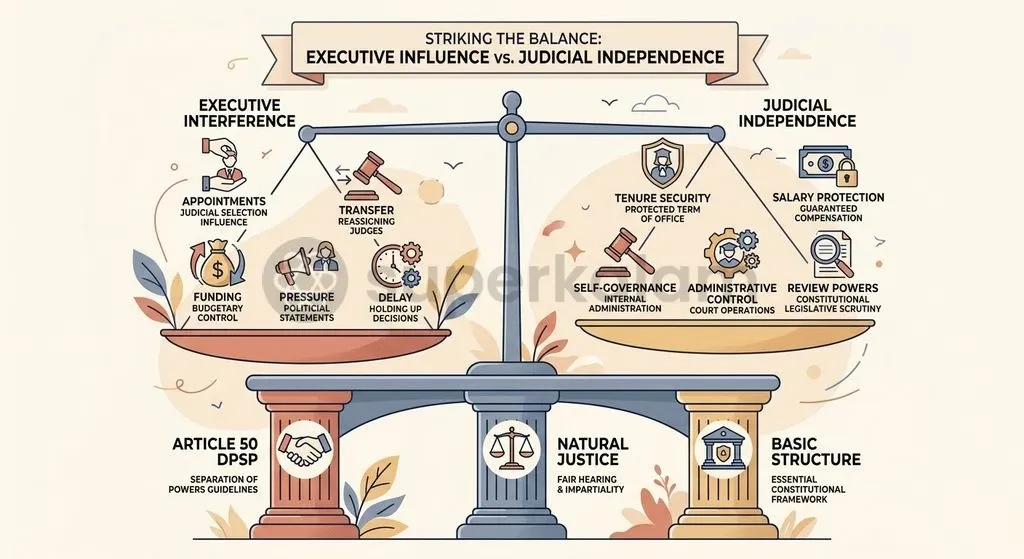
Major Arguments For and Against Independent Executive-Free Tribunals
Eliminating executive ministry control over tribunals addresses major structural conflicts of interest while introducing fresh questions regarding administrative coordination. Evaluating both perspectives clarifies the constitutional balance required in modern governance.
Arguments Supporting an Autonomous National Tribunals Commission
- Elimination of Structural Conflict of Interest: Parent ministries are frequently the primary respondents in disputes before tribunals like CAT or NCLAT. Independent appointments prevent the executive from selecting the adjudicators who decide government liability.
- Protection of Judicial Independence: Security of tenure (five years up to age 70) and fixed compensation shield members from executive pressure regarding reappointments or salary adjustments.
- Operational Standardisation: A single Commission unifies disparate selection criteria, qualifications, and disciplinary processes, replacing decades of fragmented administrative rules.
- Constitutional Alignment with Article 50: Providing functional autonomy to tribunals directly fulfils the Directive Principle under Article 50, which mandates the separation of the judiciary from the executive in public services.
Arguments Regarding Potential Implementation Challenges
- Judicial Overreach Concerns: Critics argue that extensive judicial dominance in administrative bodies limits the executive's legitimate policy role in managing specialised quasi-judicial machinery.
- Administrative Bureaucratisation: Creating a central umbrella commission risks adding another administrative tier, which could introduce procedural delays if recruitment systems are not fully automated.
- Inter-Ministerial Friction: Transferring budget management, staffing, and infrastructure oversight away from line ministries to an autonomous commission requires substantial bureaucratic realignment.
Discuss with Superkalam
Analyse the constitutional rationale of the Supreme Court in invalidating executive-led Search-cum-Selection Committees and short tenures in the Madras Bar Association rulings.
Ask NowEthical and Governance Dimensions: Separation of Powers and Speedy Justice
Tribunal governance directly impacts constitutional ethics, institutional trust, and the fundamental right to accessible, speedy justice. The integrity of any adjudicatory mechanism rests entirely on the perceived and actual impartiality of its officers.
- Article 50 Directive Principle: Mandates the separation of the judiciary from executive influence in public institutions.
- Basic Structure Safeguard: Protects judicial review under Articles 226, 227, and 32 as an inviolable constitutional safeguard.
- Institutional Impartiality: Eradicates structural conflicts of interest where the state acts as the dominant litigant.
- Natural Justice Benchmarks: Guarantees objective, independent, and timely dispute resolution for all citizens.
When government departments control the purse strings, infrastructure, and appointments of tribunals, the fundamental principle of nemo judex in causa sua (no one should be a judge in their own cause) is compromised. Citizens facing state actions require full confidence that tribunal members can adjudicate without fear of administrative reprisal or career stalling.
Persistent vacancies historically crippled tribunal functioning and created massive case backlogs. This breakdown violated the ethical mandate of timely dispute resolution. Enforcing the mandatory six-month advance selection rule under the 2026 framework transforms vacancy management from an ad-hoc executive choice into a binding institutional duty.
Discuss with Superkalam
Evaluate how effectively the 2026 framework's mandatory six-month advance recruitment rule and National Tribunals Data Grid address systemic tribunal vacancies and case pendency.
Ask NowWay Forward: Building Autonomous, Transparent, and Well-Resourced Tribunals
Consolidating the gains of the Tribunals Reforms Act, 2026 requires continuous institutional monitoring, financial autonomy, and rigorous vacancy tracking.
Key actionable measures to ensure sustainable tribunal administration include:
- Institutionalising Independent Budget Allocations: Parliament should provide the National Tribunals Commission with a dedicated consolidated budget appropriation, ensuring tribunals do not rely on line ministries for basic court infrastructure and digital tooling.
- Operationalising the National Tribunals Data Grid: Real-time caseload and pendency metrics should be integrated across all benches, facilitating data-driven transfers and targeted resource allocation.
- Conducting Mandatory Judicial Impact Assessments: As directed by the Supreme Court in Rojer Mathew (2019), every new tribunal proposal or structural modification must undergo rigorous assessment to gauge financial requirements, expected caseloads, and required bench capacity.
- Strict Adherence to Selection Timelines: The Commission must enforce the statutory mandate to initiate recruitment six months prior to scheduled vacancies, preventing chronic operational disruptions.
- Continuous Capacity Building for Technical Members: Technical members drawn from civil services or industry should receive structured judicial training in procedural law, natural justice principles, and judgment writing.
Key Takeaways
- Constitutional Insertion: Part XIV-A (Articles 323A and 323B) was introduced by the 42nd Constitutional Amendment Act, 1976, authorizing administrative and subject-specific tribunals.
- Judicial Review Protected: In L. Chandra Kumar (1997), the Supreme Court ruled that judicial review under Articles 226/227 and Article 32 is a basic feature, keeping tribunal verdicts subject to High Court Division Bench scrutiny.
- 2021 Provisions Struck Down: The Supreme Court invalidated short 4-year terms, 50-year minimum age bars, and executive-heavy selection committees for infringing upon separation of powers and judicial independence.
- National Tribunals Commission Established: Enacted in August 2026 and notified on September 30, 2026, the new legal framework establishes a 5-member judiciary-led Commission to administer appointments, performance reviews, and infrastructure.
- Tenure, Pay, and Vacancy Timelines: The 2026 framework establishes a 5-year tenure (up to age 70), standardised salaries (₹2,50,000 for Chairpersons; ₹2,25,000 for Members), and a mandatory 6-month advance vacancy recruitment rule.
Mains Question
"The establishment of an independent statutory National Tribunals Commission marks a structural shift away from executive-dominated tribunal management." In this context, evaluate the role of the Tribunals Reforms Act, 2026 in reinforcing judicial independence and separation of powers under Article 50. (15 Marks)
Evaluate NowMains Question
"Tribunal decisions cannot bypass High Court scrutiny and remain subject to supervisory judicial review." Elucidate the constitutional boundaries of tribunalisation in India with reference to Articles 323A, 323B, and the landmark ruling in L. Chandra Kumar. (10 Marks)
Evaluate NowPractice MCQs
QUESTION 1
With reference to the constitutional provisions governing tribunals in India, consider the following statements:
- Article 323A authorises Parliament exclusively to establish administrative tribunals for disputes related to public service conditions.
- Article 323B empowers both Parliament and State Legislatures, within their legislative competencies, to establish tribunals for specific subjects like taxation and land reforms.
- Decisions of tribunals established under Part XIV-A bypass the supervisory jurisdiction of High Courts and can only be challenged directly in the Supreme Court. Which of the statements given above are correct?
QUESTION 2
Consider the following statements regarding the structure and mandate of the National Tribunals Commission (NTC) under the Tribunals Reforms Act, 2026:
- The Commission comprises a Chairperson, two Judicial Members, and two Technical Members.
- The Chairperson must be a retired Supreme Court Judge or a retired High Court Chief Justice.
- Appointments of the Chairperson and Judicial Members require mandatory consultation with the Chief Justice of India. Which of the statements given above is/are correct?
QUESTION 3
With reference to the institutional parameters introduced by the Tribunals Reforms Act, 2026 and its rules, consider the following statements:
- It standardises a 5-year tenure for members up to 70 years of age.
- It mandates the initiation of the selection process at least six months prior to the occurrence of a vacancy.
- It imposes a mandatory 50-year minimum age floor for the appointment of tribunal members. Which of the statements given above is/are correct?
QUESTION 4
In L. Chandra Kumar v. Union of India (1997), the seven-judge Constitution Bench of the Supreme Court held that:
QUESTION 5
Consider the following statements regarding the Supreme Court's rulings in the Madras Bar Association cases:
- The Court struck down provisions prescribing a short four-year tenure and a 50-year minimum age limit for tribunal members.
- The Court affirmed that the legislature cannot re-enact struck-down statutory provisions without removing the underlying constitutional defect. Which of the statements given above is/are correct?