Satellite Radio Interference: How Mega-Constellations Threaten Astronomy
As thousands of commercial satellites flood Low Earth Orbit, stray orbital signals and downlinks threaten to blind frontline ground-based radio observatories.
Oct, 2026
•9 min read

Context
The rapid expansion of commercial mega-constellations across Low Earth Orbit (LEO) poses an escalating structural threat to global ground-based radio astronomy. As thousands of telecommunication satellites populate orbital corridors, their transmissions blind sensitive cosmic receivers.
Astronomical research demonstrates that this interference stems from multiple channels:
- Licensed broadband downlinks operating in active communication allocations.
- Out-of-band harmonics leaking beyond designated bandwidths.
- Unshielded onboard electronics radiating across protected radio windows.
Because terrestrial radio quiet zones provide zero shielding against overhead sources, orbital radio frequency interference creates a critical regulatory challenge for multilateral spectrum governance under the International Telecommunication Union.
Why in the News? The Threat from Low Earth Orbit
Commercial aerospace operators are deploying unprecedented numbers of communications satellites into Low Earth Orbit. As of August 2026, scientific assessments confirm that radio frequency interference (RFI) from these mega-constellations is severely corrupting sensitive cosmic observations across terrestrial observatories.
This rapid orbital proliferation creates two primary conflicts:
- Scientific displacement: Ground-based assets protected under international spectrum allocations are placed into direct conflict with the global expansion of space-based broadband networks.
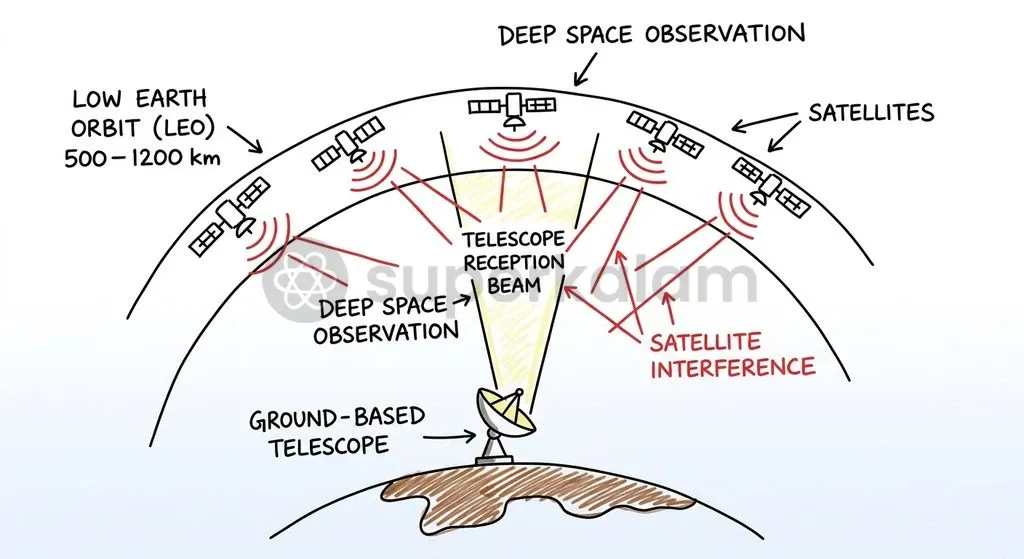
- Transmitter density: The sheer volume of low-orbit satellites passing continuously across telescope fields of view emits signals that overwhelm cosmic emissions.
Discuss with Superkalam
Recall the two legally protected spectral lines mentioned in the article that are fundamental for radio astronomy.
Ask NowWhat Is Satellite Radio Interference and Unintended Radiation?
Satellite radio interference consists of human-made electromagnetic signals from spacecraft that enter astronomical receivers and corrupt cosmic data. Radio telescopes observe celestial phenomena at extreme sensitivity levels, detecting signals measured in Janskys ($1\text{ Jy} = 10^{-26}\text{ W m}^{-2}\text{ Hz}^{-1}$) or microJanskys, which makes them millions to billions of times more sensitive than commercial telecommunications equipment.
According to the ITU Radio Regulations (Article 5 and Footnote 5.340), radio astronomy relies on narrow, legally protected spectral windows. These bands are preserved for essential cosmic lines, notably:
- The neutral hydrogen 21-centimetre line at 1420 MHz, fundamental for mapping galactic structures and cosmological evolution.
- The interstellar hydroxyl (OH) spectral line at 1612 MHz, used to probe interstellar matter and stellar envelopes.
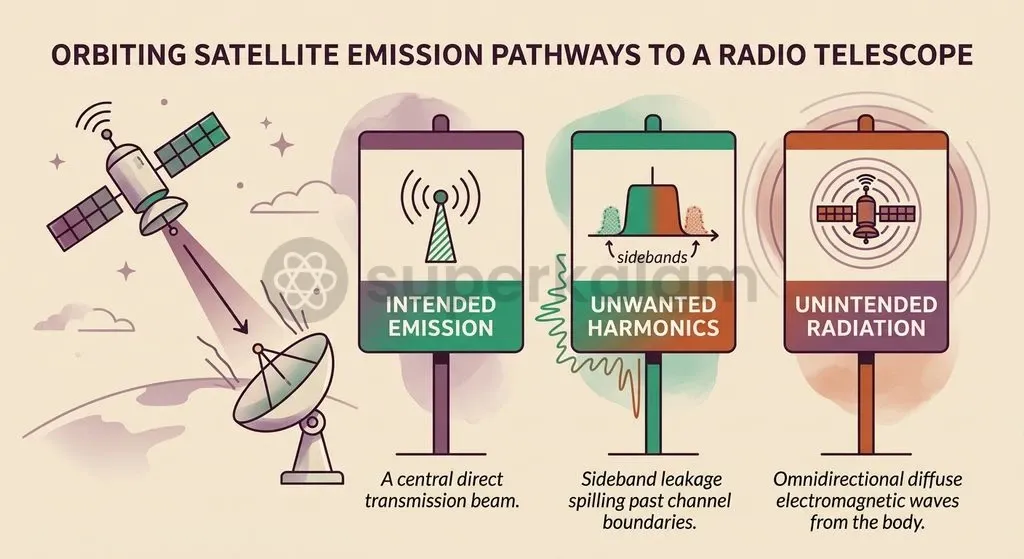
Satellite transmissions threaten these windows across three distinct categories:
| Interference Category | Mechanism of Origin | Regulatory Status | Impact on Telescopes |
|---|---|---|---|
| Intended Emissions | Direct, licensed communication signals transmitted via downlinks to ground stations or user terminals. | Formally licensed and allocated by national authorities and the ITU. | Blinds telescopes observing inside the transmission band; requires active coordination. |
| Unwanted Emissions | Spurious transmissions, sidebands, and harmonic leakages produced outside the designated downlink channel by the transmitter. | Regulated by general out-of-band domain masks and emission thresholds. | Spills into adjacent cosmic bands, masking spectral lines such as hydroxyl emissions. |
| Unintended Radiation | Spurious electromagnetic leakage radiating passively from onboard microprocessors, clock circuits, and internal power supplies. | Completely unregulated by ITU standards for spacecraft electronics. | Generates persistent broadband noise across critical low-frequency radio astronomy windows. |
Inside the SNIFFLES Study: What Researchers Found
The SNIFFLES observational programme tracked 4,629 satellite passes over 375.9 hours. Researchers deployed the Mopra Radio Telescope and the Australia Telescope Compact Array (ATCA) to document orbital emissions.
Observers recorded 2,345 instances of radio interference spanning more than 300 frequencies between 1 and 26 GHz. The study established that satellite signals produced flux densities up to eleven orders of magnitude—approximately 100 billion times—brighter than typical celestial radio sources, exceeding the threshold required to saturate radio telescope receivers.
The study established several critical findings:
- Hydroxyl Masers Masked: Unintended radiation from Eutelsat OneWeb spacecraft was detected at 1613.19 MHz, overlapping directly with the internationally protected 1610.6–1613.8 MHz spectral band reserved for observing cosmic hydroxyl (OH) masers.
- Persistent Boundary Radiation: In 76.9% of SNIFFLES observations for a specific Starlink version, unintended emissions appeared at 2700 MHz, right at the boundary of a primary radio astronomy allocation.
- High-Order Harmonics: Observers logged higher-order harmonic emissions up to the fourth order from Starlink Direct-to-Cell downlinks at 2.6 GHz, creating uncoordinated interference bands near 5.24 GHz, 7.86 GHz, and 10.48 GHz.
These findings built upon foundational work by Di Vruno et al. in 2023. That study used the pan-European Low Frequency Array (LOFAR) to confirm unintended electromagnetic radiation between 110 and 188 MHz on 47 out of 68 observed first-generation Starlink spacecraft, including inside the protected 150.05–153 MHz band.
Subsequent observations in 2024 revealed that second-generation Starlink 'V2 Mini' satellites emit unintended radiation up to 32 times brighter than first-generation versions.
Similarly, observations using the SKA-Low prototype Engineering Development Array 2 (EDA2) in Western Australia detected 112,534 radio emissions across 1,806 Starlink satellites over 29 days. These unwanted signals leaked into protected bands at 73.0–74.6 MHz and 150.05–153.0 MHz.
Discuss with Superkalam
Explain why terrestrial radio quiet zones are inherently incapable of shielding radio telescopes from LEO communication satellites.
Ask NowStarlink, OneWeb, and Guowang: The Rise of Mega-Constellations
The orbital environment is shifting rapidly toward massive, distributed satellite architectures. Commercial operators and sovereign states are deploying tens of thousands of active platforms into Low Earth Orbit to provide global low-latency broadband internet.
Major mega-constellation deployments currently shaping Low Earth Orbit include:
- Starlink (SpaceX): Operates thousands of active satellites in Low Earth Orbit at altitudes between 520 and 550 km, representing the densest non-geostationary satellite orbit (NGSO) constellation in history.
- Eutelsat OneWeb: Deploys an operational fleet of 648 active satellites at approximately 1,200 km altitude in polar Walker-Star orbits, using user broadband downlinks in the Ku-band (10.7–12.7 GHz) and gateway links in the Ka-band.
- Guowang (SatNet): A state-backed Chinese national satellite network planned for 13,000 satellites in Low Earth Orbit.
- Qianfan (Thousand Sails): A complementary Chinese commercial broadband constellation with a projected deployment of 14,000 satellites.
How Satellite Noise Threatens Observatories from LOFAR to India's GMRT
Global ground-based facilities rely on extreme spectral clarity to measure the distant universe. Major installations affected by satellite radio emissions include the pan-European Low Frequency Array (LOFAR), the MeerKAT array in South Africa, and the intergovernmental Square Kilometre Array Observatory (SKAO).
India's primary frontline asset, the Giant Metrewave Radio Telescope (uGMRT), faces unique operational hurdles. Situated at Khodad near Pune, the facility is operated by the National Centre for Radio Astrophysics of the Tata Institute of Fundamental Research (NCRA-TIFR). It operates across low-frequency windows from 150 to 1450 MHz.
Unlike facilities constructed in remote deserts, uGMRT lacks an uninhabited radio quiet zone buffer. The observatory operates within a semi-rural, developing industrial landscape. This environment leaves its parabolic dishes exposed to direct line-of-sight passes by LEO constellations.
To preserve scientific observations, NCRA-TIFR engineers developed bespoke algorithmic pipelines to process and excise incoming interference:
- Antenna-Level Pre-Filtering: The VOLT engine performs real-time digital filtering at the receiver front-end, discarding flagged, corrupted channels prior to signal combination.
- Time-Domain Flagging: The STRIPE engine identifies and excises transient, non-astrophysical spikes caused by rapid satellite sweeps across dish side lobes.
- Data Loss Trade-Offs: While these excision frameworks prevent total receiver saturation, digital filtering cannot recover astronomical signals corrupted during overlapping observations, leading to lost integration time and degraded sensitivity.
Discuss with Superkalam
If you were tasked with mitigating interference at an observatory like uGMRT, how would you address the trade-off between algorithmic data excision and lost integration time?
Ask NowGlobal Rules and Regulatory Gaps: Why ITU Frameworks Fall Short
International spectrum management rests primarily on the International Telecommunication Union (ITU), a specialised United Nations agency. Article 29 of the ITU Radio Regulations formally recognises the unique sensitivity of the Radio Astronomy Service. The provision directs administrations to apply site shielding, geographic separation, and antenna directivity to avoid harmful interference.
However, existing multilateral regulations contain structural omissions regarding non-geostationary mega-constellations:
- No Caps on Unintended Space Radiation: Current ITU Radio Regulations impose emission limits only on deliberate telecommunications transmissions and transmitter spurious emissions. The framework does not regulate unintended electromagnetic radiation (UEMR) leaking passively from satellite microprocessors, memory buses, or switch-mode power units.
- Terrestrial Isolation Assumptions: Historical radio astronomy protections assumed interference originated from ground transmitters. Terrestrial Radio Quiet Zones (RQZs) rely on natural mountain topography and geographic distance to attenuate terrestrial signals. They provide zero physical protection against satellite constellations radiating directly from overhead.
- Exclusion of Spacecraft Avionics: Terrestrial consumer electronics must undergo rigorous electromagnetic compatibility (EMC) testing to limit stray radiation. No equivalent, binding international EMC standard applies to orbital satellites once deployed in space.
Discuss with Superkalam
Compare the regulatory treatment of satellite communication downlinks with the treatment of unintended radiation from onboard electronics under current ITU frameworks.
Ask NowStriking a Balance: Technical Fixes, Dark Sky Reserves, and Policy Reforms
Preserving the radio sky requires coordinated action across engineering design, operational coordination, and multilateral governance. Because orbital broadband provides critical communication services to remote populations, solutions must balance commercial space utility with deep-space scientific research.
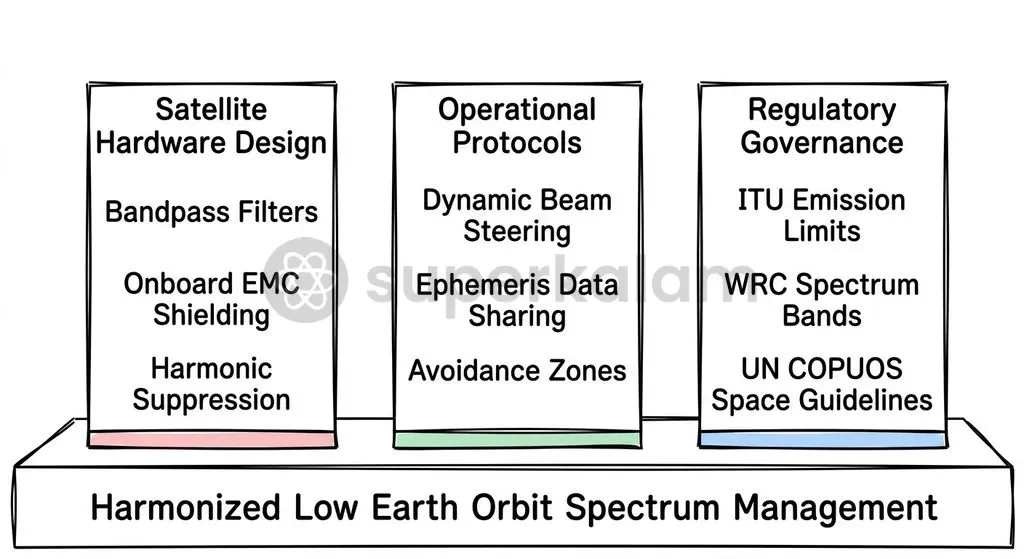
Key engineering and policy mechanisms include:
- Hardware-Level EMC Shielding: Satellite manufacturers can mitigate unintended radiation by enclosing internal computer systems and power supplies in electromagnetic shielding. Operators can also place high-attenuation bandpass filters on transmitters to eliminate harmonic generation.
- Operational Data Sharing (ODS): Observatories and constellation operators are piloting dynamic coordination frameworks. Satellites use orbital ephemeris data to steer directional downlinks away from observatories or temporarily turn off beams when crossing an observatory's immediate line of sight.
- Multilateral Agenda Setting: The UN Committee on the Peaceful Uses of Outer Space (COPUOS) Scientific and Technical Subcommittee established a five-year formal agenda item titled 'Dark and Quiet Skies, astronomy and large constellations' to draft policy recommendations for constellation management.
- Binding ITU Spectrum Reform: The International Astronomical Union (IAU) and the Square Kilometre Array Observatory are lobbying for binding extraterrestrial electromagnetic compatibility standards and orbital exclusion cones in the ITU World Radiocommunication Conference (WRC) preparatory cycles.
Key Takeaways
- Radio telescopes observe cosmic signals at extreme sensitivities measured in Janskys ($10^{-26}\text{ W m}^{-2}\text{ Hz}^{-1}$), making them highly vulnerable to commercial radio transmissions.
- The SNIFFLES study catalogued 2,345 interference events across 4,629 satellite passes, finding satellite emissions up to 100 billion times stronger than cosmic sources.
- Satellite noise consists of three distinct forms: intentional broadband downlinks, unwanted transmitter harmonics, and unintended electromagnetic radiation (UEMR) leaking passively from onboard electronics.
- Second-generation Starlink 'V2 Mini' satellites emit unintended radiation up to 32 times brighter than first-generation versions, leaking into protected radio bands.
- Terrestrial Radio Quiet Zones offer no protection against overhead satellites, forcing observatories like India's uGMRT to rely on algorithmic filtering pipelines like SPOTLIGHT, VOLT, and STRIPE.
- Current ITU Radio Regulations lack binding electromagnetic compatibility rules for non-intentional satellite electronics, prompting international scientific bodies to push for updated standards at future World Radiocommunication Conferences.
Mains Question
'The rapid proliferation of commercial mega-constellations in Low Earth Orbit has exposed critical structural limitations in the International Telecommunication Union (ITU) spectrum governance frameworks.' Critically analyse. (15 Marks)
Evaluate NowMains Question
Highlight the operational challenges posed by satellite radio interference to India's Giant Metrewave Radio Telescope (uGMRT). Examine the institutional and technological measures adopted to mitigate this interference. (10 Marks)
Evaluate NowPractice MCQs
QUESTION 1
With reference to radio astronomy and satellite radio frequency interference (RFI), consider the following statements:
- Radio telescopes detect cosmic signals at sensitivities millions to billions of times higher than commercial telecommunications equipment.
- The neutral hydrogen 21-centimetre line at 1420 MHz is preserved under International Telecommunication Union (ITU) Radio Regulations.
- Unintended radiation leaking from onboard satellite electronics is subject to strict emission thresholds under current ITU regulations.
Which of the statements given above is/are correct?
QUESTION 2
With reference to the findings of the SNIFFLES observational programme on low-Earth orbit satellite emissions, consider the following statements:
- Satellite transmissions produced flux densities up to eleven orders of magnitude brighter than typical celestial radio sources.
- Unintended radiation from Eutelsat OneWeb satellites was detected overlapping with the protected hydroxyl spectral band at 1610.6–1613.8 MHz.
- Harmonics up to the fourth order from Starlink Direct-to-Cell downlinks at 2.6 GHz were observed creating uncoordinated interference bands.
Which of the statements given above are correct?
QUESTION 3
Consider the following statements regarding the Giant Metrewave Radio Telescope (uGMRT):
- It is operated by the National Centre for Radio Astrophysics of the Tata Institute of Fundamental Research (NCRA-TIFR).
- It operates within a legally mandated uninhabited radio quiet zone that completely shields it from overhead orbital passes.
- It employs digital pipelines such as the VOLT engine and STRIPE engine to filter and excise real-time radio interference.
Which of the statements given above is/are correct?
QUESTION 4
Regarding the technical categorization of satellite radio interference, 'unwanted emissions' are best defined as:
QUESTION 5
Which of the following observatories and research prototypes detected unintended broadband emissions from Starlink satellites leaking into low-frequency protected astronomical bands (such as 150.05–153.0 MHz)?
- Low Frequency Array (LOFAR)
- SKA-Low prototype Engineering Development Array 2 (EDA2)
- Australia Telescope Compact Array (ATCA)
Select the correct answer using the code given below: