Sanctioning Russia and Iran Act 2026: 100% Tariff Threat on India Explained
US House passed the Sanctioning Russia and Iran Act 2026, authorising up to 100% tariffs on top buyers of Russian oil, including India. Key provisions, exemptions, waiver and India response.
Sep, 2026
•9 min read
Overview
The Lindsey O. Graham Sanctioning Russia and Iran Act of 2026 represents an aggressive expansion of United States extraterritorial sanctions, threatening punitive tariffs of up to 100 percent against major purchasers of Russian hydrocarbons. This legislative push directly challenges India's strategic autonomy and macroeconomic stability, as Russia supplied over 30 percent of the nation's crude oil imports in FY26.
For Indian policymakers, the statute creates an acute policy dilemma between preserving vital energy supplies and protecting export access to the United States. While Washington uses trade penalties to enforce foreign policy compliance, New Delhi asserts that sovereign energy security for 1.4 billion citizens cannot be subordinated to unilateral Western measures. Navigating this pressure requires a calibrated blend of diplomatic negotiation, alternative financial mechanisms, and accelerated supply diversification.
Why in the News?
As of September 2026, the United States Congress advanced the Lindsey O. Graham Sanctioning Russia and Iran Act of 2026, creating severe friction in India-US bilateral relations. The United States House of Representatives passed the bill on September 16, 2026, by a vote of 262 to 159, following its prior passage in the Senate by an 86 to 11 vote on August 7, 2026.
The Ministry of External Affairs affirmed on September 17, 2026, that India remains firmly committed to safeguarding national energy security through diversified sourcing. New Delhi stated that it will deploy all necessary measures to defend its economic interests and maintain independent trade ties.
Discuss with Superkalam
What proportion of India's total crude oil imports was supplied by Russia in FY26 according to trade data?
Ask NowWhat is the Sanctioning Russia and Iran Act 2026?
The Sanctioning Russia and Iran Act of 2026 is a United States statute designed to cripple Russian and Iranian energy export revenues through secondary trade penalties. The core pillars of the statute include:
- Punitive Import Tariffs (Section 113): Empowers the US President to levy tariffs of up to 100 percent on goods imported from the top five global buyers of Russian crude oil and natural gas. This provision directly exposes India and China to sweeping trade barriers.
- Maritime Logistics Interdiction: Mandates sanctions against Russia's shadow fleet of tankers used to bypass maritime insurance caps.
- Re-authorisation of Iran Sanctions: Formally re-authorises the statutory framework of the Iran Sanctions Act of 1996 to tighten curbs on Iranian energy exports.
- Executive Waiver Windows: The US President may modify or waive secondary tariffs if a target country demonstrates a significant reduction of imports or if granting an exception is certified as vital to US national security.
Understanding US Secondary Sanctions: How They Differ from CAATSA
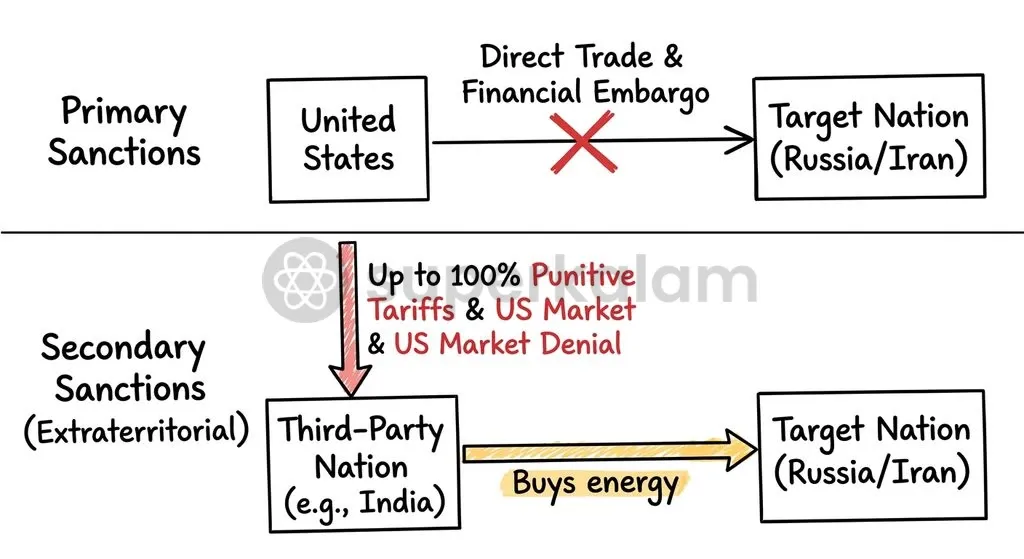
Secondary sanctions penalise non-US entities for conducting transactions with designated targets, even when no American jurisdiction, currency, or nexus is involved. Primary sanctions restrict American citizens, domestic corporations, and dollar-clearing institutions from dealing with sanctioned parties. In contrast, secondary sanctions operate extraterritorially, forcing foreign companies to choose between trading with sanctioned nations or retaining access to American commercial markets.
The Countering America's Adversaries Through Sanctions Act (CAATSA) of 2017 primarily targeted transactions involving the Russian defence and intelligence sectors under Section 231. The 2026 legislation shifts coercive leverage directly into the trade domain by deploying commercial tariffs against broad macroeconomic flows.
| Dimension | CAATSA (2017) | Sanctioning Russia & Iran Act (2026) |
|---|---|---|
| Primary Target Sector | Russian defence and intelligence establishments (Section 231) | Russian and Iranian energy exports, crude purchasers, and shadow maritime fleets |
| Enforcement Mechanism | Financial blacklisting, visa bans, export license denials, and banking restrictions | Secondary import tariffs of up to 100% on merchandise entering the US (Section 113) |
| Statutory Scope | Transaction-specific defence deals (e.g., S-400 Triumf air defence procurement) | Sovereign-level top five global purchasers of Russian crude oil and natural gas |
| Waiver Architecture | Modified national security waiver under Section 1282 of NDAA FY2019 | Executive waiver tied to significant import reductions or vital US national security needs |
| Impact on Indian Economy | Risk of military supply chain disruptions and defence acquisition hurdles | Threat of direct macroeconomic export loss and systemic domestic energy price spikes |
Discuss with Superkalam
How does an extraterritorial secondary sanction force foreign commercial entities to alter their trading behaviour?
Ask NowImpact on India's Energy Security and Russian Crude Imports
India relies on foreign producers for over 85 percent of its domestic crude oil consumption. The Petroleum Planning and Analysis Cell reports that high import dependency leaves the domestic economy deeply exposed to global supply shocks and currency volatility.
Russia emerged as India's largest single petroleum supplier following the 2022 Ukraine conflict, capitalising on discounted Urals crude pricing. Directorate General of Commercial Intelligence and Statistics data reveals that Russia accounted for over 30 percent of India's total crude imports in FY26, valued at approximately $40.8 billion.
A sudden curtailment of Russian crude flows triggers several severe macroeconomic risks:
- Refining Margins: Indian refiners would face higher crude acquisition costs by switching to Atlantic Basin or West Asian grades.
- Trade Balance Pressures: Higher crude import bills widen the merchandise trade deficit and put pressure on foreign exchange reserves.
- Inflation Spillover: Increased landing costs feed directly into transport and fertiliser inputs, stoking domestic retail inflation.
The 100% Tariff Threat: Trade Exposure, Supply Chains, and Rupee-Rouble Payments
The United States remains India's largest single goods export destination, creating acute vulnerability under proposed Section 113 secondary tariffs. Department of Commerce trade data indicates that high-employment export sectors depend heavily on the American consumer market.
Key transmission channels of this trade threat include:
- Labour-Intensive Export Shocks: A 100 percent punitive tariff would hit textiles, pharmaceuticals, gems and jewellery, and engineering goods, triggering industrial distress.
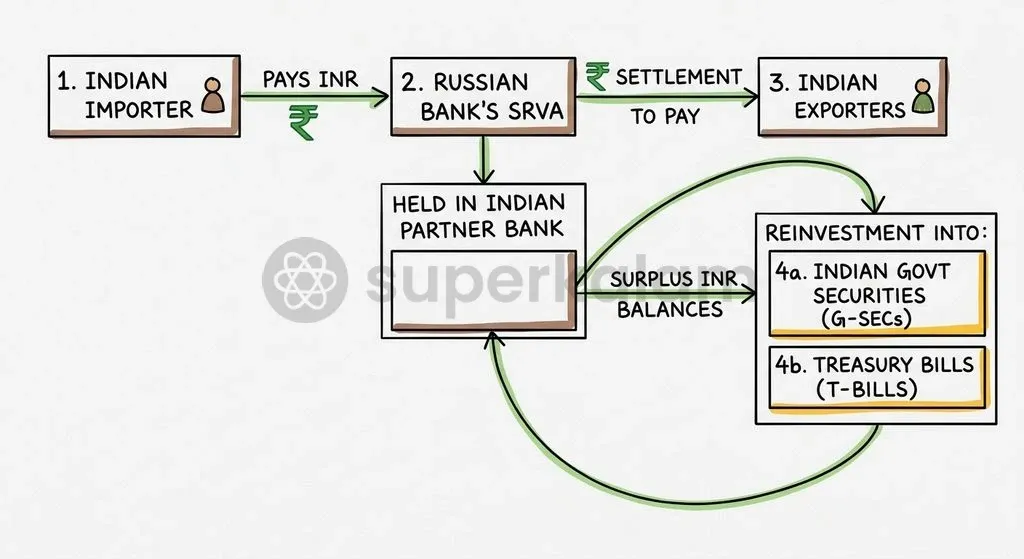
- Vostro Account Mechanisms: Under FEMA, an RBI circular issued on July 11, 2022, permitted international trade settlements in Indian Rupees via Special Rupee Vostro Accounts.
- Surplus Rupee Absorption: To ease bilateral settlement bottlenecks, the Reserve Bank of India permitted foreign entities to invest surplus balances into Central Government Securities, including Treasury Bills.
- Third-Country Currency Clearing: Refiners have used non-dollar clearing channels involving UAE Dirhams (AED) and Chinese Yuan (CNY). However, these intermediaries remain vulnerable if secondary sanctions widen.
Discuss with Superkalam
If secondary tariffs are imposed on Indian merchandise, how should policymakers prioritise support across labour-intensive export sectors?
Ask NowStrategic Autonomy vs Western Alignment: India's Geopolitical Tightrope
India maintains an established foreign policy doctrine of adhering strictly to multilateral United Nations Security Council sanctions while rejecting unilateral extraterritorial measures. Parliamentary statements from the Ministry of External Affairs consistently emphasise that sovereign purchasing decisions are guided by national interest and market fundamentals.
This independent posture faces diplomatic friction within the Quadrilateral Security Dialogue framework alongside the United States, Japan, and Australia:
- Maritime Convergence: India shares deep Indo-Pacific defence and security convergence with Quad partners.
- Continental Imperatives: New Delhi requires sustained continental defence cooperation and affordable energy supplies from Moscow.
- Bilateral Trust: Secondary sanctions risk introducing structural friction into the India-US strategic partnership.
Lessons from Past Sanctions: The 2019 Iran Oil Curtailment and Chabahar Waiver
Past sanctions episodes offer critical operational lessons for Indian diplomats navigating coercive United States legislation:
- The 2019 Iran Oil Curtailment: India completely halted crude imports from Iran in May 2019 following the termination of Significant Reduction Exceptions granted under Section 1245 of the FY2012 National Defense Authorization Act. That episode forced Indian refiners to adjust processing configurations and pay higher premiums for replacement crude.
- The Chabahar Port Carve-Out: Targeted diplomatic engagement secured statutory exceptions. The United States granted a narrow carve-out for the development of the Chabahar Port Agreement, recognising its role as a humanitarian corridor for landlocked Afghanistan and an alternative trade gateway to Central Asia.
- The CAATSA NDAA Section 1282 Relief: Defence acquisitions witnessed flexibility when the US Congress passed Section 1282 of the John S. McCain NDAA for FY2019, modifying CAATSA Section 231 to provide a national security waiver for partners transitioning away from Russian military platforms.
These precedents demonstrate that structured diplomatic bargaining can carve out vital policy space even within restrictive statutory frameworks.
Discuss with Superkalam
Why does India adhere strictly to United Nations Security Council sanctions while rejecting unilateral sanctions imposed by foreign legislatures?
Ask NowWay Forward: Payment Alternatives, Energy Diversification, and Strategic Hedging
India must pursue a multi-pronged strategy combining diplomatic leverage, financial architecture resilience, and long-term energy diversification to mitigate secondary sanctions risks:
- Diplomatic Waiver Negotiations: New Delhi should engage the United States executive branch to secure formal waivers under the national security exception clauses of the 2026 Act. Indian negotiators must highlight that affordable crude imports prevent global oil price surges that would harm international macroeconomic stability.
- Expansion of Local Currency Settlement Frameworks: The Reserve Bank of India and partner central banks must deepen bilateral currency swap lines and Special Rupee Vostro Accounts. Promoting the internationalisation of the rupee in non-sanctioned commodity trade creates structural buffers against Western financial chokepoints.
- Strategic Energy Diversification: The Ministry of Petroleum and Natural Gas should expand term contracts with producers in Latin America, West Africa, and North America. Diversifying supply sources prevents critical dependency on any single supplier while maintaining price negotiating leverage.
- Strategic Petroleum Reserves Expansion: India must accelerate Phase II of its Strategic Petroleum Reserve programme to enhance emergency buffer stocks from the current baseline, ensuring resilience against maritime disruptions or sudden geopolitical supply embargoes.
- Accelerated Clean Energy Transition: Long-term insulation from energy geopolitics requires scaling domestic non-fossil capacity. Expanding green hydrogen initiatives, solar-wind hybrid corridors, and grid-scale storage directly advances India's constitutional commitment to sustainable economic growth.
Key Takeaways
- The US House of Representatives passed the Lindsey O. Graham Sanctioning Russia and Iran Act of 2026 on September 16, 2026, introducing secondary tariffs of up to 100 percent on top buyers of Russian energy under Section 113.
- Russia remained India's largest petroleum supplier in FY26, supplying over 30 percent of crude imports valued at $40.8 billion, leaving India vulnerable to unilateral trade curbs.
- India relies on foreign imports for more than 85 percent of its domestic crude oil demand, making affordable hydrocarbon access indispensable for macroeconomic stability.
- To counter financial sanctions, the Reserve Bank of India institutionalised Special Rupee Vostro Accounts (SRVA) under FEMA regulations and permitted foreign surplus investments in Government Securities.
- India's official foreign policy recognises only United Nations Security Council sanctions, rejecting unilateral secondary measures while balancing Quad partnerships with Eurasian strategic ties.
Mains Question
"Unilateral secondary sanctions weaponise trade to enforce extraterritorial compliance, placing energy-dependent emerging economies in an acute strategic dilemma." In the context of the Lindsey O. Graham Sanctioning Russia and Iran Act of 2026, discuss how India can balance its sovereign energy security with its strategic ties with the United States. (10 Marks)
Evaluate NowMains Question
The transition of US coercive economic statecraft from sector-specific defence curbs under CAATSA to broad-based macroeconomic trade penalties under the Sanctioning Russia and Iran Act of 2026 significantly heightens external sector risks for India. Critically analyse. (15 Marks)
Evaluate NowPractice MCQs
QUESTION 1
With reference to the Lindsey O. Graham Sanctioning Russia and Iran Act of 2026, consider the following statements:
- Section 113 of the statute empowers the US President to impose tariffs of up to 100 percent on goods imported from the top five global buyers of Russian crude oil and natural gas.
- The Act mandates secondary sanctions against the shadow fleet of tankers used to circumvent maritime insurance caps.
- Executive waivers under the Act are granted unconditionally without requiring any reduction in hydrocarbon imports.
Which of the statements given above are correct?
QUESTION 2
Consider the following statements regarding the distinction between CAATSA (2017) and the Sanctioning Russia and Iran Act of 2026:
- CAATSA primarily targeted specific transactions in the Russian defence and intelligence sectors under Section 231.
- The 2026 Act expands coercive measures to broad macroeconomic trade flows through secondary import tariffs.
- Unlike CAATSA, primary sanctions penalise non-US entities operating entirely outside American territorial jurisdiction.
Which of the statements given above is/are correct?
QUESTION 3
With reference to India's energy profile and bilateral trade settlement mechanisms with Russia, consider the following statements:
- India depends on imports for over 85 percent of its domestic crude oil consumption.
- In FY26, Russia accounted for over 30 percent of India's total crude oil imports.
- The Reserve Bank of India permitted foreign entities to invest surplus balances from Special Rupee Vostro Accounts into Central Government Securities.
Which of the statements given above are correct?
QUESTION 4
Consider the following historical instances of US sanctions and exceptions involving India:
- In May 2019, India completely halted crude oil imports from Iran following the termination of Significant Reduction Exceptions.
- The US Congress amended CAATSA via Section 1282 of the NDAA FY2019 to provide a modified national security waiver for partners.
- The Chabahar Port Agreement was granted a statutory carve-out by the US recognising its role as a transit corridor for Afghanistan.
Which of the statements given above is/are correct?
QUESTION 5
Under the Lindsey O. Graham Sanctioning Russia and Iran Act of 2026, which of the following mechanisms is directly utilised to penalise major buyers of Russian hydrocarbons?